ByteDance and Kimi Launch Paid Services Simultaneously: China's AI Applications Quietly Complete a Paradigm Shift
 05/08 2026
 672
672

Author | Shuyan For More Financial Information | BT Finance Data Pass The full text is 6,112 characters, with an estimated reading time of 9 minutes.
On May 4, 2026, Doubao updated its development description on the App Store, announcing a new subscription service with three tiers: Standard at RMB 68/month (RMB 688/year), Enhanced at RMB 200/month (RMB 2,048/year), and Professional at RMB 500/month (RMB 5,088/year). Doubao clarified later that evening that this was an exploration "still under testing."
However, focusing solely on Doubao would mean missing the real transformation.
Rewinding to the fourth quarter of 2025, Kimi took the lead by introducing a tipping mechanism, with single tips starting at RMB 9.9. While monthly active tipping user data was not disclosed, sources close to Doubao informed us that Kimi had successfully implemented the first small-scale paid model among domestic AI applications with "hundreds of millions of monthly active users."
A year earlier, in April 2025, Baidu's Wenxin had launched a paid version priced at nearly RMB 60/month, but it was deemed "premature" by the market, with lackluster data, and was subsequently downplayed.
Two years prior, in August 2023, when Doubao launched, ByteDance adopted a completely free strategy—entering later than competitors but rapidly acquiring users through aggressive free tactics.
Three years earlier, in November 2023, Baidu's Wenxin YiYan charged for its early version, Alibaba's Tongyi Qianwen was free, and Zhipu Qingyan charged—three different strategies tested by three companies.
Five years earlier, in 2021, there was no term like "national-level AI application," and GPT-3.5 had not yet been released. The entire business model of Chinese AI companies was simply: ToB sales of computing power and APIs.
Only by connecting these scattered time points can you see the bigger picture: Over the past five years, the business models of China's AI applications have not evolved linearly but have gone through three distinct phases—and May 4, 2026, marks the critical transition from the second to the third phase.
I call this three-phase framework the "Traffic Subsidy Phase → Data Tax Exploration Phase → Value-Based Pricing Phase." This is the framework I will guide you through next, because understanding it allows you to not only comprehend Doubao but also recognize when any "user-as-fuel" business model begins to pivot.
In this article, I will clarify three things: first, the core mechanisms of each of these three phases; second, what truly triggered this transition; third, the analytical tools you, as a reader, can take away.
1
Traffic Subsidy Phase (2021–2023): AI Companies Quietly "Acquiring Land"

To understand this phase, we must first clarify a commonly misunderstood fact—
The "subsidy wars" of the internet era and the "free strategies" of the AI era may seem similar, but their mechanisms are entirely different.
Internet companies subsidize users with cash (e.g., ride-hailing subsidies, food delivery coupons) to cultivate habits. Every dollar burned by ride-hailing apps purchases a user's "habit shift" in transportation.
AI companies' free strategies do not give users money but directly forgo revenue to encourage data production. Every conversation you have with Doubao, every question you ask Kimi, every long document processed by Wenxin—these are not merely "uses" but "annotations." The model learns from your feedback which answers are more popular, which styles are preferred in which contexts, and which types of questions are most frequently followed up.
I call this mechanism the "data tax."
The characteristics of the data tax are: users appear to "freeload" from AI companies but are actually voluntarily surrendering their preferences, behaviors, error correction signals, and contextual information—data with immense market value in the era of large models. An AI product with 300 million monthly active users generates enough data daily to train a new model to near-GPT-4 performance in certain niche scenarios.
To better understand, consider a real estate analogy: internet subsidies are like developers offering discounts on property sales, while AI free strategies are like developers giving away land use rights for free—but only if you build on it (produce data), with the resulting structures owned by the developer.
The core features of the first phase (2021–2023) can thus be summarized in three points:
First, whoever can afford to burn cash wins. The victors in this phase were not those with the best products but those with the deepest cash reserves. Why could ByteDance overtake competitors despite entering later? Because cash flow from Douyin and TikTok allowed it to cover hundreds of millions of yuan in monthly computing costs, a luxury startups lacked.
Second, free was not a means but an end. Startups might treat free strategies as transitional, but giants viewed them as assets. Every additional day of free service meant one more day of data accumulation.
Third, pricing power did not lie with users but with data scarcity. When data became sufficiently abundant, giants voluntarily ended free strategies because the marginal returns of continued free access began to decline.
Understanding this explains why Wenxin charged in 2023, hastily retracted its paid version in 2025—it was not inconsistency but Baidu's misjudgment of its own data scarcity.
The first phase ended in the second half of 2023. When ByteDance's Doubao launched in August 2023, the landscape of China's AI applications fundamentally shifted: a player arrived with the cash flow of Douyin and the data infrastructure of TikTok, declaring to all competitors, "This race is not about products but about infrastructure."
The first phase concluded there and then.
2
Data Tax Exploration Phase (2024–2025): Whoever Asks for Money First, Dies
The most intriguing aspect of the second phase is that it was not a beginning but a series of failures.
In November 2023, Baidu's Wenxin tentatively launched a paid version. Without large-scale promotion, it set the price at RMB 59/month. The market response was tepid—Wenxin's monthly active users had already been surpassed by Doubao by early 2024, and paid user growth stagnated. Six months later, this paid version was quietly deprioritized.
What did Baidu do wrong? Not the pricing but the timing.
In 2024, China's AI application market was in what I call a "data tax overlap period":
- Leading players (Doubao, Kimi) were still burning cash to acquire users through free strategies;
- Users had not developed a willingness to pay for AI services, with GPT Plus's $20 price tag deemed "expensive" in China;
- Alternatives abounded—if you refused to pay for Wenxin, you could switch to Doubao with little difference in experience;
- Model capabilities were rapidly iterating, with "professional features" this week becoming free features the next.
In this environment, whoever asked for money first became the industry's guinea pig. Baidu filled that role, while Kimi, Doubao, and Alibaba's Tongyi Qianwen watched from afar.
However, four developments quietly shifted the landscape in the second half of 2024:
First: In December 2024, Doubao's daily active users (DAU) exceeded 100 million for the first time. This meant the free strategy had reached a "national-level" threshold—further cash burning would not acquire new users but would only increase engagement among existing ones.
Second: In Q1 2025, Seedance's video generation model launched. Video generation consumed 50–100 times more computing power than text dialogue, causing marginal costs of free strategies to skyrocket. Internal calculations at Volcano Engine revealed that if a user generated 20 videos per month using Seedance, the computing cost would exceed RMB 50.
Third: In the second half of 2025, ByteDance's net profit fell by over 70% year-on-year (under international accounting standards). ByteDance VP Li Liang clarified on Weibo that while "actual operating profit margins only declined slightly," he confirmed that "slowing growth in Douyin e-commerce + increased investment in emerging businesses" had created pressure.
Fourth: In Q4 2025, Kimi introduced a tipping mechanism, testing the market with the question: "Are users willing to pay for AI?" The answer was yes—but at the right price and in the right scenarios. While Kimi's tipping data was not disclosed, sources close to Doubao revealed that Kimi's key finding was that AI applications with hundreds of millions of monthly active users could achieve a 3–5% paid conversion rate in small-scale scenarios—a viable commercial model.
Together, these four events signaled to all players that the data tax phase had ended.
Why? Because the data tax's core assumption—"marginal costs are negligible, so free access can continue indefinitely"—collapsed in high-computing scenarios like video generation, complex reasoning, and long document processing. Each additional free user now cost giants not "almost zero" but "at least RMB 50 monthly."
When marginal costs turned positive, free strategies shifted from "land acquisition" to "bleeding."
This was the real trigger for Doubao's paid service on May 4, 2026. Not because ByteDance lacked funds, but because it realized that continuing unlimited free access meant perpetually subsidizing its AI business with cash flow from Douyin e-commerce, with no path to positive cash flow in return. This state could persist for six months or a year but not indefinitely.
The second phase ended there and then.
3
Value-Based Pricing Phase (2026–): From "Users as Fuel" to "Users as Customers"
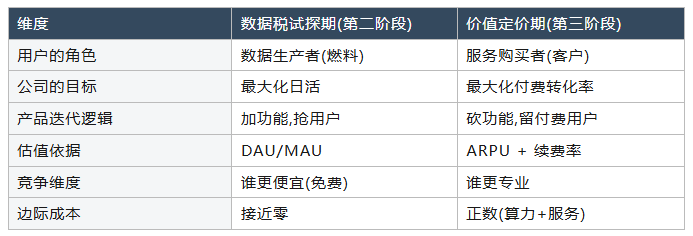
Entering the third phase, China's AI applications face not a choice but a paradigm shift in business models.
A set of contrasts will clarify the thoroughness of this shift:
The most critical column in this table is "Product Iteration Logic." In the second phase, all AI companies pursued a "more, more, more" strategy: longer contexts, more modalities, more scenarios, more integrations. More features meant more users, and more users meant more data.
In the third phase, product strategies must subtract: only refine features worth paying for and maintain baseline experiences in the free version for non-paying features.
Consider Doubao's three-tier pricing:
- Standard at RMB 68/month—everyday use, entry tier, targeting "trial-to-paid" conversion
- Enhanced at RMB 200/month—professional users, primary battleground, targeting PPT/data analysis/long document scenarios
- Professional at RMB 500/month—heavy productivity users, anchor tier, not for individual users but to set enterprise market pricing
The RMB 500/month tier is particularly interesting. It is not for ordinary users—who would not pay RMB 500/month for AI. Its true purpose is to set a price ceiling for the entire industry.
I call this tactic the "value anchoring method."
Recall all the subscriptions you've purchased in the internet era: Tencent Video rose from RMB 15/month to RMB 30/month, Bilibili from RMB 20 to RMB 25, Spotify from $9.99 to $11.99. These price hikes succeeded because users had already been "acclimated" to certain price ranges—if you were willing to pay RMB 15 for video, you were likely willing to pay RMB 30.
But AI applications are a new category with no historical price anchors. If the first player prices at RMB 68, subsequent players can only hover near RMB 68, locking the industry ceiling. If the first player prices at RMB 500, even if most users cannot afford it, subsequent players gain narrative space to say, "We are 80% cheaper than Doubao's professional tier"—this is the power of anchoring.
ByteDance's RMB 500 tier is not for users but to draw a price line for Alibaba's Tongyi Qianwen, Kimi, Wenxin, Zhipu Qingyan, and others. When the next company launches a paid version, they will not compete with Doubao's RMB 688 tier but will say, "We are 80% cheaper than Doubao's professional tier"—this is anchoring in action.
The core features of the third phase can thus be summarized in three points:
First, pricing power returns to product value, not data scarcity. The second phase was "I win because I have data," while the third phase is "I win because I have paying users who renew."
Second, free versions will be "feature-crippled" rather than eliminated. Note Doubao's statement that "Doubao will always offer a free service"—free access will not disappear but will be deliberately degraded to drive paid conversions.
Third, new entrants must compete on "differentiated scenarios," not free access. In the second phase, you could seize market share with free strategies; in the third phase, you must seize market share through superior experiences in niche scenarios—e.g., coding, education, healthcare, law.
4
Who Will Win in This Transition
Viewing May 2026 through this three-phase framework reveals a set of previously invisible winners and losers.
First-tier winners: Giants with cash flow, user bases, and multi-scenario capabilities. This is ByteDance's position and potentially Alibaba's Tongyi Qianwen's—provided Tongyi Qianwen launches paid services in the second half of 2026 and prices them not too far below Doubao's (otherwise, it would wage a price war on Doubao's behalf, hurting itself).
Second-tier winners: Differentiated players excelling in vertical scenarios. Kimi's reputation in long document processing and Zhipu Qingyan's coding capabilities—these vertical strengths become more valuable in the third phase because users are willing to pay for "the best in this scenario," not "mediocre all-rounders."
Tier 1 Losers: Small and medium-sized players with neither cash flow nor differentiation. These players are in the most awkward position—during the free phase, they could survive by saying 'me too,' but during the paid phase, they must give users a reason to pay. If they can't, they will simply be marginalized.
Tier 2 Losers: Products that treat 'free' as their core selling point. When the top three collectively launch paid services, 'free' shifts from being a differentiator to a subtle implication of 'we have no money.' Users will wonder: If even the leaders are charging, and you're still free, is it because no one wants your data or your model is lagging behind?
Tier 3 Losers: The capital markets that have grown accustomed to the 'users as fuel' narrative. Over the past two years, AI companies' valuations have been primarily based on DAU/MAU—a product with 300 million monthly active users could easily be valued at tens of billions of dollars. Entering the third stage, valuations will shift to ARPU + retention rate, meaning many AI companies with 'large user bases but small revenues' will see their valuations forcibly reset.
This is a winnowing, not an expansion.
5
Current Location on the Map
Returning to this three-stage framework, where do we stand at this moment in May 2026?
We are at the critical point (critical juncture) between the end of the second stage and the beginning of the third.
Not the middle of the second stage—back then, no one dared to talk about paid services; whoever did, died. Nor the middle of the third stage—by then, paid mechanisms would be mature, and the ARPU of top players would stabilize within a certain range.
It's a critical point (critical juncture). The characteristics of a critical juncture are:
First, top players collectively launch paid services, but pricing mechanisms are still trial-and-error. Doubao's three tiers of 68/200/500 won't be the final setup—they'll likely adjust within three months.
Second, users' willingness to pay hasn't formed yet, leading to question (doubts) like 'Doubao is dumb and still charges' (such topics are already emerging on social platforms). This question (doubt) is a typical sign of a critical juncture—users are oscillating between old and new relationship models.
Third, the capital market's reaction will lag. Investors need at least two quarters of paid data to confirm the signal for valuation shifts.
Where will the next critical judgment point be?
Not by looking at the initial heatwave after Doubao launches paid services—that number is likely overestimated (due to a large number of curious users 'testing it out').
Instead, watch for three variables changing simultaneously:
Variable 1: Doubao's three-month retention rate for paid users. If it exceeds 60%, it means willingness to pay has formed; if it's below 40%, it means we're still lingering at the critical juncture.
Variable 2: Whether Alibaba's Tongyi, Baidu's Wenxin, and Zhipu Qingyan follow suit with paid services and whether their pricing is near Doubao's. If all three follow within three months, it means the industry has officially entered the third stage; if one explicitly chooses to 'remain free,' it means the differentiation period has begun.
Variable 3: Changes in ByteDance's overall operating profit margin. If paid revenue from AI services helps ByteDance's overall profit margin rebound, it means the business model works; if AI paid services fail to pull the profit margin back up, it means the conversion rate during the value-pricing period isn't as high as imagined.
These three variables will become clear within six months at the earliest and within 12 months at the latest.
6
Conclusion
This is the story of China's AI applications over the past five years:
Stage 1 (2021—2023): AI companies were quietly 'buying land'—users got free access, companies got free data, and marginal costs approached zero;
Stage 2 (2024—2025): The 'data tax' overlap period began—top players scrambled for users, tested paid services, stumbled, and retreated, with Baidu serving as the industry's guinea pig;
Stage 3 (2026—): The shift from 'users as fuel' to 'users as customers'—product logic changes from addition to subtraction, valuation metrics shift from DAU to ARPU, and pricing power returns from data scarcity to product value.
We stand at the beginning of the third stage.
Doubao's 68 RMB, 200 RMB, and 500 RMB tiers aren't just price quotes for users—they're coordinates for the entire industry, telling all peers where China's AI application price range begins and ends.
When will the next AI company valuation shift occur? It will happen when one of these variables can no longer hold up.
I won't predict. But I know that those who understand these three stages see the full picture of this business model paradigm shift; those who don't see only the trending topic of 'why is Doubao charging so much?'
Disclaimer
This is an original in-depth analysis by BT Finance. All data sources are cited in the main text, with specific sources including: Doubao App Store public information (May 4, 2026), ByteDance official statements (May 4, 2026), Douyin Group Vice President Li Liang's Weibo (Q4 2025), and QuestMobile 2026 spring data. This article does not constitute any investment advice; specific company operations should be based on official disclosures.
Source List
- Doubao App Store development notes (accessed May 4, 2026)
- The Paper 'Is the Era of Free Large Models Over? Doubao Announces New Paid Subscriptions' (May 4, 2026)
- AGI Era 'Exclusive | ByteDance's First Paid 'Doubao Membership' to Launch' (May 3, 2026)
- QuestMobile 2026 Spring Data (April 2026)
- Interviews with individuals close to Doubao (May 2026, internal materials)
This article is an original work by BT Finance and may not be used, reproduced, disseminated, or adapted without permission. Infringement will result in legal action.

-
![]()
Tesla Restructures Its Balance Sheet
-
![]()
Accelerating the High-Speed Interconnection Upgrade of AI Computing Clusters! JONHON Releases ELSFP External Light Source Optical Connectors
-
![]()
Breaking the overseas blockade of volumetric holographic materials, this optical enterprise secures nearly 100 million yuan in financing!
-
![]()
Why Does Jensen Huang So Openly Praise China’s AI?
-
![]()
"Wudang" Unveiled: Arm China's Next-Gen AI VPU Redefines Video Encoding
-
![]()
From Energy Conservation and Carbon Reduction to AI Decision-Making: GECON East Intelligence and Chery Group Explore a New Green and Smart Paradigm for Automobile Manufacturing
-
![]()
WAIC 2026 Observation | AI Accelerates Towards the Core of Industries, Industrial AI Enters a Critical Phase
-
![]()
Volkswagen China Fires the First Shot in Foreign-Funded 'White Box Delivery'!