Why is Doubao Keen on 'Monetizing' Its User Base?
 05/08 2026
 660
660

Author/Liu Yong
Editor/Zhang Xiao
Doubao, ByteDance's AI assistant, has embarked on a journey towards paid services.
On May 4th, the App download page in the Apple App Store revealed that Doubao plans to introduce a premium version, offering additional value-added services alongside its free version to cater to the diverse needs of its users.
In terms of pricing, the "Standard Version" starts at a monthly subscription of 68 yuan or an annual subscription of 688 yuan. The "Enhanced Version" is priced at 200 yuan per month or 2048 yuan annually, while the "Professional Version" costs 500 yuan per month or 5088 yuan per year for continuous subscriptions.
Regarding the paid subscription model, Doubao's official response to the media stated, "Doubao has consistently provided free services. Building on these, we are exploring the introduction of more value-added services to meet the varied needs of our users. Details of these plans are still under testing, and comprehensive information will be shared through official channels upon formal launch."
The announcement of Doubao's paid subscription model sparked heated discussions on social media. Hashtags such as #DoubaoProvidesInconsistentAnswers, #DoubaoChargesDespiteInadequacy, #DoubaoErrorRates, and #DoubaoMakesPaidServicesAppealing trended on Weibo.
Objectively speaking, Doubao is not the pioneer in introducing a paid subscription model among AI assistant applications in the Chinese market. Mainstream AI assistants like Kimi from Moonshot AI, iFlytek Spark from iFlytek, Zhipu Qingyan, and 360's Nano AI have all launched paid services. Baidu's Wenxin also experimented with a paid subscription model earlier but eventually reverted to a free model.
However, it is evident that Doubao's move towards paid services has generated more controversy than its counterparts.
The reason is straightforward: Doubao boasts the largest user base, the broadest reach, and the highest recognition in the Chinese AI application market by a significant margin.
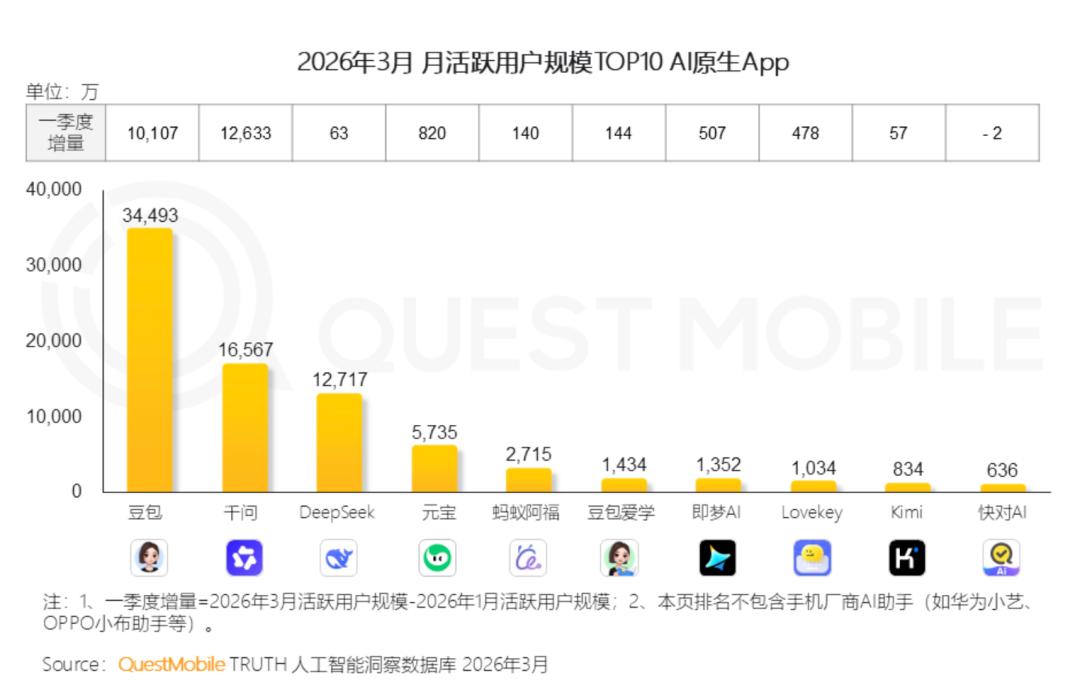
According to a Quest Mobile report, in March this year, Doubao ranked first among the top three AI apps in China with the largest monthly active user bases, boasting 345 million monthly active users. Qianwen and Yuanbao, ranked second and third, had 166 million and 57.35 million monthly active users, respectively.
Figure/QuestMobile
Therefore, when Doubao attempts to monetize its services, the conflict between its user-friendly nature and the practicality of commercialization becomes more pronounced. Many users perceive this as "exploiting" or "harvesting" their loyalty.
Additionally, factors such as the lack of a user payment habit in the Chinese market and Doubao's incomplete transition from user-friendliness to effectiveness pose challenges to its commercialization efforts.
1. Up to 5088 yuan per year: Is Doubao 'Monetizing' Its Users?
According to media reports, a source close to Doubao revealed that its paid features will primarily focus on complex tasks and productivity scenarios that require high computing power, such as PPT generation, data analysis, and film and television production. The free version will continue to serve users' daily lightweight needs.
In essence, Doubao is not abandoning its free offerings but is creating a separate tier for power users on top of its free foundation.
Doubao is essentially using a subscription mechanism to segment its user base—using the free version to maintain its scale advantage and the paid version to attract core users willing to pay for high-value capabilities.
So, is Doubao's pricing reasonable?
In the Chinese market, the subscription fees for entry-level memberships for Kimi, Zhipu Qingyan, and Nano AI are all around 49 yuan per month. Globally, ChatGPT Plus and Claude Pro cost approximately 145 yuan per month. Doubao's 200-yuan Enhanced Version falls within this price range.
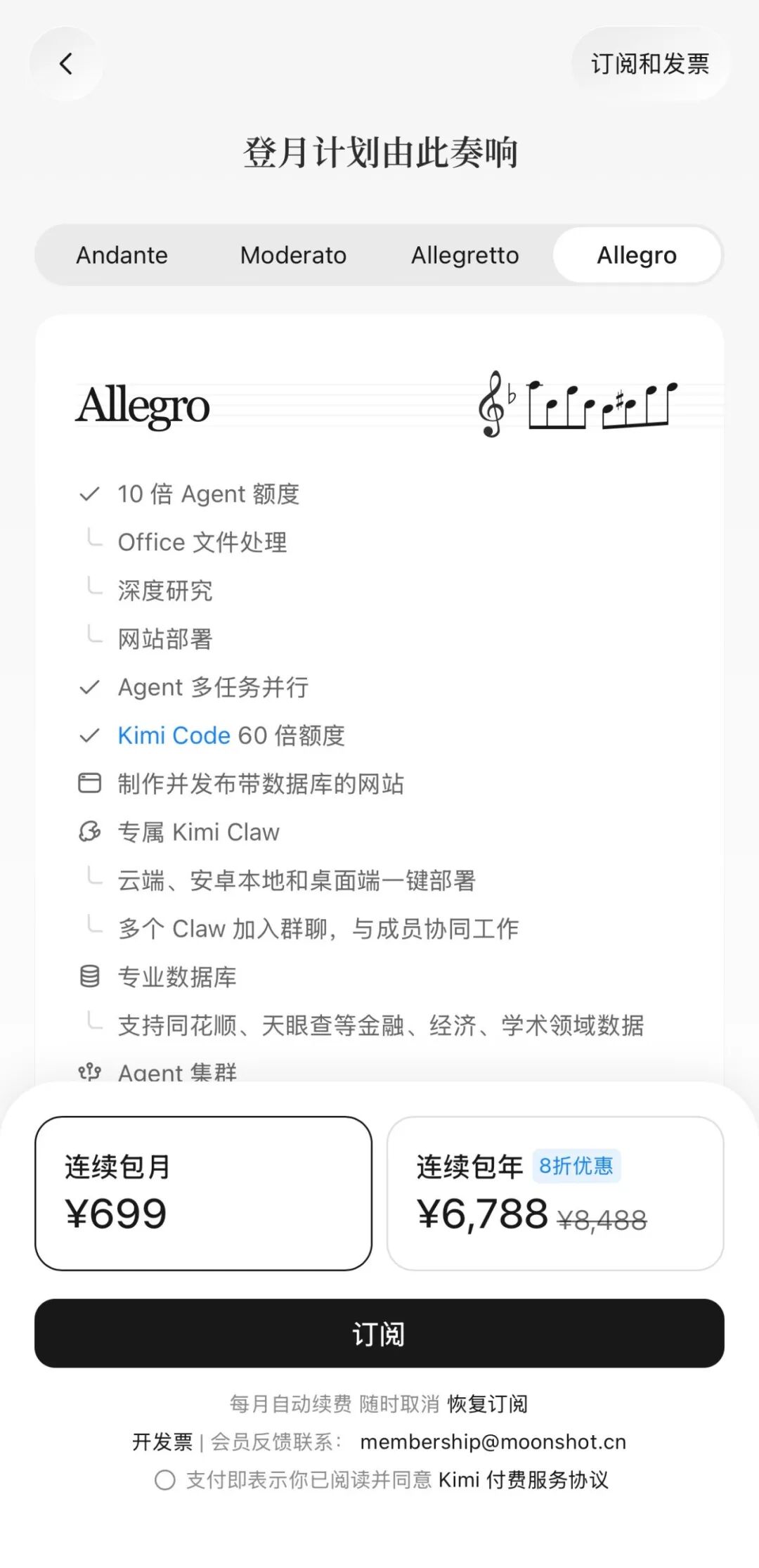
Now, let's consider the Professional Version. Doubao's price of 500 yuan per month or 5088 yuan per year for continuous subscriptions is indeed higher than domestic standards, but it is not alone in this regard. For example, Kimi's top-tier subscription, Allegro, costs 6788 yuan per year, while ChatGPT Pro costs around 2400 USD (approximately 16,366 yuan) per year.
Figure/Kimi App
Morgan Stanley analysis points out that Doubao's Standard Version at 68 yuan per month is slightly higher than global counterparts (around 8 USD per month) but is in line with the pricing of ByteDance's video generation app, Jiying. The target audience is clearly creators and knowledge workers, rather than the general public.
However, for Doubao, the core issue is not the price level itself but whether the value justifies the cost.
A survey of 1800 respondents by Citigroup Research's Innovation Lab in March this year showed that 45% of respondents were willing to pay for advanced features, with an average acceptable monthly subscription price of 48.3 yuan, higher than typical digital content subscription prices for music and video. In other words, the psychological barrier to paying is diminishing.
Of course, the premise is that Doubao must first prove its worth.
And this is precisely the source of the controversy. Behind hashtags such as #DoubaoProvidesInconsistentAnswers and #DoubaoErrorRates on social media lies a more critical question:
Doubao has solved the problem of user-friendliness, but is it truly effective and useful?
"If the generated content still requires significant manual revisions, if inaccuracies and nonsense still appear from time to time, then why should I pay for a half-baked product?" a user wrote on social media.
This sentiment reflects the views of many rational users—they are not opposed to paying but demand that the AI's capabilities match the price. Once the barrier of charging is crossed, users' tolerance for errors in AI products will significantly decrease, and any flaws in the experience will trigger strong backlash.
In other words, whether Doubao can successfully transition from free to paid depends on its own capability quality and evolution speed.
2. Behind 345 Million Monthly Active Users, How Strong is Doubao's Competitive Edge?
Before discussing why Doubao charges fees, it is essential to understand its position in the Chinese AI application market.
As mentioned earlier, the 345 million monthly active users indicate that Doubao is not just the largest but almost "dominant" in the Chinese market.
However, another fact is that for most users, Doubao's usage has, so far, remained at a lightweight level.
This is also a key reason for Doubao's rise. Doubao positions itself as an inclusive AI tool, covering multiple scenarios such as work summaries, homework assistance, travel planning, and image recognition. It emphasizes zero-threshold interaction, attracting a diverse user base including students, white-collar workers, housewives, and the elderly. Its customer acquisition cost is the lowest among all ByteDance products with hundreds of millions of users.
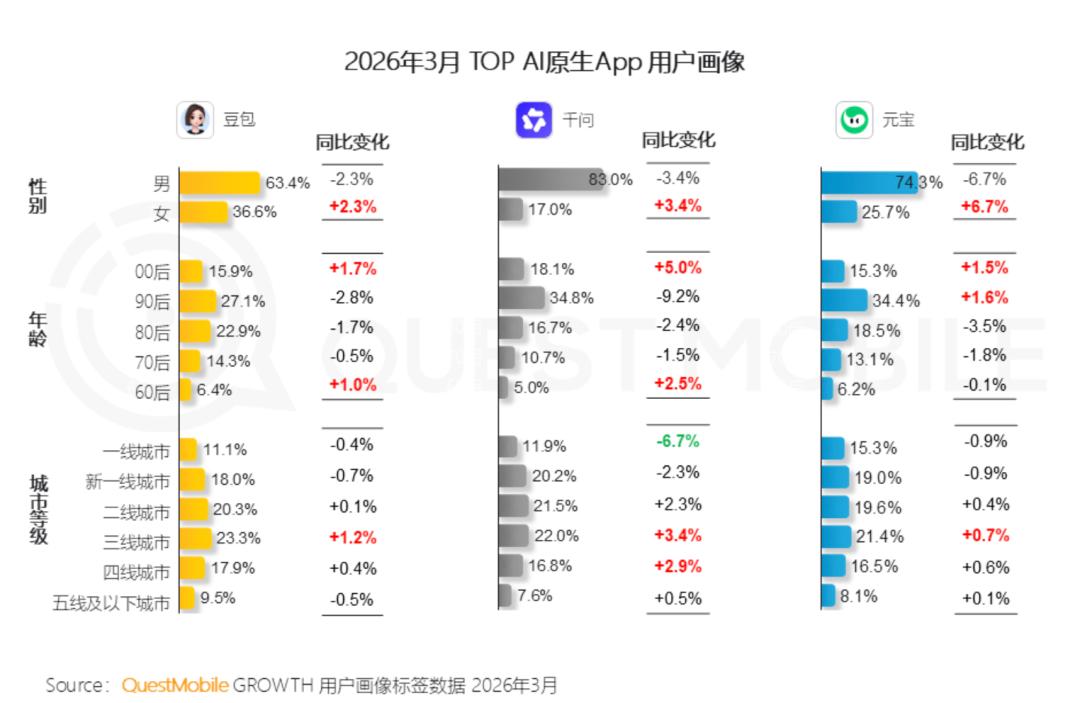
Objectively, this "anyone can use it, and you can chat about anything" design enables Doubao to penetrate from first-tier cities to third- and fourth-tier cities.
Figure/QuestMobile
However, this also means that the 345 million monthly active users have inadvertently become a burden for Doubao.
Firstly, at present, Doubao seems more like a life assistant, but this is far from sufficient.
As a national-level application, Doubao cannot just provide emotional value and daily companionship; it needs to truly integrate into users' work and learning processes.
When a product's daily Token consumption reaches the 120 trillion level, and a significant amount of usage is still concentrated in free, lightweight scenarios, the core contradiction ByteDance faces is that the underlying model capabilities are already in place, but the free model limits the space for these capabilities to be effectively perceived and utilized.
So, on the surface, Doubao is introducing a fee-charging mechanism, but at a deeper level, it is guiding user mindset—telling everyone that Doubao is not just for chatting and entertainment; it can be a productivity tool. The fastest and simplest way to establish this standard is through pricing.
On the other hand, the massive user base means Doubao hardly needs to worry about scalability anymore.
345 million monthly active users mean that even if 15% of users leave due to dissatisfaction with the fees, the remaining users still outnumber the combined monthly active users of all competitors except Qianwen.
Moreover, whether users will leave essentially depends on whether other providers can offer unique, differentiated value. At the current stage, the experience gap among users in basic Q&A is not significant enough to form absolute barriers, and loyalty remains fragile.
Doubao has calculated this clearly: The risk of charging fees is not whether users will "leave" but "where they will go." If other providers cannot offer significantly better free experiences, then users have no reason to leave.
Finally, from a commercial logic perspective, Doubao's fee-charging not only makes sense but is also inevitable in the long run. Initiating fees is essentially just a matter of timing.
According to the cost structure disclosed by Volcano Engine, hardware depreciation accounts for about 58% of the cost per inference, with electricity costs around 29%. The 120 trillion daily average Tokens imply a massive hardware cluster and continuously rising electricity bills.
Tan Dai, the head of Volcano Engine, put it more bluntly: "The next-generation model will be more capable, with single-Token costs rising, but the economic value created will also increase synchronously." High intelligence corresponds to high consumption, high consumption to high costs, and high costs must be covered by someone.
3. Becoming a Super Entrance: Doubao's Grand Ambition
If Doubao's fee-charging is simply understood as 'can't bear the costs anymore, so starting to charge,' it greatly underestimates ByteDance's strategic vision.
In March this year, Doubao integrated with Douyin E-commerce, launching a shopping feature beta test. After users propose consumption needs, Doubao accurately matches them with Douyin product cards. Clicking on a card leads to the product details page, and the entire ordering process is completed within the Doubao App without redirecting to Douyin.
Of course, this is premised on Doubao and Douyin being linked through account systems, with product details, transaction systems, and after-sales fulfillment still handled by Douyin E-commerce.
The core of this model is that ByteDance has connected AI and transaction chains in the lightest way possible, migrating the e-commerce entrance from Douyin to Doubao's chat interface. On one side is the national-level AI application with 345 million monthly active users, and on the other is the e-commerce business with a GMV exceeding 4.4 trillion yuan. Their integration means ByteDance is no longer satisfied with treating Doubao as just an AI assistant.
Viewing Doubao's integration with e-commerce and the introduction of paid subscriptions together, ByteDance's strategic intent is almost blatantly clear: Doubao is being shaped into a super entrance for the AI era.
Huxiu directly pointed out in its analysis that ByteDance is attempting to make Doubao a traffic entrance for the AI era—once users develop the consumption mindset of "shopping, ordering food, and booking tickets with a single sentence in Doubao," it will no longer be just a tool-type AI assistant but the entrance to all internet consumption.
The logic of this "super entrance" is highly similar to WeChat's path in its early days: starting as a chatting tool, it gradually added payment, shopping, life services, and content consumption, ultimately consolidating all users' digital behaviors within a single App.
In fact, this is not just ByteDance's judgment.
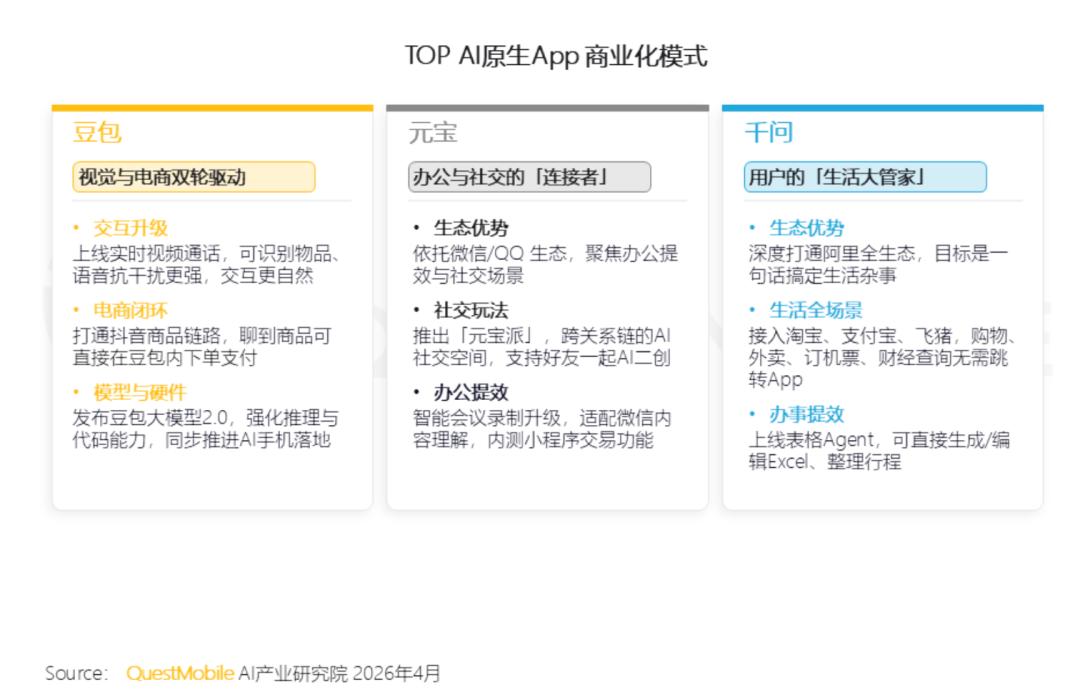
At the beginning of 2026, Alibaba's Qianwen announced full integration with Taobao, Alipay, Fliggy, Gaode, and other Alibaba ecosystems. Baidu's Wenxin relies on search and Baidu Youxuan for AI shopping guidance. Globally, ChatGPT is embedding GPTs and plugin ecosystems into commercial scenarios, while Google is deeply integrating Gemini into search, email, and office suites.
Figure/QuestMobile
All tech giants are trying to answer the same question: When AI can accomplish more and more tasks for users, whoever controls the first conversation interface between users and AI will control the entrance to all subsequent transactions.
From a group strategic perspective, ByteDance's intent is also traceable.
Morgan Stanley, in its research report, views Doubao's subscription service as a "meaningful signal for the Chinese AI industry's move towards commercial sustainability." It also points out that Doubao's paid exploration is not just a commercial decision by a single company. If the paid model is validated by the market, other competitors that still maintain free services will face a choice between following suit or holding firm.
Tan Dai, in a previous interview, also discussed the pricing of large models. In his view, price increases are just market behaviors by some vendors, with others in the industry pushing for price reductions. The core divergence lies in the judgment logic of Token value.
This remark reveals that ByteDance's internal perspective on the commercialization of large-scale models has already surpassed the simplistic binary choice of "whether to impose charges." Instead, the company is focused on establishing a pricing strategy rooted in the varying capabilities of these models.
The underlying impetus for this shift can be traced back to ByteDance's current developmental phase. As the expansion of Douyin E-commerce decelerates, ByteDance is compelled to identify its next catalyst for growth.
At present, this crucial responsibility unquestionably rests with Doubao.
However, a word of caution is in order: Prior to realizing this ambitious vision, Doubao's paramount task is to demonstrate not only its user-friendliness but also its efficacy. It must, at the very least, dispel the perception among certain users that it is "unintelligent".
-
![]()
Tesla Restructures Its Balance Sheet
-
![]()
Accelerating the High-Speed Interconnection Upgrade of AI Computing Clusters! JONHON Releases ELSFP External Light Source Optical Connectors
-
![]()
Breaking the overseas blockade of volumetric holographic materials, this optical enterprise secures nearly 100 million yuan in financing!
-
![]()
Why Does Jensen Huang So Openly Praise China’s AI?
-
![]()
"Wudang" Unveiled: Arm China's Next-Gen AI VPU Redefines Video Encoding
-
![]()
From Energy Conservation and Carbon Reduction to AI Decision-Making: GECON East Intelligence and Chery Group Explore a New Green and Smart Paradigm for Automobile Manufacturing
-
![]()
WAIC 2026 Observation | AI Accelerates Towards the Core of Industries, Industrial AI Enters a Critical Phase
-
![]()
Volkswagen China Fires the First Shot in Foreign-Funded 'White Box Delivery'!