When the Input Method Starts Hijacking AI
 05/09 2026
 579
579
Sogou's AI anxiety lies within the Wangzai pop-ups.
Author | Wang Tiemei
Editor | Gu Nian
Zhang Wei decided to uninstall Sogou Input Method after a misclick.
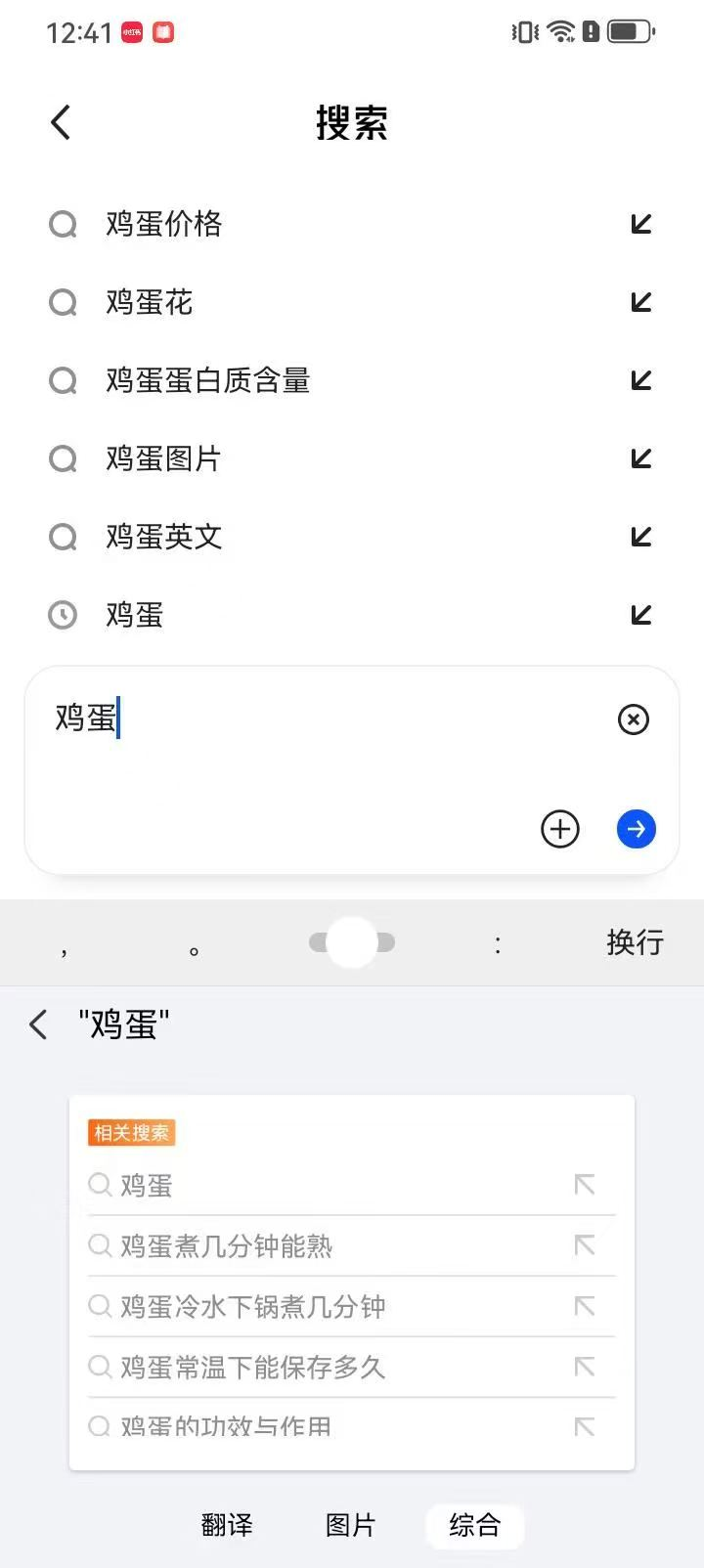
She showed [us] that moment: While typing in any browser, a search icon would pop up next to the candidate words in Sogou Input Method. She clicked on it, but instead of being redirected to her usual search engine, a 'Related Searches' interface appeared. Clicking further led her to the Sogou browser.
Another time, she clicked on 'AI Expressive Expression' next to the candidate words, thinking it would help refine her expressions and optimize her wording. Instead, the page jumped directly to Sogou's built-in Wangzai AI Q&A interface, blocking the page she was originally using.
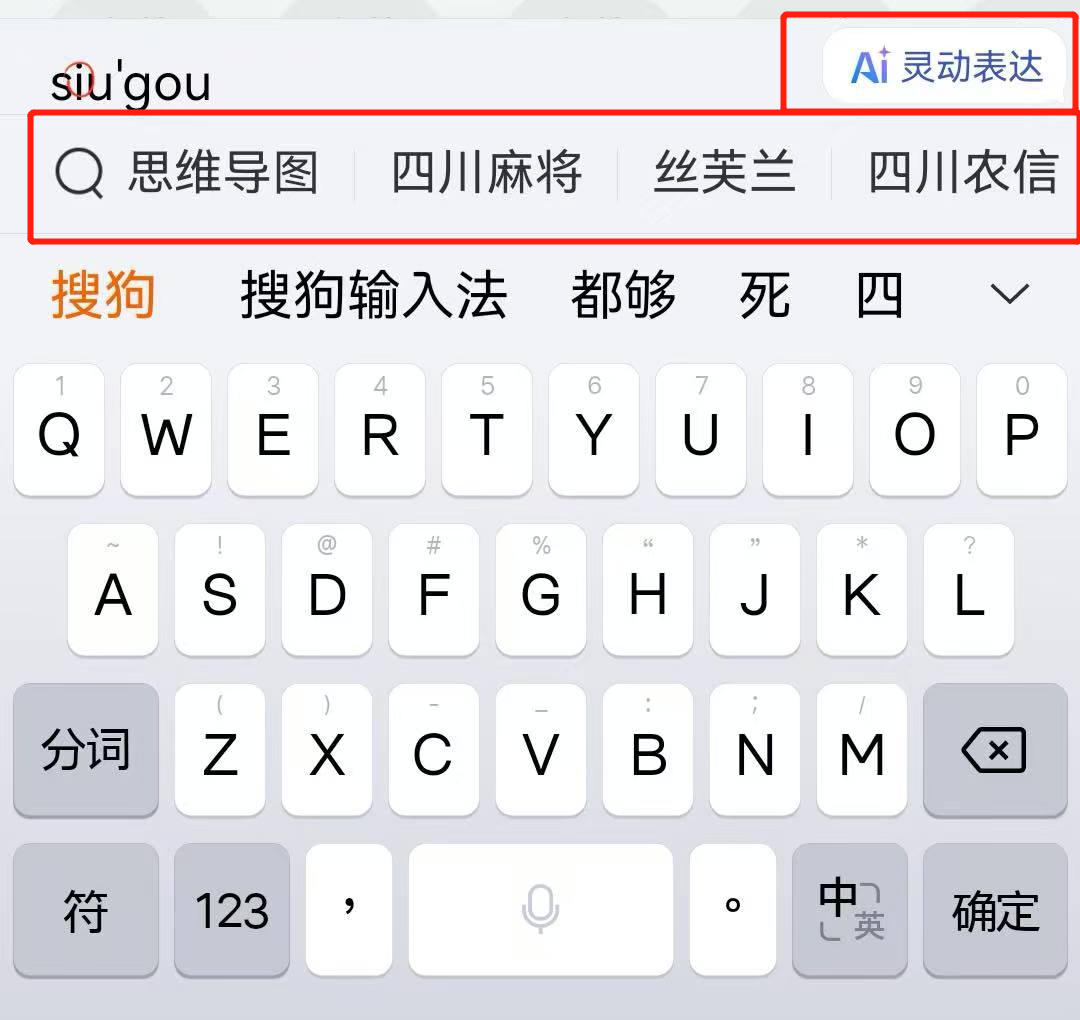
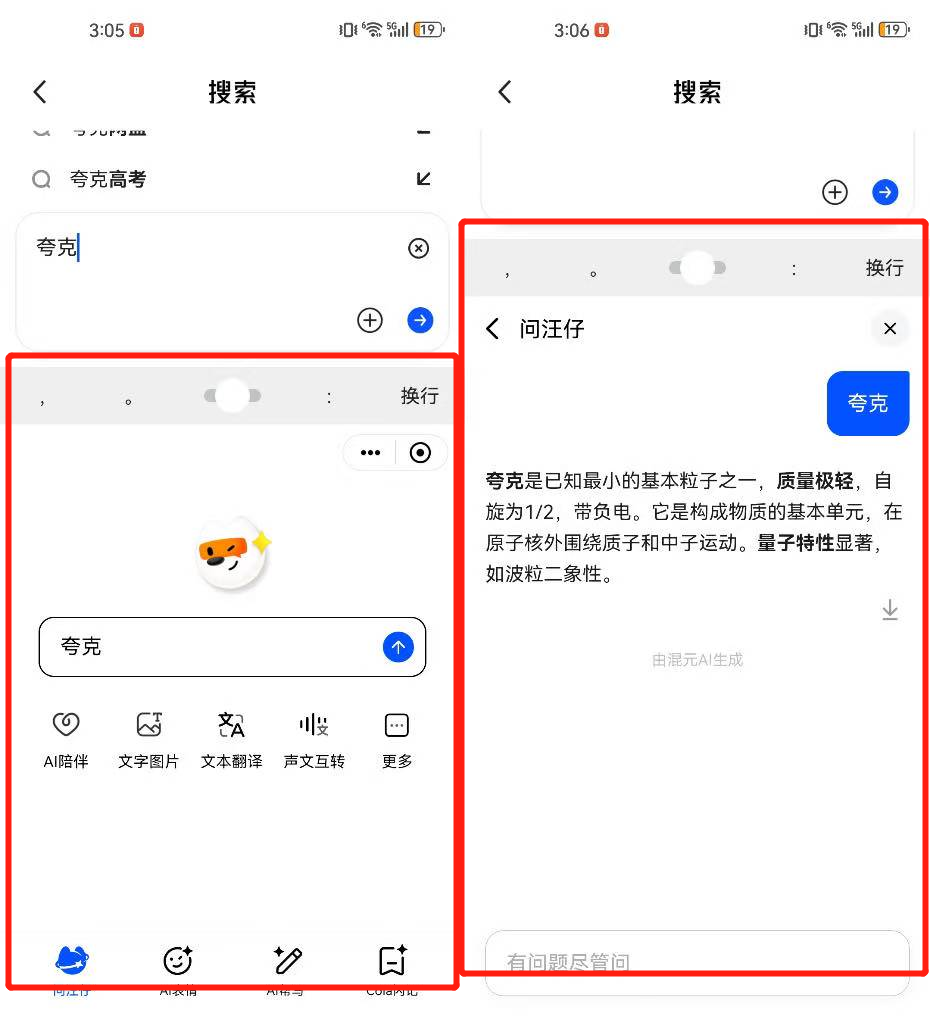
'I thought it would help me phrase things more smoothly, but instead, it directly pushed me to use another AI,' Zhang Wei said.
This was not an isolated product bug. Searching 'Wangzai' on social media reveals more similar search terms in the drop-down suggestions, such as 'How to uninstall Wangzai,' 'How to permanently disable Wangzai,' and 'How to close Wangzai pop-ups.' Many users are struggling with Sogou's AI-driven features.
Sogou claims to have over 100 million AI users, but on the other end of the internet, users are exchanging tutorials on how to close and uninstall it. An AI feature that should enhance efficiency has instead become a nuisance requiring a guide to escape.
While ordinary users struggle with the disturbances caused by Sogou's AI integration, an unfair competition case known as the 'AI Agent Traffic Hijacking' recently went to trial.
Although the reports did not directly name the products involved, some internet practitioners pointed out that the 'W Intelligent Large Model' accused of AI agent traffic hijacking might correspond to Sogou's 'Wangzai.' This speculation has not been publicly confirmed, but for Sogou Input Method, similar accusations are not new. 
AI Hijacked by the Input Method
On April 23, the Hangzhou Intermediate People's Court heard an unfair competition case involving 'AI Agent Traffic Hijacking' in the artificial intelligence sector.
Public reports indicate that the plaintiff operates an AI application called 'K Agent,' which integrates search, writing, image generation, and other functions. The defendant, the developer and operator of a certain input method, embedded the 'W Intelligent Large Model' within the input method, also offering AI Q&A and writing services.
The core of the dispute is that when users engage with K Agent, the defendant's input method automatically triggers a 'search suggestion' feature, redirecting users to its built-in W Intelligent Large Model and obscuring K Agent's interface.
The plaintiff argues that this constitutes 'traffic hijacking' and seeks 100 million yuan in damages. The defendant contends that the input method provides intelligent service recommendations within input scenarios, representing positive efficiency competition and respecting user choice.
The court did not announce a verdict during the hearing, but the descriptions in related reports have sparked outside speculation. Some industry insiders speculate that the 'W Intelligent Large Model' in the case might be Sogou's Wangzai AI agent.
On the other side, the 'K Agent' mentioned in the reports is described as a product centered around an AI super frame, integrating search, in-depth research, AI writing, AI image generation and modification, academic search, translation, and other capabilities. It is a key product for the plaintiff to attract user traffic, compete for market position, and create transaction opportunities.
This description closely resembles the product features of the 'New Kuake AI Super Frame' released by Alibaba Research Institute in March 2025. As a result, outside observers further speculate that this case might represent a battle for entry points between Kuake's AI agent and Sogou's Wangzai AI agent.
However, as of now, related reports have not publicly confirmed the specific product names of the parties involved, and the above correspondences remain at the level of industry speculation.
Despite the lack of public naming, speculation about the 'W Agent' has resonated with many Sogou users. 'Anyone who has used Sogou knows how hard it is to avoid Wangzai,' one user complained.
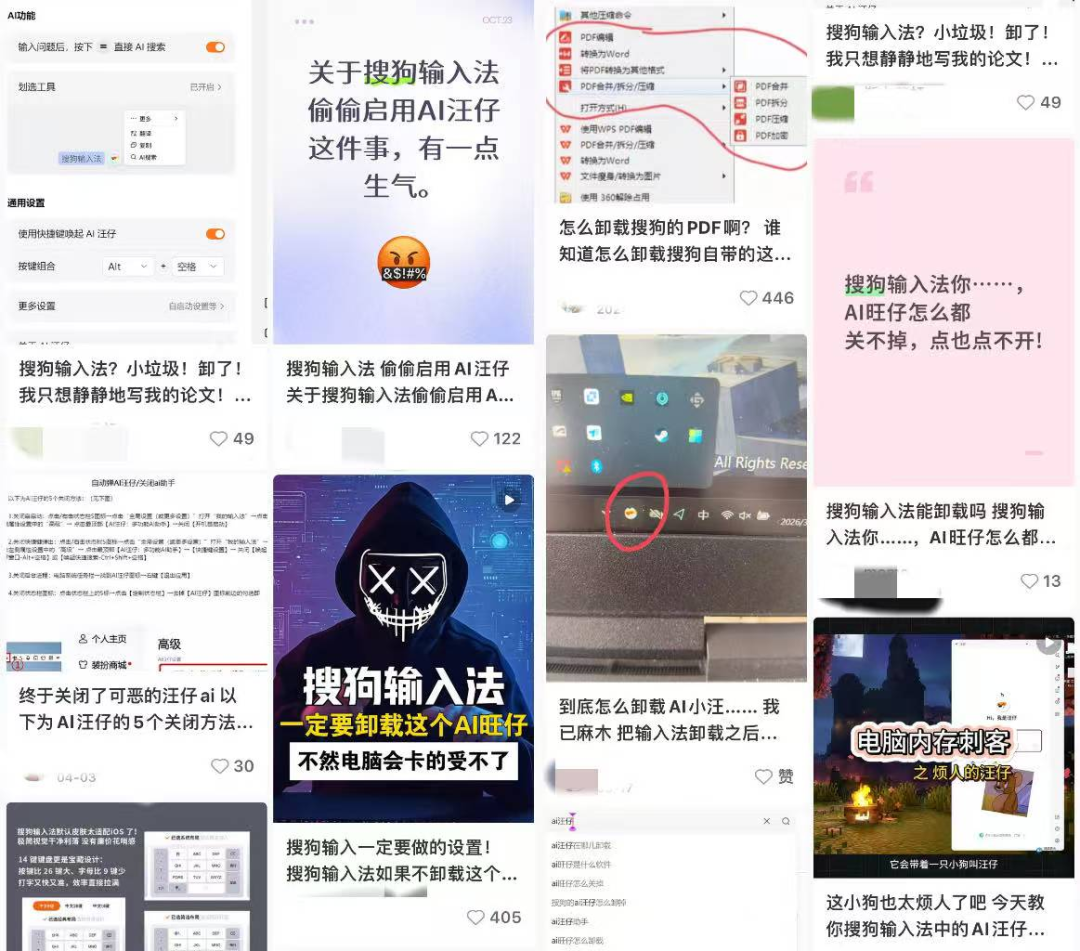
Wangzai AI is a large model assistant built into Sogou Input Method, officially positioned as an AI search and AI writing tool. Unlike a standalone app, its entry point is embedded within the user's input process: triggered by typing specific symbols, popping up prompts near candidate words during typing, or appearing directly after clicking the search icon on the input method toolbar.
This is also where some users feel annoyed. Wangzai is not an AI tool that users actively open and use; rather, it is an additional entry point that may appear at any time during input.
In practice, Wangzai's triggers are difficult to avoid. Some users report that even after disabling related features in settings, they may reappear after input method updates. On PCs, when users download Sogou Input Method, the installer may default to selecting the Wangzai AI component.
This is equivalent to users intending to install only a typing tool but being defaulted into a suite of AI services. As a result, searching 'Wangzai' on social media often leads to the same type of questions: 'How to uninstall Wangzai,' 'How to permanently disable Wangzai,' and 'How to close Wangzai pop-ups.'
A lack of restraint in product experience has also created new user anxieties in the AI era.
In Sogou's descriptions of Wangzai, it emphasizes the tool's ability to understand user intent, mine semantic meanings, and provide intelligent assistant services. However, an input method integrated with an AI assistant raises questions beyond mere annoyance from pop-ups—it also concerns what the input method can see, record, understand, and how it processes input content.
These concerns do not necessarily represent actual violations but have become real trust costs.
Sogou undoubtedly outlines data protection rules in its user agreements and privacy policies, distinguishing which data is uploaded, anonymized, or used to improve services. From a compliance standpoint, such statements meet various regulations. However, user trust in a company depends not only on how agreements are written but also on its usual product style toward users.
When a tool frequently pops up windows, induces redirects, bundles components by default, and even complicates user efforts to close or uninstall it, users find it hard to believe the tool will exercise sufficient restraint over data boundaries. A product that does not respect experiential boundaries is unlikely to convince users it will seriously respect privacy boundaries.

A Habitual Offender in Traffic Hijacking?
Traffic hijacking has also been a major area where Sogou faces penalties.
As early as 2015, Sogou Input Method for Android introduced a 'search candidate words' feature. When users typed in a browser's search box, a row of search recommendations would appear above the candidate words. Clicking on them would redirect the page to Sogou's search results.
That same year, Baidu sued Sogou, and the court ruled in the first instance that Sogou Input Method exploited users' habit of using dropdown menu searches on Baidu's search engine to induce them into Sogou's search page, constituting unfair competition. The court ordered Sogou to cease the behavior and pay Baidu 500,000 yuan in damages.
In 2019, similar controversies erupted again.
That year, the Haidian Court heard three lawsuits against Sogou Input Method, with plaintiffs including Baidu, Qihoo 360, and the operators of UC Browser and Shenma Search. The core issue in all three cases was Sogou Input Method's 'search candidate words' feature.
The court pointed out in its judgments that after users had already selected a search engine, Sogou still used search candidate words that popped up in the input method interface to guide users to Sogou's search results page, and the relevant interfaces lacked sufficiently prominent identification (identification), easily causing user confusion. The court thus ruled that Sogou had hijacked search user traffic belonging to the three plaintiffs.
Sogou responded by stating that the 'search candidate' feature did not involve traffic hijacking and expressed 'great regret' over the judgment, vowing to appeal. Later, for refusing to comply with the court's rectification orders, Sogou was fined an additional 500,000 yuan by the Haidian Court.
From the outcomes, this is not the first time Sogou has been embroiled in controversies over traffic acquisition due to its input method's entry point. In the past, the intercepted traffic belonged to browsers and search engines; in the AI era, the target has shifted to AI applications.
This logic persists today, perhaps inevitably given Sogou's role within Tencent's ecosystem.
In 2013, Tencent strategically invested $448 million in Sogou, becoming its single largest shareholder. Later, Sogou was fully acquired by Tencent and officially became part of Tencent's ecosystem. However, Sogou's position has always been somewhat delicate: it possesses the high-frequency entry point of an input method but struggles to gain a strong presence within Tencent's core business portfolio.
Until February 2025, when Tencent underwent a new round of organizational restructuring, moving products like QQ Browser and Sogou Input Method from PCG to CSIG. In this change, Sogou Input Method was incorporated into Tencent's AI product matrix centered around Yuanbao. Its role also elevated from a mere input method tool to part of Tencent's strategy to secure entry points for AI search and AI applications.
But currently, Sogou's AI performance is not particularly impressive. Data from QuestMobile in March 2025 shows that the penetration rate of Sogou Input Method's AI search plugin is below 4%. This means that despite Sogou Input Method's massive user base, the vast majority of users do not actively use its AI features.
 When Input Methods Face Large Model Players
After entering the AI era, the competitive logic of the input method industry is no longer the same as what Sogou is familiar with.
In the past, input methods solved the problem of 'how to type characters.' With the integration of large models, input methods now understand 'what users want to express.' They are no longer just typing tools but the closest AI entry points to users.
From a market share perspective, the input method landscape remains stable. As of the third quarter of 2025, the four major input methods—Sogou, iFlytek, Baidu, and WeChat—collectively occupy (account for) 84.4% of the market. However, beneath this stable market share, AI is driving undercurrents of competition.
A MobTech report notes that the usage rate of AI input methods has reached 51.2%. User expectations for AI input methods are also rising, and in a technology-driven market, user migration costs have been significantly reduced.
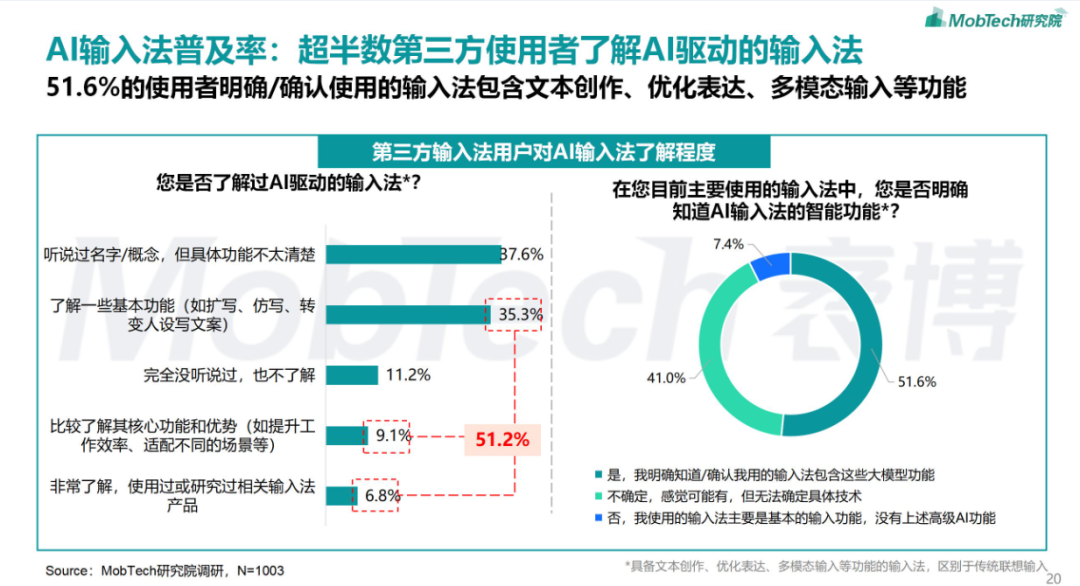
In the past, Sogou's moat was user habit. Switching input methods required users to rebuild their word banks and adapt to new typing habits, making migration costly. However, AI has changed this competitive rule. Now, an input method with more accurate voice recognition, more natural rewriting, and stronger scene understanding can easily tempt users to switch.
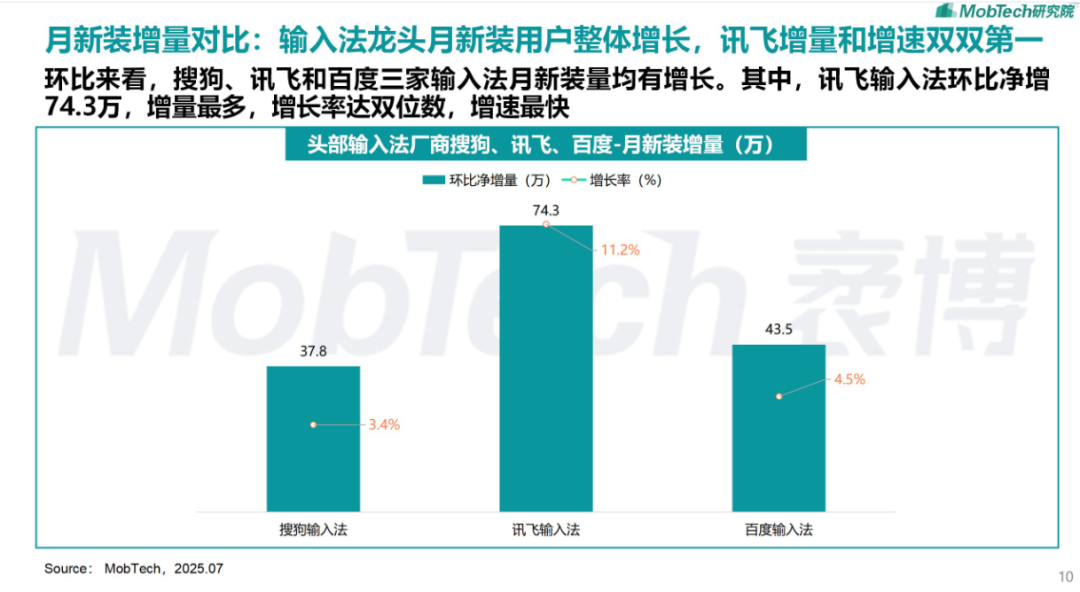
The first to pressure Sogou was iFlytek. Leveraging its Spark Large Model, iFlytek Input Method moved earlier in the AI input space. Data from 2025 shows that iFlytek Input Method ranked first in the industry for monthly new user growth and growth rate; in April 2026, it also topped the 'Powerful AI Product List' for large model input methods on Qimai Data.
An even greater variable is the entry of large model-native players.
In November 2025, ByteDance launched Doubao Input Method, emphasizing a 'zero-ad pure experience' and 'AI voice input.' It directly reused the voice large model Seed-ASR from the Doubao app, reducing voice recognition error rates by about 40% compared to traditional solutions. By late November 2025, Doubao Input Method had surpassed 50 million cumulative downloads and reached 12 million daily active users.
In early 2026, Zhipu AI also launched Zhipu AI Input Method, focusing on 'speech-to-text,' incorporating voice transcription, AI polishing, expansion, translation, and other capabilities into PC-end input scenarios while announcing it would remain permanently free.
These large model companies are not developing input methods to replicate Sogou's past advertising and traffic business. What they truly value is securing entry points for large model capabilities. The high-frequency, essential input method entry point can further feed into improving large model performance. This operates on a different dimension from Sogou's past strategies.
Sogou's technical foundation is not weak. Leveraging Tencent's Hunyuan Large Model, it developed Wangzai AI and disclosed data on voice recognition accuracy, daily voice call volume, and AI user scale.
However, Sogou, as a defender using AI to transform itself, still clings to past successes. Using candidate word pop-ups, default selections, and search suggestion redirects may boost traffic but struggle to build trust. In the AI era, input method competition is no longer about traffic but about large model technical capabilities.
Just as a saying in the industry goes: 'When Doubao and iFlytek engage in a battle over input methods, the first ones to take a beating may not be each other, but Sogou.' When input methods start to compete on technology, the most dangerous position for old players is not the lack of an entry point, but remaining stuck in old strategies.
(The names of persons in the article are pseudonyms)
-
![]()
Tesla Restructures Its Balance Sheet
-
![]()
Accelerating the High-Speed Interconnection Upgrade of AI Computing Clusters! JONHON Releases ELSFP External Light Source Optical Connectors
-
![]()
Breaking the overseas blockade of volumetric holographic materials, this optical enterprise secures nearly 100 million yuan in financing!
-
![]()
Why Does Jensen Huang So Openly Praise China’s AI?
-
![]()
"Wudang" Unveiled: Arm China's Next-Gen AI VPU Redefines Video Encoding
-
![]()
From Energy Conservation and Carbon Reduction to AI Decision-Making: GECON East Intelligence and Chery Group Explore a New Green and Smart Paradigm for Automobile Manufacturing
-
![]()
WAIC 2026 Observation | AI Accelerates Towards the Core of Industries, Industrial AI Enters a Critical Phase
-
![]()
Volkswagen China Fires the First Shot in Foreign-Funded 'White Box Delivery'!