The Living Room Can't Contain Our Ambitions! In 2026, Projector Giants Transform into AI Glasses Players
 05/09 2026
 503
503
From Living Room to the Corner of the Eye: A New Chapter in Projector Competition
By VR Gyroscope Ran Qixing
Over the past decade of smart home development, 'projectors' have been one of the fastest-growing categories in living room large-screen displays.
However, with the impact of consumer electronics such as smartphones and tablets, market saturation, and changes in consumer preferences driven by short videos and mini-dramas, the luster of projectors seems to be fading. Manufacturers are now collectively contemplating where their second growth trajectory should lie.
In contrast, the AI glasses market is rapidly heating up. Data from Gyroscope Research Institute shows that global smart glasses shipments will reach approximately 8.8 million units in 2025, a year-on-year increase of 376%, with AR glasses shipments reaching about 930,000 units, a year-on-year increase of 121%.
On this new track, players originally focused on projectors, such as Appotronics, Orange, and XGIMI Technology, are beginning to make frequent appearances.
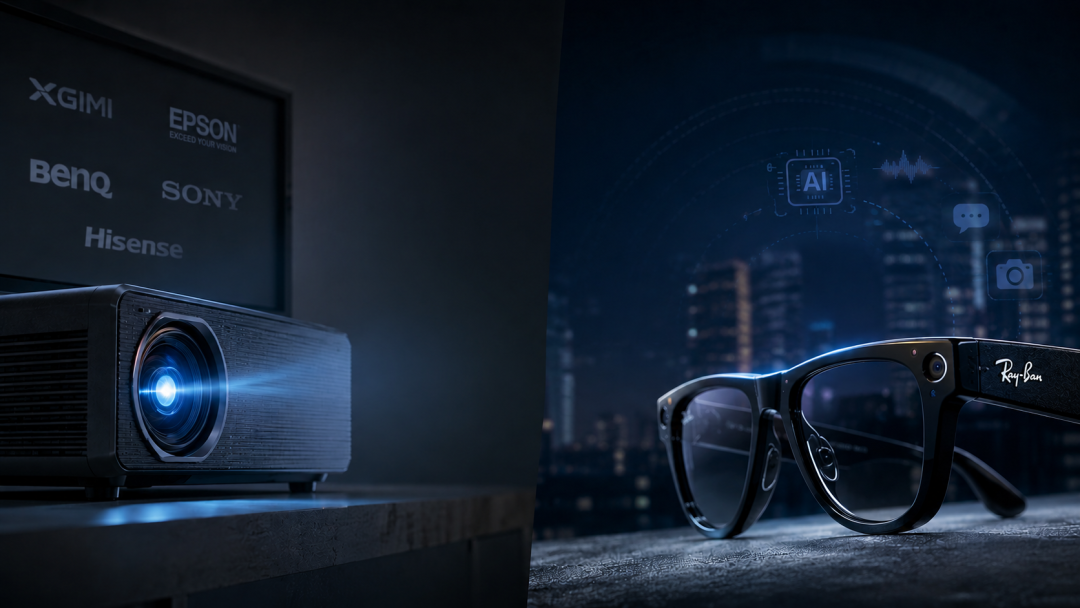
Image Source: AI Generated
01
Leading Projector Manufacturers Start Collectively Producing AI Glasses
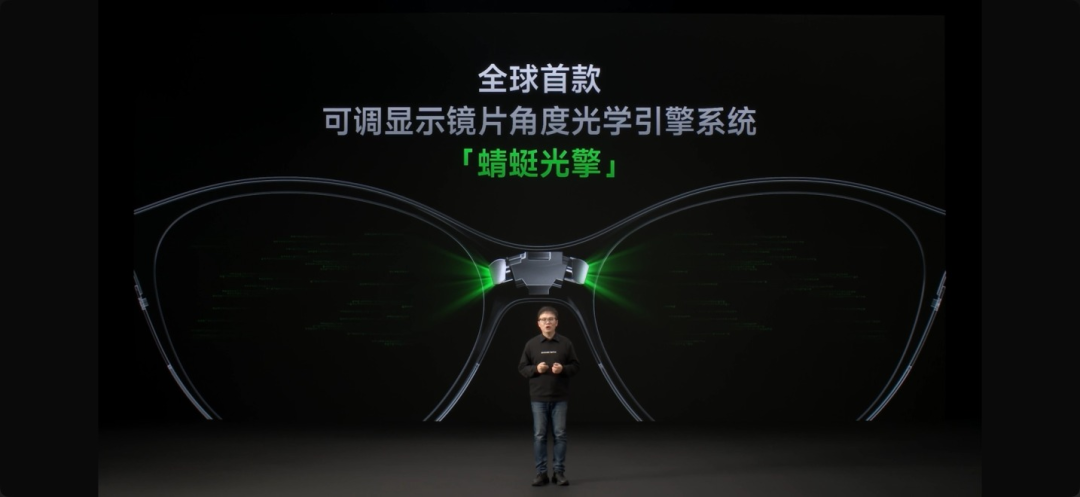
As one of the earliest projector manufacturers to enter the AI glasses industry, Appotronics (688007.SH) unveiled two AR diffractive waveguide modules as early as 2022. During the 2025 Optoelectronics Expo, Appotronics and Gudong Intelligence held a joint press conference, officially launching an LCoS (Silicon-Based Liquid Crystal) + PVG waveguide 'one-to-two' AR glasses optical solution. At the conference, Appotronics introduced two LCoS AR light engines: the Dragonfly G1 and the Rainbow C1.
In December of the same year, at the Shangee x China Aircraft Carrier fleet18 co-branded product and AI glasses launch event, Shangee Technology introduced the second generation of AI glasses: the Shangee loomos AI Recording Glasses L1 and the Shangee loomos AI Display Glasses S1. The Shangee loomos AI Display Glasses S1 is equipped with Appotronics' 'Dragonfly Light Engine,' achieving asynchronous binocular display and true 3D effects on a bendable frame, with a weight reduction of half compared to traditional dual-light-engine systems and a global brightness of up to 5000 nits.
At CES 2026 this year, the projector brand XGIMI officially announced its entry into the AI glasses market, introducing a new AI hardware sub-brand, MemoMind, and launching two AI glasses products: the Memo One and the Memo Air Display. MemoMind also confirmed that a third product is under development, which will offer a wearing experience closer to that of ordinary glasses and will be released later.

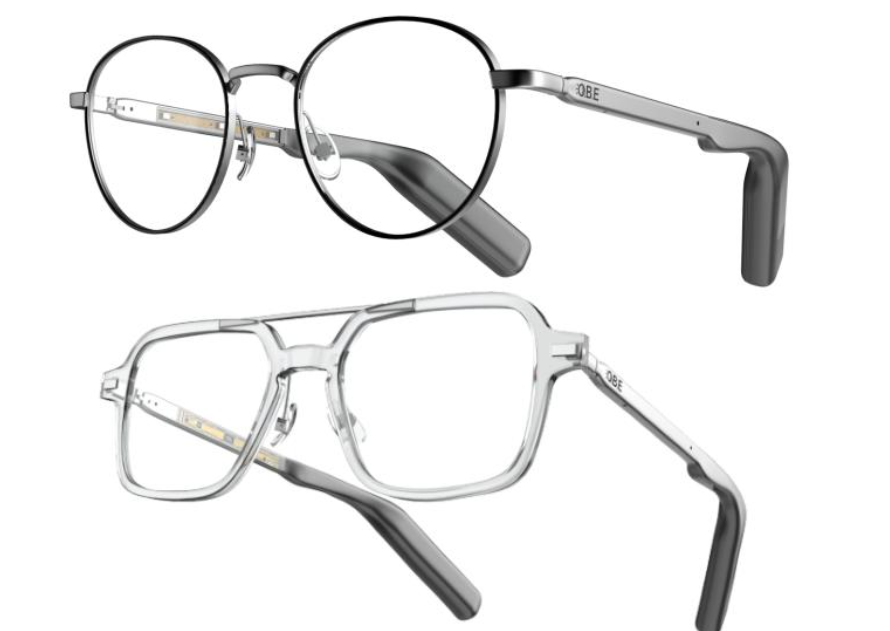
Not just Appotronics and XGIMI, in April 2026, projector manufacturer 'Orange' held its 2026 Spring New Product Launch Event, officially introducing its first AI glasses. According to reports, the Orange AI glasses weigh less than 30g, featuring a titanium alloy frame and in-mold injection molding process, offering myopia styles such as titanium half-frame, titanium wire half-frame, frameless, and pilot full-frame, as well as square sunglasses.
The AI glasses are equipped with a 6-microphone array, offering precise sound pickup from 8 meters away, excellent noise reduction, and a maximum battery life of 72 hours. They cover a full range of scenarios for work, travel, and life: integrating Bluetooth headsets and intelligent voice assistants, supporting meeting recording, simultaneous interpretation, and offline translation; innovatively featuring neck health detection for integrated intelligent interaction and health management.
In addition, the projector brand 'JMGO' has also been layout (planning) AI glasses but later split off the business for various reasons. Even Realities' founder, Wang Xiaoyi, was also the CPO of JMGO. This year's new AI glasses brand, NIMO, also has some connections to the projector industry.
02
Facing the Largest Market Fluctuation, Manufacturers Need a Second Growth Trajectory
The shift of projector manufacturers from high growth to category restructuring may be an inevitable choice in an industry cycle.
According to a report by Runto Technology, in 2025, the sales volume of China's smart projector market (excluding laser TVs) was 5.203 million units, a year-on-year decline of 13.9%; sales revenue was 8.36 billion yuan, a year-on-year decline of 16.5%, marking a record high decline (decline). Overall, looking at data from the past six years, the projector market seems to have entered a new phase of transitioning from seeking incremental growth to stabilizing existing stock.
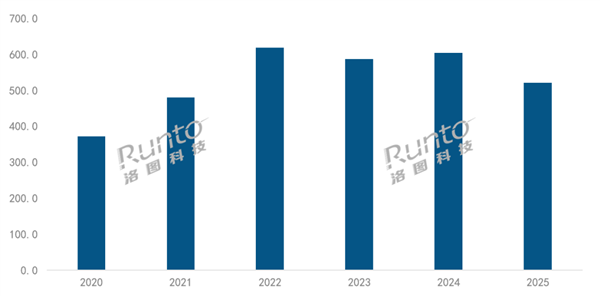
The decline in the projector market is influenced by multiple factors and is not simply due to overcapacity or consumption downgrade. On one hand, projectors are essentially high-end durable goods with longer replacement cycles compared to frequently used consumer electronics like smartphones. Coupled with price reductions in large-screen TVs, the maturity of foldable smartphones, and the impact of XR viewing glasses, along with cautious consumer spending, market demand naturally fluctuates and is not destined to continuously surge.
On the other hand, it is worth noting that with the sustained popularity of short videos, user engagement on various online audio-visual platforms has significantly increased. Relevant data shows that as of the end of 2025, the average daily usage time per person for short video applications reached 129 minutes. This trend has substantially occupied people's daily leisure and entertainment time. More critically, users' viewing mindset and habits have quietly changed, making it increasingly difficult to sit down and immersively enjoy a complete long movie, which has, to some extent, diverted the potential consumer base for projectors.
Against this market backdrop, continued investment in projector product iteration is more about refined operations within the same market; to truly find new growth, it is necessary to step out of the 'living room large-screen' category and move towards products that users may engage with more frequently. AI glasses exactly (precisely) provide such an imaginative space.
03
From Living Room Large Screens to 'Screens on the Face': The Underlying Logic of Projector Manufacturers' Cross-Industry Move
On the surface, projectors and AI glasses belong to two different categories: one is a large item placed at home, and the other is a portable hardware worn on the face. However, when examined from a technological and supply chain perspective, they have a considerable degree of overlap.
Sam, a senior industry practitioner, told VR Gyroscope, 'The projector business is relatively mature. Regardless of the technological route, it has basically achieved 70-80% of its potential. The only way forward is to differentiate and push some limits. The overall space and manpower demand are not as significant as before.'
'Projectors are essentially similar to televisions or tablets, and most teams have experience with consumer electronics like smartphones and computers. For making AI glasses, the organizational structure is basically complete. Additionally, in projectors, the light engine and software are crucial, and these capabilities can also play a certain role in AI glasses.'
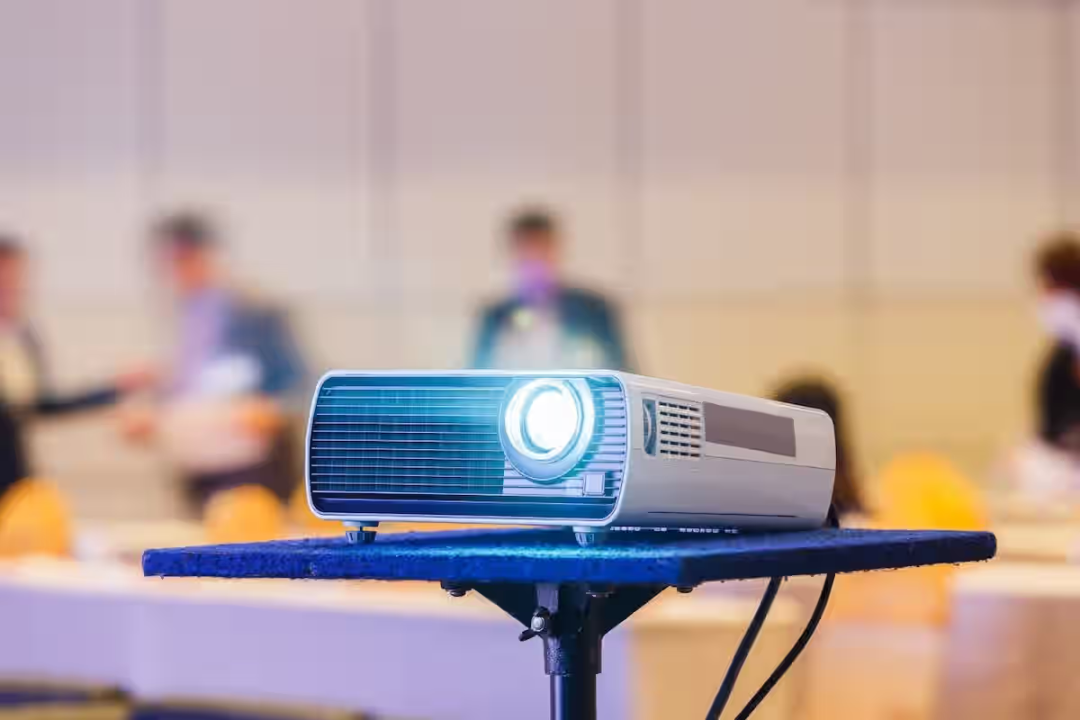
Among this batch of projector manufacturers transitioning, Appotronics is a representative example. The underlying technology of Appotronics' AR optical engine relies on its proprietary LCoS core light source technology. It is reported that LCoS is widely used in projectors due to its advantages of high brightness, low power consumption, long lifespan, and technological maturity.
Projector manufacturers are migrating their mature optical technologies to the AR track (sector), leveraging their existing light engine R&D capabilities to quickly customize and adapt to the miniaturization and lightweight demands of AI glasses, which can be seen as a natural progression. According to VR Gyroscope's sources, in addition to covering upstream AR optical engine layout (layout), Appotronics will also launch consumer-grade AI glasses under its own brand.
Beyond similar product architectures and technology teams covering the transition, there is a deeper reason for projector manufacturers to venture into AI glasses. Sam emphasized, 'Ultimately, for any company, the focus now is on AI, and glasses are the best entry point.'
04
Final Thoughts
Currently, most of the AI glasses products from these projector companies are still in their 'first generation' phase, with varying business, product, and scenario positioning.
For projector manufacturers who have already succeeded in the living room, this time they need to re-understand the more challenging issue of 'personal electronic products' compared to home appliances. After all, with AI glasses, it is no longer a simple 'projection' logic but rather the logic of human perception and interaction with information, along with various complex constraints related to human factors, wearability, and fashion design.
In 2026, the entire AI glasses market is becoming increasingly competitive, with players ranging from major companies like Meta, Alibaba, Huawei, and Xiaomi to innovative firms such as Rokid, Thunderbird Innovation, INMO, XREAL, and DPVR. Consumers have more choices, but the market share available to players is shrinking.
-
![]()
Who are the key players in the WiFi6 chip market, both visible and behind the scenes?
-
![]()
Doubao to Start Charging: Without Transparent Pricing, How Can There Be Competition?
-
![]()
What is the recovery timeline for Microsoft after the breakup?
-
![]()
Who is Most Panicked by Doubao's Charging Model?
-
![]()
OpenAI Surprises Apple: Doubao Phone Emerges as the 'Trailblazer'
-
![]()
There's No Such Thing as a Truly Free Doubao
-
![]()
The Living Room Can't Contain Our Ambitions! In 2026, Projector Giants Transform into AI Glasses Players
-
![]()
Apple: Can It Remain 'Steadily Happy' Despite AI Absence and Rising Storage Costs?