Samsung Quietly 'Exiting' China? Don't Be Fooled—It's Making a Fortune Behind Closed Doors
 05/09 2026
 337
337
The end of one era often marks the beginning of another. Ladies and gentlemen, shortly after the May Day holiday, the home appliance industry was shaken by significant news.
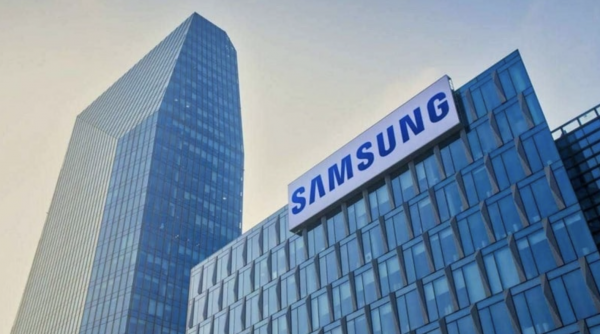
On May 6, 2026, Samsung Electronics released a statement announcing the cessation of sales for all home appliance products in the Chinese mainland—including TVs, monitors, refrigerators, washing machines, and more. This news immediately polarized WeChat Moments into two distinct camps.
Users from the post-90s and even post-2000s generations eagerly shared the news, exclaiming, "My youth ends here! My family's first LCD TV was a Samsung!" Meanwhile, veteran industry insiders remained unfazed, stating, "This isn't surprising. They should have pulled out long ago."
We're talking about Samsung here! The global leader in consumer electronics, with TV sales ranking first worldwide for 20 consecutive years. After more than three decades in China, why the sudden exit?
Some began to dismiss Samsung's presence in China: "Samsung has failed in China!" Others pointedly remarked, "They're just not doing business at a loss anymore." Today, let's delve into what Samsung is truly up to with this move.

The Fall of a Giant
Let's take a stroll down memory lane. In the 1990s, owning a Samsung "Premium" Skyview TV made one the envy of the neighborhood.
After 2000, Samsung monitors became ubiquitous in internet cafes, offices, and households. "Samsung screen" became synonymous with high-quality displays. At its peak, Samsung held over 15% of China's TV market share, competing fiercely with Sony and Panasonic.
But that was then. Now, the numbers might shock you: In 2025, Samsung's TV market share in China fell below 2%, refrigerators to 0.41%, and washing machines to 0.38%.
Yes, you read that correctly—not 4.1%, but 0.41%. What does that mean? Walk into any home appliance store, and you'll see massive displays for Hisense, TCL, Xiaomi, and Skyworth. Where's Samsung? Probably tucked away in a corner next to obscure brands.
That's not even the most painful part. According to Samsung's financials, its home appliance business in China incurred losses of 200 billion won (approximately RMB 945 million) in 2025.
Losing nearly a billion yuan a year—who could endure that? So, rather than a "retreat," it's more like someone finally called time on an unprofitable venture.

Samsung Wasn't Defeated by Sony—It Was Outpaced by 'China Speed'
Some might ask: How could Samsung, the global leader, lose to Chinese brands? The answer is simple: It's not that Samsung didn't try—its competitors were just too formidable.
Let's start with TVs. In the past, consumers trusted "Sony picture quality" and "Samsung screens." Now? Young people open Xiaohongshu and search for "TV recommendations," only to find: Hisense ULED X, TCL Mini LED, Xiaomi Mega Screen—all at half the price of Samsung but with superior specs.
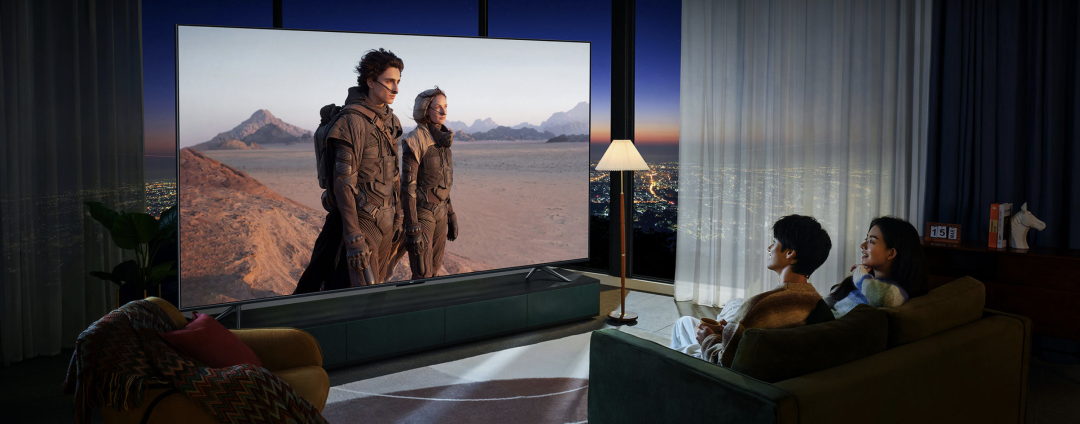
Now, consider white goods (refrigerators, washing machines). Haier, Midea, and Gree dominate the local market. Add in Casarte for high-end and Xiaomi/Viomi for budget options—Korean brands can't even get a foothold.
What's even more daunting? The speed of Chinese brands' innovation. A Chinese company can go from concept to product launch in just six months. Samsung? With global R&D and planning, the process takes twice as long.
By the time Samsung's new products hit the shelves, Chinese manufacturers are already selling second or third-generation models. That's what we call a "dimensional reduction strike."

Losses in Home Appliances? Semiconductors Make It Back in a Day
At this point, you might feel sorry for Samsung. Don't. On the same day it announced the home appliance sales halt, Samsung released its Q1 2026 financials: Revenue hit 133.9 trillion won, with operating profit soaring 756% YoY to 57.2 trillion won.
Yes, 756%. Of that, semiconductors contributed 53.7 trillion won in operating profit—over 93% of the total. What does that mean? While Samsung's home appliances lose over 100 million yuan annually in China, its semiconductor division earns hundreds of billions each month.
Compared to semiconductors, home appliance losses are negligible. What's Samsung's real moneymaker?
- Memory chips (global No.1)
- OLED panels (global No.1)
- Chip foundry (global No.2, behind TSMC)
Simply put, Samsung is now a semiconductor giant that happens to make smartphones. Home appliances? That's just "nostalgia business." With the AI boom driving explosive demand for HBM (high-bandwidth memory), Samsung's HBM orders are booked until 2028.
Against this backdrop, Samsung's strategy is crystal clear: Allocate all talent, capital, and energy to the most profitable sectors. If consumer (C-end) businesses aren't profitable—cut them. If enterprise (B-end) businesses are lucrative—go all in. This isn't a retreat—it's strategic focus.

A Golden Opportunity for Chinese Brands?
After Samsung's exit, Hisense, TCL, and Lei Jun (Xiaomi) are likely celebrating.
Samsung was once an unavoidable rival in the high-end TV market. Now that it's gone, who will capture this annual hundred-billion-yuan market? Most likely Hisense's laser TVs and ULED X, along with TCL's Mini LED and giant screens. This presents a perfect opportunity for Chinese brands to elevate their brand image.
Consumers once believed "domestic brands are inferior to imports." With Samsung gone, Chinese brands can fill that high-end perception gap. Additionally, Samsung's monitor (display) exit creates space for Xiaomi, AOC, ASUS, and others.
For ordinary consumers, Samsung's home appliance sales halt raises two key concerns:
What if my Samsung appliance breaks? Don't worry—Samsung's announcement stated that after-sales service will continue normally under China's "three guarantees" policy. Repairs and replacements will proceed as usual.
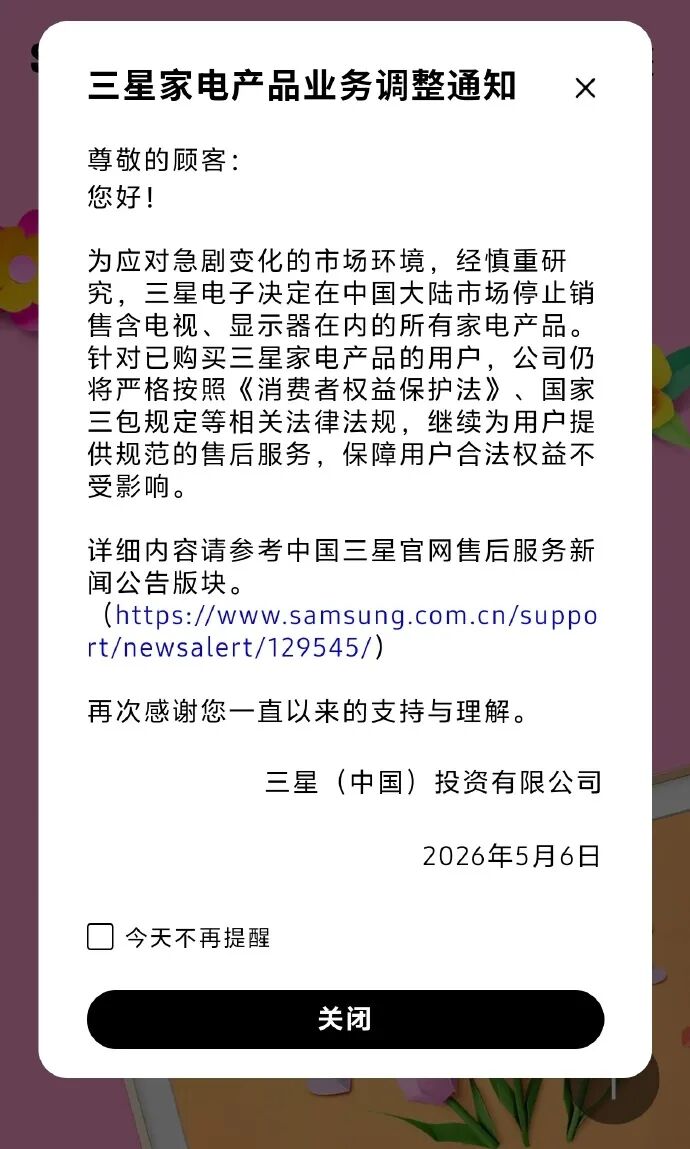
What if I want to buy Samsung home appliances later? They won't be available domestically. But honestly, today's domestic TVs, refrigerators, and washing machines already match—or even surpass—international brands in performance and price.

No Permanent King—Only the Choice of the Times
Samsung's story in China reflects an era. It witnessed China's journey from "screen and chip scarcity" to "dual dominance in screens and chips."
Thirty years ago, we looked up to Samsung as the pinnacle of technology. Thirty years later, Samsung can't sell home appliances in China—not because its products worsened, but because Chinese manufacturing caught up.
So, don't call this a "Samsung retreat." They're simply shutting down unprofitable home appliance operations to chase the fattest profits in the AI era: semiconductors.
This is the true logic of business: No permanent king—only the choice of the times. And witnessing this era's transition firsthand is quite an honor.
-
![]()
The Living Room Can't Contain Our Ambitions! In 2026, Projector Giants Transform into AI Glasses Players
-
![]()
Apple: Can It Remain 'Steadily Happy' Despite AI Absence and Rising Storage Costs?
-
![]()
Anthropic Comes to the Rescue: Is It Amazon's Turn to Shine Among the MAG7?
-
![]()
Qualcomm: Can This 'AI Shot in the Arm' Offset the Smartphone 'Achilles' Heel'?
-
![]()
The Mass Adoption of Large Models in Vehicles Sparks the Intelligent Vehicle War
-
![]()
From Now On, We Should Study Kimi with the Same Dedication as DeepSeek
-
![]()
Samsung Quietly 'Exiting' China? Don't Be Fooled—It's Making a Fortune Behind Closed Doors
-
![]()
From 1% to 60%—China’s NEV Penetration Rate Hits 10-Year Milestone: What Does Plug-in Hybrid Surpassing Pure Electric Signify?