Who is Most Panicked by Doubao's Charging Model?
 05/09 2026
 674
674

Over the past two years, China's AI industry has operated on an unspoken consensus: offer free services to scale user bases first, then pursue commercialization.
This approach is hardly surprising. China's internet success story over the past two decades has followed this exact formula: acquire traffic for free, then monetize through advertising, e-commerce, or value-added services. From search engines and short videos to mobile payments, this model has proven universally effective.
However, in early May, Doubao updated its paid subscription terms on the Apple App Store page, planning to introduce three tiers: Standard Edition at 68 RMB/month (688 RMB/year), Enhanced Edition at 200 RMB/month (2,048 RMB/year), and Professional Edition at 500 RMB/month (5,088 RMB/year), while retaining a free basic version.
Doubao, with 345 million monthly active users (MAUs)—the largest AI application in China—has started charging.
Behind this move lies mounting cost pressures. Doubao's daily token consumption has surpassed 120 trillion, a 1,000-fold increase in two years. ByteDance's annual capital expenditures now exceed 100 billion RMB, with a growing portion allocated to AI computing power.
Larger user bases enhance model capabilities but also drive costs higher. The traditional internet logic of "more users, more profits" has flipped in the AI era to "more users, more losses."
I. A 1,000-Fold Cost Explosion with No One to Foot the Bill
To understand why Doubao is charging, consider the data: In March 2026, Doubao's large model processed over 120 trillion tokens daily—a 1,000-fold surge in under two years. Just three months prior, this figure was half.
Tokens are the fuel for AI operations.
Every user message, image, or video generated requires server clusters to operate at full capacity, consuming electricity and degrading hardware. A 1,000-fold usage increase implies non-linear cost growth for ByteDance.
Rumors circulated earlier that ByteDance's 2025 capital expenditures exceeded 150 billion RMB, with 90 billion allocated to AI computing power. In 2026, it planned to invest another 160 billion RMB, including 85 billion for AI chips. Reports indicated net profit fell over 70% year-on-year during the same period.
Although Douyin Group Vice President Li Liang clarified on Weibo that the profit decline, calculated under international accounting standards, included changes in preferred stock and option costs, and that actual operating profit margins only "slightly declined," he acknowledged that "slowed growth in Douyin e-commerce and increased investments in emerging businesses" had pressured second-half operating margins.
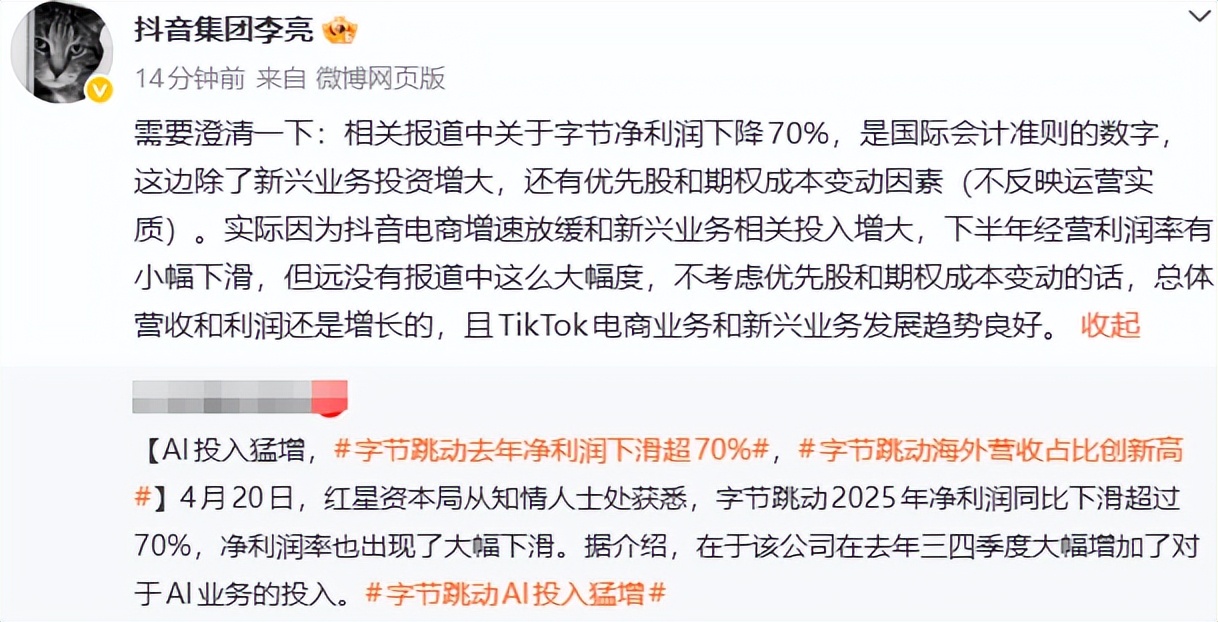
ByteDance is pouring more money into AI, but the tricky ( tricky : tough) problem is that AI costs do not decrease with scale—they escalate.
Traditional internet monetization relies on a clear division of labor: platforms provide products, users contribute attention, and advertisers pay. Every second of screen time can be segmented, priced, and sold. This structure sustained nearly all large internet platforms for two decades.
AI disrupts this relationship. Users no longer browse—they assign tasks, such as generating reports, analyzing data, or organizing materials. Tasks involve complete processing chains with no gaps for attention-based advertising.
This renders the internet's most successful 20-year monetization formula obsolete in the AI era.
Moreover, every new user utilizing complex features incurs independent computing costs. Better products attract more users, triggering higher-frequency high-computing scenarios, and driving total costs upward.
Video generation, one of the most computing-intensive AI applications, operates on a different magnitude than text-based interactions. As such features expand to more users, computing demand will grow exponentially with no short-term ceiling.
Three hundred million MAUs are assets under traffic logic but liabilities under computing logic.
However, viewing Doubao's charging model solely as a cost-survival tactic underestimates its strategic intent.
Doubao has long struggled with market perception: it is seen as a ByteDance-backed entertainment tool for casual chats, not a serious productivity platform. This impression stems directly from its user acquisition strategy.
As discussed in our earlier article *Why Doubao: Late Start, Minimal Spending, Yet Dominates AI*, while Tencent and Alibaba invested heavily in paid user acquisition, Doubao relied on "organic traffic" from Douyin influencers. Many users discovered Doubao through Douyin recommendations, treating it as free entertainment rather than a productivity tool from day one.
The 68 RMB monthly fee serves as a mandatory perception reset. After all, users willing to pay 68 RMB monthly are unlikely seeking casual conversation. However, this rebranding only succeeds if users accept the value proposition.
II. How Many Will Convert?
Doubao's 345 million MAUs are frequently cited as the strongest rationale for optimism about its charging model. The logic seems straightforward: even a 1% conversion rate would yield 3.45 million paying users, generating over 2 billion RMB annually at 68 RMB/month.
Morgan Stanley estimates that with a paid conversion rate of 0.3%–3.0% and MAUs ranging from 345 million to 525 million, Doubao's annual revenue from subscriptions could reach 101 million to 1.5 billion USD, assuming an average revenue per paying user (ARPPU) of 98 USD.
This calculation is mathematically sound but overlooks a critical question: Who are these 345 million users?
Doubao's user acquisition strategy differs fundamentally from other domestic AI products.
Kimi, for example, acquired early users through aggressive commercial advertising—splash screens, information feeds, and Zhihu recommendations. Every Kimi ad implicitly educated users about its value: this tool is useful and potentially worth paying for. While this did not immediately drive payments, it established baseline expectations.
Doubao's users did not undergo this process. Its growth stemmed from organic Douyin traffic, pre-installed partnerships with smartphone manufacturers, and word-of-mouth referrals. Users' first interaction with Doubao was never "How much is this tool worth?" but "It's free—let's try it."
These two acquisition models represent entirely different starting points for Paid mindset ( Paid mindset : willingness to pay).
Moreover, low paid conversion rates are not unique to Doubao—they plague the entire AI industry.
OpenAI currently leads in consumer AI monetization. Even so, as of early 2026, it had approximately 50 million paying users out of over 900 million weekly active users—a paid penetration rate below 10%.
What does this imply? Even the world's most renowned, capable, and early-to-monetize AI application sees over 90% of its active users refuse to pay.
Another inescapable factor is Chinese consumers' historical reluctance to pay for digital content.
Few domestic digital products have achieved genuine paid adoption, and even fewer have sustained it. Video streaming platforms took nearly a decade to scale membership subscriptions, yet many users still seek shared accounts or wait for free content.
Music streaming offers another example. Before stricter copyright enforcement, Chinese users largely expected music to be free. Platforms eventually drove conversions not by enhancing content value but by restricting free access and creating inconvenience.
These precedents convey a consistent message: transitioning from free to paid in China requires more than a superior product—it demands time, habit reshaping, and, to some extent, designing pressure by making free options inadequate.
Doubao's current approach retains a free version while offering enhanced capabilities in paid tiers—a gentle strategy that does not force payments. However, this gentleness also limits conversion incentives: if the free version suffices, the paid version appears unnecessary.
III. Who Suffers Most After Doubao Charges?
With Doubao, the largest AI player by user base, implementing charges, how should other domestic AI competitors respond?
Kimi's situation is most representative. As the independent product furthest along in consumer AI monetization, it has spent nearly two years building a paid user base—its most critical asset.
The competitive conditions are vastly unequal. Kimi, a pure AI company, must cover every computing expense through subscription revenue. Doubao, backed by ByteDance, can subsidize computing costs for free users through advertising and e-commerce while targeting high-value users with subscriptions.
This is not a fair fight: Kimi must rely on subscriptions to survive, while Doubao can fall back on advertising and e-commerce.
Yuanbao faces a different but equally passive predicament.
With 57.35 million MAUs—less than one-third of Doubao's scale—Yuanbao invested heavily in AI red envelope campaigns during the 2026 Spring Festival, with Tencent allocating 1 billion RMB. At Tencent's annual meeting, Pony Ma expressed direct caution about Doubao's mobile assistant.
Yet Yuanbao's current challenge is that it competes head-on with Doubao in the consumer AI space but lacks Doubao's massive MAU base to support a tiered paid strategy. Charging too early could stifle scale growth. However, Tencent's advertising and gaming cash flows allow it to delay monetization.
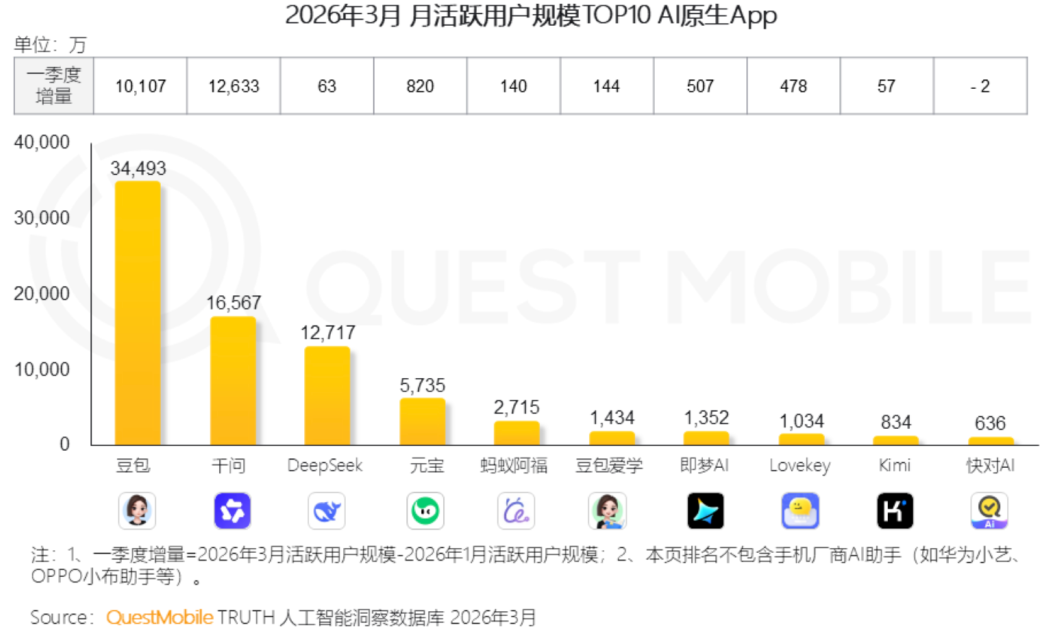
Qianwen most closely resembles Doubao, trailing with 166 million MAUs—nearly half of Doubao's as of Q1 2026, per QuestMobile data. Qianwen remains in user expansion mode, lagging Doubao by nearly double in scale. Charging prematurely at this stage would voluntarily slow its pursuit.
Then there's DeepSeek.
As an open-source model, DeepSeek avoids consumer subscriptions and direct competition in the paid market. On the surface, Doubao's charging model seems irrelevant to it. However, this very fact makes DeepSeek the greatest potential threat to the entire Payment logic ( Payment logic : paid logic).
Open-source models fundamentally question a premise: Why should users pay for AI? If open-source alternatives continuously approach the capabilities of closed-source products, developers can build applications with nearly identical experiences, and users can opt for free alternatives, what justifies the subscription fees of Doubao, Kimi, or ERNIE Bot?
Doubao's charging model truly signals a broader industry shift.
Over the past two years, all AI products competed on who could offer more for free and grow faster. Henceforth, the competition will center on who can better manage costs and establish sustainable commercial loops. Kimi, Yuanbao, and Qianwen each face pressures, while DeepSeek's open-source path continues to compress pricing space across the industry.
As "good enough" AI becomes increasingly free, the true scarcity may no longer be model capabilities but the cash flow, ecosystems, and commercial systems needed to sustain them long-term.
-
![]()
Tesla Restructures Its Balance Sheet
-
![]()
Accelerating the High-Speed Interconnection Upgrade of AI Computing Clusters! JONHON Releases ELSFP External Light Source Optical Connectors
-
![]()
Breaking the overseas blockade of volumetric holographic materials, this optical enterprise secures nearly 100 million yuan in financing!
-
![]()
Why Does Jensen Huang So Openly Praise China’s AI?
-
![]()
"Wudang" Unveiled: Arm China's Next-Gen AI VPU Redefines Video Encoding
-
![]()
From Energy Conservation and Carbon Reduction to AI Decision-Making: GECON East Intelligence and Chery Group Explore a New Green and Smart Paradigm for Automobile Manufacturing
-
![]()
WAIC 2026 Observation | AI Accelerates Towards the Core of Industries, Industrial AI Enters a Critical Phase
-
![]()
Volkswagen China Fires the First Shot in Foreign-Funded 'White Box Delivery'!