Is Kuaishou Reliant on Kling to Sustain Its Growth?
 05/12 2026
 571
571
Who Anticipates Kling's 'Graduation' from Support?
Kuaishou's 'Star Performer' Kling: Domestic Favorite, Undervalued Abroad.
Following the May Day holiday, Kling has emerged as a focal point in the capital market. According to Sina Technology, Kuaishou Technology is planning to spin off its AI video business, Kling, aiming for an IPO next year. Industry insiders estimate the valuation of this round to be at $20 billion (approximately RMB 130 billion).
Market rumors also suggest that Kling's Annual Recurring Revenue (ARR) has reached $500 million. However, as of now, neither Kuaishou nor Kling's official channels have confirmed these claims.
What does $500 million in ARR signify? Less than four months ago, Kuaishou CEO Cheng Yixiao mentioned a figure of 'over $300 million' during an earnings call. The jump from $300 million to $500 million falls within the ambiguous range between 'plausible' and 'speculative'.
On one hand, there are high-profile market rumors; on the other, a reserved official stance. What path will Kling's spin-off take?
Has Kuaishou truly reached a juncture where it relies on Kling for growth? Or is the capital market imposing its narrative, orchestrating a 'forced independence' for Kling from its parent company?
01
Kling's Aspirations, Kuaishou's Risk
Rewinding two years, few could have foreseen that Kuaishou, a short-video platform known for its 'bro' culture (laotian, meaning 'close friends') and livestreaming, would ascend to the global forefront in AI video generation.
Since its official launch in June 2024, Kling has enjoyed top-tier resource allocation within Kuaishou's ecosystem.
In April 2025, Kuaishou elevated Kling AI from an internal technical unit to an independent first-tier business division, placing it alongside core departments such as the main platform, e-commerce, commercialization, and internationalization. Senior Vice President Gai Kun was appointed to lead the division, reporting directly to CEO Cheng Yixiao. In August of the same year, Gai Kun also took charge of Kling AI's technical department, consolidating oversight from business to technology.
This resource allocation has yielded impressive results.
In terms of revenue, Kling AI's quarterly income in 2025 reached RMB 150 million, RMB 250 million, RMB 300 million, and RMB 340 million, respectively, totaling over RMB 1 billion—far exceeding the initial annual target of $60 million. In December alone, monthly revenue surpassed $20 million, equating to an ARR of $240 million; by January 2026, this figure had risen above $300 million.
In terms of user base, Kling's global user count exceeded 60 million by the end of 2025, generating over 600 million videos and serving more than 30,000 enterprise clients and developers. By January 2026, monthly active users surpassed 12 million, with App-end paying users growing by 350% month-over-month.
Moreover, Kling's revenue structure is highly valuable. Unlike some AI products that heavily rely on C-end membership subscriptions, nearly 70% of Kling's revenue comes from P-end (professional creators) and B-end clients, indicating higher user loyalty and willingness to pay. Overseas, Kling topped iOS drawing and design app charts in nearly 40 countries and regions with its 'motion control' feature.
Cheng Yixiao mentioned during the March 2026 earnings call that Kling's ARR had exceeded $300 million in January, expressing 'strong confidence in achieving over 100% year-over-year revenue growth for Kling this year'.
However, during the same earnings call, Kuaishou announced that its group-wide capital expenditure (Capex) for 2026 would reach approximately RMB 26 billion, an increase of about RMB 11 billion from 2025, with a significant portion allocated to Kling's computing infrastructure.
On one hand, there is the prospect of doubling revenue growth; on the other, doubling investment. Kling's ambitions are soaring on Kuaishou's substantial financial commitments.
Yet, the 'leap' from $300 million to $500 million in ARR lacks clear official confirmation in publicly disclosed data. The market's $500 million ARR figure appears more like a capital-driven 'expectation' based on Kling's growth trajectory.
02
The Village's Hopes May Also Hinder Progress
Given the 'cash-intensive' nature of AI, Kling's existence poses a valuation dilemma for Kuaishou.
In 2025, Kuaishou reported annual revenue of RMB 142.8 billion and adjusted net profit of RMB 20.6 billion, both record highs. Yet, the day after these results were announced, Kuaishou's stock price suffered its largest single-day drop in 11 months, with its total market cap briefly falling below HK$200 billion.
The capital market's lukewarm response is understandable. Kuaishou's traditional businesses face pressure from plateauing traffic and slowing growth: Daily Active Users (DAU) reached 408 million in Q4 2025, with decelerating momentum; livestreaming revenue declined 1.9% year-over-year, revealing fatigue in its traditional pillars.
What worries investors more is Kuaishou's 'spending spree' on AI.
In 2025, Kuaishou's R&D expenditure grew 18.8% from RMB 12.2 billion to RMB 14.5 billion, primarily directed toward AI. During the 2025 earnings call, CFO Jin Bing revealed that the group's total capital expenditure for 2026 was expected to increase by approximately RMB 11 billion to RMB 26 billion, covering computing investments for Kling's large models and other foundational AI models.
RMB 26 billion is equivalent to 1.26 times Kuaishou's 2025 full-year net profit. In other words, Kuaishou is betting its hard-earned profits entirely on AI.
Kling accounts for a significant portion of this investment. Some investors argue that multimodal content is a capital-intensive sector, and long-term reliance on group funding could drag down overall profits. While competitors are making AI investments in the hundreds of billions, Kuaishou's cash flow does not hold a clear advantage. Even with a focused breakthrough strategy, Kuaishou struggles more than cash-rich rivals like ByteDance and Alibaba.
Under the premise of a spin-off and listing, Haitong International estimates Kuaishou's stock price could reach HK$84. This valuation is based on two core metrics: Kuaishou's core business is valued at 8 times its expected 2026 net profit of RMB 21.9 billion, while Kling's business is valued using an expected 2027 ARR of $600 million (corresponding to 2026 ARR of $373 million) and a 25 times Price-to-ARR (P/ARR) multiple.
For reference, comparable company Runway has a P/ARR of 21 times, while Anthropic and OpenAI reach 27 times and 34 times, respectively.
Additionally, talent retention is a critical issue. In early September 2025, Zhang Di, a core technical figure at Kling AI, departed to join Bilibili as a technology leader. Data shows that since Su Hua stepped down as Kuaishou's chairman in October 2023, over 10 vice-president-level executives have left or resigned.
The more successful Kling becomes, the more Kuaishou faces a dilemma: continuing full ownership risks capital market backlash for dragging down the core business; granting independence risks sending an underprepared 'child' into the world.
03
Competition Won't Wait for Kling, Nor Will the Market Wait for Kuaishou
While Kling has achieved success, its market is rapidly becoming crowded and challenging.
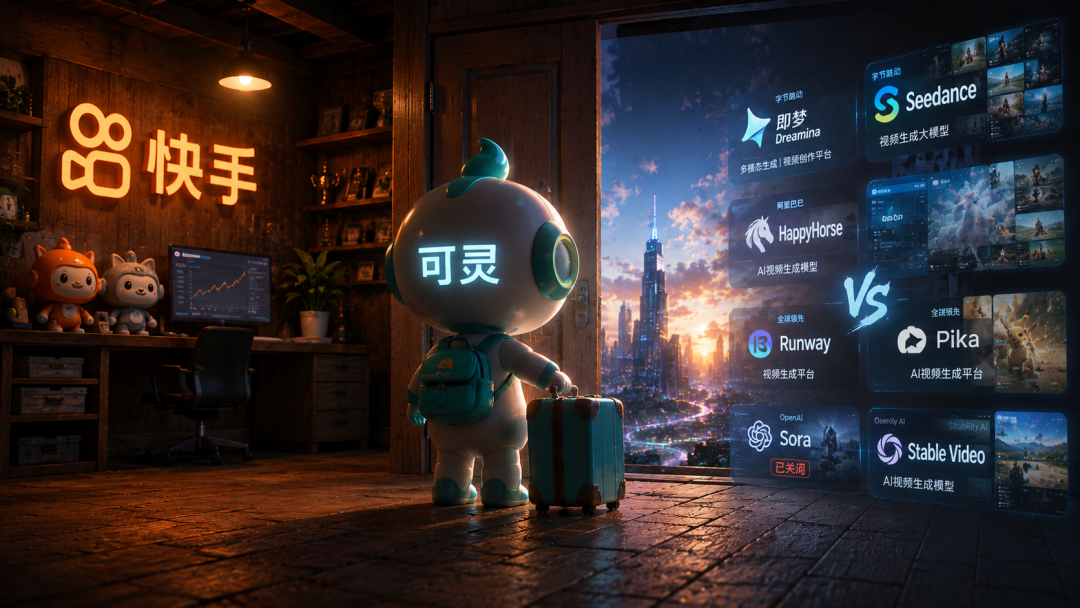
A symbolic event was Sora's 'exit.' In March 2026, OpenAI officially shut down Sora's standalone app and API, fully withdrawing from the consumer-grade AI video market. The 'AI video iPhone moment' that captivated global imagination two years ago ultimately stumbled at the commercialization threshold.
Sora's experience serves as a mirror: technical brilliance does not equate to commercial viability.
Compared to North America, China's market battle is just entering its fiercest phase. The industry now features a 'Big Three' rivalry among ByteDance's Jimeng Seedance, Kuaishou's Kling, and Alibaba's HappyHorse.
After ByteDance's Seedance 2.0 launched, it quickly went viral, supporting full-modality inputs (text, images, videos, audio) and excelling in multi-reference object and physical simulation capabilities, firmly binding itself to the film and television production ecosystem.
Alibaba entered the fray in April 2026 with HappyHorse 1.0, dominating Artificial Analysis's evaluation rankings with a low-price strategy and Alibaba's ecosystem resources, making its entry impossible to ignore.
More notably, ByteDance has formed a complete product matrix in video generation, ranging from Jimeng to Xiaoyunque short-drama agents, creating a cohesive 'ecosystem' of video generation product lines. Facing such a systematic offensive, Kling, trapped within Kuaishou's valuation framework and relying solely on Kuaishou's resources to compete against ByteDance's entire ecosystem, faces dim prospects.
From this perspective, spin-off independence may not be a 'yes or no' choice but a 'when' timing question. An independently operated Kling can secure financing more flexibly, compete more focusedly, and directly tap into the capital market's enthusiasm for AI.
iResearch estimates that China's AI video generation market size could exceed RMB 20 billion in 2026. CITIC Construction Investment offers an even more optimistic projection, with a mid-sized market space of RMB 76.3 billion and long-term potential reaching RMB 155.4 billion.
However, behind this vast market lies equally enormous competitive costs and computing power consumption. According to SemiAnalysis, Sora's daily inference costs alone reached $14 million. The domestic situation is equally tense, with ByteDance's Jimeng routinely seeing hours-long user queues post-launch.
In this 'computing power arms race,' the ability to secure funding faster and spend it more efficiently determines who gains the upper hand. An independently spun-off Kling, with broader financing channels and clearer valuation logic, inherently possesses a competitive edge.
In summary, the rumors of Kling's spin-off reflect a natural progression driven by internal and external pressures rather than a proactive choice. The capital market demands clearer valuation narratives, Kuaishou seeks a lighter AI burden, and the Kling team craves independent development space and incentives. All three parties' demands coincidentally align at this juncture.
The question remains: Is $500 million in ARR within reach? Is Kling truly prepared to stand alone financially?
These answers will likely only emerge once Kling officially opens its financing window. Until then, the market can only continue speculating.
- END -
-
![]()
Tesla Restructures Its Balance Sheet
-
![]()
Accelerating the High-Speed Interconnection Upgrade of AI Computing Clusters! JONHON Releases ELSFP External Light Source Optical Connectors
-
![]()
Breaking the overseas blockade of volumetric holographic materials, this optical enterprise secures nearly 100 million yuan in financing!
-
![]()
Why Does Jensen Huang So Openly Praise China’s AI?
-
![]()
"Wudang" Unveiled: Arm China's Next-Gen AI VPU Redefines Video Encoding
-
![]()
From Energy Conservation and Carbon Reduction to AI Decision-Making: GECON East Intelligence and Chery Group Explore a New Green and Smart Paradigm for Automobile Manufacturing
-
![]()
WAIC 2026 Observation | AI Accelerates Towards the Core of Industries, Industrial AI Enters a Critical Phase
-
![]()
Volkswagen China Fires the First Shot in Foreign-Funded 'White Box Delivery'!