While the Entire Industry Fixates on Tokens, Baidu Advocates for a New Standard
 05/14 2026
 656
656
Produced by | Bullet Finance
Art Editor | Qianqian
Reviewed by | Songwen
"For the first time, AI's focus has shifted from models to applications."
"General-purpose intelligent agents represent the 'next-generation gateway' in AI."
"Numbers signify the 'tangible' intelligent agents of the AI age."
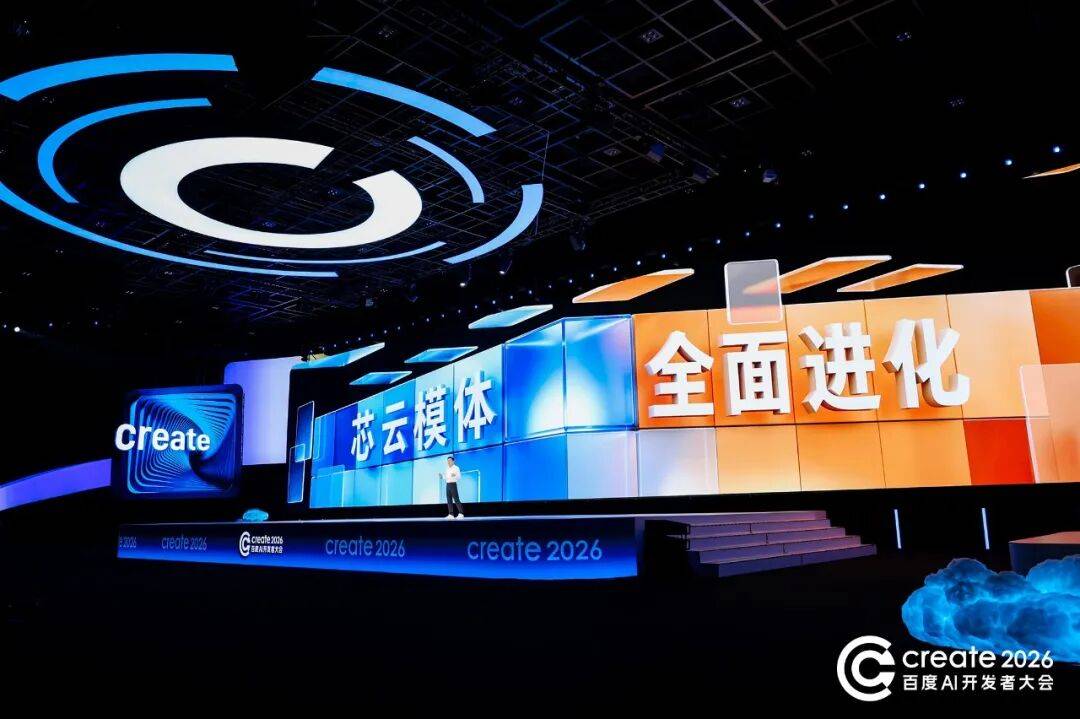
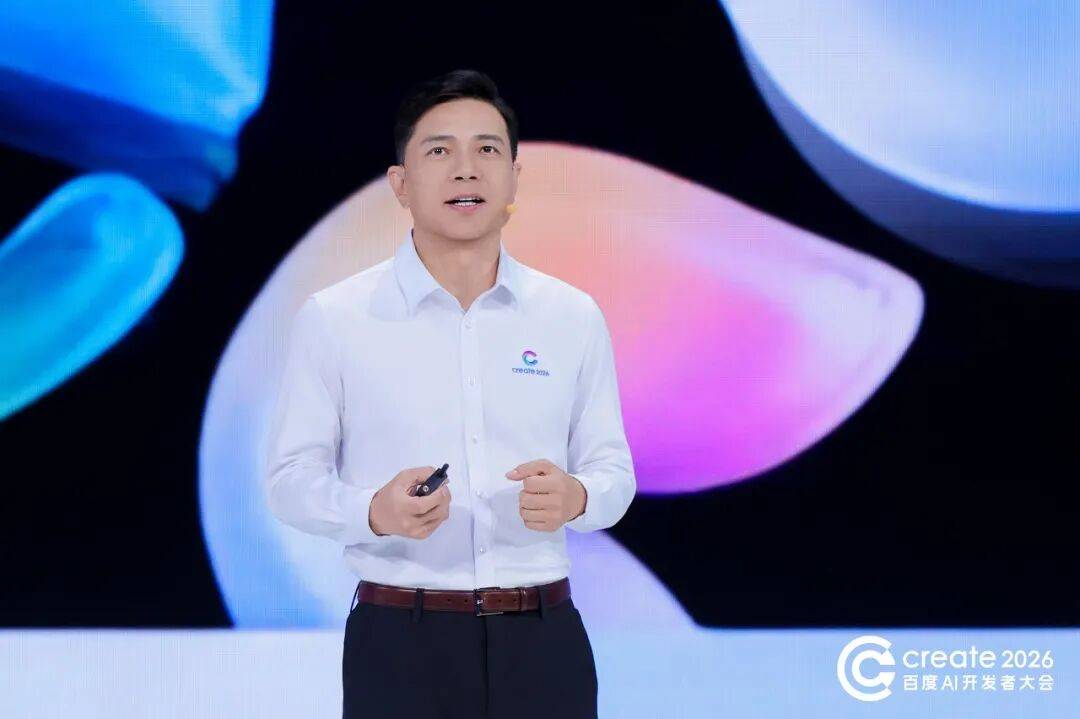
At the Create 2026 Baidu AI Developer Conference held in Beijing today, Li Yanhong took the stage to address thousands of developers and AI practitioners, discussing the dawn of the intelligent agent era.
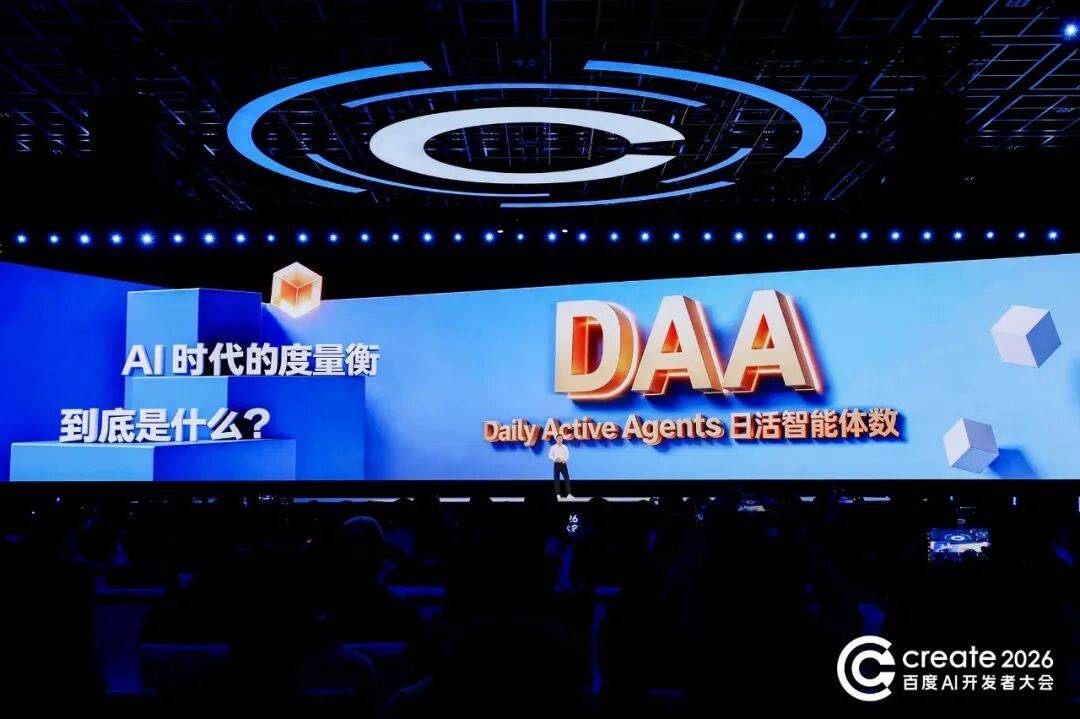
With intelligent agents becoming ubiquitous, how do we assess AI's value? Li Yanhong proposed, "I'm introducing a non-mainstream perspective—I believe the metric should be Daily Active Agents, or 'DAA' for short."
This isn't Li Yanhong's first "non-mainstream" idea. Over the past three years, he has championed concepts like "prioritizing applications over models," "developing millions of highly useful applications instead of a single super app," and "empowering everyone to be a developer."
In just three years, these non-mainstream ideas have gained traction and become the new industry norm. So, can Li Yanhong's DAA concept similarly evolve from non-mainstream to mainstream?
1. The AI Era's 'Metric System'—DAA
At the conference's outset, Li Yanhong shared his insights on the popular OpenClaw. He remarked, "This marks the first time in history that an intelligent agent has surpassed a model in popularity! For the first time, AI's protagonist is not the model but the application!"
With the surge in intelligent agent applications, Li Yanhong introduced the DAA concept. Just as DAU (Daily Active Users) is a standard metric for mobile apps in the mobile internet era, DAA serves as the standard for the AI era. "To gauge a platform and ecosystem's prosperity, we should focus more on the DAA metric, observing how many Agents are actively working for humans and delivering results."
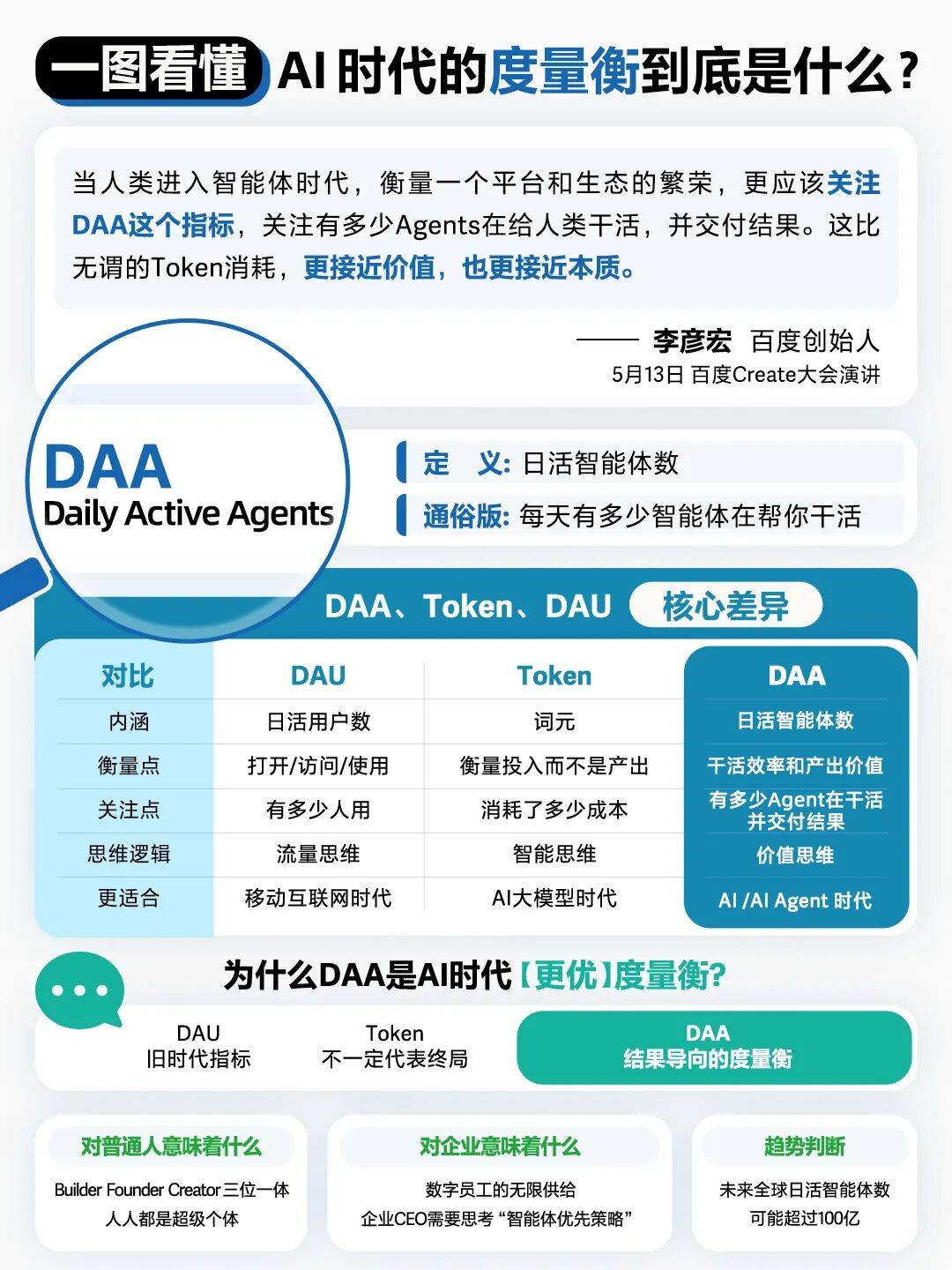
Currently, the AI industry's primary focus remains on Tokens, which is why Li Yanhong refers to DAA as a non-mainstream viewpoint.
This situation echoes the 2024 World Artificial Intelligence Conference, where Li Yanhong also presented a similar "non-mainstream" perspective.
At that time, the AI industry and society at large were engrossed in the "parameter race," competing based on large model parameters and benchmark scores. The industry's core debate centered on whether "large models are practical," with the common goal of finding a "Killer app."
Amidst this atmosphere, Li Yanhong proposed a different stance. He believed in "prioritizing applications over models," contradicting the industry's focus on large model competitions. While others bet on ChatGPT-style killer apps, he turned his attention to intelligent agents, stating, "In the future, millions of intelligent agents will form a vast ecosystem." When the industry aimed to build super apps, he declared, "In the AI era, the goal is not to launch a single 'super app' but to create millions of 'highly useful' applications."
At that time, intelligent agents were a niche technical concept, unknown to ordinary users. However, this year, Li Yanhong's aforementioned non-mainstream views have become the industry's standard. Notably, the popularity of this year's "Lobster" has demonstrated that intelligent agents, as AI's core application, have become the industry's universal choice.
Returning to DAA, it indeed differs from the Tokens that currently dominate industry attention. But as Li Yanhong said, "Compared to meaningless Token consumption, DAA is closer to value and essence."
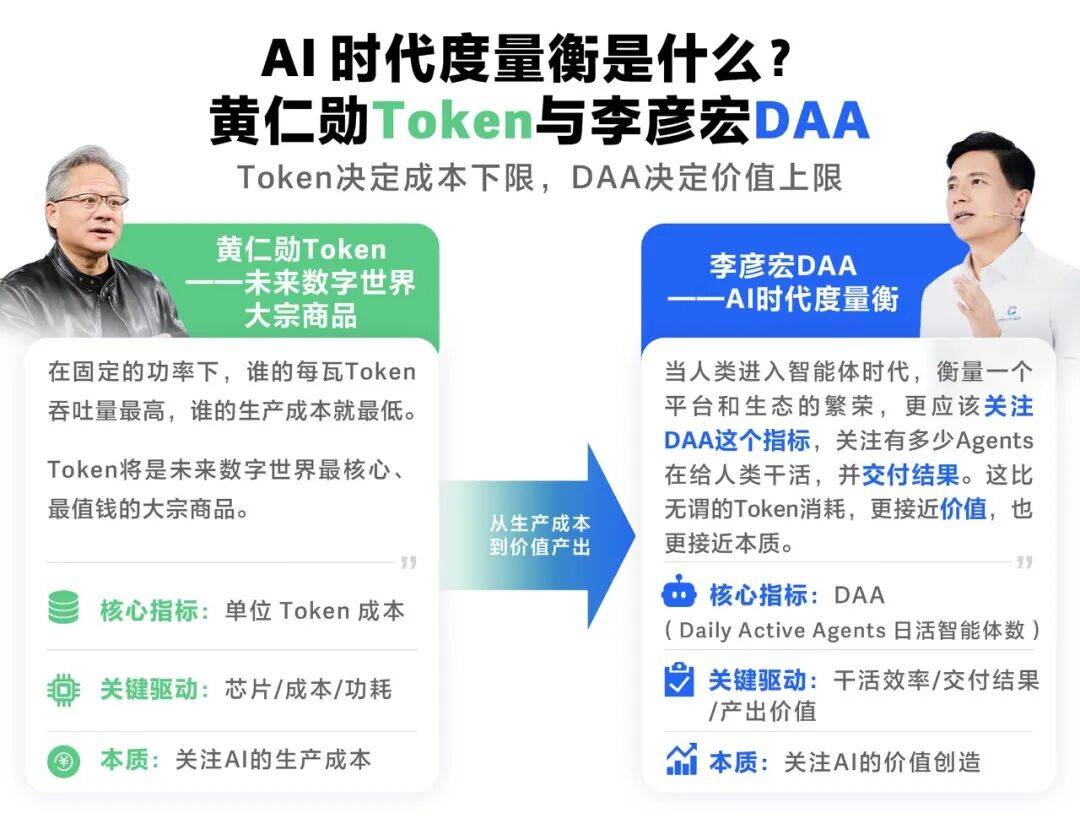
"Robin's insights always cut through the noise and grasp the essence," remarked a conference practitioner during a conversation with Bullet Finance. "A few years ago, the industry was almost solely focused on models, but Baidu had already quietly laid the groundwork for intelligent agents and full-stack technology. The DAA concept introduced today also captures the essence of AI value and should quickly gain popularity."
In Li Yanhong's view, AI's transition from large models to the intelligent agent era is not only a result of its evolution but will also have a similar impact on human-machine relationships and organizational forms.
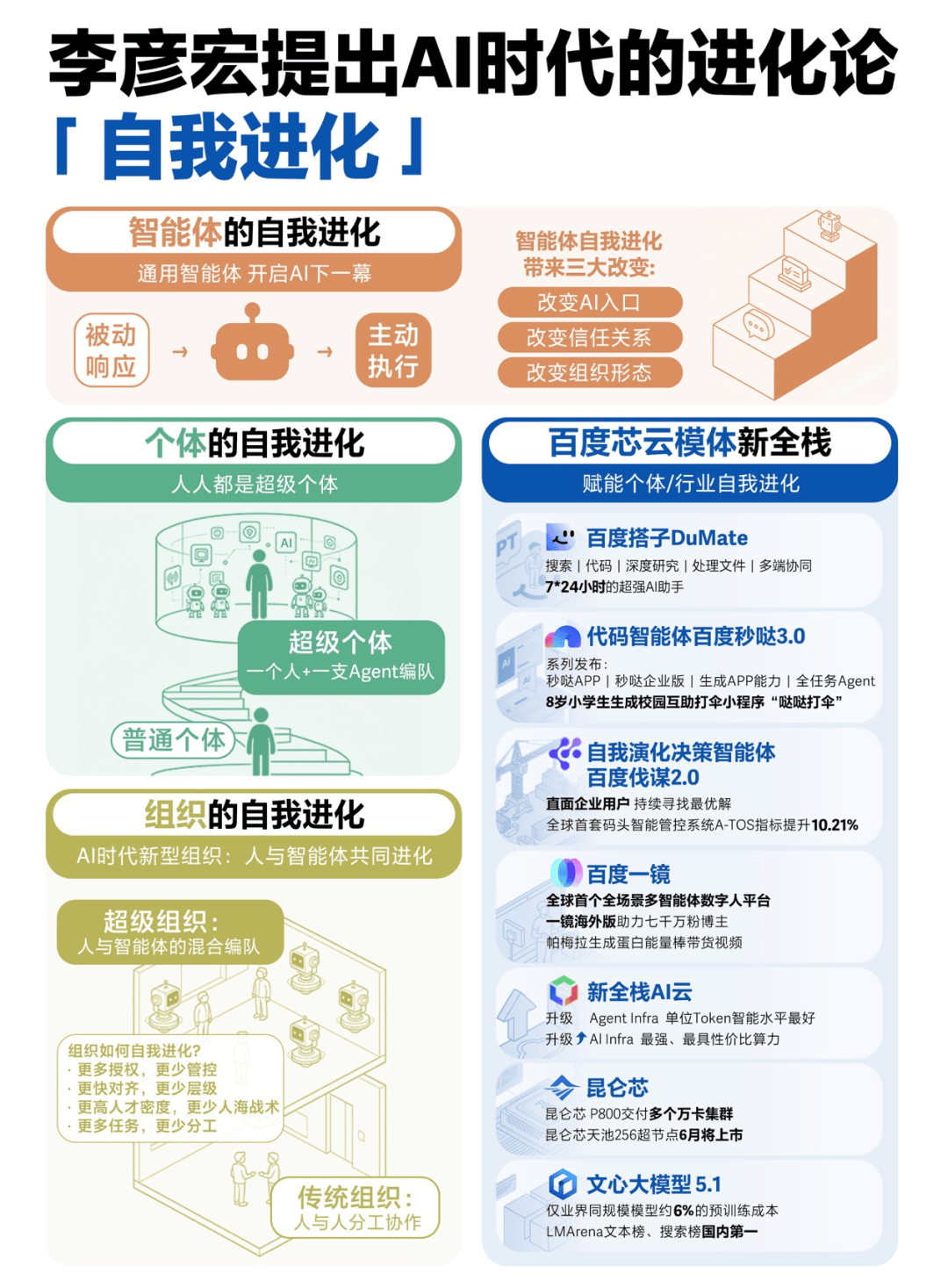
In 2024, Li Yanhong explicitly proposed that everyone can be a developer, using AI to program in natural language and achieve various functions—this is the direction of AI empowerment for individuals. Today, he further emphasizes the concept of "super individuals," stating that with AI, individuals can not only become developers but also entrepreneurs and creators, making the popularity of "one-person companies" feasible.
From a broader perspective, Li Yanhong believes this is the "evolutionary revolution" brought by AI. As intelligent agents, they possess the ability to learn and evolve autonomously; as individuals, people can also self-evolve with the help of AI to become super individuals; as organizations, companies will also self-evolve into a new form that combines humans and intelligent agents.
Examining Li Yanhong's statements over the past three years, it's clear he has accurately predicted AI's evolutionary direction. Although his concepts were novel at the time and not yet industry consensus, after three years of development, they have become the standard.
Why does Li Yanhong have such a high accuracy rate?
From a personal standpoint, Li Yanhong adheres to first principles and self-evolution. First principles enable him to see through complex appearances and focus solely on AI's value and origins to understand its evolutionary path. While others were caught up in the large model parameter race, he had already shifted his attention to intelligent agents.
Adhering to first principles allows him to be a "minority" and dare to express views that differ from industry trends. In an AI industry prone to blind following and intense internal competition, this determination is precisely the prerequisite for his accurate predictions.
As a leading global AI company, Baidu's practices align with Li Yanhong's judgments, enabling his cognition to continuously evolve. Among them, Baidu's new full-stack layout of "chip-cloud-model-agent" is both a product of his first principles and a reinforcement of his commitment to them.
Additionally, continuous self-evolution is also a key factor in his "accurate predictions." Based on the value metric of the intelligent agent era and DAA, Li Yanhong stated that Baidu, as a platform company, has built up "chip-cloud-model-agent" full-stack capabilities to support the explosion of intelligent agent applications.
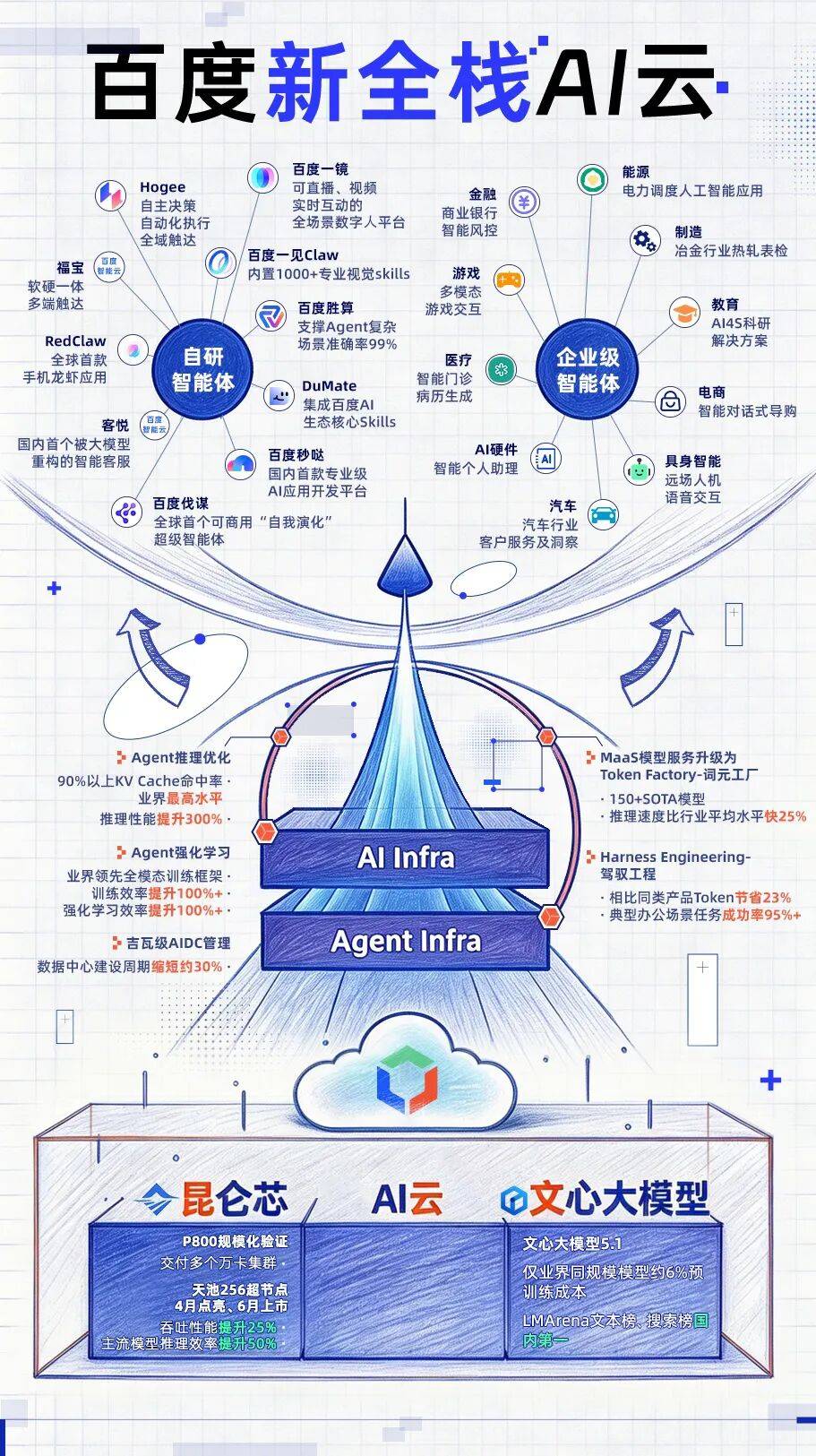
However, rebuilding the entire underlying infrastructure is essential for this new entity—intelligent agents—to facilitate their invocation. "To better serve our customers, users, developers, and partners, we will continue to invest in strengthening our full-stack capabilities, building intelligent agent-native infrastructure, and achieving comprehensive evolution of chip-cloud-model-agent!"
This also echoes the core demand of the DAA metric for "agent activity and value delivery." It can be said that Li Yanhong's "self-evolution" thesis has given rise to the DAA metric and directly driven Baidu's iteration from the "old full-stack" to the "new full-stack."
Specifically, this new full-stack layout forms a perfect closed loop: The Kunlun Core P800 has completed large-scale validation, with multiple 10,000-card clusters delivered since 2025. On Kunlun Core's fully domestic clusters, the training of Wenxin 5.1's important version has been successfully completed.
In addition, the Tianchi 256-card super node based on Kunlun Core was activated last month and will officially launch in June, with throughput performance improved by 25% compared to the previous generation; Baidu Intelligent Cloud has built dual foundations of AI Infra + Agent Infra to support the development, deployment, and scheduling of intelligent agents. In 2025, AI cloud revenue increased by 34% year-on-year, securing "double firsts" in domestic large model-related bid wins; Wenxin Large Model 5.1 ranked first in China on both the LMArena text and search lists; while Baidu's intelligent agent products such as DuMate and Famous 2.0 have achieved a closed loop of value from technology to scenarios.
3. Seeing It Is One Thing, Doing It Is Another: Baidu's Practices Fulfill Predictions
The AI industry is not short of "prophets" but lacks "doers." Every "non-mainstream" judgment made by Li Yanhong has ultimately been translated into tangible value through Baidu's product practices. At today's conference, Baidu collectively launched and upgraded a series of products, including the general-purpose intelligent agent DuMate, the code intelligent agent Miao Da, the digital human intelligent agent Baidu Yijing, and the self-evolving decision-making intelligent agent Famous 2.0, fulfilling all predictions made over the past three years with real-world cases.
The most eye-catching product is the general-purpose intelligent agent Baidu DuMate, launched just this March. It can "see" the screen and "operate" software, achieving full-link automation from "idea input" to "result delivery." It has already topped both the PinchBench and DeepResearch lists.
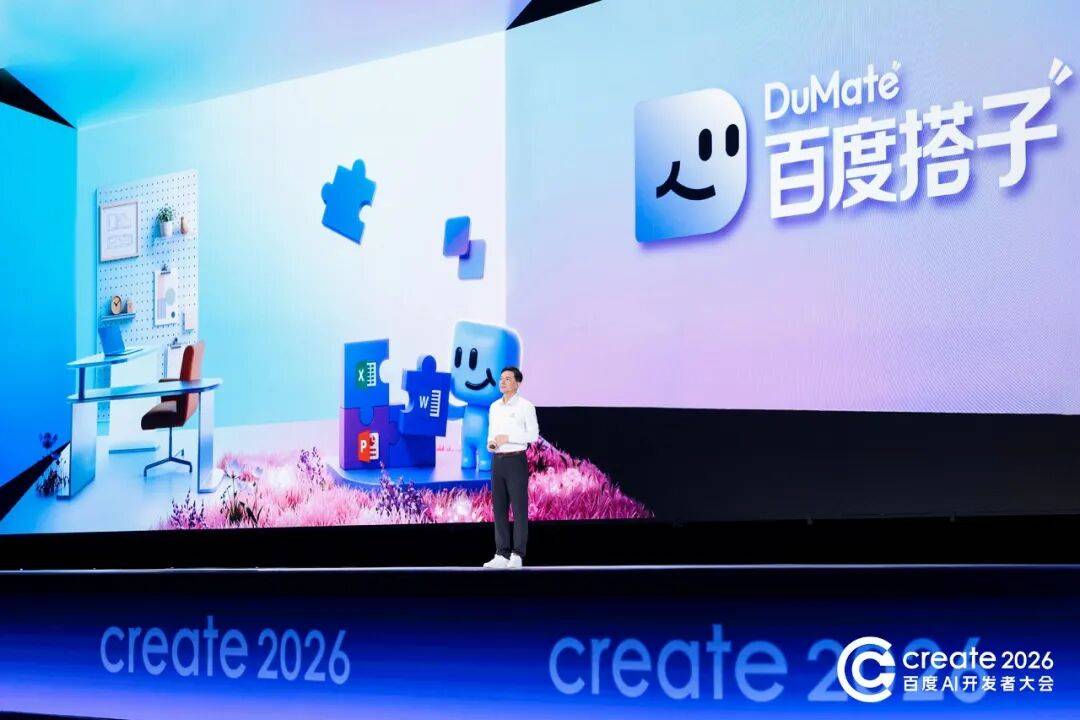
Among the cases introduced at the conference, a founder of a clothing e-commerce company used DuMate to simultaneously handle the work of three positions—customer service, operations, and marketing—processing customer emails, cleaning sales data, generating product renderings, and building flash sale pages, all without human intervention.
A founder + intelligent agent DuMate accomplished the work of an entire team, embodying Li Yanhong's statement that "driven by today's intelligent agent wave, human individuals are also self-evolving, with Builders, Founders, and Creators becoming one. Every developer is also an entrepreneur and a creator."
AI empowerment for individuals knows no age limits. An 8-year-old young developer named Puman shared his story of using Miao Da at the conference. A second-grade student, he used Miao Da to automatically generate a "Dada Umbrella" mini-program based on the classroom application "Dada Umbrella," supporting functions such as order placement, umbrella sharing, umbrella pooling, and point upgrades. When it rains, students who forget their umbrellas can "share" the umbrellas of classmates on the same route home through the mini-program, bringing AI into campus life.
The Miao Da used by Puman has now launched version 3.0 at the conference, upgrading from generating mini-programs to directly generating Apps and introducing an enterprise version to help companies evolve into a new form of coexistence between humans and AI. The core of Miao Da 3.0 is to lower development barriers, allowing ordinary people to quickly build applications using natural language, with cumulative services exceeding 10 million users.
The self-evolving decision-making intelligent agent Baidu Famous has also been upgraded to version 2.0, further directly targeting business experts and focusing on three major scenarios: production scheduling, process optimization, and logistics planning. It can convert complex business problems into mathematical models through natural language, achieving globally optimal decisions and truly becoming "smarter the more it is used" for enterprises.
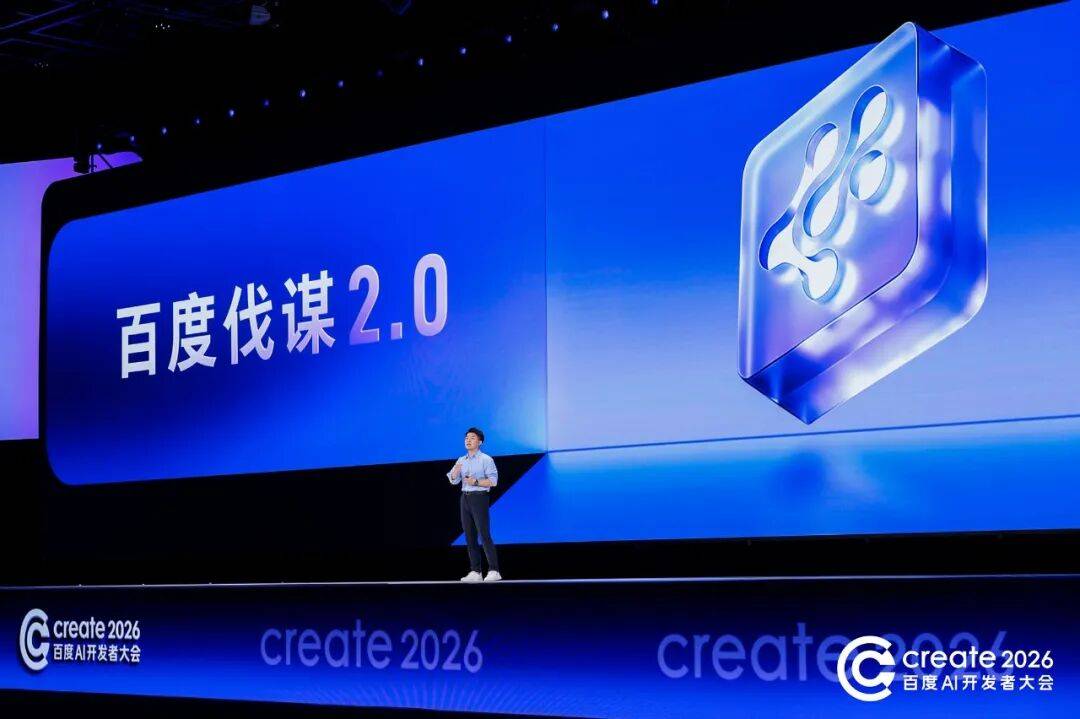
At the Qingdao Port Automated Terminal, the terminal intelligent control system A-TOS empowered by Famous 2.0 achieved a 10.21% efficiency improvement. In the automotive manufacturing sector, IAT Automobile used Famous 2.0 to compress wind resistance testing time from 10 hours to minutes, shortening the entire vehicle R&D cycle by 25%. In the scientific research field, Beijing University of Technology used Famous 2.0 to optimize the design of a space station micro-chromatograph, reducing testing errors by 8% and solving a problem that had plagued the team for over a year.
At the conference, witnessing case after case of intelligent agent empowerment gave people the feeling of verifying "prophecies" across time and space. Li Yanhong's non-mainstream views from several years ago have been validated and generated value through individual and enterprise practices.
This cannot help but evoke a sense of awe that the AI revolution is never about "who runs faster" but about "who sees farther and does more solidly." Li Yanhong's three-year history of fulfilled predictions offers the industry an insight: True leaders are never followers of consensus but proposers and practitioners of non-mainstream ideas; the core competitiveness in the AI era is never the speed of blind imitation but the determination to see through appearances and adhere to essence.
Baidu's ability to ride the AI wave and become an industry benchmark is precisely because it has leaders like Li Yanhong who "see farther" and the product strength supported by the new full-stack layout to "do more solidly." Adhering to value original intention amid non-mainstream ideas and reinforcing the technological foundation through self-evolution—this is perhaps the confidence behind Baidu AI.
-
![]()
Why Does Jensen Huang So Openly Praise China’s AI?
-
![]()
"Wudang" Unveiled: Arm China's Next-Gen AI VPU Redefines Video Encoding
-
![]()
From Energy Conservation and Carbon Reduction to AI Decision-Making: GECON East Intelligence and Chery Group Explore a New Green and Smart Paradigm for Automobile Manufacturing
-
![]()
WAIC 2026 Observation | AI Accelerates Towards the Core of Industries, Industrial AI Enters a Critical Phase
-
![]()
Volkswagen China Fires the First Shot in Foreign-Funded 'White Box Delivery'!
-
![]()
AI Agent Smartphones: The Next Competitive Edge Transcends Large Models
-
![]()
Over 880 Million Yuan Worth of Orders Unveiled, Bidding Launched for Shenzhen Eastern Public Transport
-
![]()
Tesla's Robotaxi Hits the Road: A Monumental Gamble with an Uncertain Future