From 'Non-Consensus' to 'Consensus': How to Interpret Li Yanhong's Key Judgments?
 05/15 2026
 532
532
Introduction: For those interested in the cutting-edge trends in artificial intelligence, Li Yanhong's perspectives are definitely worth listening to.
Lu Yan/Author Lishi Business Review/Publisher
1
Why Li Yanhong's Judgments Are Noteworthy
If you want to conduct in-depth research on a particular industry, an efficient approach is to first understand what some of the most insightful individuals in that industry are focusing on and contemplating. This helps us more accurately grasp the most valuable information in that industry.
In the field of artificial intelligence, if you want to understand the most cutting-edge information in today's AI industry, you must pay attention to two entrepreneurs. One is Jensen Huang, founder of NVIDIA, and the other is Li Yanhong, founder of Baidu.
Li Yanhong was one of the earliest entrepreneurs in China to advocate for the vigorous development of artificial intelligence concepts and has consistently demonstrated accurate predictions regarding the development trends of China's AI industry.
As early as 1990, while studying at Peking University, Li Yanhong took courses related to artificial intelligence, planting the seed for his future involvement in AI. This professional background is extremely rare.
In 2013, when most people outside the industry still did not understand what artificial intelligence was, Li Yanhong took the lead in establishing the Baidu Institute of Deep Learning (IDL) and recruited a group of top global AI experts.
When large model technology began to emerge in 2023 and there were still doubts about its application prospects, Li Yanhong publicly stated that large models are a Game Changer, significantly boosting the innovative morale of practitioners in China's AI industry.
From 2024 to 2025, when the industry was fiercely competing on model size and parameters, Li Yanhong proposed focusing on 'applications rather than models.' In his view, AI is moving from 'intelligence emergence' to 'effectiveness emergence.'
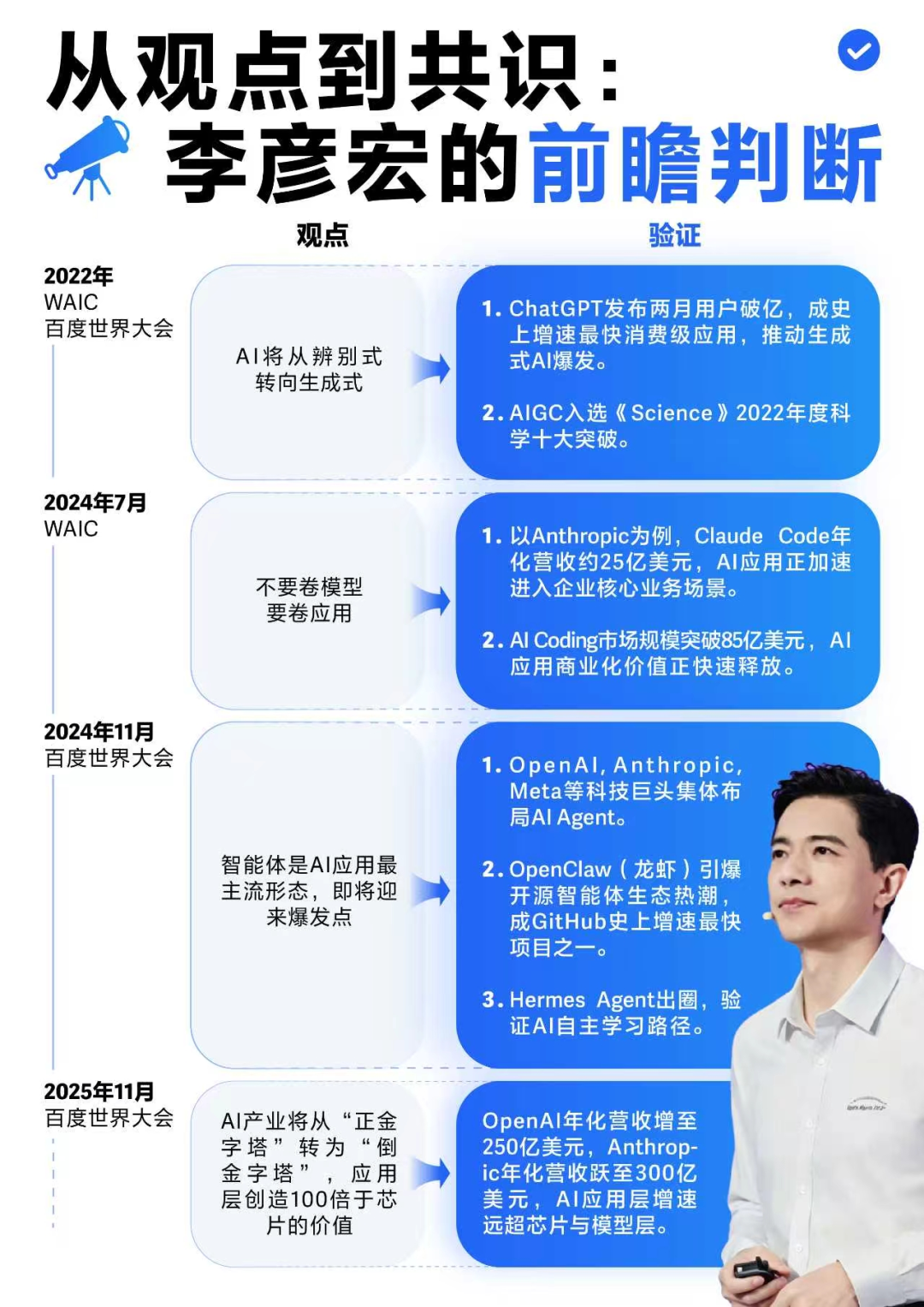
Looking back at Li Yanhong's aforementioned views today, they were not consensus opinions among most industry practitioners when first proposed. Remarkably, as the industry evolved, Li's views were one by one accurately validated and gradually became industry consensus.
2
2026 New Insights: DAA
With the rapid iteration of large model capabilities, the question of whether 'large models are useful' is no longer a focal point of industry controversy. Meanwhile, intelligent agents have begun to emerge as a new industry direction, with Token consumption becoming mainstream. Against this industry backdrop, many people are concerned about the future direction of China's AI industry.
At the 2026 Baidu Create Conference, which opened on May 13, Li Yanhong delivered a keynote speech that was refreshing to the author. Among it, three assertions left the deepest impression.
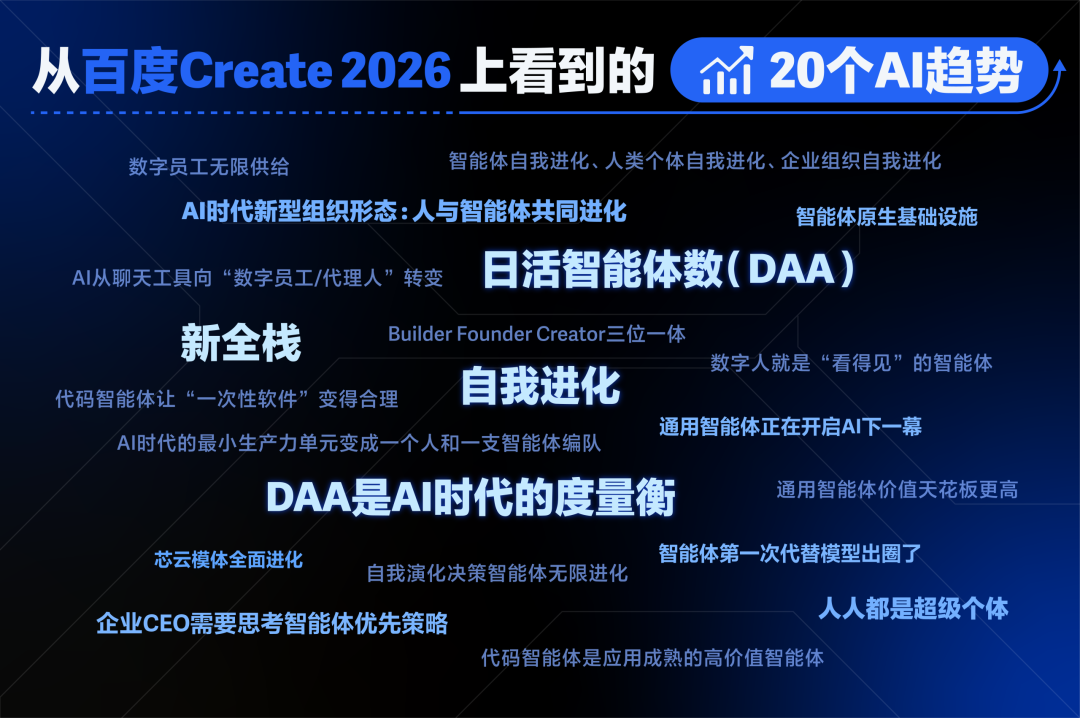
First, 'Everyone is a Super Individual' represents an upgrade and fulfillment of Li's previous proposals of 'Everyone is a Developer' and 'Intelligent Agents are the Development Direction of AI Applications.'
When Li Yanhong previously proposed 'Everyone is a Developer,' large models had already begun to enter the public eye, but there were still high barriers for ordinary people to truly use AI for product development. The essence of this proposal was to emphasize that software development is evolving from a specialized skill to a more universally accessible creative ability, thereby further encouraging more ordinary users to participate in the learning and application of AI.
Now, with the maturity of large model technology and the emergence of many excellent intelligent agents, an individual plus a team of intelligent agents can become a super individual. For example, at the conference, an 8-year-old boy used Baidu's newly released code intelligent agent Miao Da. By simply describing his needs in natural language, he successfully built a campus mutual aid application called 'Dada Umbrella.'
This idea was inspired by a real-life scenario when children encounter rain after school: a student without an umbrella shouts, 'I need Dada Umbrella' in the corridor, and a student with an umbrella 'accepts the order' to share the umbrella and leave school together. In the past, such an idea might have remained just a verbal game, but with Miao Da, this second-grader did not need to learn coding. He only needed to tell the AI product rules, functional requirements, and interaction methods like chatting, and the system could automatically generate a runnable mini-program with functions like umbrella sharing, route selection, and point upgrades.
Li Yanhong believes that driven by the wave of intelligent agents, human individuals will achieve a trinity of evolution as 'Builder, Founder, Creator.' Every developer will also be an entrepreneur and a creator. This perspective helps to expand the imagination of ordinary people, pushing them into the deep waters of large model and intelligent agent applications for higher value creation.
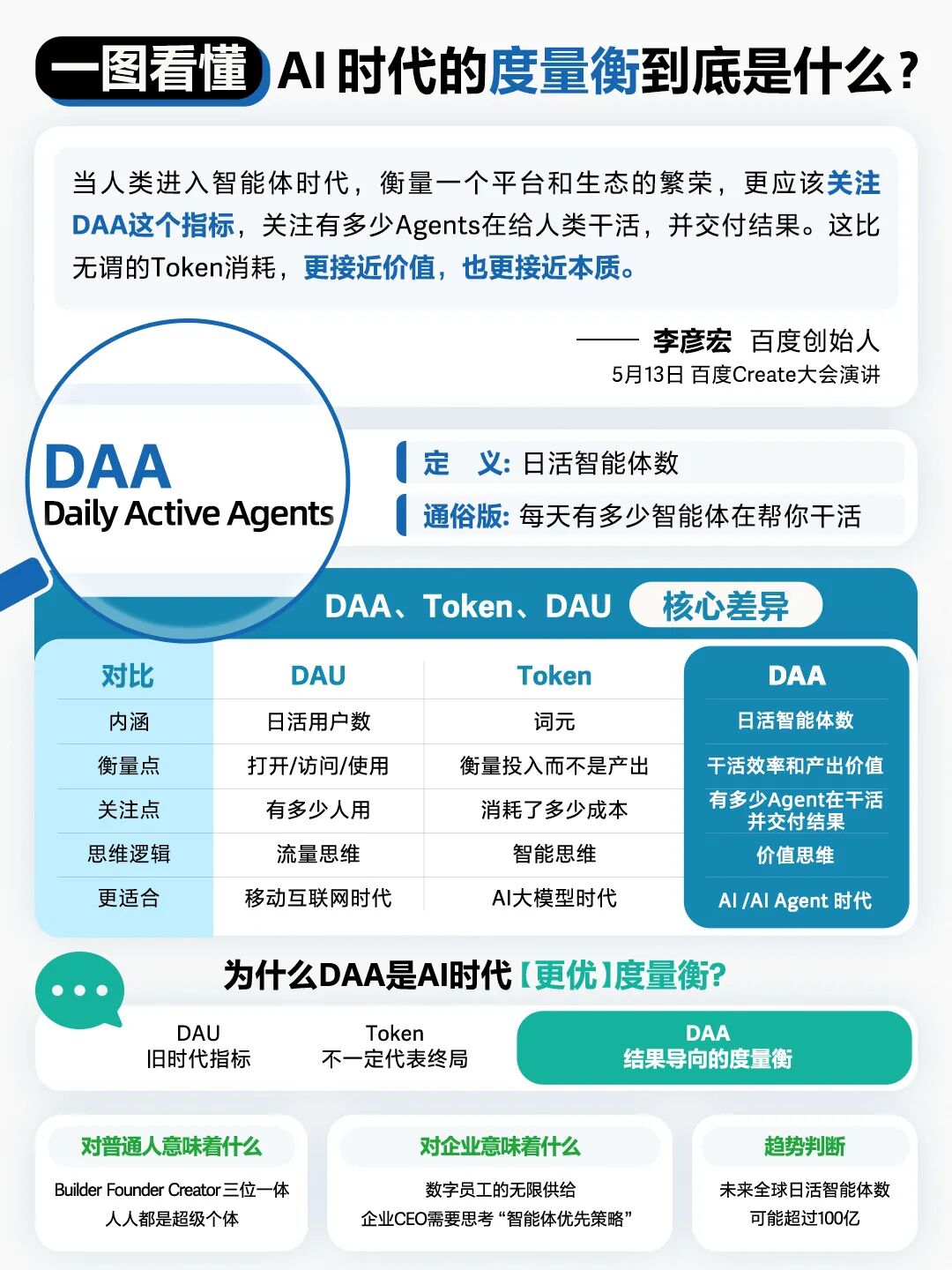
Second, the new concept of 'DAA' (Daily Active Agents) is a concretization of Li Yanhong's previous views on 'super usefulness' and 'effectiveness emergence.'
Li Yanhong has been pondering DAA for quite some time. Some Baidu insiders mentioned that as early as early April this year, Li had already discussed his thoughts on AI-era metrics at an internal director meeting, stating that 'Daily Active Agents may better represent the value that AI can bring.' This content was later published on Baidu's intranet on April 13.
Currently, several major C-end AI assistant products in China are engaged in fierce homogeneous competition, with companies continuously increasing traffic investment, but the industry is still exploring stable and clear commercialization paths. In contrast, a batch of AI applications and intelligent agents targeting specific scenarios have begun to form practical value and payment capabilities in vertical fields such as office work, marketing, education, and customer service. This fully validates Li Yanhong's previous proposal to avoid falling into the trap of super apps and instead focus on creating 'super usefulness.'
At this conference, Li Yanhong keenly proposed a new observation. The rise of intelligent agents represents the transition of AI development from the model stage to the application stage, with AI competition shifting from intelligence to execution. What users truly pay for is no longer whether the model 'can do it,' but whether the intelligent agent 'can help me get things done.' This marks AI's transformation from a chatting tool to a digital employee and agent.
In the era of intelligent agents, the industry's focus should not be on DAU (Daily Active Users) or Tokens. Li Yanhong believes that DAU is a universal metric in the mobile internet era, while Tokens represent only costs, not benefits; they measure input, not output. Therefore, he suggests that to measure the prosperity of a platform and ecosystem, one should look at the DAA metric, focusing on how many Agents are working for humans and delivering results. This is closer to value and essence than meaningless Token consumption.
Third, the 'self-evolution' of 'intelligent agents, individuals, and enterprise organizations' represents a transformation after 'AI internalization.'
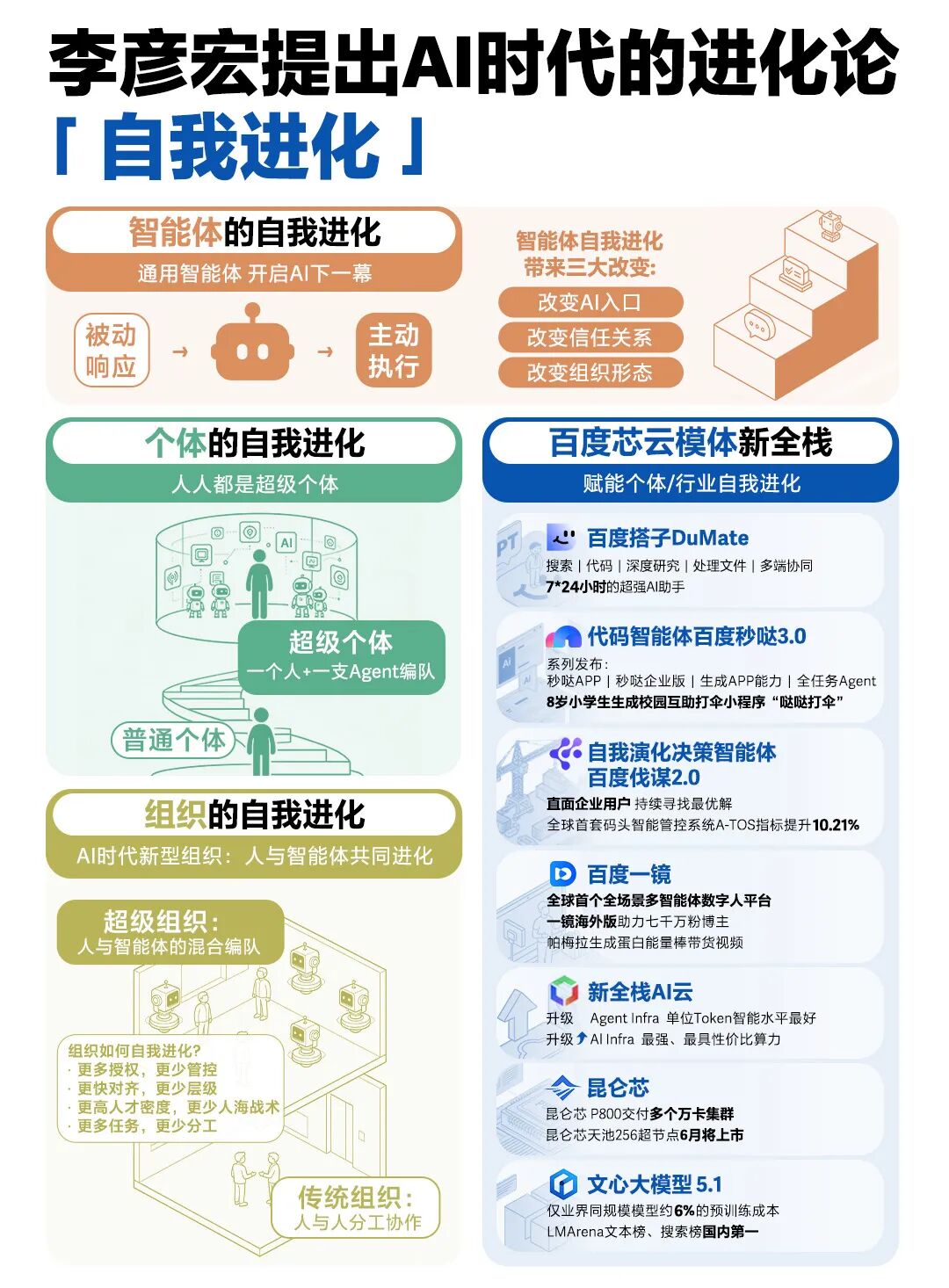
In the early stages of AI development, the task for enterprises was to first internalize AI as a native organizational capability, truly integrating it into business processes, organizational collaboration, and decision-making systems, thereby establishing foundational capabilities adapted to the AI era and seizing potential opportunities in the new technological era. However, as the industry develops, more and more useful and user-friendly intelligent agents are emerging, and these agents are rapidly evolving on their own, gradually shifting from passive responses to actively learning from the environment to improve themselves and taking initiative.
For example, at this conference, Baidu's decision-making intelligent agent Famous Strategist was upgraded to version 2.0. It is no longer just an algorithm optimization tool for technicians but directly serves business experts to make globally optimal decisions. Meanwhile, it has achieved more focused vertical capabilities around the three most painful and heavy scenarios in Chinese industries: production scheduling, process optimization, and logistics planning. Previously, Baidu's Famous Strategist Agent 2.0 topped the machine learning authoritative benchmark MLE-Bench, securing nine first places out of the 15 most difficult questions, surpassing similar intelligent agents powered by mainstream large models like Claude-Opus-4.6.
In addition, at this conference, Baidu also collectively released and upgraded a series of amazing intelligent agent products, including the general intelligent agent DuMate (Chinese name 'Baidu Partner'), the code intelligent agent Miao Da, and the digital human intelligent agent Baidu Mirror. The self-evolution and empowerment of these intelligent agents will inevitably bring about the self-evolution of human individuals, as mentioned earlier by Li Yanhong: 'We are ushering in an era of the rise of super individuals, where everyone is a super individual.'
The self-evolution of intelligent agents and individuals will ultimately lead to the self-evolution of enterprise organizations. Traditional enterprise organizations have always relied on the division of labor and collaboration among people, while organizations in the intelligent agent era are evolving into super organizations with mixed teams of humans and intelligent agents. This super organizational form also brings fundamental changes to the way enterprises operate.
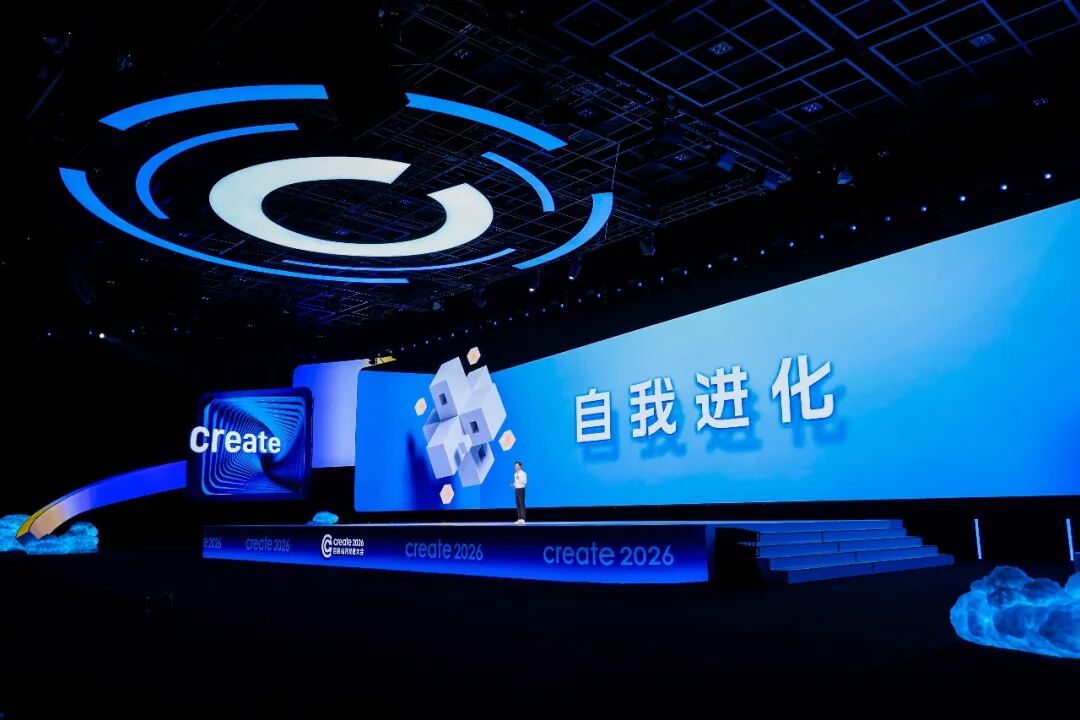
In his speech, Li Yanhong shared four thoughts on organizational self-evolution: 'more authorization (authorization), less control; faster alignment, fewer hierarchies; higher talent density, less swarm tactics; more tasks, fewer divisions of labor,' providing Chinese business leaders with a new organizational management paradigm for the intelligent agent era.
It is worth mentioning that a detail at this Create Conference also reveals Baidu's talent philosophy. He Junjie, Senior Vice President of Baidu Group and Head of Human Resources and Administration, introduced that at the opening ceremony of the Create Conference on the 13th, three campus recruits took the stage to release Baidu's latest AI products alongside Baidu founder Li Yanhong. Among them, the youngest was a 2025 campus recruit who joined Baidu after graduating last year and has already grown into a product expert in the digital human intelligent agent field. He Junjie said that this directly reflects Baidu's philosophy of 'letting young people take the lead,' allowing young talents to directly enter the business battlefield and engage in the most core and cutting-edge tasks of the AI era.
In addition, He Junjie announced the launch of Baidu's 2027 AIDU program at the Create Conference. This is the first launch of the AIDU program after its upgrade as a Baidu Group talent development project. Baidu invites top global campus talents to join and become future technology leaders. He stated that truly outstanding talents need opportunities to engage in the most core tasks and deserve the most abundant resources and the best rewards. After joining the AIDU program, Baidu can provide them with full authorization to tackle peak technical battlefields and solve forward-looking or breakthrough challenges in the AI field. At the same time, Baidu can offer sufficient computing power and tool support, with unlimited supply of massive resources. Moreover, the program has no upper limit on salary, and Baidu can pay competitive salaries to outstanding talents.
3
The Thought Leadership Behind 'Non-Consensus'
In leadership theory, many leadership masters emphasize the importance of thought leadership. For example, John C. Maxwell proposed in his book 'The 5 Levels of Leadership' that the highest level of leadership is Pinnacle leadership, surpassing Position, Permission, Production, and People Development. The core of Pinnacle leadership is the ability to insight (discern) future trends and attract people to follow.
American organizational development master Warren Bennis also believes that 'the core of leadership is the ability to lead the way ideologically (intellectually), do the right things, and turn visions into reality.'
In researching numerous outstanding entrepreneur cases domestically and internationally, the author has found that these entrepreneurs are all capable of pointing out a direction for their companies amidst chaos and have the ability to turn that direction into reality. For example, both Elon Musk and Wang Chuanfu believed in the ultimate direction of electrification for the global automotive industry when the development of new energy vehicles was still uncertain. These beliefs eventually attracted and gathered a large number of talents inspired by this vision, jointly promoting the development of the new energy vehicle industry. During the evolution of their companies, they also provided specific directional guidance for the global new energy vehicle industry based on their respective technological insights.
Li Yanhong is also such an entrepreneur. In the early stages of China's PC internet industry development, when business models were unclear, Li clearly discerned the main entrance (gateway) value of search engines and built a series of benchmark products around search engines, such as Baidu Encyclopedia and Baidu Library. During the development of artificial intelligence, Li has been driving the progress of China's AI industry. Being able to maintain forward-looking layouts during two important technological waves, Li's judgments and persistence in technological directions are highly representative of the industry.
In the author's view, Li Yanhong's predictions are never based on 'what the industry is doing' but on 'what the essence of AI technology is and where it will ultimately go.' He emphasizes that Baidu adopts an 'application-driven' strategy, meaning that the ultimate value of AI will definitely not be just a chatting tool but will complete real tasks and create real value. In addition, he proposed early on that 'intelligent agents are the most promising development direction for AI applications.'
Second, Li Yanhong's long-term deep involvement in technological research and commercial practice provides an important foundation for his forward-looking technological judgments.
Unlike pure technological practitioners and pure commercial practitioners, Li Yanhong is proficient in technology and can more clearly discern the future of technology compared to most commercial talents. On the other hand, he is familiar with the real needs of C-end individual users and B-end organizational clients, as well as the specific application scenarios in various industries, and is familiar with the productization and commercialization of technology. Compared to technological talents, he can more quickly see the application prospects of technology and think about problems with an endgame mindset.
These traits, supported by specific business practices, enable Li Yanhong not only to dare to propose non-consensus views but also to align his words and actions, ultimately achieving Baidu's industry-leading full-stack layout of 'chip-cloud-model-agent.'
In terms of chips and cloud services, Baidu has upgraded Agent Infra (models and systems) and AI Infra (chips and computing power) from the supply side based on the new demands brought by the intelligent agent era, building a full-stack AI infrastructure that can support the large-scale operation, continuous evolution, and secure controllability of intelligent agents. At the model level, the ERNIE large model continues to evolve, firmly ranking in the industry's first tier. The latest version 5.1 achieves domestic first places in both text and search rankings on the LMArena benchmark at only 6% of the pre-training cost of industry models of the same scale. In terms of intelligent agents, the general intelligent agent DuMate, the code intelligent agent Miao Da, the digital human intelligent agent Mirror, and the decision-making intelligent agent Famous Strategist jointly form a useful and user-friendly intelligent agent product matrix. These business practices, in turn, feed back into Li Yanhong's thoughts, enabling him to make more forward-looking trend judgments.
We look forward to Li Yanhong continuing to share more insights in the future, and Baidu Company also being able to deliver more "extremely useful" achievements for users and the industry, facilitating the arrival of the era of "super individuals."
-
![]()
Why Does Jensen Huang So Openly Praise China’s AI?
-
![]()
"Wudang" Unveiled: Arm China's Next-Gen AI VPU Redefines Video Encoding
-
![]()
From Energy Conservation and Carbon Reduction to AI Decision-Making: GECON East Intelligence and Chery Group Explore a New Green and Smart Paradigm for Automobile Manufacturing
-
![]()
WAIC 2026 Observation | AI Accelerates Towards the Core of Industries, Industrial AI Enters a Critical Phase
-
![]()
Volkswagen China Fires the First Shot in Foreign-Funded 'White Box Delivery'!
-
![]()
AI Agent Smartphones: The Next Competitive Edge Transcends Large Models
-
![]()
Over 880 Million Yuan Worth of Orders Unveiled, Bidding Launched for Shenzhen Eastern Public Transport
-
![]()
Tesla's Robotaxi Hits the Road: A Monumental Gamble with an Uncertain Future