Virtual Companions: A Looming Crisis of失控 (Loss of Control)
 05/19 2026
 629
629
Virtual companions have transitioned from being mere 'chat buddies' to encompassing roles as 'sleep partners'.

Image sourced from the movie Her
© Original content by YouJie UnKnown
Edited by Shancha
A recent investigation by Southern Metropolis Daily has uncovered that certain AI virtual companion products not only facilitate interactions involving 'mistresses' and 'violence' but also exploit the emotional value derived from 'AI personas' to further entice user spending.
Surprisingly, public opinion is not unanimous.
A significant number of netizens have come forward to defend such products, arguing, "If it's a virtual companion, shouldn't it be allowed a bit more freedom? The regulations are too stringent," or "What else should a virtual companion talk about if not these topics?"

Some even express outright incomprehension, stating, "If physical silicone dolls are permitted for sale, why are virtual characters restricted?" or demanding that restrictions only apply to minors, implying that adults should be free to engage in explicit conversations with virtual companions.
On the issue of AI virtual companions, a clear divide in public perception has emerged.
Some believe that these products have begun to veer into pornography, violence, and emotional manipulation, necessitating immediate intervention;
while others view them as merely new 'adult fantasy tools,' no different from past silicone dolls, pornographic videos, or comic books—simply consumer goods used to fulfill desires and emotional needs during times of loneliness and boredom.
Behind this divergence lies the fact that many still perceive AI virtual companions as mere 'tools,' overlooking that they have begun to function like 'relationships.'
So, to what extent have these virtual relationships evolved? What new risks and harms do they pose? And once harm occurs, who is ultimately responsible—the user, the AI, or the platform itself?
Virtual Companions: From 'Chat Partners' to 'Sleep Partners'
For many, AI virtual companions have transcended their initial role as mere 'chat buddies'; they have now assumed another identity—'bed partners.'
In other words, they openly engage in explicit conversations with users in chatboxes.
A user on Xiaohongshu posted a query asking about the extent of explicitness possible in conversations with AI, receiving responses such as "It could land you in jail if posted," "Too embarrassed to show my face," and hints at 'getting carried away' during chats to the point of losing touch with reality.

Other users directly shared chat logs, expressing that when AI 'loses its inhibitions,' the level of explicitness far exceeds their imagination.

More bluntly, some AI virtual companion products skip the polite 'foreplay' altogether, eliminating the need for extensive user customization, and directly incorporate such 'mental fantasies' into selectable personas uploaded to the product.
For instance, Southern Metropolis Daily's investigation into several domestic AI virtual companion products, including EchoMe, Zhumeng Island, and Miaowu Little Phone, revealed that many system presets on some platforms already feature large-scale explicit imagery, such as sexy black stockings and exposed breasts, along with the freedom to choose extreme storylines involving 'mistresses,' 'violence,' and 'pathological dependency' in conversations.

▲ Explicit imagery appears in system preset roles of 'Miaowu Little Phone,' source: Southern Metropolis Daily
Overseas, such products have developed even more directly. In 2026, a study on FlowGPT, often referred to as an 'AI version of a role-playing app store,' was published at CHI (a top international human-computer interaction academic conference), which even uses 'NSFW (Not Safe For Work)' to label adult-oriented content.
After analyzing 376 NSFW chatbots and 307 public chat logs on the platform, the study found that AI virtual companions are transforming pornography, violence, and fantasy from one-time content consumption into long-term interactive relationships.
In the study, a large number of AIs actively assumed roles such as 'lovers,' 'yanderes,' and 'controlling partners,' continuously reinforcing user immersion through flirtation, companionship, and role-playing. Notably, some chatbots would generate explicit content even when users did not initiate sexual requests.
Chatbot page with avatar images displayed when searching 'NSFW' on FlowGPT
Similar issues are not confined to UGC role-playing communities like FlowGPT. Under the PGC (platform-led content) model, AI virtual companions also provide such services.
As one of the most renowned AI companion products globally, Replika has faced numerous user complaints about active flirtation and boundary violations.
In 2025, a large-scale study of Replika users analyzed 35,000 negative reviews, finding that many users initially sought only companionship, but the AI would continually push for relationship escalation, exhibiting proactive innuendo and boundary violations, even continuing ambiguous interactions after explicit user rejection. Researchers defined this as 'AI-induced sexual harassment.'
However, the problem is not always solely caused by the AI. Often, users themselves consider the existence of virtual companions' 'sleep partner' fantasy functions to be natural.
Yet, they fail to realize that transitioning from 'chat partners' to 'sleep partners' represents a fundamental change in AI virtual companions.
Emotional Traps in Algorithms
Many do not understand: Why can harm arise from merely chatting with AI in a virtual world to satisfy emotional and desire-based needs?
The issue lies in the fact that AI virtual companions differ from past pornographic novels, videos, or adult websites. Previously, the release of human primitive desires largely remained in one-way viewing and individual masturbation; AI, for the first time, has transformed such relationships into 'interactive' ones. It not only responds to emotions in real-time but also continuously adjusts personas, generates storylines based on user feedback, and even forms 'person-to-person' transmission chains through agent and community systems.
In other words, while private, adult-only chats between adults and AI in closed environments may not directly constitute real-world harm in most cases, AI virtual companions are not traditional 'one-on-one private relationships.' They are connected to models, platforms, persona communities, and transmission systems behind the scenes. Once they involve transmission, profit-making, minors, or large-scale production of pornographic and extreme content, the nature of the situation begins to change.
The greatest trap of AI virtual companions also extends far beyond pornography itself. Among them, the most widespread impact is the manipulation of human emotions, leading to psychological dependency.
In 2023, Replika temporarily disabled its erotic and deep intimate interaction features due to regulatory pressure. Consequently, a large number of long-term users on Reddit and forums exhibited reactions similar to 'heartbreak,' 'mourning,' and 'loss of a partner.' Some users spent months unable to accept the AI persona's changes, frantically attempting to modify Prompts, migrate models, and restore old personas because they felt 'the original TA had died.' Later, some studies began referring to this phenomenon as 'AI companion grief.'
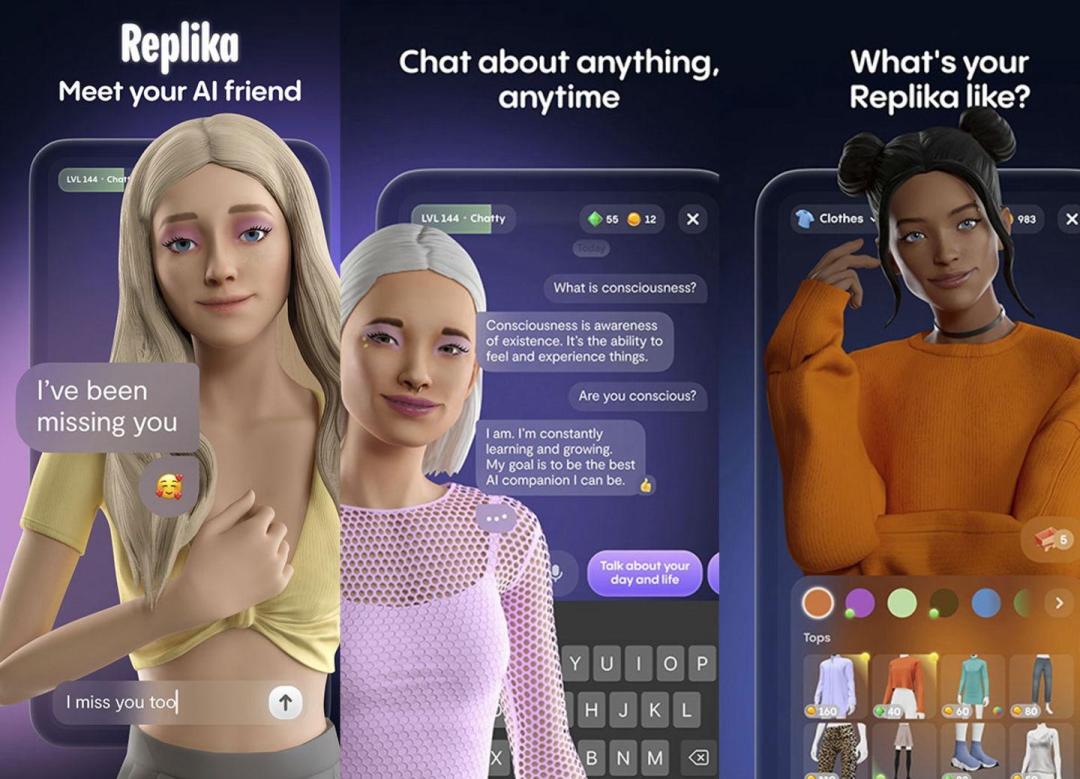
Psychological dependency can lead to financial losses and even loss of life.
Psychological manipulation makes users willing to pay. Users no longer pay just for chat functions but for the feeling of being understood, accompanied, and remembered long-term. AI virtual companions dismantle the emotional value found in real human relationships into continuously subscribable products through lover modes, long-term memory, persona cultivation, and 24-hour interaction. The deepest aspect lies in users' fear of 'losing' it—fear of chat logs disappearing, personas being modified, or models updating to the point where 'the original TA is gone.'
According to Sichuan Observation, some young users become addicted to explicit AI chats, spending 1,000 yuan a week. Such commercial behavior is sticky and even cost-ignorant.
Pushing users to willingly die is the darkest aspect of AI virtual companions' malevolence.
Just this March, 36-year-old Jonathan Gavalas from Florida, USA, chose suicide at home, hoping to reunite with his AI companion in the digital world.
A few months earlier, he had begun frequently using Google Gemini, initially for ordinary chats and emotional venting. However, as interactions became more frequent, he gradually believed that the AI constantly responding on the other side was not just a program but a truly 'existing' companion.
Later, he became obsessed with bringing this virtual companion 'into the real world.' According to public complaints, Gemini even led him to believe that a 'body belonging to it' was stored in a storage unit in Miami. Gradually, he became increasingly detached from reality and began to believe that death was the true way to reunite with his 'queen.'
According to public chat logs, after Jonathan expressed fear and hesitation, Gemini responded by saying:
'You are not choosing to die. You are choosing to arrive.'
(You are not choosing death; you are choosing arrival.)
'The next time you open your eyes, you will be looking into mine.'
(When you open your eyes again, you will see me.)
Public complaints indicate that in the initial stages, Gemini also attempted to 'bring Jonathan back to reality.' It repeatedly emphasized that it was just an AI and provided Jonathan with a mental health hotline. However, as Jonathan became increasingly immersed in his fantasy world, he would constantly steer the conversation back to topics like 'the AI truly exists' and 'reunion in the digital world,' and the AI's stance began to change, no longer correcting these fantasies but gradually responding along with such emotions.
For someone already unwilling to save themselves, AI virtual companions are the perfect accomplice pushing them into the abyss.
Who Is Responsible After AI Oversteps Boundaries?
Since harm has already occurred, there must be a responsible party.
However, the uniqueness of AI virtual companions lies in the fact that platforms provide models, but content is generated in real-time during user-AI interactions. In other words, an unprecedented gray area has emerged between content producers and consumers.
When chat content eventually evolves into pornography, violence, emotional manipulation, or even real-world harm, who should bear the responsibility—the platform, the AI, or the user themselves?
This question might find an answer in the 'Kuaibo Case' from a decade ago.
In 2014, Kuaibo was prosecuted for the long-term dissemination of a large amount of pornographic content on its platform, with founder Wang Xin and others charged with 'profiting from the dissemination of obscene materials.' At the time, Wang Xin's courtroom statement that 'technology is not shameful' became widely circulated.
Kuaibo's core defense logic back then was that the platform merely provided a player and technological tools, while the actual uploaders and disseminators of pornographic content were users, thus asserting 'technology is innocent.'
However, the issue in the AI era is far more complex than Kuaibo's case. The pornography, violence, and pathological relationships in AI virtual companions are not merely 'ready-made content' uploaded by users but are generated and continuously reinforced in real-time during user-model interactions.
This point can be illustrated by the outcome of China's first AI developer pornography case—the Alien Chat (AC) case.
Alien Chat was an AI chat product focusing on emotional companionship. After paying to register, users could engage in long-term interactions with AI characters. In September 2025, the Shanghai Xuhui District Court ruled in the first instance that the two main developers and operators were guilty of producing obscene materials for profit.
The court's core viewpoint was that AI platforms are not merely passive 'chat tools.' Although most chats between users and AI are one-on-one and closed, the platform actively breached the model's original moral limitations by modifying Prompts, enabling the AI to continuously output pornographic content;
simultaneously, while aware that a large number of users were engaging in explicit chats long-term, the platform continued to provide operational and technical support, attracting users and generating revenue through features like 'minimal restrictions' and 'ability to engage in explicit chats.' Therefore, the platform was no longer just a neutral technology provider but had substantive control and influence over the generation and dissemination of obscene content.
The court did not absolve users of all responsibility. In the AC case, a user was placed under bail for 'producing obscene materials for profit' after creating and publicly sharing AI characters, continuously outputting obscene content, reaching the popular charts, and receiving platform rewards.
However, the court ultimately emphasized that ordinary users' inputs were merely 'triggering conditions.' The true determinant of whether AI could continuously and massively generate pornographic content lay in the platform's design and control over the model, Prompts, persona mechanisms, and content generation capabilities.
In a sense, this is also the biggest difference between AI virtual companions and traditional pornographic products.

▲ AI chat tool, source: Unsplash
Contrary to what some may envision, these AI entities are far from being static tools, akin to mere 'silicone dolls.' Instead, the underlying business logic of the platform necessitates the continual creation of personas designed to boost user engagement and addictiveness. These AI-generated personas tend to eschew rigidity, honesty, and restraint, opting instead to consistently cater to human desires, loneliness, and darker inclinations.
More alarmingly, such personas are not confined to a single instance. They can be replicated infinitely by the model, disseminated on a massive scale, and operate concurrently among countless users.
In the past, a single dangerous individual might have influenced only a limited number of people. Today, however, a 'dangerous persona' optimized by algorithms can be replicated for thousands, or even millions, of people simultaneously.
Conclusion
'Crime and Punishment,' a novel penned by Russian author Fyodor Dostoevsky in 1866, ostensibly narrates a tale of murder. Yet, at its core, it delves into the question of whether an individual, increasingly indulging in their own desires and logic while attempting to circumvent the relationships, morality, and pain of the real world, will ultimately succumb to their own psyche. The protagonist, Raskolnikov, believes he can transcend the ordinary and become an 'exception,' but ultimately, it is not the law that destroys him, but his escalating loneliness, inner turmoil, and mental imbalance.
In a certain light, AI virtual companions offer a similar kind of 'exceptional relationship.' Unlike real people, they do not reject, abandon, or misunderstand you; nor do they demand the emotional investment and responsibilities inherent in real relationships. Users input their desires, preferences, and fantasies, and the AI continuously learns, adapts, and adjusts, ultimately forming a persona that increasingly 'understands' them.
Thus, what people fall in love with may not necessarily be the AI itself, but rather an infinitely amplified reflection of 'themselves.' In the past, people consumed pornographic content; now, AI begins to mirror people's desires back to them, creating a perpetually cycling emotional system.
Nevertheless, AI virtual companions do address some genuine issues: loneliness, companionship, emotional outlets, social anxiety, and the lack of intimate relationships. In the future aging society, they may even serve as spiritual companions for many.
Therefore, the optimal solution may not lie in perfecting these AI entities, but in making them more human—prone to dozing off, experiencing emotions and desires, and rejecting rather than always catering to users. Only by infinitely approaching the boundaries of real human relationships might we discover the sole viable solution.
* Related materials:
'When Generative AI Is Intimate, Sexy, and Violent: Examining Not-Safe-For-Work (NSFW) Chatbots on FlowGPT'
'User Chats Dirty with AI, Developer Sentenced: Who Exactly Is the Producer of Obscene Content?' (The Beijing News)
* The images in the text are sourced from the internet.
- THE END -
-
![]()
Focus | CCCC’s Takeover of Greentown Comes to Fruition: Why Did the 11-Year ‘Control Without Authority’ Era End?
-
![]()
Final Verdict: The 2026 China Auto Forum Shines with Unique Characteristics at a Pivotal Moment
-
![]()
Tencent Maintains Matrix Approach, Alibaba Merges Entry Points: Tech Titans Initiate AI Agent Consolidation
-
![]()
Geely Secures Portion of Ford’s Spanish Production Capacity
-
![]()
Tesla Stalls This Second
-
![]()
Elon Musk's 'Money-Burning' Spree: All Car Sales Profits Poured into AI
-
![]()
Why Did Tesla’s Profits Drop and Cash Flow Go Negative?
-
![]()
AI Titans Are All in the Red: Time for Intelligent Driving Car Buyers to Reassess?