No Shortcut to the 'Final Circle' of the Autonomous Delivery Van (Robovan) Era
 05/19 2026
 572
572
In May, the sea breeze in Qingdao still carried a lingering chill.
Representatives from Neolix and TELD stood in a newly constructed station, affixing a nameplate to the small yard—'Power Island No. 1.'
A decade ago, this site would have been little more than a parking lot with a scattering of charging stations. However, by 2026, it had taken on far greater significance: autonomous parking, robotic charging, automated cleaning, vehicle self-inspection, and future integration with virtual power plant dispatch.
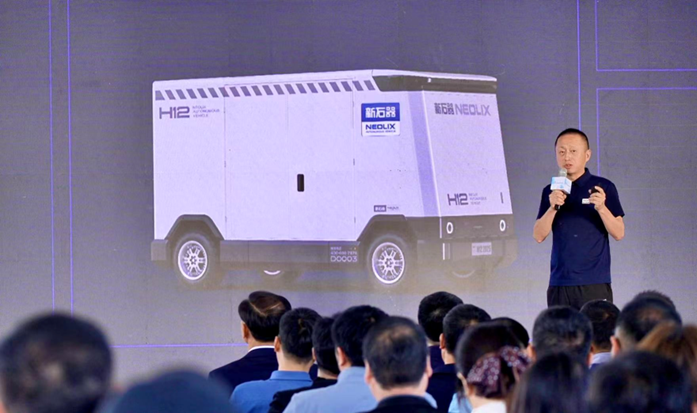
'This represents the infrastructure for the autonomous driving era,' declared Yu Enyuan, founder of Neolix, as he stood on stage. Beside him, Yu Dexiang, chairman of TELD, added, 'The second half of the new energy vehicle story is autonomous driving—vehicles operating independently.'
Just days before this launch event, UISEE officially embarked on its Hong Kong Stock Exchange IPO journey. The company, which had shifted its focus from 'passenger' to 'logistics' after a tumultuous path, had finally reached the IPO threshold.
Taken together, these two events suggest that the Robovan sector has indeed reached a pivotal juncture requiring re-evaluation.
From Storytelling to Data-Driven Realities
Prior to 2025, the narrative surrounding unmanned delivery was relatively straightforward.
The strength of the algorithm, the number of kilometers logged in road testing, the extent of road access secured in a particular city—these were all compelling stories. Investors were willing to listen and invest in the 'future imagination space.'
However, after 2025, the winds of change blew.
Not because the technology had lost its allure, but because the vehicles were now actually on the roads. When thousands or even tens of thousands of vehicles are operating daily, everyone came to realize: the real challenge isn't making the vehicles move—it's ensuring they move continuously, cost-effectively, and at scale.
Neolix's 'Power Island' is a manifestation of this new logic.
How did unmanned vehicles charge in the past? Manually. Vehicles had to wait for human operators to plug them in one by one. If the fleet grew to hundreds of vehicles, charging alone would necessitate a sizable team. Not to mention cleaning, inspections, maintenance, and other routine tasks.
'One hub can serve thousands of vehicles,' Yu Enyuan stated at the launch event. In essence, he was calculating whether operational marginal costs could significantly decrease as scale increased.
This is the true litmus test for the industry in 2026.
The same logic applies to UISEE. The company didn't secure its Hong Kong Stock Exchange entry ticket because its technology was vastly superior—but because it identified 'profitable scenarios' ahead of others: airports.
Hong Kong International Airport, Singapore Changi Airport—these locations impose extremely stringent safety requirements on logistics, with nearly zero tolerance for errors. UISEE's ability to operate vehicles in such environments speaks volumes.
More importantly, airport logistics offer high customer acquisition costs, high renewal rates, and extremely high client switching costs. Once entrenched, it forms a formidable competitive barrier.
Thus, when UISEE achieved a gross margin of 51.1% in 2025, it had effectively transitioned from 'storytelling' to 'data-driven realities.'
Two Paths, One Shared Anxiety
Comparing the trajectories of Neolix and UISEE reveals an intriguing phenomenon.
Neolix has pursued a 'broad and comprehensive' strategy. It covers express delivery, supermarkets, dining, construction materials, agricultural products—any urban delivery scenario imaginable. And it doesn't just build vehicles—it constructs networks, charging infrastructure, and even expands overseas.
'Power Island' is a node in this expansive network. Under its 'Global 100 Cities Plan,' Neolix aims to build 300 Power Islands and 3,000 relay stations over the next three years, serving 300,000 unmanned vehicles.
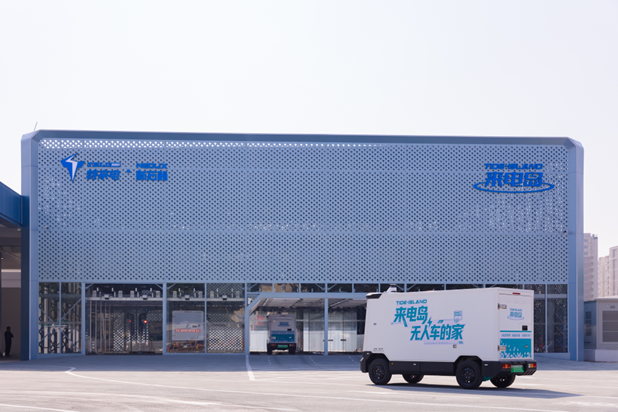
This ambitious target underpins a heavy-asset model. Building islands, deploying networks, and expanding overseas all demand significant capital. Neolix is betting that once network density reaches a certain threshold, operational costs will plummet, creating an exclusive competitive advantage.
UISEE, on the other hand, has taken a different path.
It hasn't rushed into the urban road fray but instead opted for 'high-walled' scenarios like airports, factory zones, and free trade zones. These scenarios may offer less imaginative potential than open roads but come with a key advantage: profitability.
An airport unmanned logistics project may take a year or two from bidding to deployment, but once launched, it secures long-term contracts of three to five years. Airports have extremely high safety standards, making supplier replacement decisions costly and ensuring strong client retention.
This approach renders UISEE financially 'healthier.' With a gross margin exceeding 50%—a rare feat in the cash-burning autonomous driving industry—it stands out.
Yet, UISEE harbors its own anxieties.
The market ceilings for airports and factory zones are visible. There are only so many large hub airports globally, and market penetration will eventually plateau. To sustain post-IPO growth expectations, UISEE must eventually deploy vehicles on open roads—a battlefield where Neolix has already been operating for years, and Jiushi is equally determined.
Two paths, two choices, but the anxiety is shared: who can reach the breakeven point first?
Overseas Markets: No Easy Escape
Even as domestic markets remain uncertain, overseas expansion has become a common strategy for nearly all Robovan companies.
Neolix is the most aggressive in this regard. It has entered nearly 20 countries and regions, including the UAE, Thailand, Singapore, and Japan, with a 2026 deployment target of 10,000 vehicles in the UAE alone.
This figure is staggering for any global market. But Yu Enyuan knows overseas markets are no utopia.
'Infrastructure is incomplete, with gaps in logistics support, communication services, and energy supply,' he acknowledged at the launch event, recognizing a harsh reality: exporting vehicles is easy—keeping them operational is hard.
This is why Neolix pursues 'ecosystem expansion overseas'—bringing TELD along for the ride. Short on charging networks? We'll bring our own charging stations. Lacking operational systems? We'll replicate our entire infrastructure.
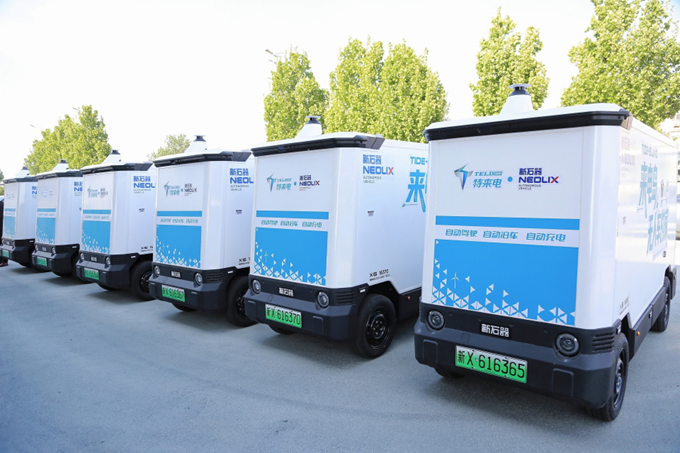
This approach is resource-intensive but potentially correct.
Selling vehicles alone is a one-time transaction. If overseas clients buy vehicles but can't charge, maintain, or dispatch them, reputations suffer. It's better to bundle full-service packages upfront—though initial investments are high, the long-term competitive barrier is deeper.
UISEE's overseas strategy differs. It leans toward 'technology licensing + flagship projects.' In Singapore, for example, it secured an airport project first, then used it as a springboard to expand into other Southeast Asian markets.
This approach is lighter but slower. In autonomous driving, where 'first-mover advantage' matters, delaying even a step could mean losing a regional market.
The True Significance of 'Power Island'
Returning to 'Power Island.'
If viewed merely as an autonomous charging station, its importance is underestimated.
Yu Enyuan made a notable remark at the launch: 'Neolix has completed its strategic extension from 'vehicle manufacturing' to 'mobility service provider.''
In simpler terms, this means: 'We're no longer just selling vehicles—we're selling mobility capacity.'
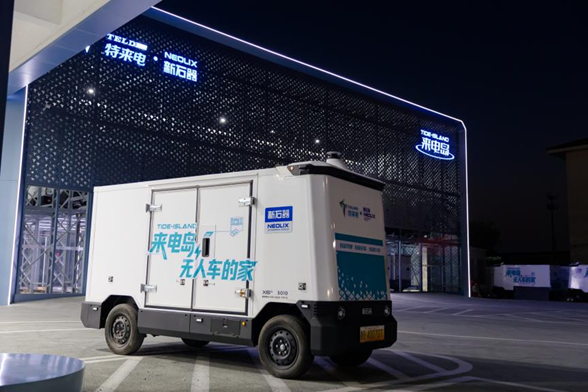
This represents a fundamental shift in positioning.
If you sell vehicles, your clients are logistics companies, and your competitors are other vehicle manufacturers. But if you sell mobility capacity, your clients are anyone with delivery needs, and your competitors are traditional logistics systems.
The market spaces are not even comparable.
'Power Island' acts as a 'hub' in this mobility network. Vehicles come here at night for charging, cleaning, and self-inspection, then head out during the day. The dispatch system dynamically decides when each vehicle returns or departs based on order heatmaps and battery levels.
If this system functions effectively, its barrier isn't the technology itself—autonomous charging and parking are replicable—but the 'network.'
When you have enough vehicles, densely distributed islands, and smart dispatch algorithms, replicating this network becomes prohibitively expensive for latecomers. You'd need to build vehicles, islands, dispatch systems, and secure enough orders to sustain the network.
This is Neolix's strategic calculation.
Yu Dexiang put it more bluntly: 'Autonomous charging will become the core infrastructure for large-scale unmanned vehicle deployment.'
TELD's willingness to partner with Neolix speaks volumes. As a charging industry leader, TELD understands better than anyone that future charging networks won't serve 'people'—they'll serve 'vehicles.' And unmanned vehicle charging behaviors differ entirely from private cars—they're more concentrated, regular, predictable, and optimizable.
Thus, 'Power Island' isn't just Neolix's island—it's TELD's ticket to the autonomous driving era.
No Shortcuts in the Final Circle
UISEE's IPO filing includes a notable data point.
Cumulative losses over three years exceeded 600 million yuan, but revenue grew at a 42.7% CAGR. Together, these figures sketch a typical profile of autonomous driving companies: growing but still unprofitable.
This isn't unique to UISEE. Neolix, Jiushi, and all remaining players face the same question: when will profitability arrive?
There's no easy answer.
To become profitable, you need scale. To achieve scale, you need orders. To secure orders, you need infrastructure. To build infrastructure, you need capital.
It's a vicious cycle. And breaking it has no shortcuts.
'Power Island' offers one potential solution. It attempts to lower marginal costs through centralized infrastructure. But building islands requires significant capital, necessitating marketplace support.
UISEE's IPO is another potential solution. Going public doesn't solve profitability issues, but it secures a longer-term 'ticket' and more resources for this protracted battle.
The 2026 Robovan industry resembles the shared mobility sector a few years ago. Everyone has entered the final circle, but no one dares claim victory. All they can do is keep running, building, optimizing—and wait for the day profitability arrives.
Yu Enyuan concluded the launch event with a remark: 'To make unmanned delivery more convenient for the public and urban logistics more inclusive.'
The statement sounds grand but is difficult to achieve.
Because 'convenience' and 'inclusivity' require a network woven from countless 'Power Islands,' an infrastructure that loses money daily yet persists in expansion, and a marathon with an unknown finish line.
This is the final circle of the Robovan era.
There are no shortcuts—only hard work.
-
![]()
After an 8 Billion Yuan Investment in Wuhan, Will French Automobiles Outperform Japanese Ones?
-
![]()
"Charging Industry Set to Move Beyond 'Cutthroat Low-Price Competition'", "Charging sector, profitability, structural enhancement, high-quality growth, the 15th Five-Year Plan era"
-
![]()
No Shortcut to the 'Final Circle' of the Autonomous Delivery Van (Robovan) Era
-
![]()
Yann LeCun's Retweet Declares Meta AI 'Dead'
-
![]()
Token Package Plans Launch: The 'Traffic War' in the AI Era Now Involves Doubao and Peers
-
![]()
Which enterprises have incorporated world models into their autonomous driving solutions, and what are the differences in their implementations?
-
Alibaba's AI Revenues Made Transparent, Tencent's AI Strategies Remain Hidden
-
![]()
Hands-On App Creation is Now a Reality! Tencent's TuSi vs. Ant Group's LingGuang: One Offers Installability, the Other, Speed