Yann LeCun's Retweet Declares Meta AI 'Dead'
 05/19 2026
 442
442

A few days ago, Julia Kempe posted a farewell message on X, announcing her departure from Meta and her upcoming move to Oxford's Ellison Institute of Technology starting next month to continue foundational research on foundational models.
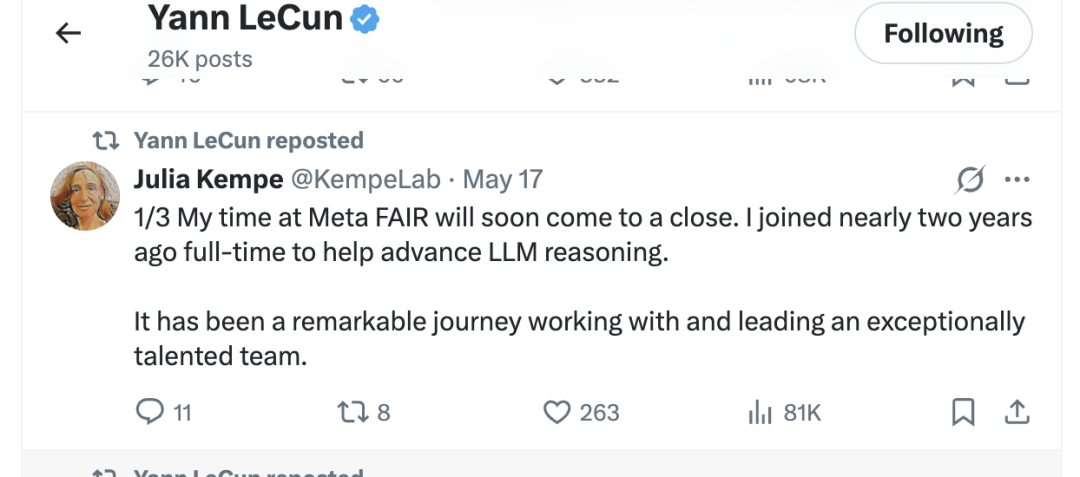
But within hours, Yann LeCun retweeted her.
This researcher may not be widely known, but it suffices to say that after LeCun's departure, she was the Meta researcher whose research direction most closely aligned with his. She holds the Silver Professorship (highest honor) in NYU's mathematics department.
Note a detail—LeCun's X profile has long featured a signature statement, with the first line reading, 'I do not write posts on X.' He rarely posts original content and seldom retweets. Yet this time, he swiftly amplified Meta's personnel news, seemingly with a hint of vengeance.
Rewind to last year: Zuckerberg spent $14.3 billion on an AI 'rescue plan' by hiring Alexandr Wang, establishing the new Meta Superintelligence Labs (MSL), and forcing legendary researchers like LeCun to report to a 28-year-old. This led to LeCun's angry resignation from Meta. Today, Kempe's departure seems to confirm that Zuckerberg's bet on Wang's path has hit a dead end.
LeCun's retweet feels like a verdict: Meta will never succeed in foundational model research.
Recruited researchers are leaving en masse.
In June 2025, two months after the poorly received release of Llama 4, Meta CEO Mark Zuckerberg finalized the company's largest-ever external investment: a $14.3 billion acquisition of a 49% non-voting stake in AI data services provider Scale AI. The deal valued Scale AI at $29 billion overall, with founder Alexandr Wang's personal stake worth approximately $5 billion.
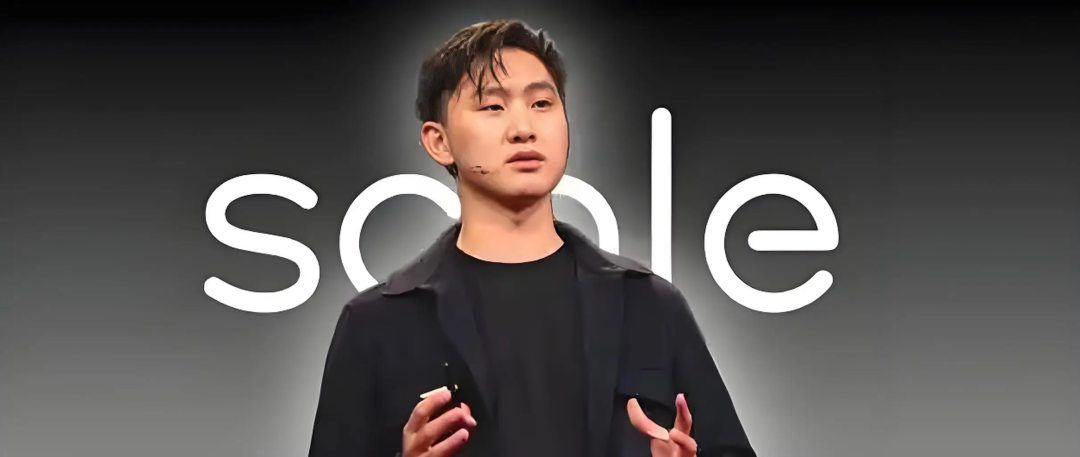
This acquisition was essentially a talent grab, spending $14.3 billion to acquire Wang personally. Scale AI remained independently operated, with Wang retaining his role as CEO while also serving as Meta's newly appointed Chief AI Officer, reporting directly to Zuckerberg.
Wang is just 28 years old.
Simultaneously, Meta launched a massive talent raid, poaching from OpenAI, Google, Anthropic, and Thinking Machines Lab—snatching five founders from Mira Murati's Thinking Machines Lab alone, including the legendary '$1.5 billion ghost engineer' (reported multiple times in the industry, though Meta never publicly confirmed the name).
The newly formed MSL was split into four teams: Wang's own TBD Lab for LLMs, Rob Fergus's FAIR team restructured as an MSL subgroup for long-term research, Friedman's Products team for consumer integration, and Aparna Ramani's Infra team for infrastructure.
The vision was grand. In a June 30, 2025, memo to all employees, Zuckerberg hailed Wang as 'this generation's most impressive founder.'
Then, within nine months, things unraveled.
The first cut came in October 2025—just four months after Wang took over, MSL slashed 600 positions.
The second cut came in January 2026—Reality Labs prepared layoffs to make way for AI.
The third cut came in March 2026—Meta shifted from 'centralized leadership' to a 'redundant leadership' structure. A new Applied AI Engineering unit was created under Maher Saba, reporting directly to CTO Andrew Bosworth and bypassing Wang. Media outlets bluntly noted this move 'effectively strips Wang of absolute autonomy.'
Nine months in, Zuckerberg began reclaiming authority.
April brought the Muse Spark model release, described by Wall Street as 'promising but investors want to see strategy.' Then came the April 30 Q1 earnings call—Bloomberg's headline: 'Meta CEO Mark Zuckerberg Vague on Earnings Call About AI Revenue Plans.' Even the CEO couldn't articulate how AI would generate revenue.
By May, the exodus began.
At least eight MSL members have left since July 2025. Notable names include Avi Verma, a former OpenAI hire lured by Meta's high salary, who returned to OpenAI within a month.
Ethan Knight also returned to OpenAI.
Rishabh Agarwal left Meta after five months to join Periodic Labs.
Julia Kempe, the researcher retweeted by LeCun, announced her departure on May 16 to join Oxford's Ellison Institute for foundational model research.
Industry observers note that more and more former MSL employees are surfacing at rival companies, with OpenAI being a common destination.
Translation: The talent Zuckerberg spent billions to acquire couldn't stay. Meta's and Zuckerberg's short-termism made focused researchers feel out of place.

Why does Kempe matter?
Her bio comes from NYU's website.
Julia Kempe is the Silver Professor of Mathematics at NYU (highest honor), with a PhD in mathematics from Berkeley. Before joining Meta full-time in 2024, she led NYU's Center for Data Science for five years. Such academic credentials are rare in Silicon Valley industrial labs. Meta recruiting her to MSL signaled to the outside world that MSL wasn't just Wang's product workshop—top scholars were willing to join.
At MSL, she led the Foundations of Reasoning Team, tasked with giving Llama a 'thinking' foundation. She was a core contributor to the reasoning advancements in Llama 3.3 and 4.
This role couldn't be easily filled—the market lacks scholars who combine academic prestige, product alignment, and academic endorsements. She and LeCun belonged to the same school of thought, shared European mathematical backgrounds, and had similar research tastes. After LeCun left Meta, Kempe was the closest internal substitute.
Her resignation isn't just a researcher changing jobs—it's a collapse of Meta's foundational model research.
Her new role rejects Wang's entire approach. Meta can no longer pursue the industrial lab-plus-scaling model of OpenAI or Anthropic. By choosing Oxford, she's publicly declaring: she hasn't abandoned AI—she's abandoned Meta's AI path.
Adding her to the list of at least eight MSL departures over the past 10 months, she represents the highest sunk cost—others returned to OpenAI within a month, which could be dismissed as 'cultural mismatch.' Kempe stayed nearly two years, observing internal operations before making her decision. Her departure lowers the threshold for remaining researchers still on the fence.
Zuckerberg himself is wavering. Wang was partially stripped of power in March, and Bloomberg described Zuckerberg's April 30 earnings call as 'vague on AI revenue plans.' Kempe resigned on May 16, and four days later, Meta announced 8,000 layoffs—hardly a coincidence.
Meta's downfall began with Llama 4.
Reviewing Meta's collapse, signs emerged early last year.
In January 2025, DeepSeek R1 emerged with performance nearing GPT-4, reportedly trained for under $6 million. Silicon Valley was shaken. Meta panicked.
Three months later, in April 2025, Meta rushed out Llama 4. Industry consensus was blunt: this was Meta's response to DeepSeek. Overseas media headlines read, 'Meta's answer to DeepSeek is here.' Scout and Maverick models launched first, with the 2T-parameter Behemoth still training, claiming to distill its capabilities down to the first two.
Then Llama 4 stumbled.
Llama 4 Maverick scored just 16% on the aider polyglot coding benchmark—Claude Sonnet 3.7 scored around 60%. In the open-source community, Zvi Mowshowitz wrote a tweet titled 'Llama Does Not Look Good 4 Anything.' Industry criticism was harsher: 'Scout and Maverick feel like rushed responses to China, not tools for developers.'
Worse followed. Meta submitted a special version called 'Llama-4-Maverick-03-26-Experimental' to LMArena—tuned specifically for human preference voting—which immediately topped the LMArena leaderboard. Once the community exposed this, LMSYS revised its leaderboard rules to counter Meta. Meta's VP of Generative AI, Ahmad Al-Dahle, had to issue a denial, but the benchmark manipulation further humiliated Meta.
Llama 4 wasn't a technical failure—it was a pacing failure. Meta tried to match DeepSeek's progress in three months, failed, and resorted to benchmark manipulation. Getting caught was worse than falling behind.
Then came the 'Avocado Project,' but Meta's latest update was to announce a delay. Undoubtedly, the difficulty in delivery is now confirmed.
Not to mention Meta's recent halted acquisition of Manus. Overall, while Zuckerberg desperately pursues AI, AI seems to be hunting Meta. Nearly all internal paths have reached dead ends.
In Closing
Horizontally comparing—OpenAI, Anthropic, and Google DeepMind haven't resorted to spending sprees to save themselves in the past three years. OpenAI grew slowly from its Y Combinator days, Anthropic built its team from a few OpenAI defectors, and DeepMind quietly developed AlphaFold within Google for 11 years.
Only Meta kept trying to buy a shortcut. Now that path is nearly over.
It collapsed in nine months.
The deeper issue: scholars like Kempe, leaving MSL for Oxford's foundational research, might earn a fraction of their MSL salary. Scholars vote with their feet not for money, but for dignity. MSL could offer sky-high packages but not research dignity. Kempe's final role at Meta involved consumer agents, far removed from the reasoning research she did at NYU.
Under Wang, MSL wasn't a research institute—it was a company desperate to ship products. Such a place can't retain scholars with their own research tastes.
This isn't just a Meta issue. From 2025 to 2026, Silicon Valley as a whole engaged in talent raids, spending sprees, and rebranding, with all companies shifting toward 'application-oriented + scaling.' Yet curiously, the most talented researchers are quietly exiting.
They're not moving to bigger, richer places. They're choosing smaller, quieter, purer research environments.
Yann LeCun's simple retweet declared Meta's AI model thoroughly dead (completely dead).
That retweet was like a resignation letter without text—Kempe wasn't the only one leaving Meta. It was a joint letter from the entire pure-research faction represented by LeCun to Zuckerberg.
Only money can't buy AI.
-
![]()
Focus | CCCC’s Takeover of Greentown Comes to Fruition: Why Did the 11-Year ‘Control Without Authority’ Era End?
-
![]()
Final Verdict: The 2026 China Auto Forum Shines with Unique Characteristics at a Pivotal Moment
-
![]()
Tencent Maintains Matrix Approach, Alibaba Merges Entry Points: Tech Titans Initiate AI Agent Consolidation
-
![]()
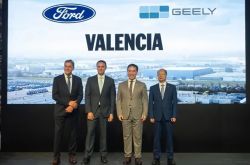
Geely Secures Portion of Ford’s Spanish Production Capacity
-
![]()
Tesla Stalls This Second
-
![]()
Elon Musk's 'Money-Burning' Spree: All Car Sales Profits Poured into AI
-
![]()
Why Did Tesla’s Profits Drop and Cash Flow Go Negative?
-
![]()
AI Titans Are All in the Red: Time for Intelligent Driving Car Buyers to Reassess?