A $2 Trillion Ticket to Mars: SpaceX Initiates the Largest IPO in Human History
 05/24 2026
 714
714
Author|Jiang Zhou
Editor|Chen Xiaoran
In 2002, Elon Musk established SpaceX with the ambitious aim of facilitating human landings on Mars. At that time, however, most people regarded it as the fanciful fantasy of a billionaire.
Twenty-four years on, this Mars-bound enterprise submitted its S-1 prospectus to the U.S. Securities and Exchange Commission (SEC). The ticker symbol is set as "SPCX", and the listing date is scheduled for June 12.
The price of this "ticket" to Mars has now been unveiled. Multiple sources suggest that SpaceX's IPO is anticipated to raise between $70 billion and $75 billion, corresponding to a valuation ranging from $1.75 trillion to $2 trillion. This fundraising amount is poised to set a record as the largest IPO in human history.
Mars is still far away, but Musk has handed the "ticket" to get there over to Nasdaq.
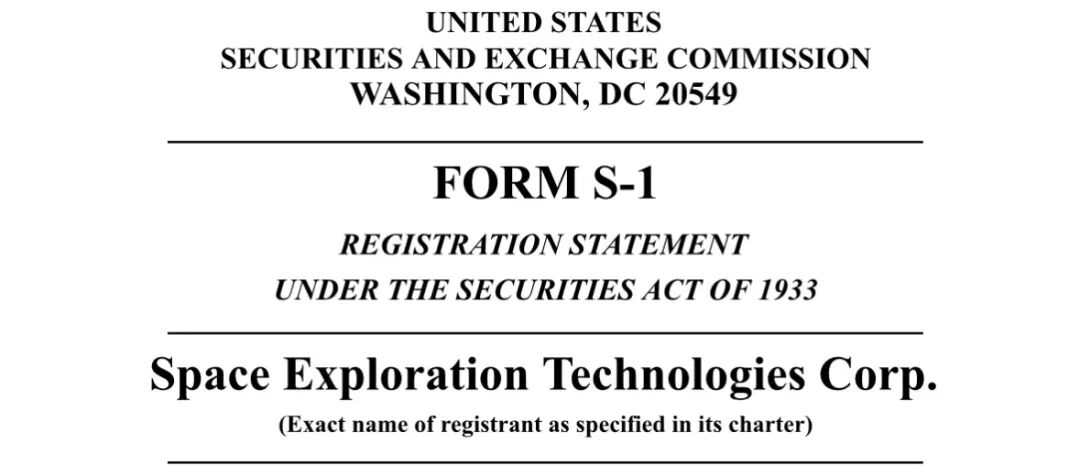
Image Source: SEC Official Website
A closer examination of this highly anticipated prospectus reveals that the term "largest" extends well beyond just the scale of the IPO.
The prospectus states that SpaceX has secured the largest addressable total market (TAM) in human history. According to SpaceX's estimates, the company's quantifiable TAM is valued at $28.5 trillion. To put this into perspective, the total U.S. GDP for 2025 is approximately $3.08 trillion.
Within this vast target market, artificial intelligence (AI) accounts for $26.5 trillion, network connectivity makes up $1.6 trillion, and the traditional space sector is worth $370 billion. These figures correspond precisely to SpaceX's three business segments: the artificial intelligence segment (AI segment), Starlink (Connectivity segment), and space exploration (Space segment).
Yet, TAM is merely a theoretical concept. Shifting our focus to the real financial performance over the past three years, from 2023 to 2025, SpaceX's total revenue increased from $10.387 billion to $18.674 billion, with a compound annual growth rate (CAGR) of 34.08%.
Despite this robust growth, it pales in comparison to the staggering TAM figures. By the first quarter of 2026, SpaceX's total revenue growth rate had slowed down to 15.42%.
Analyzing the revenue structure, the Starlink business serves as the foundation of SpaceX. In 2025, this segment contributed $11.387 billion in revenue, accounting for over 60% of the total. Additionally, the AI business generated $3.201 billion, while the space business brought in $4.086 billion.
In stark contrast to the lofty $28.5 trillion long-term market ceiling stands the current reality of $18.67 billion in revenue. SpaceX's profit trajectory has been far more volatile than its revenue growth.
From 2023 to 2025 and through the first quarter of 2026, SpaceX reported net profits of -$4.268 billion, +$791 million, -$4.937 billion, and -$4.276 billion, respectively. The cumulative unrecovered losses have reached $12.69 billion.
Where do these losses stem from? The answer lies in the profitability of each business segment.
Currently, Starlink is SpaceX's only profitable segment. In 2025, it achieved an operating profit of $4.423 billion with a profit margin of 38.8%. In contrast, the xAI segment incurred a full-year loss of $6.355 billion, while the space business lost $657 million.
The money earned by Starlink falls far short of covering the high burn rates of xAI and Starship. The proceeds from the IPO are intended to bridge this financial gap.
The disparity between profitable and loss-making segments is ultimately reflected in the balance sheet. As of the end of March 2026, SpaceX held $15.852 billion in cash and equivalents but carried long-term debt totaling $29.111 billion.
Cash Cow vs. Money Pit
Notably, in 2025, SpaceX had just raised $20 billion through private financing. Less than a year later, the prospectus reveals where that substantial amount of money was allocated.
In the first quarter of 2026, SpaceX's net cash flow from operating activities grew by 44.02% year-over-year to $1.047 billion, indicating improving cash generation from the Starlink business.
However, capital expenditures surged by 144.13% year-over-year to $10.107 billion during the same period. This means that the cash earned from operations barely covers a fraction of the capital spending.
Over a longer time horizon, from 2023 to 2025, SpaceX's cumulative net operating cash flow was $17.081 billion, while cumulative capital expenditures reached $36.315 billion, leaving a cash flow deficit exceeding $20 billion—which matches the amount raised through the 2025 private financing.
Where is the money being spent? Starship is the biggest cash drain.
To date, SpaceX's Starship has completed 11 flight tests, with 4 failures, 2 partial successes, and 5 full successes. The 12th test flight is scheduled for May 22, marking the first launch of the third-generation rocket.
The comprehensive cost per Starship launch, including research and development (R&D) amortization, launch site modifications, and engine production, is approximately $420 million. Engines alone require 39 Raptor engines per launch, each costing $2.5 million, totaling nearly $100 million just for engines.
Coupled with multiple iterations and upgrades, R&D expenses have soared. From 2022 to 2025 and through the first quarter of 2026, SpaceX's cumulative R&D spending reached $17.726 billion.
According to further disclosures, in the first quarter of 2026, the Space segment invested $930 million in R&D for the next-generation Starship launch vehicle project. In 2025, related R&D expenses totaled $3.004 billion.
The AI segment is also burning cash at a frenzied pace. In 2025, SpaceX's AI segment capital expenditures reached $12.727 billion, accounting for 60% of the total capital spending across the three segments. In the first quarter of 2026, AI segment capital spending hit $7.723 billion, projecting to exceed $30 billion annually. In comparison, xAI's full-year revenue in the same period was just $3.201 billion.
However, while fundraising can address debt issues, it cannot resolve a more fundamental question: How long can Starlink, the sole revenue pillar, sustain this level of financial support?
Who Will Pay for the $2 Trillion Ticket?
Currently, SpaceX's Starlink is generating profits, but its growth is slowing down. Meanwhile, Starship and xAI are burning cash at an accelerating rate. The $20 billion raised through private financing in 2025 has been exhausted, cash flow is tightening again, and an IPO has become urgent.
Yet, the funding gap is only the surface issue. Even if this fundraising effort succeeds, a more fundamental question remains unanswered: What justifies a $2 trillion valuation?
Some institutions have set target estimates, requiring SpaceX to achieve three goals by 2030: Starlink reaching 20 million users with an average revenue per user (ARPU) stabilized above $70; Starship achieving weekly commercial launches with single-launch costs below $120 million; and xAI surpassing $50 billion in annual revenue while turning profitable.
How far are these goals? The data provides the answers.
Starlink's user growth rate slowed to 4.2% in the first quarter of 2026, with ARPU dropping to $66 and still declining. To reach 20 million users, SpaceX needs to add 3.78 million users annually over the next four years. However, the current annualized growth is only 3.48 million, with growth still slowing down. ARPU has fallen by about $3 - $4 annually over the past two years; stabilizing it at $70 requires an immediate halt to the declines.
Starship's current comprehensive launch cost is $420 million, with a target of below $120 million, requiring a reduction of over 70%. The current test frequency is 4 - 5 times annually, with a target of weekly launches, needing a more than 10-fold increase. Out of 11 test flights, only 5 were fully successful, a 45% success rate, which is still far from commercial launch standards.
xAI's 2025 revenue was $3.2 billion, and it needs to grow to $50 billion, implying a four-year CAGR of 98.5%. For comparison, OpenAI's growth rate in the same period was about 67%, while NVIDIA's peak AI-driven growth did not exceed 90%. More troublingly, xAI's cash burn is accelerating, with first-quarter 2026 capital spending at $7.723 billion, projecting to exceed $30 billion annually.
Now, let's consider market sentiment. The 2025 private financing round raised $20 billion at a $1.45 trillion valuation, led by top venture firms like Sequoia and Andreessen Horowitz. That was the pricing in the private market. The IPO, however, faces a broader investor base. Will institutions be willing to take over at a valuation higher than $1.45 trillion? Will retail investors buy into the Mars story?
SpaceX admits in its prospectus that if it cannot achieve full first-stage rocket recovery and reuse before the sixth major Starship redesign, or if on-orbit satellite failure rates remain above design thresholds, capital needs will exceed current financing plans, and additional funding may not be obtainable.
In other words, SpaceX's capital resilience is nearing its breaking point. This may be the real reason behind its decision to go public now.
The $20 billion raised privately in 2025 has been spent, the 2026 burn rate is accelerating, and Starlink's growth is slowing down. These three factors converge into a pressing timeline: SpaceX must secure its next round of funding from public markets before Starlink reaches its peak and Starship and xAI burn through the cash flow.
Mars remains a distant dream. The price of the "ticket" to get there is now detailed in the prospectus. On June 12, it all depends on whether the market is willing to pay.
-
Ofilm Teams Up with ADSensE to Propel Large-Scale Deployment of All-Solid-State LiDAR Powered by ADS6311 Chip!
-
![]()
Loss of 2.5 Billion Yet Facing Strong Demand for Shares? Another Battle for Control of Lianchuang Electronics
-
![]()
Huawei’s Enjoy Series Flies Off the Shelves, Prompting Xiaomi to Double Down on Budget Smartphones
-
![]()
Beijing Hyundai's Top Executive Criticizes Industry Disorder: Certain Brands Treat Customers as Beta Testers
-
![]()
The domestic mobile phone market has declined for five consecutive quarters! Huawei defies the trend with significant growth: maintains its top market share
-
Annual Revenue Surpasses 3 Billion: An Automotive Trim 'Little Giant' Makes Its Debut on the Beijing Stock Exchange
-
![]()
The Space Force Wants to Spend $30 Billion on Rocket Launches: Is Trump Doubling Down, and Is SpaceX the Big Winner?
-
![]()
Going Crazy! One out of Every Three Plug-in Hybrids Sold in Europe is a Chinese Vehicle