Loss of 2.5 Billion Yet Facing Strong Demand for Shares? Another Battle for Control of Lianchuang Electronics
 07/23 2026
 425
425
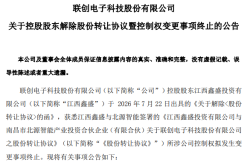
After market close on July 22, Lianchuang Electronics announced that the plan for a Jiangxi state-owned enterprise to take the helm, disclosed last December, had been officially terminated, but almost at the same time, its controlling shareholder, Jiangxi Xinsheng, proposed a new control transfer scheme.
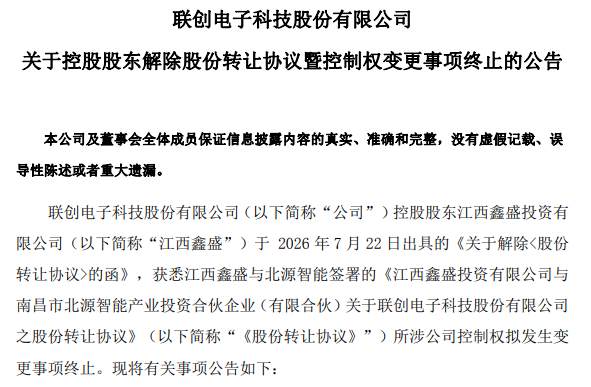
Trading in the company's shares has been suspended starting July 23, with the suspension expected to last no more than two trading days. This nearly seven-month saga of control abruptly changed direction on the night of dense -released announcements, and the market entered a brief period of silent anticipation.
The origin of this control change can be traced back to December 24, 2025. At that time, Jiangxi Xinsheng signed a Share Transfer Agreement with Nanchang Beiyuan Intelligent Industry Investment Partnership, stipulating that Beiyuan Intelligent would acquire 70,866,100 unrestricted tradable shares held by Jiangxi Xinsheng at a total price of approximately 900 million yuan, representing 6.71% of the company's total share capital at the time. If the transaction was completed, Lianchuang Electronics' controlling shareholder would have changed to Beiyuan Intelligent, with Jiangxi State-owned Assets Venture Capital Management Co., Ltd. becoming the indirect controlling shareholder, and the actual controller would have changed to the Jiangxi Provincial State-owned Assets Supervision and Administration Commission.
However, nearly seven months have passed, and the transaction has yet to be completed. On July 22, 2026, Jiangxi Xinsheng officially issued a termination letter, stating that due to the fact that not all conditions precedent in the Share Transfer Agreement had been fulfilled, it decided to terminate the share transfer.
The announcement did not disclose in detail which conditions precedent had not been met, but the fact that the shares had not been transferred to the China Securities Depository and Clearing Corporation Limited for registration was already a given, and the relevant equity change report had also been declared invalid. After termination, Jiangxi Xinsheng still held 91,584,300 shares in the company, representing 8.66% of the total share capital, and Han Shenglong remained the actual controller. The company expressed deep regret for any inconvenience caused to investors by this termination.
While the old plan was terminated, a new plan has already been initiated. Jiangxi Xinsheng is planning to transfer some of its shares in the listed company, which may result in changes to the company's controlling shareholder and actual controller. The counterparty belongs to the business services industry, with the proportion of shares to be transferred ranging from 6% to 8%. All parties are currently discussing and negotiating specific transaction plans and agreements.
Unlike the clear state-owned background of the previous round, the identity of the counterparty in this transaction remains unclear. The term business services industry covers a wide range, from corporate management consulting and investment management to legal services, thus amplifying the room for market interpretation. The announcement also explicitly warned that the matter was only at the intention -stage and carried significant uncertainty.
Compared to the clearly identifiable state-owned buyer in the old plan, the true identity of the buyer in this round remains to be revealed. Before the official announcement, the market had apparently caught wind of the news, as Lianchuang Electronics' share price had risen for three consecutive trading days starting July 20, with a cumulative deviation of over 20% from the closing price, triggering abnormal fluctuations. As of the close on July 22, the share price stood at 7.23 yuan per share, with a total market capitalization of 7.646 billion yuan, but the cumulative decline in the share price since the beginning of 2026 had reached approximately 34.39%.
In response to the abnormal share price movements, the company stated after verification that, apart from this new share transfer agreement, there were no other significant matters that should have been disclosed but were not. The premature abnormal share price movements stood in stark contrast to the company's dismal fundamentals.
According to the company's annual report, Lianchuang Electronics achieved revenue of 8.259 billion yuan in 2025, a year-on-year decrease of 19.12%, with a net loss attributable to the parent company of 1.011 billion yuan, representing an 82.94% year-on-year increase in losses. The cumulative losses over three years reached 2.556 billion yuan, and the company's asset-liability ratio had climbed to 90.74% by the end of 2025.
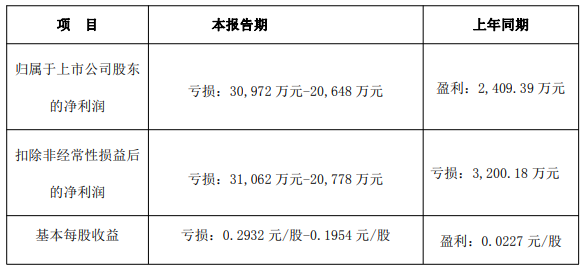
The downward trend continued into 2026, with the company expecting a net loss attributable to the parent company of between 310 million yuan and 206 million yuan for the first half of the year, compared to a profit of 24.0939 million yuan in the same period last year. The company explained that this was mainly due to multiple factors, including significant price increases in memory chips, weakening demand in downstream end markets, and intense competition in the consumer electronics industry.
From an industry perspective, Lianchuang Electronics is not without highlights. In 2025, the company's automotive optics business achieved revenue of 3.072 billion yuan, a year-on-year increase of 49.10%, with automotive lens revenue increasing by 83.88% year-on-year. As a major global supplier of ADAS lenses, the company has deep partnerships with international solution providers such as Mobileye and Nvidia, as well as domestic leading platforms like Horizon Robotics and Baidu.
According to the company's public plans, the Hefei Automotive Optics Industrial Park is expected to reach full production in 2026. However, the rapidly growing automotive optics business is not yet sufficient to support the overall performance of the company. According to the annual report data, revenue from touch display products decreased by 61.50% year-on-year, while non-automotive optics revenue decreased by 41.67% year-on-year. The decline in traditional businesses is dragging down overall performance.
From a Jiangxi state-owned enterprise to a mysterious buyer in the business services industry, the story of Lianchuang Electronics' control transfer is entering its second act. The mystery may be unveiled after two trading days of suspension, but for this company, which holds a strategic position in the automotive optics sector yet is mired in financial difficulties, who takes the helm may only be the first challenge; returning to profitability is the true test of survival.
-
Ofilm Teams Up with ADSensE to Propel Large-Scale Deployment of All-Solid-State LiDAR Powered by ADS6311 Chip!
-
![]()
Loss of 2.5 Billion Yet Facing Strong Demand for Shares? Another Battle for Control of Lianchuang Electronics
-
![]()
Huawei’s Enjoy Series Flies Off the Shelves, Prompting Xiaomi to Double Down on Budget Smartphones
-
![]()
Beijing Hyundai's Top Executive Criticizes Industry Disorder: Certain Brands Treat Customers as Beta Testers
-
![]()
The domestic mobile phone market has declined for five consecutive quarters! Huawei defies the trend with significant growth: maintains its top market share
-
Annual Revenue Surpasses 3 Billion: An Automotive Trim 'Little Giant' Makes Its Debut on the Beijing Stock Exchange
-
![]()
The Space Force Wants to Spend $30 Billion on Rocket Launches: Is Trump Doubling Down, and Is SpaceX the Big Winner?
-
![]()
Going Crazy! One out of Every Three Plug-in Hybrids Sold in Europe is a Chinese Vehicle