Huawei’s Enjoy Series Flies Off the Shelves, Prompting Xiaomi to Double Down on Budget Smartphones
 07/23 2026
 419
419
Source: YuanSight
Could rising memory prices spell the end for budget smartphones next year? Major smartphone makers are more worried than you might think.
Recently, two major developments from the supply chain have ignited intense discussions within the industry.
According to Jiemian News, citing industry insiders, smartphone manufacturers downstream are putting up strong resistance to the surging prices of memory components. Notably, OPPO and Vivo recently turned down Samsung’s memory price quotes for the third quarter.
Shortly thereafter, reports surfaced that Xiaomi had raised its smartphone shipment target for all of 2026 from around 90 million units to 110 million units—a substantial increase of approximately 16%. Most of this additional volume is expected to come from low-end models.
The memory price surge, initially fueled by demand for AI computing, has sent shockwaves through the supply chain, causing smartphone memory prices to skyrocket by over 300%. As a result, budget smartphones—where memory now accounts for up to 40% of the total component costs—have become the primary focus for manufacturers’ adjustments.
Media reports reveal that over the past six months, several domestic smartphone manufacturers have slashed production capacity for their mid-to-low-end products by 15% to 20%. Furthermore, numerous budget models released this year have seen price hikes ranging from 100 to 300 yuan, sparking concerns that “budget smartphones may vanish next year.”
However, the market downturn resulting from manufacturers collectively reducing orders for budget smartphones has been more severe than anticipated.
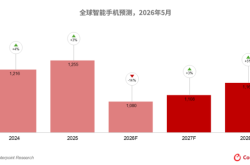
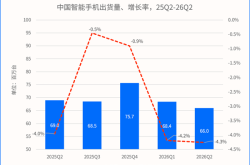
IDC data shows that in the second quarter of 2026, domestic smartphone shipments reached approximately 66.01 million units, marking a 4.3% year-on-year decline—the fifth consecutive quarter of contraction. Counterpoint further downgraded its global smartphone shipment forecast for the year in early June to roughly 1.08 billion units, a 13.9% year-on-year decrease and the lowest figure since 2013.
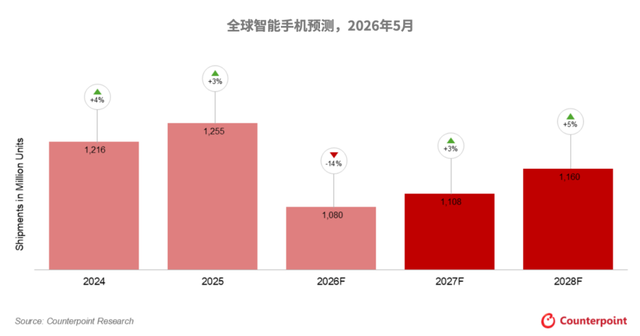
Source: Counterpoint
As downstream manufacturers intensify their resistance and consumers refuse to shoulder the brunt of upstream cost increases, the year-long standoff over memory price hikes is nearing a turning point.
01 Market Contraction
Over the past year, faced with soaring upstream memory prices, multiple smartphone manufacturers have adopted a unified strategy: raising prices and streamlining their mid-to-low-end product lines to safeguard overall revenue and profit margins.
According to Phoenix Finance, several leading domestic smartphone brands launched a fresh round of price adjustments in early March this year, affecting most models currently on sale as well as upcoming releases. The scale and magnitude of these increases reached a five-year high.
Additionally, Tencent DeepNet recently cited the latest data from channel partners, indicating that the retail prices of several mid-to-low-end models with configurations like 8GB+128GB and 12GB+256GB have risen by 200 to 400 yuan.
Counterpoint’s “Memory Price Tracking Report” reveals that the sharp rise in memory chip prices during the first quarter of 2026 caused smartphone bill-of-materials (BOM) costs to increase by over 20% quarter-on-quarter, with entry-level products bearing the brunt of the impact.
Take budget smartphones priced below $200 (approximately RMB 1,353) as an example. Given current memory prices and assuming the cost of other components remains stable, a new model with a 6GB LPDDR4X + 128GB eMMC storage configuration would see storage devices account for 43% of the total BOM cost.
Under the pressure of high memory costs, nearly all leading manufacturers have proactively streamlined their low-end product lines over the past six months, redirecting limited resources toward more profitable mid-to-high-end products. However, given the already saturated smartphone market, this adjustment has triggered a market reaction far greater than expected.
Data from the China Academy of Information and Communications Technology shows that the average replacement cycle for smartphones in China has now reached 40.2 months—nearly three and a half years. IDC predicts that by 2026, this cycle may extend further to over 42 months, setting a new record.
In terms of market sales, IDC data indicates that in the first quarter of 2026, smartphone shipments in China reached approximately 69.04 million units, a 3.3% year-on-year decline, with entry-level budget smartphones plummeting by as much as 13.9%. In the second quarter, shipments reached approximately 66.01 million units, down 4.3% year-on-year.
Furthermore, as the demand-stimulating effect of government subsidies weakens, overall smartphone sales in China during the “618” shopping festival this year fell by nearly 15% compared to the same period last year, indicating clear short-term demand fatigue.
Under such market conditions, if manufacturers continue to pass upstream costs onto consumers through price hikes, it could further suppress replacement intentions, causing already weak demand to shrink even further. This would ultimately result in the precarious situation of declining shipment volumes and squeezed profit margins.
The market’s verdict is clear: price hikes are not the solution. The new challenge facing major smartphone manufacturers has shifted from cost control to competing for market share and retaining their core customer base. Budget smartphones are poised to become a pivotal variable in this competition.
02 Memory Price Volatility
Behind manufacturers’ renewed focus on budget smartphones lies not only a recalibration of their consumer market strategy but also a significant signal: downstream manufacturers are no longer willing to absorb the escalating costs of memory.
Over the past year, driven by the AI narrative, upstream memory prices have transitioned from sharp increases to “chaotic” hikes. As AI large model training and inference scales expand, AI data centers’ demand for high-bandwidth memory (HBM) and server DRAM has surged exponentially.
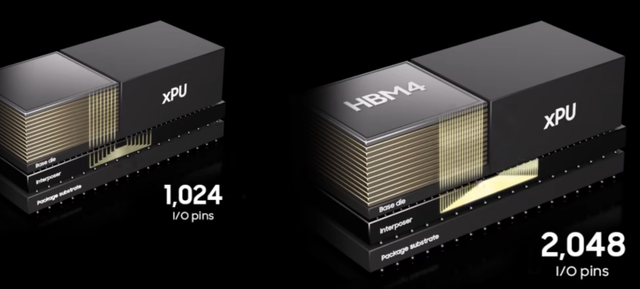
Source: Samsung
To capitalize on this trend, Samsung, SK Hynix, and Micron—collectively holding 90% of the global market share—have shifted their advanced memory production capacity toward higher-margin enterprise products, significantly reducing consumer-grade memory output.
Combining data from multiple agencies, the memory market has continued its upward trajectory since the second half of 2025. In the first quarter of this year, contract prices for generic DRAM rose by 55% to 60% quarter-on-quarter, while NAND flash memory prices increased by over 30%. Consumer-grade high-capacity QLC products saw price hikes of no less than 40%.
Corresponding to these soaring prices, the top three memory manufacturers have reported record financial results.
Samsung’s Q2 2026 earnings preview indicates an estimated operating profit of KRW 89.4 trillion (approximately USD 58.4 billion), a new quarterly record, up 56% quarter-on-quarter and far exceeding analysts’ average forecast of KRW 84.2 trillion.
SK Hynix’s Q1 sales surpassed KRW 50 trillion for the first time, with an operating profit of KRW 37.6 trillion and an operating profit margin of 72%, both company records.
Micron’s Q3 fiscal year report shows revenue of USD 41.46 billion, a 346% year-on-year increase and a 74% quarter-on-quarter rise, with net profit surging over 100% to USD 28.24 billion.
It is evident that the original memory upcycle has deviated from fundamental pricing dynamics, transforming into a price-gouging spree by the top three manufacturers.
Consequently, resistance from downstream manufacturers and the market has become almost inevitable.
TrendForce’s latest research report notes that smartphone manufacturers’ demand for memory purchases has weakened significantly. Most brands completed major new product production and component procurement in the first half of the year, while sluggish smartphone sales have eroded memory suppliers’ bargaining power.
As procurement costs for smartphone manufacturers approach their upper limits and consumers refuse to pay premium prices for memory, pressure is mounting on memory manufacturers to slow their price hikes. The smartphone industry is poised for a new price inflection point.
Additionally, domestic manufacturers like Changxin Memory Technologies are expanding LPDDR4X supply by increasing production capacity and improving yields, filling gaps left by Korean and U.S. manufacturers in certain mature process nodes. This could accelerate the reshaping of the mobile DRAM supply structure for smartphones.
03 Reevaluating Budget Smartphones
As leading manufacturers reevaluate their mid-to-low-end product lines, market demand for “budget smartphones” is also evolving. Parameter comparisons and price subsidies are losing their effectiveness, with differentiated selling points becoming the new battleground for budget models.
Capitalizing on this shift, Huawei, which has solidified its position in the mid-to-high-end segment, is now accelerating its push into the budget smartphone market.
Counterpoint data shows that Huawei’s domestic market share reached 23% in the second quarter of 2026, the highest since Q4 2020. Researchers attribute this growth partly to strong demand for the Enjoy 90 Pro Max, which drove a 24% year-on-year increase in shipments.
From a market performance perspective, the Enjoy 90 Pro Max’s starting price of RMB 1,699 stands out in the current budget smartphone market, where “price hikes and reduced configurations” are prevalent. Third-party data indicates that the model surpassed 3.1 million activations within three months of its launch.
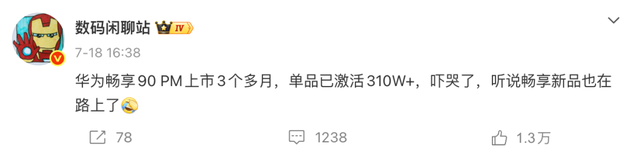
Screenshot sourced from Weibo @DigitalChatStation
From a product positioning standpoint, the Enjoy 90 Pro Max features the Kirin 8000 processor, an 8,500mAh large battery, and the native HarmonyOS, creating a device that prioritizes battery life and basic smoothness over “high-end specs”—aligning more closely with the actual needs of budget smartphone users.
Huawei’s success in the budget smartphone market amid upstream cost increases demonstrates that precision in entry-level product functionality, supply chain control, and brand and ecosystem premium capabilities have become new levers for manufacturers adjusting their budget smartphone product lines.
Xiaomi’s decision to raise its shipment target and allocate the additional volume to low-end models stems from changes in the upstream supply chain. According to Jiemian News, citing a source close to Xiaomi, the company believes the current memory market is poised for a reversal.
In the long run, demand for budget smartphones will not disappear but will shift from one brand to another. For major manufacturers, ensuring a strong user base for budget smartphones—beyond cost control—has become crucial in the current saturated market competition.
Some images sourced from the internet. Please notify us for removal if there are any copyright infringements.
-
Ofilm Teams Up with ADSensE to Propel Large-Scale Deployment of All-Solid-State LiDAR Powered by ADS6311 Chip!
-
![]()
Loss of 2.5 Billion Yet Facing Strong Demand for Shares? Another Battle for Control of Lianchuang Electronics
-
![]()
Huawei’s Enjoy Series Flies Off the Shelves, Prompting Xiaomi to Double Down on Budget Smartphones
-
![]()
Beijing Hyundai's Top Executive Criticizes Industry Disorder: Certain Brands Treat Customers as Beta Testers
-
![]()
The domestic mobile phone market has declined for five consecutive quarters! Huawei defies the trend with significant growth: maintains its top market share
-
Annual Revenue Surpasses 3 Billion: An Automotive Trim 'Little Giant' Makes Its Debut on the Beijing Stock Exchange
-
![]()
The Space Force Wants to Spend $30 Billion on Rocket Launches: Is Trump Doubling Down, and Is SpaceX the Big Winner?
-
![]()
Going Crazy! One out of Every Three Plug-in Hybrids Sold in Europe is a Chinese Vehicle