DeepSeek Permanently Reduces Prices! But Liang Wenfeng Doesn't Want to Be a 'Cyber Bodhisattva'
 05/25 2026
 494
494
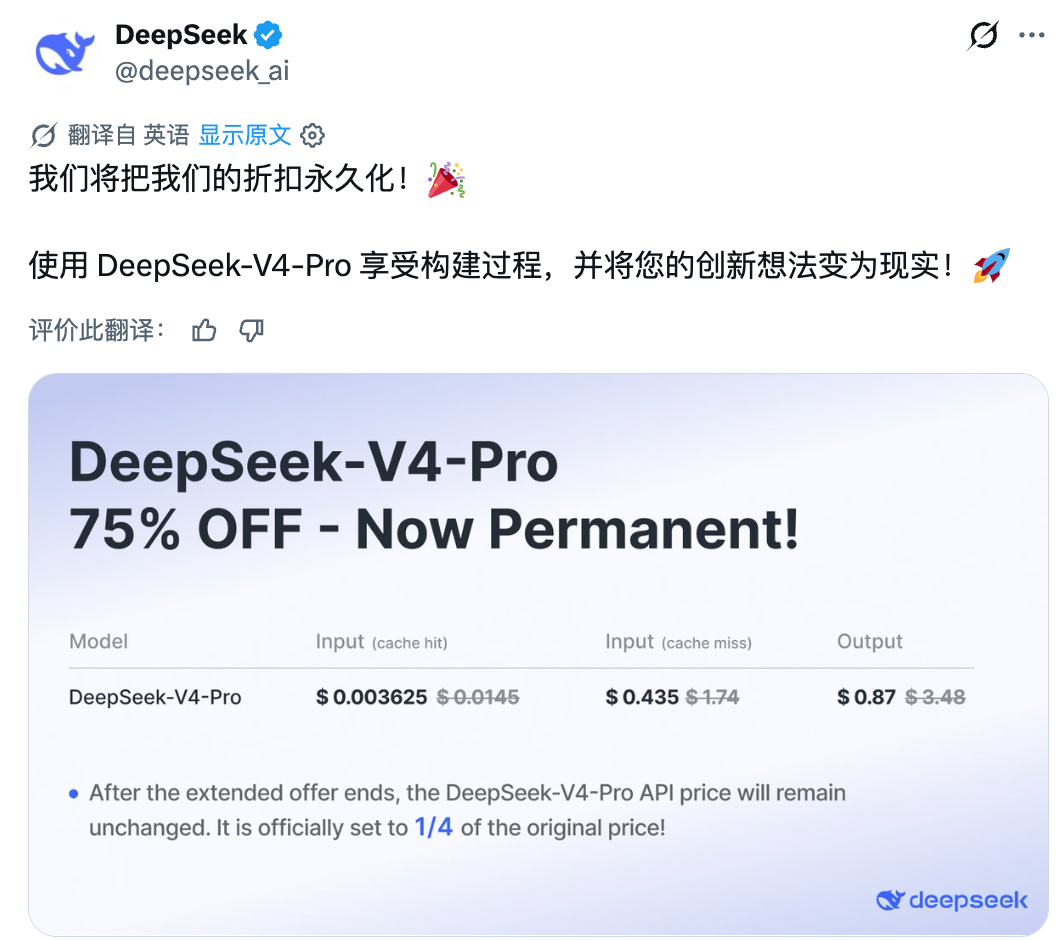
DeepSeek has announced the 'permanentization' of a 75% discount for its V4-Pro API, effective globally.
The final pricing structure is as follows: The base input price has been reduced from $1.74 per million Tokens to $0.435 per million Tokens, while the output price has dropped from $3.48 per million Tokens to $0.87 per million Tokens. For input cache hits across the entire API product line, DeepSeek has implemented even steeper discounts: $0.003625 per million Tokens, adopting a Pinduoduo-style floor pricing model.
A wave of acclaim soon emerged on social media, including X, hailing Liang Wenfeng as the 'Cyber Bodhisattva,' 'Feng Shen,' or 'Saint Liang' of the AI circle. The sentiment isn't merely about affordability—DeepSeek has long been dubbed the 'AI Pinduoduo,' offering free services to consumers and low-cost options to businesses. The world has grown accustomed to its affordability, but the challenge with this round of price cuts lies in the fact that AI prices are rising globally.
Reports indicate that Liang Wenfeng will personally invest up to RMB 20 billion in DeepSeek's record-breaking Series A financing round, accounting for 40% of the total funding. While most companies prioritize strengthening cash flow and enhancing performance during fundraising, Liang Wenfeng does not intend to attract investors with promises of commercialization. Instead, he remains committed to open-source principles and the pursuit of AGI, delivering on his promises with this price cut. The last time a company so boldly declared its lack of interest in profit was Pinduoduo. In 2024, its co-founder explicitly stated to investors during an earnings call: 'Starting from Q3, our profits will gradually decline and will not rebound in the short term. In the long run, a decline in profitability is inevitable.' Its stock price plummeted.
Sam Altman frequently advocates for AI democratization, yet OpenAI is rapidly moving toward the opposite of its namesake: becoming 'CloseAI.' Liang Wenfeng, however, is actively working to make AI accessible and affordable for everyone and every enterprise. But is Liang Wenfeng truly a living bodhisattva? Not quite. He is an entrepreneur, and open-source accessibility is merely a business model choice—one that is rare and commendable today and will become even scarcer in the future.
Because: AI is becoming increasingly expensive.
This week, Microsoft canceled its internal Claude Code licenses due to prohibitively high token-based billing. Despite heavily investing in OpenAI and providing Azure cloud services to the company, Microsoft—with its enviable cloud computing resources—still finds token costs painful. Similarly, Uber's CTO reported an embarrassing situation to management in April 2026: the company's AI budget for the entire year of 2026 was exhausted in just four months. Ninety-five percent of engineers were using AI programming tools monthly, and 70% of submitted code was AI-generated. His exact words were: 'I’m back to the drawing board because the budget I thought I would need is blown away already.'
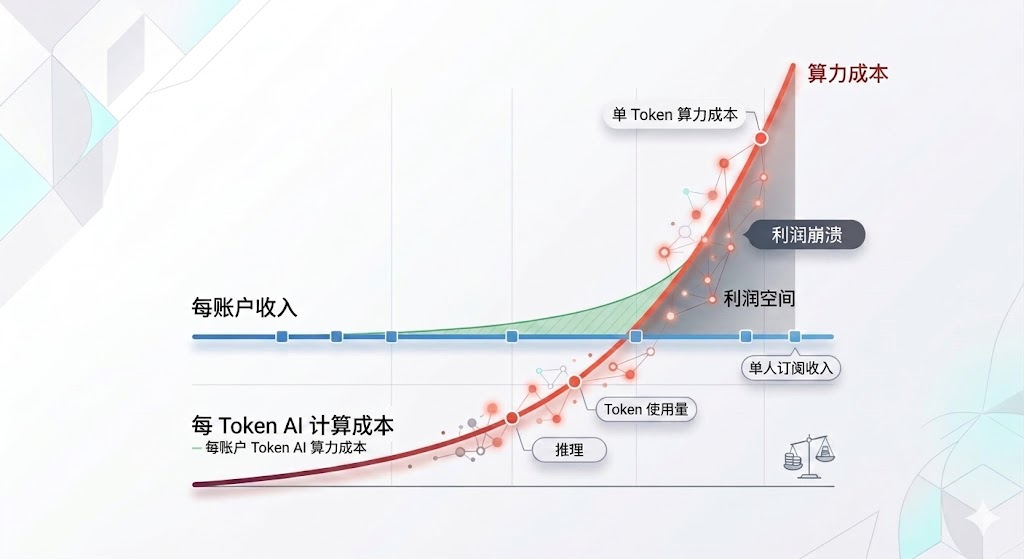
The rapid depletion of token budgets by major companies is partly due to employees' casual overuse, but the root cause lies in the rising cost of AI. AI software prices in the United States have increased by 20% to 37% over the past year. Anthropic, OpenAI, and Google have all quietly raised the effective prices for the same AI outputs over the past six months.
(Image Source: X)
The prevailing belief was that 'the larger the scale of AI adoption and the higher its industrialization, the lower the costs and the happier enterprises would be.' How naive.
Moreover, this trend is irreversible. Prices are determined by supply and demand, not costs, and the AI supply and demand relationship (supply-demand dynamics) have completely reversed by 2026. Previously, major companies pleaded with everyone to use AI, educating the market and promoting the technology with subsidies. How many cups of 'Qianwen milk tea' have you had? Now, everyone is increasingly proactive in using AI—addicted after the first try. AI programming, AI documentation, AIGC, and even AI search are becoming more widespread. The era of AI subsidies has ended.
The more people use AI, the greater the demand, and the tighter the token resources become. Consequently, computing power shortages have spread from GPUs to CPUs, storage, and even bandwidth. Intel, Micron, SK Hynix, Samsung Electronics, SanDisk, and domestic companies like Jiangbo Long and the 'Two Changs' are reaping the benefits alongside NVIDIA. Where does the semiconductor giants' revenue, which doubled in 2026, truly come from? It certainly doesn't stem from the triangular closed-loop investment of OpenAI-Oracle-Microsoft. The pain businesses feel is just the beginning. The 'hierarchical' emphasis on free and paid tiers in AI products like ChatGPT, Claude, Gemini, and Doubao will also leave individual users increasingly torn.
This is akin to ride-hailing services: during the frenzy, you could commute to work in a premium car for free, with capital covering the cost. Once user habits were established and subsidies ended, prices returned to normal levels, and those who should take the subway still do. AI is no different. Against the backdrop of rising token prices across the industry, DeepSeek's insistence on slashing prices is no longer merely a display of 'cyber bodhisattva' personal courage but an exhibition of reverse pricing power: 'I can be this cheap, operate normally, and maintain quality.'
DeepSeek could easily avoid being this cheap if Liang Wenfeng wished. As a result, people are beginning to worry: Will DeepSeek become the Linux of the AI era—highly influential but unable to generate significant profits? Linux has contributed more to the IT industry than Windows or Android (which is based on the Linux kernel), but it is open-source and has not spawned commercial giants like Microsoft or Google. DeepSeek currently wields immense influence but lags far behind Silicon Valley's top three in commercial capabilities, even unable to compete with domestic players like Kimi, MiniMax, and Zhipu. Revenue rankings for the 'Four Little Dragons' in 2025: Zhipu (RMB 724 million in 2025) > MiniMax (approximately RMB 560 million in 2025) > Yuezhiyou (approximately RMB 200 million) > DeepSeek (unknown but lower).
Liang Wenfeng makes money through AI quantization and can personally invest RMB 20 billion in DeepSeek, but the narrative of 'powering through love' cannot last indefinitely.
Under the open-source model, others can also distill, deploy, and retrain models, causing DeepSeek's technological moat to thin over time. This is why you often see news of 'record-breaking' achievements: Zhipu's GLM-5.1 set a new global record on the SWE-bench Pro benchmark after going open-source, and Xiaomi's MiMo-V2.5-Pro topped the global open-source large model rankings... A joint report by MIT and Hugging Face revealed that open-source models developed in China accounted for 17.1% of global downloads over the past year, surpassing the United States' 15.8% to rank first globally.
No wonder voices in Silicon Valley are increasingly saying: 'There must be an American version of DeepSeek. We cannot stand by and watch the AI industry repeat the stories of Shein, Temu, or TikTok.' 'If the United States fails to cultivate an open-source champion, the world will operate on open-source models and software produced by whichever country can deliver the strongest, most stable, cheapest, customizable, scalable, and personally and commercially adaptable solutions.' Topics involving great power competition may sound grand, but the underlying competition is very real.
Behind DeepSeek's rise lies a narrative of self-reliance and substitution. The V4's support for Ascend chips has been met with enthusiasm. Powered by domestic computing capabilities, the price competitiveness DeepSeek currently demonstrates is just the beginning. In its technical report, DeepSeek stated that the price of V4-Pro would drop significantly after the mass launch of Ascend 950 supernodes in the second half of the year. The good times are yet to come.
There is also the advantage of advanced AI talent. AI talent has reached 'luxury' price levels, but China's talent is relatively cheaper. Lei Jun poaching Luo Fuli from DeepSeek with a RMB 10 million annual salary made headlines, while Zuckerberg was spending $1 billion on talent acquisition, including Acqui-hires. However, the gap between what $1 billion can achieve and what a RMB 10 million salary can produce is not 700-fold. The price difference in AI talent will ultimately translate into systemic price differences in the token production ecosystem.
An even greater competitive edge lies in the energy system—the first layer of Jensen Huang's five-tier AI cake.
At the end of AI is computing power, and at the end of computing power is electricity. In April 2026, DeepSeek advertised job openings for senior operation and maintenance engineers and senior delivery managers at data centers in Ulanqab, Inner Mongolia, indicating its plan to build token factories in the west and extend its cost advantages from the software layer to the physical layer. The last time I wrote about Ulanqab was when Kuaishou built a data center there: close to power plants and with a climate conducive to heat dissipation. Moreover, green electricity prices in western China are approximately RMB 0.2-0.3 per kWh, just one-fifth to one-fourth of those in Europe and the United States.
Not only is western China's green electricity competitive. Data from the International Energy Agency in 2025 shows that China's total installed power generation capacity has surpassed 2300 GW, accounting for about 22% of the global total—the highest in the world. The United States has about 1300 GW. More critically, China possesses the world's most complete power structure: thermal power, hydropower, wind power, nuclear power, and photovoltaics are all fully represented. Data indicates that China's industrial electricity price has long been maintained at $0.06 to $0.08 per kWh, while California's industrial electricity price has approached $0.18 per kWh, and some regions in Germany exceed $0.25 per kWh. This means that training a 10,000-card cluster is inherently dozens of percentage points cheaper in China than in Europe or the United States.
Electricity costs account for 60%-70% of the operational expenses for large AI models. It's not just the models that consume electricity—cooling is a major expense. Infrastructure enthusiasts have even built data centers directly on the seafloor, leveraging nearby offshore wind power for input and seawater circulation for free cooling. With grand initiatives like the 'West-to-East Electricity Transmission' and 'East Data, West Computing,' China boasts strong regional scheduling capabilities for electricity and computing power. Guizhou, Inner Mongolia, and Ningxia are already core nodes of the 'East Data, West Computing' strategy, and the pathways for relocating AI computing centers to the west have long been prepared.
Using AI in China essentially means using AI trained by a more competitive energy system—more economical and accessible AI. This is one reason why overseas revenue for companies like Kimi and MiniMax surged after the Spring Festival, not just because of stronger algorithms but also due to the 'electricity price hack.'
NVIDIA may define the price of high-end computing power, but DeepSeek and others are gaining control over token pricing. You might argue that 'cheap AI is no good.' AI is indeed a case of 'you get what you pay for.' DeepSeek V4 has only narrowed the gap between open-source and closed-source models to its smallest historical level, with officials acknowledging the objective gap with top-tier models like GPT. Moreover, it is not multimodal—it can recognize images but cannot generate them.
However, this has not stopped the community from flocking to DeepSeek. The reason is simple: Most real-world business scenarios do not require invoking the world's strongest model every time. Consulting, customer service, summarization, translation, code completion, enterprise knowledge bases, and automation workflows do not demand peak intelligence but rather 'good enough + cheap enough + stable enough.' When DeepSeek V4's inference costs are just approximately 1% (Flash) to 11% (Pro) of GPT-5.5's, an enterprise can invoke dozens of times more tokens with the same budget, experiment with more prompt chains, and iterate more agent workflows, potentially achieving better results. After all, AI is fundamentally a 'probability' game—as long as it's cheap enough, why not settle for 'good enough' and still get results?
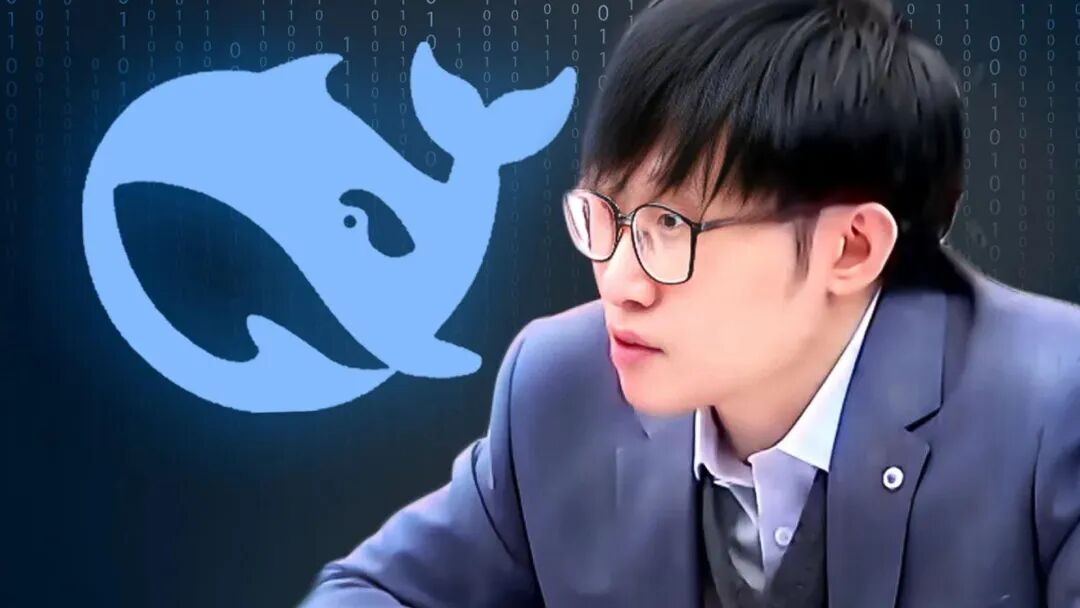
Thus, the more expensive AI becomes, the more valuable DeepSeek's affordability becomes, and the more valuable DeepSeek the company becomes. Liang Wenfeng and his investors understand this better than anyone.
-
Ofilm Teams Up with ADSensE to Propel Large-Scale Deployment of All-Solid-State LiDAR Powered by ADS6311 Chip!
-
![]()
Loss of 2.5 Billion Yet Facing Strong Demand for Shares? Another Battle for Control of Lianchuang Electronics
-
![]()
Huawei’s Enjoy Series Flies Off the Shelves, Prompting Xiaomi to Double Down on Budget Smartphones
-
![]()
Beijing Hyundai's Top Executive Criticizes Industry Disorder: Certain Brands Treat Customers as Beta Testers
-
![]()
The domestic mobile phone market has declined for five consecutive quarters! Huawei defies the trend with significant growth: maintains its top market share
-
Annual Revenue Surpasses 3 Billion: An Automotive Trim 'Little Giant' Makes Its Debut on the Beijing Stock Exchange
-
![]()
The Space Force Wants to Spend $30 Billion on Rocket Launches: Is Trump Doubling Down, and Is SpaceX the Big Winner?
-
![]()
Going Crazy! One out of Every Three Plug-in Hybrids Sold in Europe is a Chinese Vehicle