Wu Yongming Places His 'Bets' on AI: Alibaba at a Critical Juncture
 05/25 2026
 470
470
Author/Vincent
Editor/Jiajia
'Previously, we aimed for models that excelled in 'verbal proficiency,' but now, our focus has shifted to models capable of 'practical execution,'' remarked Zhou Jingren, head of Alibaba Group's Tongyi Large Model Business Unit, at the recent Alibaba Cloud Summit. With the advent of Qianwen Qwen3.7-Max, large models have been propelled into a new era.
It is reported that this represents the third iteration of the Qianwen large model within the past three months. Coupled with its extensive promotion in 2025, it signifies that, under Wu Yongming's 'ALL IN AI' strategy, Qianwen has supplanted Kuake as Alibaba's vanguard and a premier gateway for C-end users in its AI endeavors.
In fact, a closer examination of Alibaba's AI strategy reveals an internal transition from 'Kuake's decline' to 'Qianwen's ascent.' This appears to be a strategic recalibration by Wu Yongming and Alibaba. After investing substantial resources in Kuake and receiving market feedback, the Qianwen app emerged as a savior, assuming Alibaba's mantle of forging an 'AI gateway.'
【1】Kuake's Ascent: The 'Chosen One' in Alibaba's AI Strategy
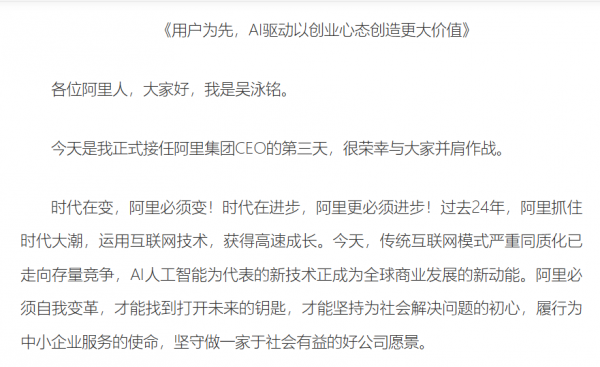
'If we fail to keep pace with the AI era's transformations, we will inevitably be supplanted by new entities,' declared Wu Yongming, Alibaba's newly appointed CEO, in a letter to all employees in September 2023. He emphasized that the traditional internet model had reached its zenith, and Alibaba must embrace AI to fuel its growth in the next decade.
 (Source: CNR)
With a clear direction set, Alibaba embarked on a series of AI-driven reforms. In November of that year, Alibaba unveiled its first batch of strategic-level innovative businesses, with the previously obscure Kuake being designated as the C-end strategic gateway for Alibaba's AI endeavors.
Why Kuake? From Alibaba's management perspective, led by Wu Yongming, the rationale was straightforward:
Firstly, Kuake's user demographics and growth trajectory. In September 2023, Kuake's daily active user growth surpassed 35%, with a user base predominantly comprising individuals under 35, aligning with Alibaba's objective of penetrating the youth market.
Secondly, Kuake's technological prowess. In November 2023, Kuake unveiled a self-developed large model boasting hundreds of billions of parameters, topping the C-Eval and CMMLU evaluation lists with scores of 89 and 77.08, respectively.
In Wu Yongming's estimation, Kuake possessed user growth, a youthful user base, and its own technological capabilities, making it the ideal candidate for Alibaba's C-end AI product: 'In the era of large models, targeting the youth demographic, Kuake has a tremendous opportunity to create revolutionary search products.'
With Wu Yongming's unwavering support, Kuake garnered strategic priority resources from Alibaba:
In 2024, Kuake successively introduced AI writing, AI PPT, AI question-answering, academic search, AI health assistant, AI image generation, and other functionalities. Through these comprehensive features, Kuake aimed to present a tangible and complete product form to users.
In March 2025, Alibaba announced that Kuake would be upgraded to an 'AI Super Frame,' marking its official establishment as the primary AI gateway. Wu Jia, former president of Alibaba's Intelligent Information Business Group, was promoted to Vice President of Alibaba Group and CEO of Kuake, reporting directly to Wu Yongming. This signified the establishment of an independent, resource-concentrated structure for strategically vital businesses.
Since November 2023, Kuake has been regarded as a super gateway for Alibaba's AI strategy, serving as a bridge to connect with C-end users. Wu Jia even projected that Kuake would become the first domestic super AI application with over 100 million daily active users (DAU) by 2025.
This was a high-stakes gamble. From a corporate perspective, Wu Yongming wagered that Kuake could become the gateway for young users in the AI era. For the Kuake team, led by Wu Jia, they bet on the team's and their own development prospects and career trajectories.
【2】Data Hype: Why Kuake Failed to Become an AI Gateway
Fueled by Alibaba's massive resource investment, Kuake once emerged as a star product in Alibaba's AI transformation.
Data from Qimai indicated that by the end of 2024, Kuake's cumulative downloads exceeded 370 million, with users born after 2000 accounting for over 50%. It ranked first on the AI category charts in app stores for several consecutive months. By 2025, Kuake's total monthly active users had reached nearly 150 million, with daily active users stabilizing at the 50 million mark.
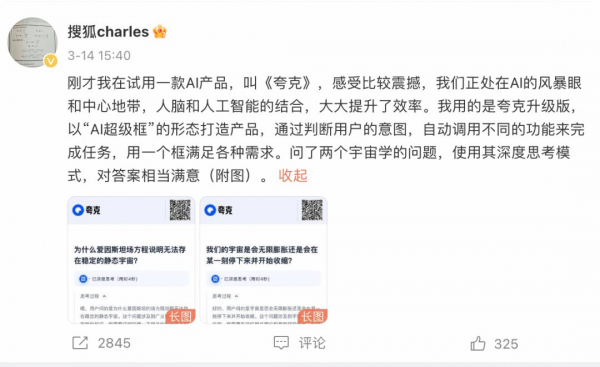
The user growth figures appeared impressive. Even when Kuake unveiled the 'AI Super Frame,' Zhang Chaoyang remarked, 'Using one frame to meet various needs, I posed two cosmological questions and utilized its deep thinking mode. I was quite satisfied with the responses.'
In the 'AI Product Evaluation Experience Series Report' released by Huachuang Securities, it directly stated, 'The new Kuake's AI Super Frame has the potential to become a national-level 'AI Super Gateway.'
 (Source: Weibo)
With industry authority endorsement and Kuake's impressive data, many seemed to believe that Kuake had fulfilled Wu Yongming's expectations, becoming Alibaba's super gateway in the AI era.
However, a closer look reveals that both Zhang Chaoyang and Huachuang Securities' evaluations pointed to Kuake's search adoption. This implies that users initially utilized search and then AI, still not breaking free from what Wu Yongming considered the traditional internet model.
More bluntly, behind the massive data lies structural data. LatePost revealed that in 2025, the usage rate of Kuake's AI functions was less than 20%, with nearly 80% of usage time still firmly centered on tools like cloud storage and scanning.
This means that although Kuake can compete with Doubao (172 million MAU) and DeepSeek (145 million MAU) in terms of users, user perception of the two is vastly different:
For users, Doubao and DeepSeek are AI tools and gateways. They visit these apps to experience AI services. However, Kuake is more akin to a browser and search engine with AI functionalities. Most users seeking AI services would think of Doubao and DeepSeek first, only utilizing Kuake's AI functions incidentally when browsing information through Kuake search.
The disparity in user perception and cognition led to the failure of Wu Yongming's strategy to establish Kuake as Alibaba's AI gateway. This is the most significant difference between Kuake and Doubao, DeepSeek, and even Tencent Yuanbao—not in data, but in user perception.
From a user mindset and perception standpoint, after betting on Kuake since November 2023 and investing massive strategic priority resources over the past two years, Alibaba ultimately gained not the coveted AI gateway but an AI functional upgrade to a traditional internet product with a relatively high proportion of young users.
【3】Setting Sail Again: Qianwen's Breakthrough Against All Odds
Just as 'adults nurture rather than merely screen,' after Kuake failed to meet the requirements of an AI gateway, Alibaba opted to focus on a different option, elevating the previously marginalized Tongyi app.
In November 2025, Alibaba relaunched the Qianwen project, officially renaming the Tongyi app to the Qianwen app. It is understood that this renaming was personally decided by Wu Yongming, aiming to position the Qianwen app as a super native AI application for C-end users.
Given that in the AI application field, Doubao and DeepSeek have already established their positions and taken the lead with functionalities like question-answering and office tools, Alibaba adopted a differentiated approach of 'not just conversing but also executing' to address users' AI pain points.
Alibaba's strategy is the '1+N' method, where '1' denotes the Qianwen app, and 'N' represents Alibaba's ecosystem businesses, such as Taobao, 1688, Xianyu, DingTalk, Kuake, and other scenario-based apps. Currently, the Qianwen app can return links to Taobao, 1688, and Xianyu, hoping to gain user acceptance through scenario-based linking.
To this end, during the 2026 Spring Festival on February 6, the Qianwen app launched a Spring Festival free order event. The first-day event concluded with 15 million orders, 15 times the originally anticipated 1 million orders. On the 14th, the Qianwen app integrated with Alibaba's ecosystem, including Fliggy and Damai, enabling users to purchase airline tickets, hotel stays, train tickets, and scenic spot tickets on the Qianwen app.
DataEye Research Institute estimated that the Qianwen app's budget during the Spring Festival reached 6 billion yuan, far surpassing Yuanbao's 1 billion yuan and Doubao's 1.5-2 billion yuan.
'DAU is not our primary metric; we primarily focus on user feedback and experience. For instance, the frequency with which users say 'Qianwen, help me' signifies the formation of a user mindset,' Wu Jia remarked. The 6 billion yuan marketing expenditure was aimed at altering user perception, not merely inflating user data.
With substantial investment and the selling point of 'not just chatting but also executing,' the Qianwen app successfully broke out during the Spring Festival.
QuestMobile data revealed that in September 2025, the Tongyi app had only 3.06 million monthly active users, while Doubao and DeepSeek had 172 million and 145 million, respectively. The Tongyi app was merely a fraction of their user base.
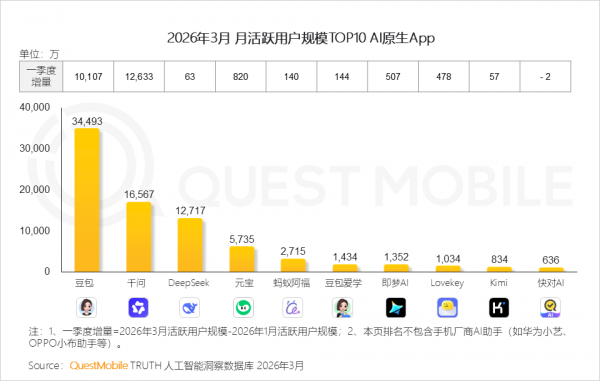
However, six months later, the Qianwen app caught up with Doubao and DeepSeek. In March 2026, the Qianwen app's monthly active users reached 170 million, surpassing DeepSeek's 130 million and ranking second only to Doubao's 340 million on China's AI native app charts.
More crucial than scale is the increment. In the first quarter of 2026, the Qianwen app added 126 million active users, ranking first among domestic AI native applications.
 (Source: QuestMobile)
It can be said that in terms of both incremental and existing users, the Qianwen app has ascended to the top tier of China's AI applications. After the misstep with Kuake, Wu Yongming also 'found his way back,' employing a differentiated competition against Doubao and DeepSeek to secure a crucial 'AI super gateway' for Alibaba's AI strategy.
The shift from Kuake to Qianwen may appear as a hasty 'change of horses,' but reviewing the performance of these two products, compared to Kuake's awkward positioning as a 'browser with AI functionalities,' the Qianwen app has caught up with the top tier in terms of data.
For Wu Yongming, launching the Qianwen app is also a self-correction of a previous misstep. Establishing user cognition and mindset for the Qianwen app will be Alibaba's primary objective in the next phase. This relates to whether the Qianwen app, which has gained a solid footing in terms of user scale, can become Alibaba's future super AI gateway.
END
-
Ofilm Teams Up with ADSensE to Propel Large-Scale Deployment of All-Solid-State LiDAR Powered by ADS6311 Chip!
-
![]()
Loss of 2.5 Billion Yet Facing Strong Demand for Shares? Another Battle for Control of Lianchuang Electronics
-
![]()
Huawei’s Enjoy Series Flies Off the Shelves, Prompting Xiaomi to Double Down on Budget Smartphones
-
![]()
Beijing Hyundai's Top Executive Criticizes Industry Disorder: Certain Brands Treat Customers as Beta Testers
-
![]()
The domestic mobile phone market has declined for five consecutive quarters! Huawei defies the trend with significant growth: maintains its top market share
-
Annual Revenue Surpasses 3 Billion: An Automotive Trim 'Little Giant' Makes Its Debut on the Beijing Stock Exchange
-
![]()
The Space Force Wants to Spend $30 Billion on Rocket Launches: Is Trump Doubling Down, and Is SpaceX the Big Winner?
-
![]()
Going Crazy! One out of Every Three Plug-in Hybrids Sold in Europe is a Chinese Vehicle