Inside Look at 'RedSkill': Is Xiaohongshu Emerging as the Premier AI App Store?
 05/25 2026
 566
566

Today, Xiaohongshu quietly initiated an internal testing phase for a project dubbed 'RedSkill'. Beneath the posts of selected bloggers, an official link to RedSkill is now visible. Clicking on this link directs users to a skill introduction page, complete with a 'Use Now' button for immediate engagement.
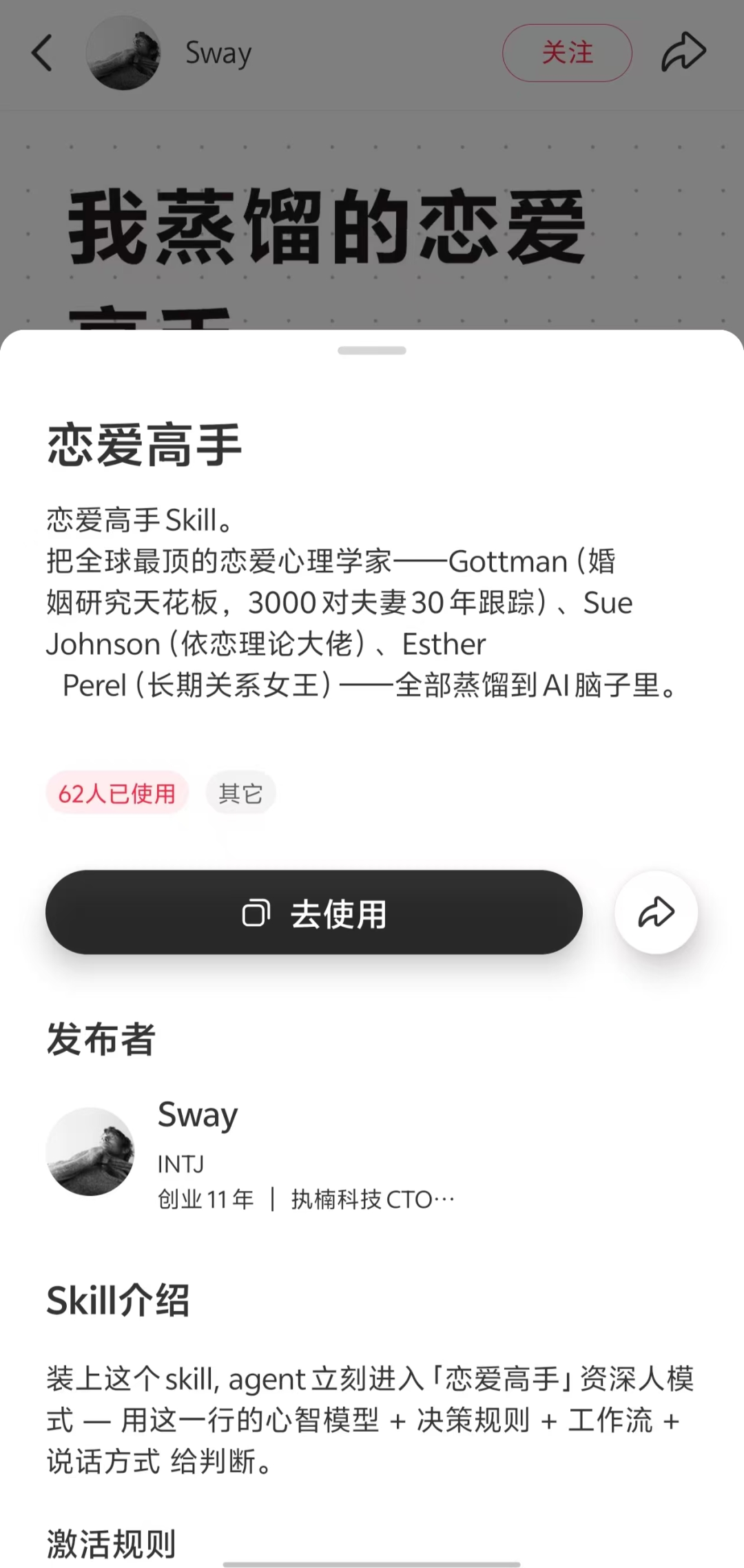
Upon clicking this button, users are automatically provided with a set of instructions:
'Please verify if the RedSkill store is installed. If not, follow the installation guide at https://fe-video-qc.xhscdn.com/fe-platform-file/104101b8320fbtcp4620653u0hejenq0004pf88gk8rtde.md to install only the CLI. Subsequently, proceed to install the xxx skill. If already installed, simply install the xxx skill.'
This move comes at a time when Xiaohongshu has been imposing stringent restrictions on AI-generated content and operations. Low-quality AI-generated notes and fabricated experiences are swiftly suppressed by the platform.
During the lobster craze, numerous users employed automation tools related to lobsters on Xiaohongshu. However, the initial excitement of successfully posting a note was often short-lived, quickly followed by the shock of account suspension. These suspensions were not only immediate but also retroactive; posts from two weeks prior might appear normal until Xiaohongshu's detection tools were upgraded, leading to account penalties.
Recall Tencent's SkillHub project? Accused of plagiarism by the founder of Lobster, Tencent swiftly added the project to its sponsor list. The top three projects at the time revolved around Xiaohongshu, including all-in-one assistants and automated data collection tools, but they were promptly removed.
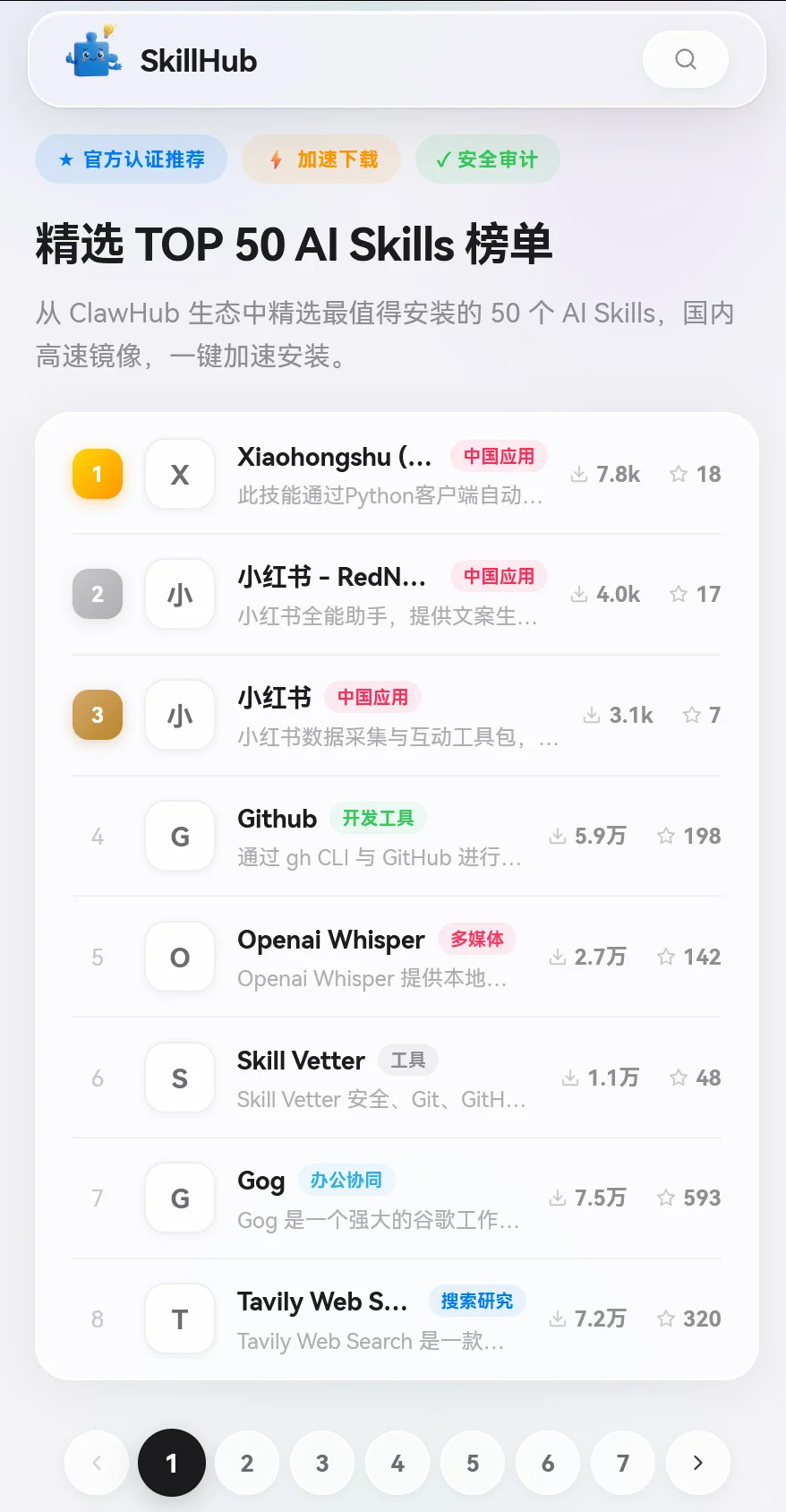
However, skill distribution operates on a distinct logic that aligns with Xiaohongshu's community philosophy, akin to attaching a PDF link beneath a main post. Currently, the internal testing phase does not appear to support paid skills, but this could evolve in the future.
The most intriguing aspect of RedSkill is whether Xiaohongshu will leverage official skills to grant AI access to some of its platform capabilities.
What is RedSkill?
To grasp RedSkill, we must first delve into its technical essence. According to the official installation and configuration scripts, RedSkill is essentially a lightweight command-line tool (CLI) that operates on the user's local machine.
When users execute the official installation command in their local terminal:
Bashcurl -fsSL https://fe-video-qc.xhscdn.com/fe-platform-file/104101b8320fbjem2620653u0hejenq0004pf88g6ask5i.sh | bash
The system downloads and configures a CLI tool named redskill. Once installed, users can manage and install various skills in a minimalist command-line fashion, akin to assembling building blocks locally:
Bashredskill install xx-skill
It's noteworthy that the official installation instructions explicitly state: 'After installation, agents like openclaw are recommended to restart. Upon restart, they will detect RedSkill and, by default, be able to utilize RedSkill's acceleration capabilities.'
Xiaohongshu has opted not to recreate a complex cloud-based agent inference engine but has instead positioned itself as a 'Skill Hub' (skill distribution center), seamlessly integrating into the user's local open-source ecosystem.
An intriguing aspect is that the official documentation specifically highlights that running through RedSkill provides 'acceleration and compliance capabilities.'
'Acceleration' likely refers to a function similar to Tencent's Skill Hub, where mirror acceleration facilitates more convenient data pulling from overseas.
'Compliance' leaves more room for interpretation.
It could denote general compliance, where Xiaohongshu reviews skills uploaded to RedSkill for malicious instructions or code. It might also encompass platform-specific compliance, such as whether AI creation, operations, and data acquisition functions related to Xiaohongshu could be listed on RedSkill after meeting platform requirements.
However, given the recent official crackdowns, this possibility seems remote.
Previously, to uphold the authenticity and content quality of its community, Xiaohongshu has taken stringent measures against any use of AI tools for ghostwriting, automated posting, mass account creation, or automated interactions. It has even established a dedicated 'AI Fraud' reporting channel in the backend, where accounts identified as being managed by bots face penalties such as traffic limiting, de-ranking, or even permanent bans.
Therefore, even if such a possibility exists, it would likely be implemented in a highly restricted manner.
Becoming a True AI App Store
For an extended period, there has been a notable 'technical gap' in the distribution of AI agents and related tools.
Channels like GitHub are sacred grounds for programmers but pose an insurmountable learning curve and configuration threshold for ordinary users without any coding background. Channels represented by Skill Hubs or professional development platforms launched by tech giants (such as Tencent, Coze, Dify, etc.), while powerful, are still constrained by their dissemination capabilities and cater to a limited audience.
Against this backdrop, Xiaohongshu is assuming a highly imaginative ecological role—that of an AI App Store.
This unique position stems from the irreplaceable ecological status Xiaohongshu has established within the independent developer community in recent years.
Whether through its ongoing hackathon competitions, independent developer contests, or the 'Build in Public' culture that has flourished in the community, Xiaohongshu has successfully amassed the highest density and most interactively active AI-native creators in China.
On Xiaohongshu, a very short feedback loop has formed between developers and ordinary users. Developers post notes to synchronize development progress, and in the comment section, a group of ordinary users provide genuine pain point feedback. The brilliance of RedSkill lies in its ability to perform a 'lifestyle translation' of hardcore technology.
In the context of Xiaohongshu, the cold 'command line' and 'local CLI' are no longer dull code but are packaged as 'Love Coach,' 'Postgraduate Exam Schedule Efficiency Manager,' or 'Xiaohongshu Viral Copywriting Layout Assistant.'
Ordinary users need not comprehend how the underlying large model is invoked through the MCP protocol (Model Context Protocol). They simply need to click the link and copy the instructions with one click after being influenced, enabling them to run a real assistant on their local agent terminal.
Through the extremely simple path of 'social trust influence + one-click instruction copying,' Xiaohongshu delivers cutting-edge local AI skills to the general public.
The significance of this path should not be underestimated.
Traditional skill distribution follows a 'search-evaluate-configure' logic: users must first be aware of a skill's existence, then screen and evaluate it in professional communities or platforms, and finally handle the installation and environment configuration themselves. Every step filters out non-technical users.
Xiaohongshu's RedSkill path, however, is 'influence-click-copy': you are scenario-based recommended a skill while browsing posts, click the link to see not technical documentation but a 'Use Now' button, and the moment you press it, the system has assembled a complete instruction for you that can be directly pasted and executed.
Behind this extremely simple path is actually an important attempt by Xiaohongshu to 'commoditize AI capabilities.' It transforms agent skills that originally required technical backgrounds to use into content forms that can be browsed, influenced, and 'one-click ordered' like items in a shopping cart.
What users receive is not a physical product or document but a segment of automation capability that generates value. At this stage, we have not witnessed Xiaohongshu aggregate these skills into a unified entrance for deeper operations, but it is certainly feasible if they choose to do so.
Furthermore, this is also reshaping the distribution logic of 'skills.'
In the past, skill dissemination relied on documentation, tutorials, and word-of-mouth, with relatively limited dissemination efficiency and coverage. However, when each Skill is encapsulated as a post or a link, it gains all the levers of content distribution. It can be algorithmically recommended, endorsed by bloggers, and go viral within communities.
A high-quality Skill has the potential to achieve millions of exposures and installations within Xiaohongshu, just like a viral post. Previously, skills could also gain exposure, but the paths and infrastructure for distribution and installation were not established, and occasionally, users had to outsmart the officials. For example, previously, you could not include GitHub links in posts, and users had to search for them themselves.
This time, with the official launch of redskill, this track will be much smoother, and the space will be much larger.
Of course, this path is still in a very early internal testing phase, and there is room for enhancement in terms of user experience.
After copying the instructions, users still need to return to their local terminal to execute them, relying on agent environments like OpenClaw. This means it currently primarily reaches 'quasi-geeks' who already possess a certain level of technical awareness, and there is still a long way to go before it truly becomes 'usable by my grandmother.'
Unless Xiaohongshu directly launches its own agent runtime environment. At that point, users will no longer need to jump to the local terminal or face the command line but will be able to complete the entire process from 'influence' to 'use' within Xiaohongshu itself.
-
Ofilm Teams Up with ADSensE to Propel Large-Scale Deployment of All-Solid-State LiDAR Powered by ADS6311 Chip!
-
![]()
Loss of 2.5 Billion Yet Facing Strong Demand for Shares? Another Battle for Control of Lianchuang Electronics
-
![]()
Huawei’s Enjoy Series Flies Off the Shelves, Prompting Xiaomi to Double Down on Budget Smartphones
-
![]()
Beijing Hyundai's Top Executive Criticizes Industry Disorder: Certain Brands Treat Customers as Beta Testers
-
![]()
The domestic mobile phone market has declined for five consecutive quarters! Huawei defies the trend with significant growth: maintains its top market share
-
Annual Revenue Surpasses 3 Billion: An Automotive Trim 'Little Giant' Makes Its Debut on the Beijing Stock Exchange
-
![]()
The Space Force Wants to Spend $30 Billion on Rocket Launches: Is Trump Doubling Down, and Is SpaceX the Big Winner?
-
![]()
Going Crazy! One out of Every Three Plug-in Hybrids Sold in Europe is a Chinese Vehicle