How Smart Is the Ring Valued at $11 Billion?
 05/26 2026
 397
397
A small ring is striving to prop up an $11 billion behemoth in the U.S. stock market.
Recently, Oura Health Oy, a global leader in the smart ring industry, has been confirmed to have confidentially filed for an initial public offering (IPO). If successful, it would mark the first smart ring company to enter the capital market and could potentially achieve the largest IPO in the history of this niche sector.
Rewinding to 2013, three Finnish engineers, hailing from companies like Nokia and Polar, founded the smart ring company Oura in a garage. Their initial vision was straightforward: to develop a device capable of accurately monitoring sleep. After numerous iterations, they discovered that the ring form factor provided the optimal balance between comfortable wear and precise acquisition of finger vein signals.
A decade on, the Oura Ring has transformed from a sleep monitoring tool into a comprehensive personal health management platform that integrates heart rate, blood oxygen levels, body temperature, stress levels, and menstrual cycle predictions. It has garnered a celebrity user base, including Mark Zuckerberg, Eileen Gu, and Cristiano Ronaldo, and has grown into the world's largest smart ring unicorn.
Oura's decade-long journey has been far from smooth. In its early days, funding shortages posed the biggest challenge, with the founding team even relying on personal credit cards to keep operations afloat at one point. By 2015, a turning point arrived when their first-generation product launched a crowdfunding campaign on Kickstarter, ultimately raising over $650,000—six times the original goal.
Subsequently, winning the CES Innovation Award in 2016 and receiving an authoritative report from the Stanford Research Institute in 2017, which confirmed its leading position in sleep monitoring accuracy, significantly boosted Oura's market recognition.
What truly propelled its breakthrough was the global public health event we all experienced. In 2020, its built-in body temperature monitoring feature demonstrated unique value in early COVID-19 screening, rapidly propelling the Oura Ring into the spotlight and driving exponential sales growth.
This marked Oura's true ascent, but at that time, it could still only be considered an excellent hardware company. The key transformation into a highly innovative tech company began in 2022 with the appointment of current CEO Tom Hale and his push for business model innovation.
After taking office, Hale made a highly controversial decision: to fully implement a hybrid model of 'hardware sales + software subscription.' Users are required to purchase the ring hardware for $299 or more and then pay a $5.99 monthly subscription fee to access all in-app deep health analyses and personalized recommendations.
The shift from a free to a paid model naturally upset consumers, and the market reacted fiercely with widespread criticism.
However, Hale withstood the pressure, firmly believing that in the AI era, the core of a top-tier hardware company must be a great software and data services company. He insisted that subscriptions were the inevitable path to continuously creating long-term value for users and supporting R&D investment.
Through candid blog posts and long-term sharing of usage details and experiences, Hale transformed the initially unpopular subscription service into a contributor of approximately 20% of the company's revenue while building extremely high user engagement.
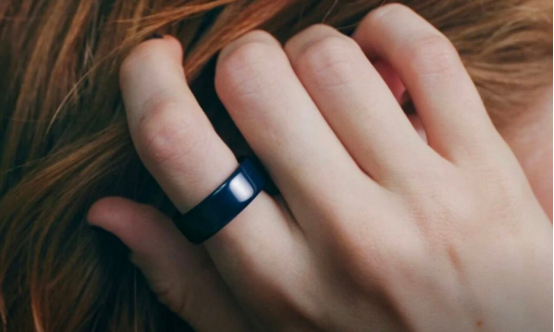
Latest data shows that Oura's paid membership base has grown fourfold in two years and is expected to surpass 5 million in the second quarter of this year, with annual company revenue potentially reaching $1.5 billion. It is this predictable, sustained growth in recurring revenue, combined with the scalable data assets from hardware sales, that collectively supports the ring's $11 billion valuation.
Examining Oura's success through the lens of the AI industry reveals far more than just a consumer electronics brand story. It also uncovers an industry trend: as AI and hardware deeply integrate, the commercial value focus is irreversibly shifting from the physical device itself to the algorithms it carries and the derived data services.
Of course, Oura's choice of a ring as the biosensing carrier forms the foundation of its data services. Compared to the wrist—where mainstream smartwatches are worn—the capillaries at the fingertips have a higher density, enabling stronger and clearer photoplethysmogram signals. This provides higher-quality, lower-noise raw data for subsequent AI algorithm analysis.
Over the past decade, Oura has continuously collected high-precision physiological data from millions of users around the clock. This vast, continuous, and unique database constitutes a deep moat for training more accurate AI models for sleep staging, stress prediction, recovery level assessment, and more.
This 'front-end sensing hardware + back-end intelligent cloud services' model now represents a key business approach for AI hardware.
Oura's rise and capital market favor have had a global ripple effect.
According to our statistics, former Gree Electric Appliances executive Wang Ziru has boldly announced his entry into this sector, with his team developing a smart ring priced around 4,000 RMB, featuring differentiated functions like built-in motors and voice recording.
Domestic cleaning appliance giant Dreame has also cross-industry launched the Dreame Ring, even making an appearance on China's CCTV Spring Festival Gala.
Overseas tech giants are equally eyeing the space, with Google and Meta continuously exploring AI glasses, while Apple has secured multiple smart ring patents.
The notion that 'all hardware deserves an AI remake' seems to be becoming an industry consensus, with investors actively seeking the next human-computer interaction gateway. Over the past year, a wave of startups focusing on new hardware forms like AI earphones and AI rings—such as Future Intelligence and Atomic AI—have completed new funding rounds.
The essence of this enthusiasm lies in how advancements in sensor miniaturization and AI chip energy efficiency now make possible dedicated devices that can continuously and unobtrusively collect high-quality data—precisely the high-quality source needed to train and optimize AI models.
In the AI era, a successful hardware product's core competitiveness lies not just in precise sensors and chips but in using hardware as an entry point to build, through software and algorithms, a service ecosystem that continuously delivers value and deeply binds with users. This may be the most crucial insight the billion-dollar ring offers to the AI industry.
-
Ofilm Teams Up with ADSensE to Propel Large-Scale Deployment of All-Solid-State LiDAR Powered by ADS6311 Chip!
-
![]()
Loss of 2.5 Billion Yet Facing Strong Demand for Shares? Another Battle for Control of Lianchuang Electronics
-
![]()
Huawei’s Enjoy Series Flies Off the Shelves, Prompting Xiaomi to Double Down on Budget Smartphones
-
![]()
Beijing Hyundai's Top Executive Criticizes Industry Disorder: Certain Brands Treat Customers as Beta Testers
-
![]()
The domestic mobile phone market has declined for five consecutive quarters! Huawei defies the trend with significant growth: maintains its top market share
-
Annual Revenue Surpasses 3 Billion: An Automotive Trim 'Little Giant' Makes Its Debut on the Beijing Stock Exchange
-
![]()
The Space Force Wants to Spend $30 Billion on Rocket Launches: Is Trump Doubling Down, and Is SpaceX the Big Winner?
-
![]()
Going Crazy! One out of Every Three Plug-in Hybrids Sold in Europe is a Chinese Vehicle