DeepSeek Announces Permanent Price Reduction, First Winner Emerges
 05/26 2026
 640
640

Last Friday, DeepSeek announced that its 75% API discount would shift from temporary to permanent.
For developers, the price remains unchanged, but the rights period has shifted from one month to indefinite. Users worldwide are thrilled. However, price is just the surface; the real variable worth noting lies elsewhere: a programming agent named Reasonix is going viral on GitHub.
Its logic is extremely straightforward: it exclusively adapts to DeepSeek, reducing usage costs by an additional 80% through extreme engineering optimizations.

Two parallel narratives unfold—one overt, one covert. How does Reasonix leverage DeepSeek's underlying features to achieve a dimensionality reduction? Why are 'model + agent' engineering combinations replacing pure model performance? These are the questions that need unpacking.
01 'Prefix Caching' and 'Byte Fingerprinting'
Let's start with 'Prefix Caching,' a large language model (LLM) inference optimization technique widely adopted last year.
The core idea is simple: cache KV Cache from historical dialogues to enable subsequent requests to directly reuse these intermediate results, significantly reducing the generation latency of the first token and improving inference efficiency.
The technical details are somewhat cumbersome, so most developers perceive DeepSeek's prefix caching merely as a 'cost-saving' measure. However, Reasonix's development team grasped the physical-level essence: byte-level stability (Byte-stable).
To understand Reasonix, one must first grasp DeepSeek's caching logic: Prefix Hash.
Imagine a user's prompt as an extremely long string of numbers in machine terms. A hashing algorithm assigns a 'unique digital signature'—termed a 'fingerprint'—to this text. As long as the user's content matches the server's cached fingerprint, there's no need to recompute it, and costs can be reduced by 80%.
However, everyone knows fingerprints are unique, and this caching logic has a fatal flaw: it requires dialogue content to be an exact, word-for-word match from the start.
Most programming agents on the market are designed for a 'cache-free era,' with a single optimization goal: minimizing the total number of tokens sent.
To save money, these agents dynamically compress historical dialogues and delete useless intermediate reasoning processes. Alternatively, to keep the model focused, they rearrange system prompts in each dialogue round.
However, these seemingly clever optimizations disrupt prefix continuity. A single minor change can shatter the 'exact match,' rendering millions of cached tokens useless. This is a classic case of 'losing the forest for the trees'—saving 100 tokens in length while directly losing 10,000 tokens in cache.
Reasonix adopts a solution that may seem clumsy by traditional standards: the 'Append-Only Loop.'
Simply put, it adheres to a strict rule in the model's operational loop: no rearranging, compressing, or modifying history. Whether from tool call results or user feedback, everything is appended chronologically. This seemingly clumsy (clumsy) approach results in progressively longer contexts as dialogues unfold.
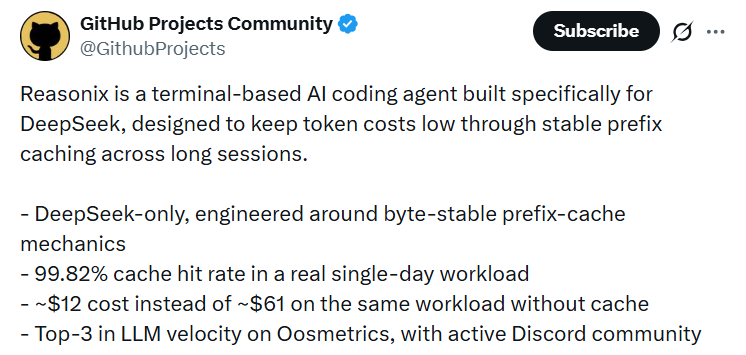
Yet, genius-level results follow. Since the prefix remains unchanged, the model 'remembers' this extremely long context. Even in multi-hour programming sessions, Reasonix paired with DeepSeek V4 maintains a cache hit rate above 94%. In extreme GitHub Projects tests, the hit rate soared to a staggering 99.82%.
Thus, this is an extremely precise mathematical calculation: in an environment where DeepSeek's cache hit costs are negligible, the marginal cost of retaining long contexts is far lower than the cold-start costs of re-injecting after cache disruption.
02 Chain-of-Thought Recovery Mechanism
As a programming agent developed exclusively for DeepSeek, Reasonix benefits not just the new V4 but also the older R1 model.
R1, the previous-generation reasoning model, is best known for displaying chain-of-thought (CoT) reasoning spanning thousands of words in its labels. However, in practical engineering, this 'reasoning-first' approach poses two significant challenges for agents: thought leakage and syntax deformities.
Thought leakage occurs when R1, during reasoning, exhibits strong 'executive urges.' If an agent uses R1, it should only initiate tool calls after completing its thoughts. Yet, due to the lengthy reasoning chains, R1 often writes tool call instructions within the CoT itself.
Most agents can only recognize officially defined Tool Call blocks, ignoring 'rogue' instructions in the CoT as plain text. In severe cases, this can freeze sessions.
Reasonix addresses this with a real-time scanning mechanism. Even if tool call instructions escape into the CoT, Reasonix accurately identifies and reroutes them for execution.
This not only boosts scheduling efficiency by 38% but, more importantly, saves costly reasoning tokens. The model no longer needs to rethink due to minor CoT disruptions.
Syntax deformities are equally straightforward. Even if the model correctly initiates a tool call, JSON's fragility remains an agent's nightmare. A single extra comma or missing quote can halt the agent.
Under the 'Append-Only Loop,' a failed tool call due to syntax errors forces the agent to feed error messages back to the model, which regenerates the logic. Multiple inefficiencies arise: error messages pollute the context, regenerated responses disrupt fingerprint certainty, and cache advantages diminish.
Thus, Reasonix employs a 'self-healing' scheme: before instructions reach the executor, Reasonix performs a round of perception-constrained self-repair. It's like a senior programmer fixing bugs—automatically adding missing symbols, correcting formats, and rearranging fields.
After repair, tool execution failure rates drop below 3%. Session histories become 'clean' and correct, allowing prefix caching to accumulate continuously.
03 The Hegemony of Passive Ecosystems
Returning to the catalyst: DeepSeek's permanent price reduction is a programming bonanza for developers but a thunderbolt for competitors.
A blunt yet cruel (harsh) business formula emerges:
AI Product Dominance = (Model Native Capability + Community Engineering Completion) / User Migration Cost.
Clearly, in today's AI industry, if a model's performance reaches 90% of competitors' at 1/10 the price, a devastating substitution effect ensues.
Recently, Baidu's AI Developer Conference and Alibaba Cloud Summit occurred domestically, while Google I/O 2026 took place abroad. All aimed to integrate their AI products into unified portals, creating insurmountable ecological barriers.
In contrast, DeepSeek lacks cloud platforms like Baidu Cloud or Alibaba Cloud, Google's global YouTube and Gmail presence, or even multimodal capabilities.
Yet, it has proven a logic respected by developers worldwide: maintain top-tier capabilities domestically, maximize cost-effectiveness, and usage will follow. The open-source community will fill in the rest.
Traditionally, big firms believed ecosystems were built top-down. We've seen 'walled gardens' in early agent-era tools like Doubao Mobile Assistant and Qianwen APP.
Reasonix proves the power of passive ecosystems. It's not a commercial product like Claude Code or Codex but a developer-built fortress exclusive to DeepSeek.
Why would developers optimize DeepSeek specifically? The answer is simple: DeepSeek leaves ample profit space for global developers. Engineering optimizations can't offset token costs for expensive domestic and foreign models, but on DeepSeek, every optimization translates directly into developers' 'trial-and-error freedom.'
This is the power reversal brought by open source.
We acknowledge DeepSeek lags behind global top models, but when API prices are low enough, V4 evolves from a model into universal AI infrastructure, with the community organically addressing its shortcomings. While Liang Wenfeng's team may lack time for extreme TUI optimizations, teams like Reasonix lead 'actuaries' to swiftly fill gaps.
This interest-driven ecosystem evolves far faster than big firms' all-in-one products.
04 Shift in Evaluation Paradigms
Thus, domestic AI can now proudly join the agent programming race.
If foreign Opus 4.7 on Claude Code or GPT-5.5 on Codex are unavailable, we use DeepSeek V4 on Reasonix.
Amid the joy and pride, a subtle yet critical shift occurs: AI competition now hinges on 'model + coding agent' combinations.
Many AI firms prefer cramming all features into a single UI, but Reasonix follows a vertical path like Claude Code: programming-only, terminal-deep. It avoids IDE plugin competition, instead developing a Yoga-based cell-diff renderer. While a lower-barrier desktop version exists, the focus remains on terminal interactions.
In Artificial Analysis' evaluation system (evaluation system), efficiency and cost now dominate.
Needless to say, Anthropic and OpenAI's product bundles are pricey. A $20 monthly subscription often falls short for developers. Yet, with Reasonix + DeepSeek, 400 million tokens cost just $12 (DeepSeek International pricing).
This extreme affordability enables not just trial-and-error freedom but also multi-agent collaboration ecosystems. Users can batch-generate task execution plans without fearing explosive bills. This psychological unshackling paves the way for AI to enter large-scale productivity.
Reasonix marks the agent field's shift from flashiness to actuarial precision. AI competition now hinges on byte-level cache fingerprints and tool call error corrections.
DeepSeek has turned computing power and intelligence into cheap, universally accessible tap water. Reasonix is the first efficient, low-loss faucet.

-
Ofilm Teams Up with ADSensE to Propel Large-Scale Deployment of All-Solid-State LiDAR Powered by ADS6311 Chip!
-
![]()
Loss of 2.5 Billion Yet Facing Strong Demand for Shares? Another Battle for Control of Lianchuang Electronics
-
![]()
Huawei’s Enjoy Series Flies Off the Shelves, Prompting Xiaomi to Double Down on Budget Smartphones
-
![]()
Beijing Hyundai's Top Executive Criticizes Industry Disorder: Certain Brands Treat Customers as Beta Testers
-
![]()
The domestic mobile phone market has declined for five consecutive quarters! Huawei defies the trend with significant growth: maintains its top market share
-
Annual Revenue Surpasses 3 Billion: An Automotive Trim 'Little Giant' Makes Its Debut on the Beijing Stock Exchange
-
![]()
The Space Force Wants to Spend $30 Billion on Rocket Launches: Is Trump Doubling Down, and Is SpaceX the Big Winner?
-
![]()
Going Crazy! One out of Every Three Plug-in Hybrids Sold in Europe is a Chinese Vehicle