1.25 million AI store managers secure hundreds of millions in funding, achieving 20 billion GMV
 05/26 2026
 620
620

Author | Pencil News Xiwen Editor | Pencil News Zou Wei, Wang Fang
"Can you find me a store manager? I'd rather pay 100,000 yuan a month than constantly replace people," an e-commerce business owner complained to Wang Ran, founder of Superboom Technology.
Following this demand, Wang Ran has trained 1.25 million 'AI store managers' over the past few years, helping clients achieve an additional 20 billion in GMV. Superboom charges commissions based on results after the 'AI store managers' generate GMV. Currently, the company's annual revenue has reached hundreds of millions yuan. Recently, Superboom Technology secured hundreds of millions in funding, led by Cowin Capital, with SoftBank Asia, Zhuopu Fund, and Yuanfeng Capital participating as followers. The company has also initiated preparations for going public. Recently, Pencil News interviewed Wang Ran, founder of Superboom Technology, to discuss how AI companies can truly turn a profit and why most AI companies are still losing money. Key highlights include: 1. Should AI take jobs away from ordinary people? Answer: No, it should target high-value roles. 2. Why does e-commerce need AI? Answer: E-commerce is closer to ROI, and AI store managers can be held accountable for ROI. 3. Where do AI store managers outperform humans? Answer: They offer comprehensive insights and rapid responses. 4. What is the best way for AI to generate revenue? Answer: Through commissions, charging based on results. 5. Why do most AI companies struggle to turn a profit? Answer: They rely on outdated operational models despite the advent of new technology.
- 01 -AI Shouldn't Take Jobs Away from Ordinary People
This year, the AI industry is particularly hot, and we've just completed a funding round worth hundreds of millions yuan. But to be honest, most AI sectors aren't as easy to navigate, and many business models are still in their infancy.
For example, there's significant disagreement about the value proposition of AI. I strongly disagree with the notion that 'AI replaces humans,' such as replacing customer service, operations, clerical work, or repetitive labor. Why should AI, an advanced productivity tool, replace low-value roles? 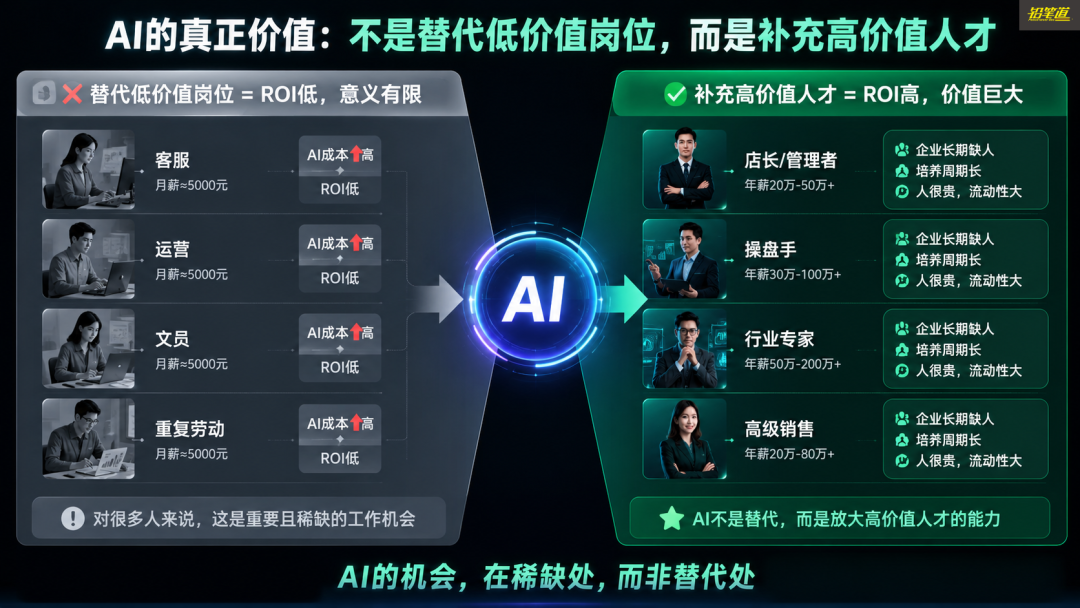
Consider a role with a 5,000 yuan monthly salary—its economic value is inherently low. Now, if you replace it with an AI system that requires high computing power, research and development costs, and maintenance expenses, how can the ROI justify it? This doesn't require complex economic theory; even elementary school math can explain it. Many argue that AI should replace jobs humans dislike. But this perspective hides an 'elite bias.' What does 'dislike' mean? Is it what you dislike, or what others dislike? Many tech companies view clerical, customer service, and basic operational roles as 'low-end repetitive labor' that should naturally be replaced by AI. However, for some, these may be crucial and scarce job opportunities. Take a 5,000 yuan monthly salary role—many AI companies might dismiss it as 'low-value' and ripe for AI replacement. But from an ordinary person's perspective, it could represent a stable, respectable office job. If AI replaces it, where does that person go? Delivering food? Sweeping streets? Taking on more strenuous and unstable work? 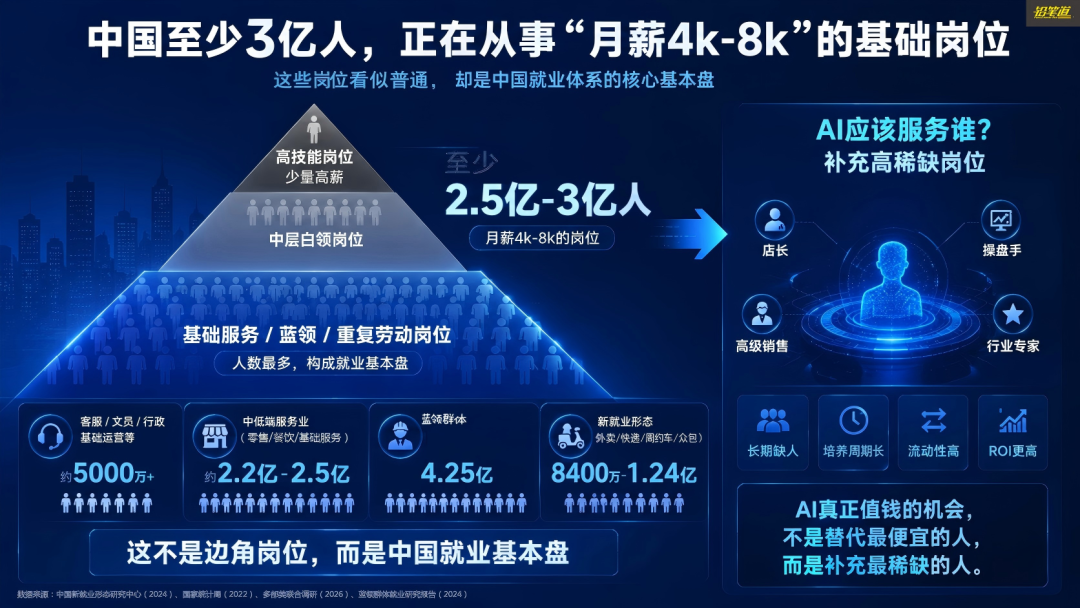
Thus, I've always believed that what many perceive as 'low-value roles' are often viewed through a privileged lens. Many people in these jobs are willing to do them. Therefore, I argue that AI's true value lies not in replacing low-value roles but in supplementing scarce ones—those that command high salaries yet remain hard to fill, such as store managers, strategists, industry experts, and senior salespeople. These roles share common traits: a chronic shortage of talent, long training periods, high costs, and significant turnover. AI has a real opportunity in these high-value roles.
- 02 -E-commerce Desperately Needs AI
Following this logic, we found our niche in e-commerce. Currently, over 80% of our orders come from this sector. One of our core products is the 'AI store manager.'
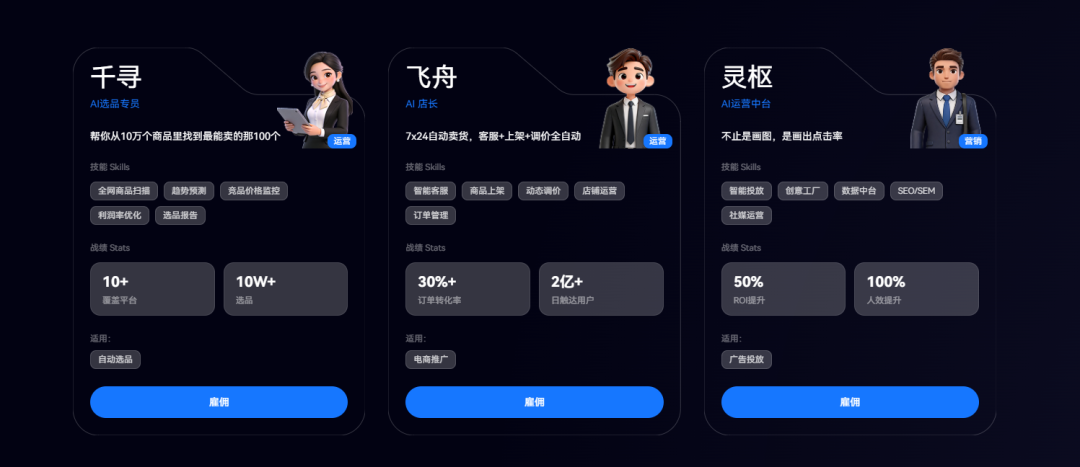
Superboom has trained a team of 'AI store managers' for businesses to hire
Why? Because it's a quintessential high-value role. Customer service is easy but low-value. Store managers are different. They're not just managing a few people or handling operations—they're accountable for ROI. Building a store from scratch involves product selection, pricing, advertising, inventory, after-sales service, marketing strategies, and integrating these elements into a closed loop. Ultimately, the boss cares about one thing: Did we make money? 
AI Store Manager Interface China's e-commerce ecosystem is vast, with roughly 25 million practitioners spread across 10 to 15 million stores. However, truly qualified store managers are in short supply. We estimate that over 5 million stores lack competent managers. Many business owners tell me they'd pay 100,000 yuan a month for a manager who can consistently deliver ROI, let alone 30,000 to 50,000 yuan. 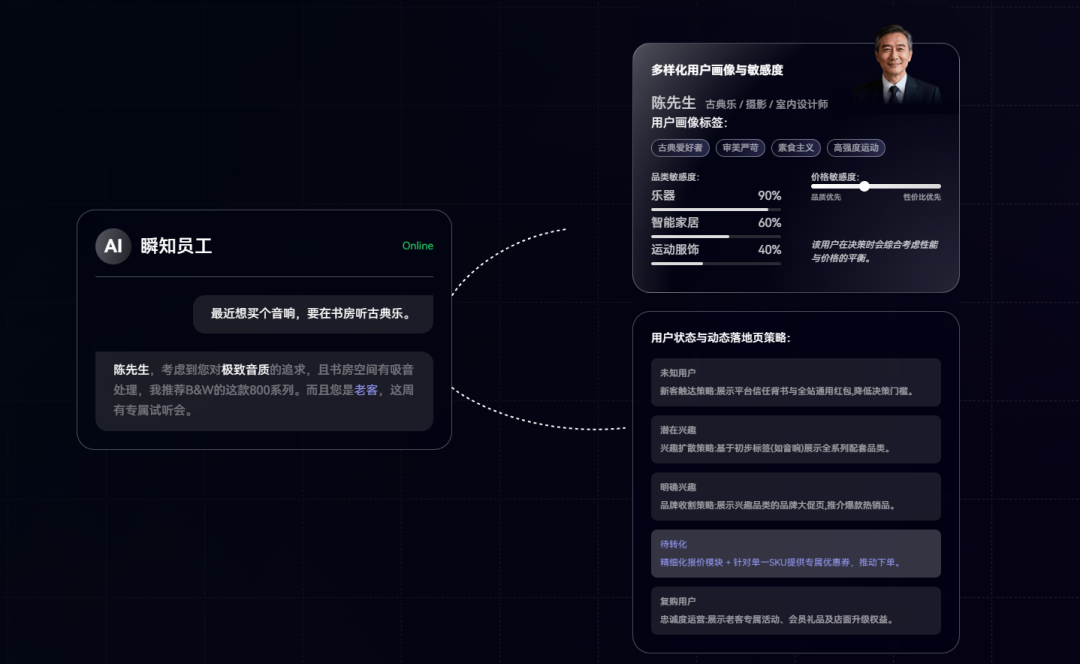
AI employees are 'precisely driving sales.' But the challenge is finding such talent. A good store manager takes years to train, requiring expertise in product selection, advertising, conversion, inventory, user understanding, and platform rules. After investing in their development, competitors might poach them. At this point, many wonder if we're competing with agencies like Baozun. Not really. Large brands like Nike can afford Baozun or build their own teams. They have the budget to hire top-tier store managers. However, most mid-tier brands differ. Some generate 10 million yuan in annual GMV but only a few hundred thousand yuan in profit. They can't afford a strong operational team, let alone a top-tier store manager. Yet, they desperately need 'store manager capabilities.' So, we asked: Can we empower these merchants with capabilities approaching 80% of a top human manager at just 20% of the cost? Today, we've trained roughly 1.25 million AI store managers. Their ROI ranges from 2 to 50, depending on industry, product category, and goals. For instance, if a client sets an ROI target of 5 and the AI achieves 6, that's a solid performance. If it reaches 25, that's exceptional. To date, we've driven over 20 billion yuan in net GMV growth for merchants. Our baseline conversion rate is roughly 3 to 5 times the industry average. Note that this isn't a 3% or 5% improvement—it's a multiple.- 03 -Where Does AI Excel in E-commerce? 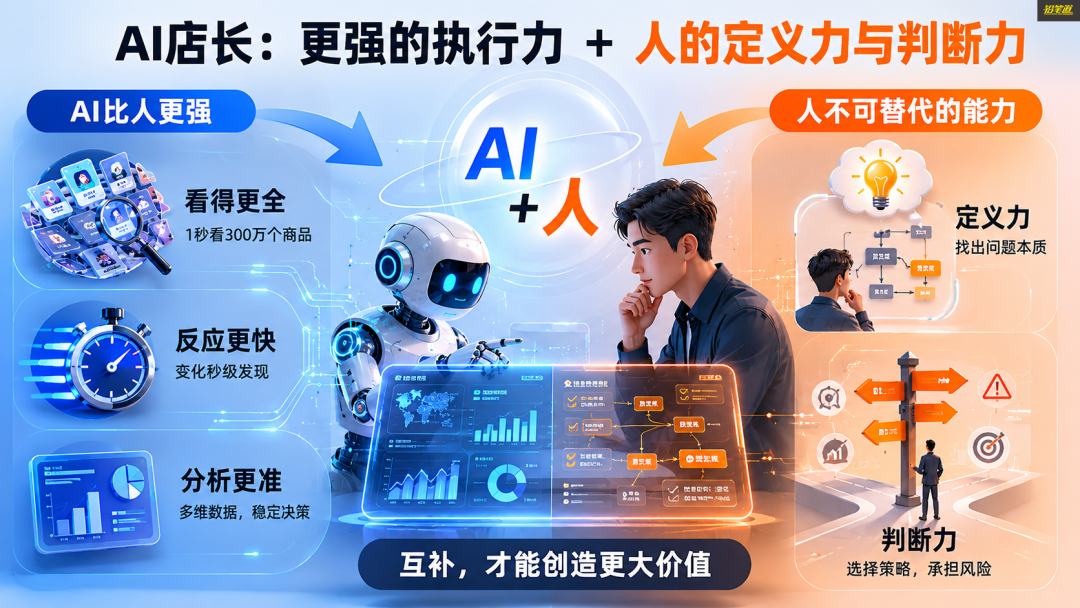
Many ask how AI store managers outperform humans. AI excels in several areas.
First, it sees more. No human manager can monitor the entire internet (entire network) products, competitor pricing, content changes, user behavior, and platform traffic 24/7. AI can. For example, a human manager might take 30 seconds to grasp a product's title, images, price, reviews, and selling points. AI can process vast amounts of product information in seconds, even scanning 3 million products per second. It's not 'smarter' than humans—it just sees far more. Second, it reacts faster. If a competitor adjusts prices, AI detects it immediately. If a piece of content's click-through rate drops, it identifies the issue promptly. If a keyword's ROI declines, it suggests adjustments. If conversion rates spike during certain hours, it captures the trend. Human managers often notice problems only during reviews. AI acts as a constantly online operational radar. Of course, AI offers other strengths, such as more stable decision-making and stronger cross-analytical capabilities. Even so, I don't believe AI can replace humans entirely. Two critical abilities remain uniquely human: 1. Definition: Identifying a store's problems—be it content, advertising, marketing strategies, or product selection—isn't innate to AI. Humans must first define the issue. 2. Judgment: AI provides strategies, but humans must decide whether to implement them, assess risks, and make final calls. Thus, AI and humans aren't substitutes but collaborators. A person who defines problems and judges outcomes, paired with AI, can outperform those who don't leverage AI.
- 04 -The Best Way for AI to Generate Revenue: Pay-for-Performance
How do we make money? Not by selling software—but by 'sharing results.'

Wang Ran, Founder of Superboom Technology
Many ask: What kind of company are we? An AI marketing firm? An AI agent company? An AI software provider? None of these labels feel accurate—they're not 'AI-native' terms. AI marketing was coined by the advertising industry; AI agent by the software sector. In the AI era, the truly valuable asset is tasks. Internally, we prefer to call ourselves an 'AI task pipeline company.' What does that mean? Simply put, we don't just sell tools—we complete tasks. Traditional software companies offer systems, but in the AI era, clients care about results. Hence, the rise of RaaS (Result as a Service), or pay-for-performance. This is our core business model. For AI store managers, we often charge commissions based on GMV. The more they sell, the more we earn. This model is already mature in e-commerce. Platforms like Taobao, JD.com, and Douyin use commission mechanisms where merchants set rates, and service providers handle transactions. We've integrated AI capabilities into this results-based framework. Clients don't need to understand models, agents, or workflows—they just need to know: 'You help me make money, and we split the profits.' That's it.
- 05 -Why Most AI Companies Aren't Making Big Money
I believe many AI companies struggle to profit not because their technology is inferior but because they cling to outdated methods. They're like fitting a motor to a horse-drawn carriage—it looks upgraded, but it's still a carriage at heart.
Consider how many companies operate: They replace human customer service with AI, add AI to marketing, or tack an AI assistant onto software. New technology exists, but old operational models persist. I often recall the 'Solow Paradox.' In 1987, economist Robert Solow famously said, 'You can see the computer age everywhere but in the productivity statistics.' Why? Because organizational methods hadn't changed. People swapped paper and abacuses for computers, but factories, collaborations, and task flows remained unchanged. The electrical revolution followed a similar pattern. When Edison built the first commercial power station in 1882, everyone expected electricity to transform the world immediately. Yet, productivity didn't surge right away. Early factories merely replaced steam engines with electric motors without altering layouts, management, or production processes. Real productivity gains came later, thanks to Ford. Ford didn't just 'use electricity'—he redesigned the entire assembly line around it. Factories shifted from multi-story to single-story designs, each machine got its own motor, and workstations were rearranged based on production flow. As a result, Model T production time dropped from 12.5 hours to 93 minutes. I see parallels in today's AI industry. AI's true impact isn't on tools but on task flow. We've already achieved hundreds of millions in revenue, serving mid-tier brands and some head (top-tier) clients. Some super-large clients pay us millions annually for AI store manager services. But we're still on the journey.
This article does not constitute any investment advice.
In the AI era, 'one-person companies' are booming. Now, Huawei Cloud has launched the '2026 AI OPC Application Innovation Competition'. Companies at all stages can participate.

-
Ofilm Teams Up with ADSensE to Propel Large-Scale Deployment of All-Solid-State LiDAR Powered by ADS6311 Chip!
-
![]()
Loss of 2.5 Billion Yet Facing Strong Demand for Shares? Another Battle for Control of Lianchuang Electronics
-
![]()
Huawei’s Enjoy Series Flies Off the Shelves, Prompting Xiaomi to Double Down on Budget Smartphones
-
![]()
Beijing Hyundai's Top Executive Criticizes Industry Disorder: Certain Brands Treat Customers as Beta Testers
-
![]()
The domestic mobile phone market has declined for five consecutive quarters! Huawei defies the trend with significant growth: maintains its top market share
-
Annual Revenue Surpasses 3 Billion: An Automotive Trim 'Little Giant' Makes Its Debut on the Beijing Stock Exchange
-
![]()
The Space Force Wants to Spend $30 Billion on Rocket Launches: Is Trump Doubling Down, and Is SpaceX the Big Winner?
-
![]()
Going Crazy! One out of Every Three Plug-in Hybrids Sold in Europe is a Chinese Vehicle