Leveraging Smartphones for Profit to Bolster the Auto Business: Is Xiaomi’s Fortune Tied to AI?
 05/27 2026
 407
407
Xiaomi’s Q1 financial report offers some intriguing insights.
Numerous reports have focused on the impressive absolute figures: RMB 99.1 billion in revenue, RMB 4.7 billion in profit, and RMB 6.072 billion in adjusted net profit, placing Xiaomi among the top-tier Chinese tech companies. However, many media outlets have selectively overlooked the year-on-year declines of 10.9%, 56.5%, and 43.1%.
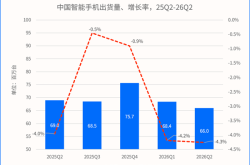
One of Lei Jun's standout strengths over the past decade has been his knack for uncovering value in seemingly unpromising areas. He has expanded the user base with extremely low-margin hardware and then monetized through internet services. This model was nearly unbeatable during the smartphone era and remains effective today. In Q1, Xiaomi’s smartphone revenue was RMB 44.2 billion, a 12.5% year-on-year decline. Global shipments reached 33.8 million units, ranking in the top three globally for 23 consecutive quarters. This position is commendable, but Xiaomi is somewhat eclipsed by Apple, whose market share is on the rise. It's not that Xiaomi’s smartphones are inferior; rather, the entire Android camp is feeling the impact of Apple's market penetration, compounded by rising supply chain costs for components like storage, which is hurting the industry.
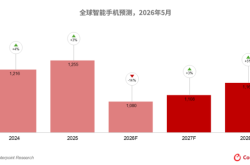
Despite this, Xiaomi’s Average Selling Price (ASP) rose to RMB 1,310, indicating significant progress in premium positioning, driven by the synergy with Xiaomi Automotive. However, this is not the only factor; the impact of overall consumer electronics price increases due to rising storage costs and shortages of DRAM and NAND cannot be overlooked. Today, all smartphone manufacturers are raising prices, but this does not equate to instant success. Price increases coupled with declining sales mean that only Apple and Samsung can maintain sales volumes, while the mid-range market is objectively shrinking, affecting Xiaomi, OPPO, vivo, and Honor. Therefore, while Xiaomi’s smartphone unit prices have increased, the revenue decline simply reflects selling fewer units.
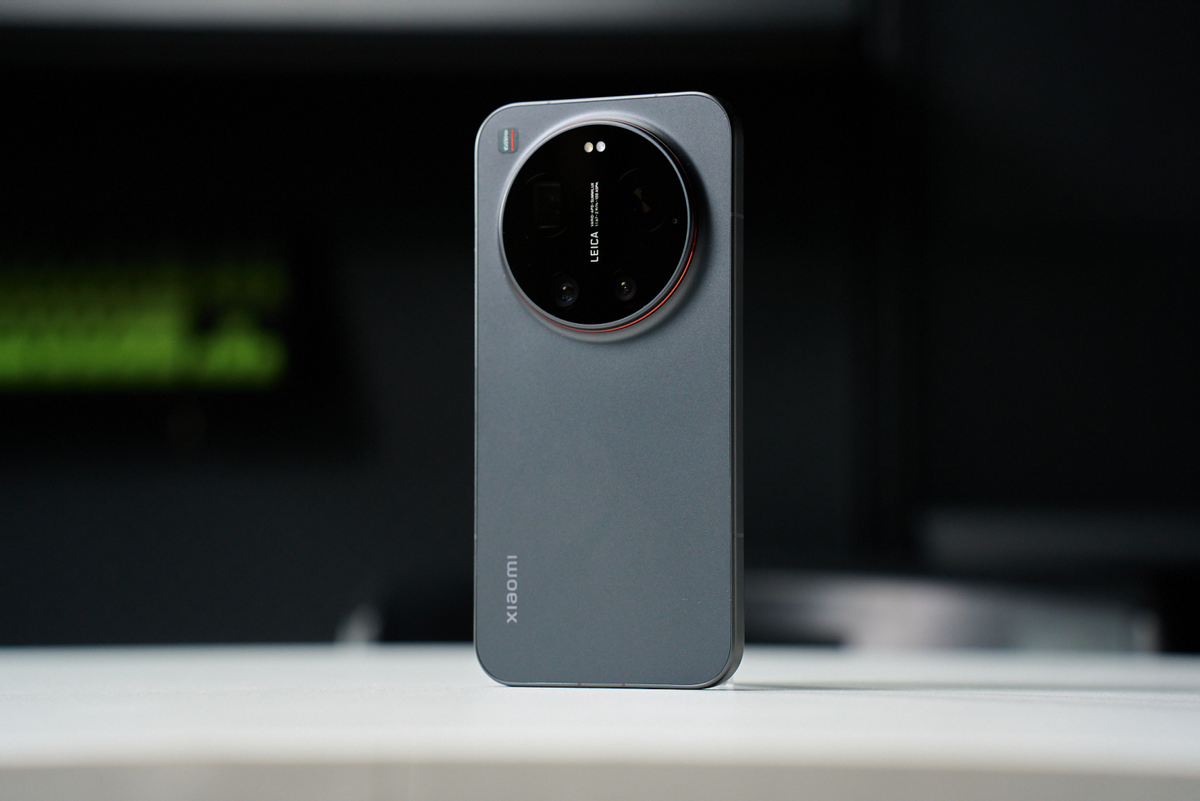
(Image source: Leikeji Photography)
However, the true stabilizer of Xiaomi’s fundamentals is not the smartphones themselves, but its internet services: RMB 9.5 billion in revenue with a 76.1% gross margin, proving the effectiveness of Xiaomi’s pioneering internet hardware model. Many people have long viewed Xiaomi as a hardware company, but from a business structure perspective, it increasingly resembles Amazon’s hardware strategy: the real profit generators are not hardware products like Kindle, Echo, and Fire TV, but Prime, advertising, cloud, and content ecosystems. For Xiaomi, smartphones, TVs, air conditioners, air purifiers, and smart bands are essentially entry points for users, with true profits coming from internet services.
This is not a new narrative, but the financial report confirms that Xiaomi’s model is indeed effective, generating real profits. So even with declining smartphone revenue, Xiaomi’s smartphone × AIoT division's operating profit doubled quarter-on-quarter, supported by its internet business. This model was once mocked for 'making only a few dollars per smartphone sold,' but as market competition intensifies, Xiaomi’s cost-effectiveness model becomes increasingly valuable, maintaining competitiveness in the ruthless hardware market, much like Meituan’s prolonged battle in local services. 'Picking up coins' itself is a rare capability.
But new challenges have emerged: the automotive business is extremely capital-intensive.
Xiaomi Automotive delivered 80,856 units in Q1, generating RMB 19 billion in revenue, maintaining strong momentum. The SU7 proves that Xiaomi can replicate its strong product capabilities across almost any category—a dream that Zhuimi has long pursued is already a reality at Xiaomi. If Xiaomi wishes, it could establish 2,000 Business Units (BUs), all capable of rapidly scaling and generating revenue.
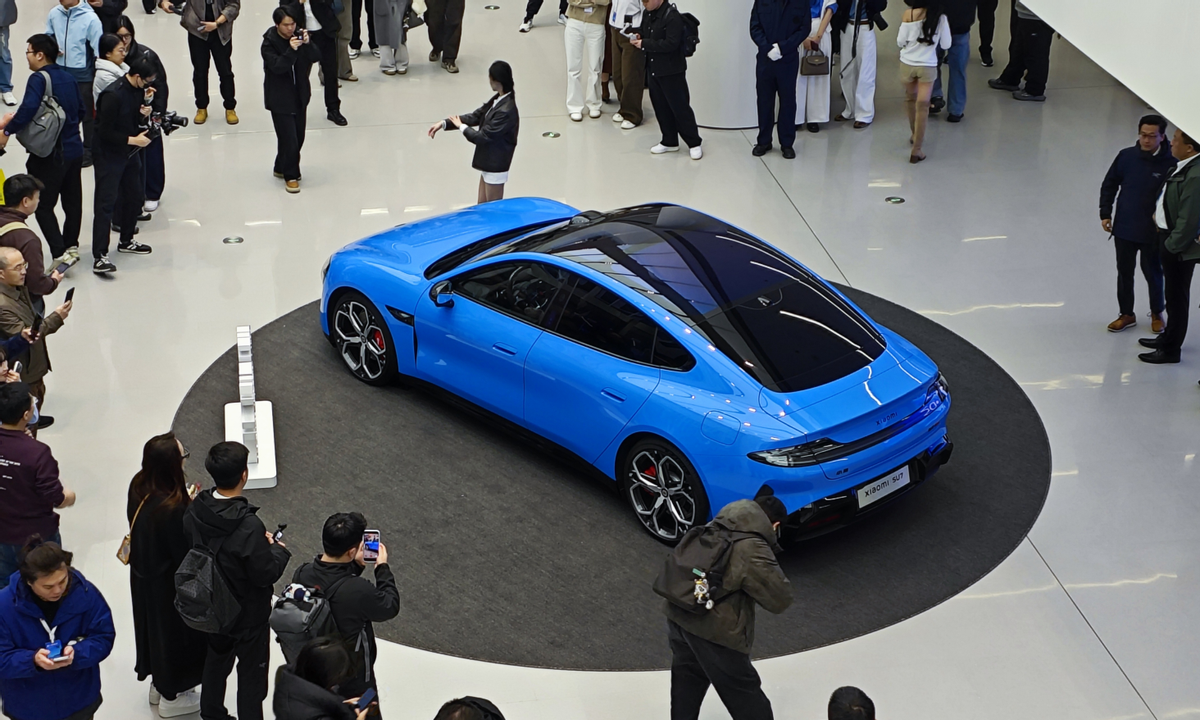
(Image source: Dianchetong Photography)
More importantly, Xiaomi Automotive has stabilized. Despite facing several rounds of negative publicity, which came fiercely, the financial report shows that the so-called negative impact on Xiaomi Automotive's sales is negligible, as buyers continue to purchase. Good products fear no slander because today's Xiaomi Automotive does not rely on 'specifications,' 'alternatives,' or 'hype' to survive; it is a brand in itself, with established user perception.
The automotive business incurred a loss of RMB 3.1 billion, with gross margins dropping from 23.2% to 20.1%, indicating that competition in the new energy vehicle industry remains fierce. However, the cruelest aspect of the automotive industry is not the inability to manufacture or sell vehicles but the rapid erosion of profits after scaling. Ultimately, the survivors are often not the most glamorous companies but those with the highest supply chain efficiency, such as BYD, Chery, Great Wall, Geely, and Changan. Today, Xiaomi is still in the 'market capture' phase, and losses are common for new entrants, with few earning profits (cold fact: excluding Seres, only NIO has earned profits for two quarters among new forces; Li Auto has earned profits in the past). The key is whether Xiaomi Automotive can stabilize its gross margins.
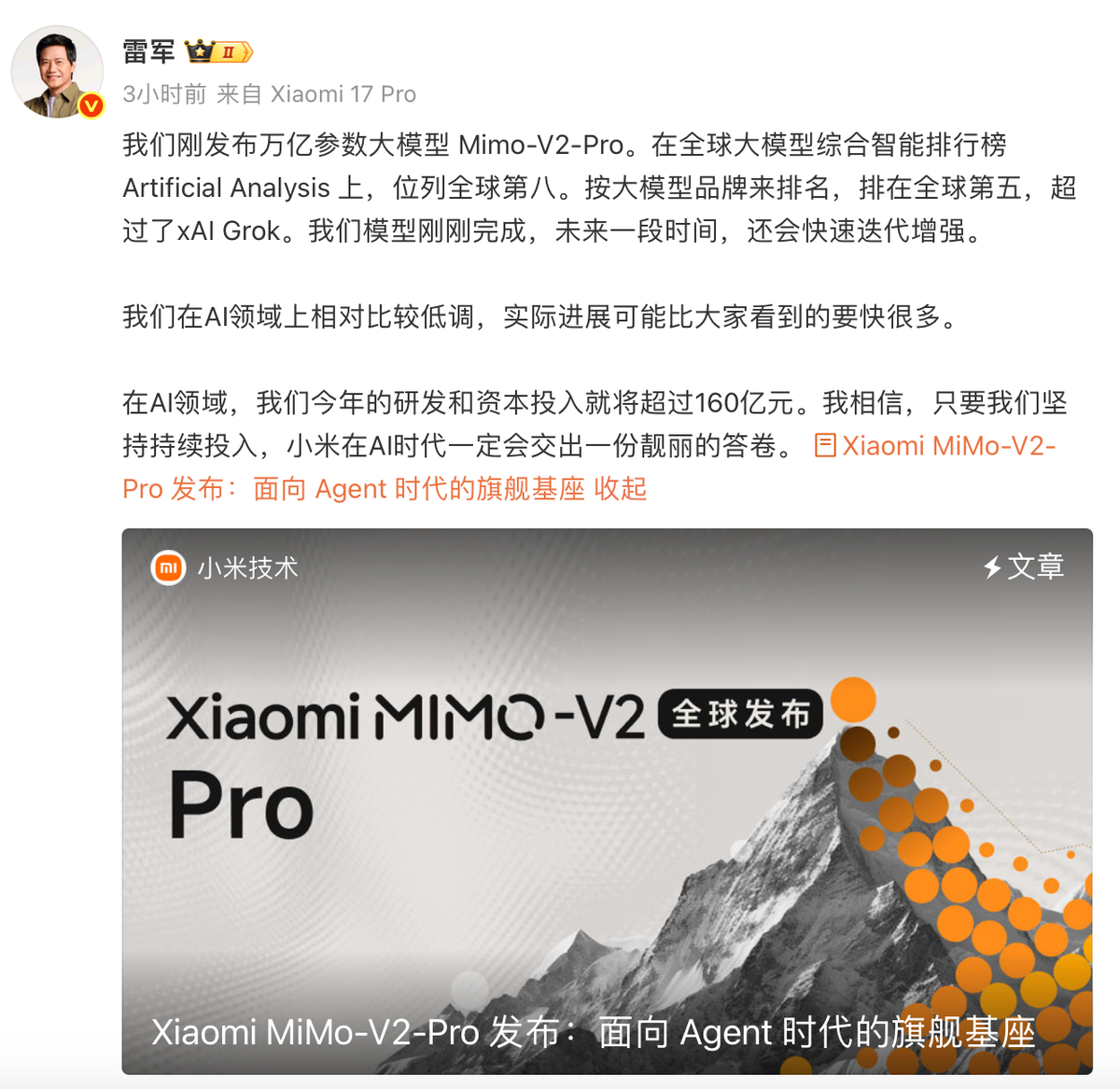
So Xiaomi has entered a very delicate state: internet services support the smartphone business, smartphones support the automotive business, and today's profits support tomorrow's AI. The most frequent keyword in Xiaomi’s financial report is not smartphones or automobiles but AI. This year, AI investment will be at least RMB 16 billion, with RMB 60 billion over the next three years. Q1 R&D expenses reached RMB 9 billion, a 33.4% year-on-year increase.
What is Xiaomi’s core competitiveness in AI? If we look at model capabilities, Xiaomi’s approach is similar to DeepSeek’s: open-source, distillation, fine-tuning, and engineering optimization, rapidly closing the capability gap to the first tier rather than betting on foundational model generational gaps like OpenAI. This approach is nothing to be ashamed of, as the global AI industry increasingly resembles the flourishing Android era. What truly matters is not the model itself—under open-source conditions, foundational model capabilities will level out, and ultimately, success depends on who can best embed AI into real-world scenarios and generate revenue.
Lenovo, whose stock price has doubled in the past month, offers another perspective. Its core growth driver is not PCs but servers and AI infrastructure, with its Infrastructure Solutions Group revenue surging and AI server order backlogs reaching USD 21 billion, essentially reaping the rewards of AI infrastructure, as Jensen Huang described AI's 'five-layer cake,' with the fourth layer being enterprise-grade infrastructure. Lenovo is earning 'shovel money during the gold rush,' and Yang Yuanqing probably never dreamed that decades of diligent work as a professional manager would yield less performance and growth than a few months of AI dividends—proving that choice matters more than effort.
He Rundong received the 'overlord' dividend thrown by Zhang Linghe at home. Of course, we shouldn't just envy his good fortune; the fundamental reason is that he worked hard, vividly, and wholeheartedly when he played Xiang Yu years ago. Companies like Lenovo, Intel, Samsung Electronics, SK Hynix, Micron Technology, Longsys, and even NVIDIA did not anticipate today's instant wealth, but none could have achieved it without their diligent efforts in recent years.
In this light, Xiaomi is still far from reaping its instant wealth. Its most attractive aspect is not Luo Fuli's models or AI-to-B infrastructure but physical AI entry points. Few companies globally possess such a comprehensive and robust portfolio of smartphones, automobiles, TVs, air conditioners, smart speakers, robots, operating systems, and AI agents, which will serve as super entry points for physical AI in the future.
Thus, you'll notice that all of Xiaomi’s AI initiatives are advancing toward 'system-level agents.' It is developing Xiaomi Miclaw for smartphones, which will integrate with Super Xiaomi AI in the future; OneVL for automobiles, unifying VLA, world models, and latent space reasoning; advancing large model deployment in smart homes; and directly training robots in automotive factories. Its goal is certainly not chatbots—Xiaoai Assistant is a thing of the past for Xiaomi, at best a side quest. What it is building is a cross-'human-vehicle-home' AI super system, making Xiaomi increasingly resemble a 'consumer AI hardware company' rather than a traditional hardware company.
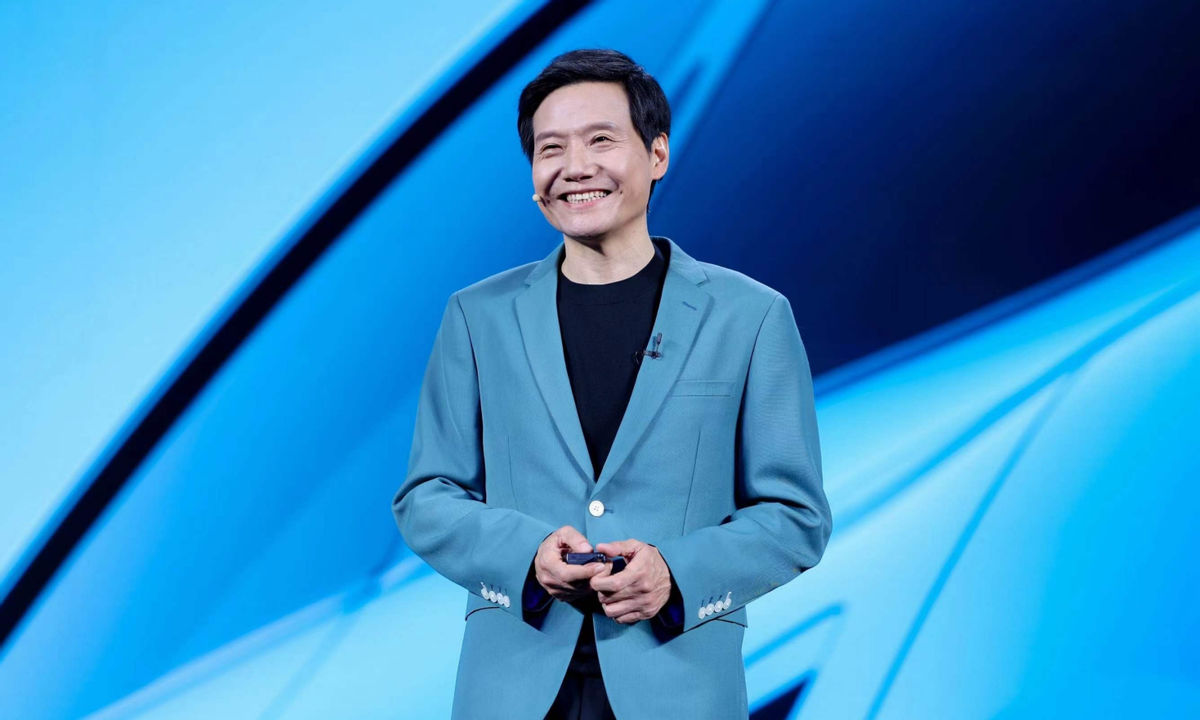
AI agents are the future of human-computer interaction and the bridge between the physical and digital worlds. Companies with the most terminals, scenarios, and user behavior data theoretically have the greatest advantage. Therefore, Xiaomi’s future is promising, but its present is somewhat lean: AI is not yet profitable, the automotive business is still losing money, and the smartphone business lacks growth momentum.
Fortunately, Xiaomi’s cash flow is stable, and it can fully afford to wait for and capture the super dividends of the AI wave.
-
Ofilm Teams Up with ADSensE to Propel Large-Scale Deployment of All-Solid-State LiDAR Powered by ADS6311 Chip!
-
![]()
Loss of 2.5 Billion Yet Facing Strong Demand for Shares? Another Battle for Control of Lianchuang Electronics
-
![]()
Huawei’s Enjoy Series Flies Off the Shelves, Prompting Xiaomi to Double Down on Budget Smartphones
-
![]()
Beijing Hyundai's Top Executive Criticizes Industry Disorder: Certain Brands Treat Customers as Beta Testers
-
![]()
The domestic mobile phone market has declined for five consecutive quarters! Huawei defies the trend with significant growth: maintains its top market share
-
Annual Revenue Surpasses 3 Billion: An Automotive Trim 'Little Giant' Makes Its Debut on the Beijing Stock Exchange
-
![]()
The Space Force Wants to Spend $30 Billion on Rocket Launches: Is Trump Doubling Down, and Is SpaceX the Big Winner?
-
![]()
Going Crazy! One out of Every Three Plug-in Hybrids Sold in Europe is a Chinese Vehicle