Navigating the Token Era: How to Lead with Full-Stack Solutions? H3C Unveils Its 'Six-Pulse Swordplay' Strategy
 05/27 2026
 490
490
[Global Cloud Observer | Focus on Tech Trends]
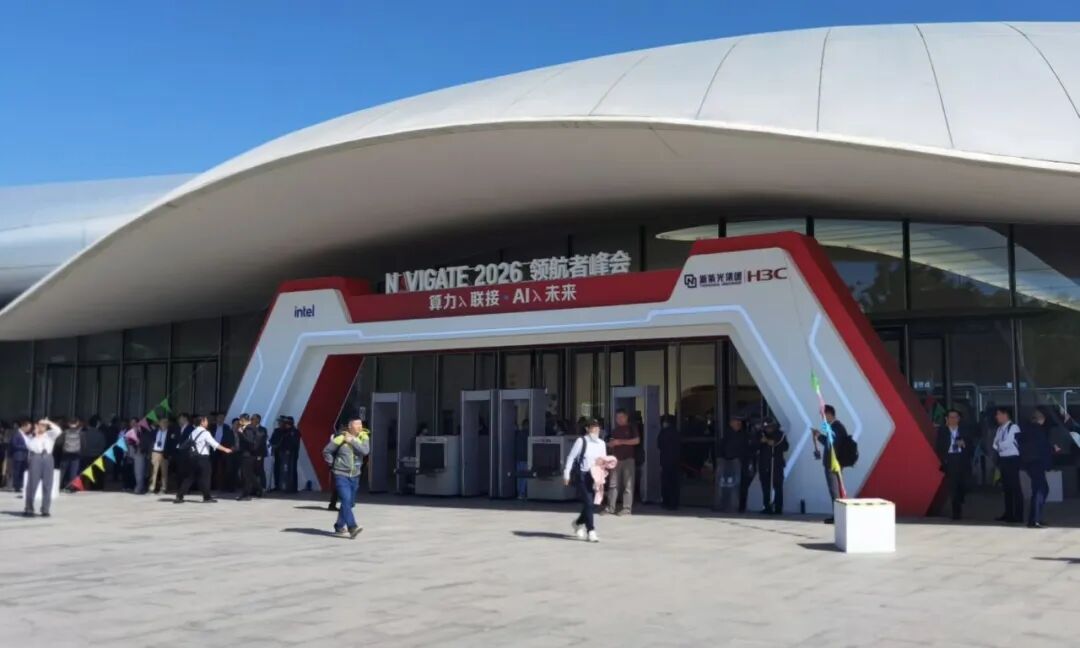
Today, the AI landscape is rapidly evolving.
China's daily Token usage has surpassed 140 trillion, with global AI infrastructure investments exceeding a trillion dollars. The explosion of the Token-based economy, centered around tokens as the core unit of measurement, is attracting heroes from all corners to join the fray. High-level experts are gathering, much like warriors in a martial arts saga, pointing their swords to the sky—who will rise to the challenge?
Recently, at the NAVIGATE Summit, H3C unveiled its 'Six-Pulse Swordplay' strategy tailored for the AI infrastructure domain. Facing the Token economy boom, Yu Yingtao, Chairman of Unisplendour Corporation and President & CEO of H3C, stated that Token cost-effectiveness is not determined by a single card or capability but by the deep synergy of six dimensions: computing, networking, storage, cloud, security, and operations.
This approach, akin to the 'Six-Pulse Swordplay,' integrates the six inner forces of 'computing power, networking, storage, cloud, security, and operations' into a unified whole, wielding invisible sword qi to tackle the numerous challenges of large-scale AI deployment.
So, how does H3C's six-pronged swordplay achieve seamless coordination and integration, ensuring every Token delivers maximum cost-effectiveness?
1 Computing Power 'Shaoshang Sword': Thunderous Breakthroughs with Mighty Inner Strength
Just as the Shaoshang Sword is the foundation of the entire martial arts system, computing power in the AI era emphasizes the ultimate strength of 'overpowering with force.' Without robust computing power, all intelligence is mere talk. H3C's 'Shaoshang Sword' of computing power targets the ceilings of computing density and energy efficiency, delivering powerful and impressive results.
The newly launched high-density, all-liquid-cooled integrated system S90000, unveiled at the NAVIGATE Summit, is a thunderous Shaoshang Sword, bristling with sharpness.
Zhang Tao, Chief Technology Officer and Chairman of the Technical Committee at H3C, pointed out that Token consumption is surging exponentially, yet traditional computing deployments are constrained by three major bottlenecks: space, power supply, and cooling. H3C chose to tackle these head-on with extreme engineering, achieving deep miniaturization of nodes within the cabinet, reducing the motherboard volume by 25%, and completely removing local power supplies and fans from the nodes, dedicating every inch of space to high-density deployment of computing chips. Ultimately, within a mere 1U standard node space, six high-performance CPUs are deployed, leading the industry in single-node computing density. A single cabinet can house up to 36 computing nodes, with over 30,000 computing cores, tripling the computing density compared to traditional solutions.
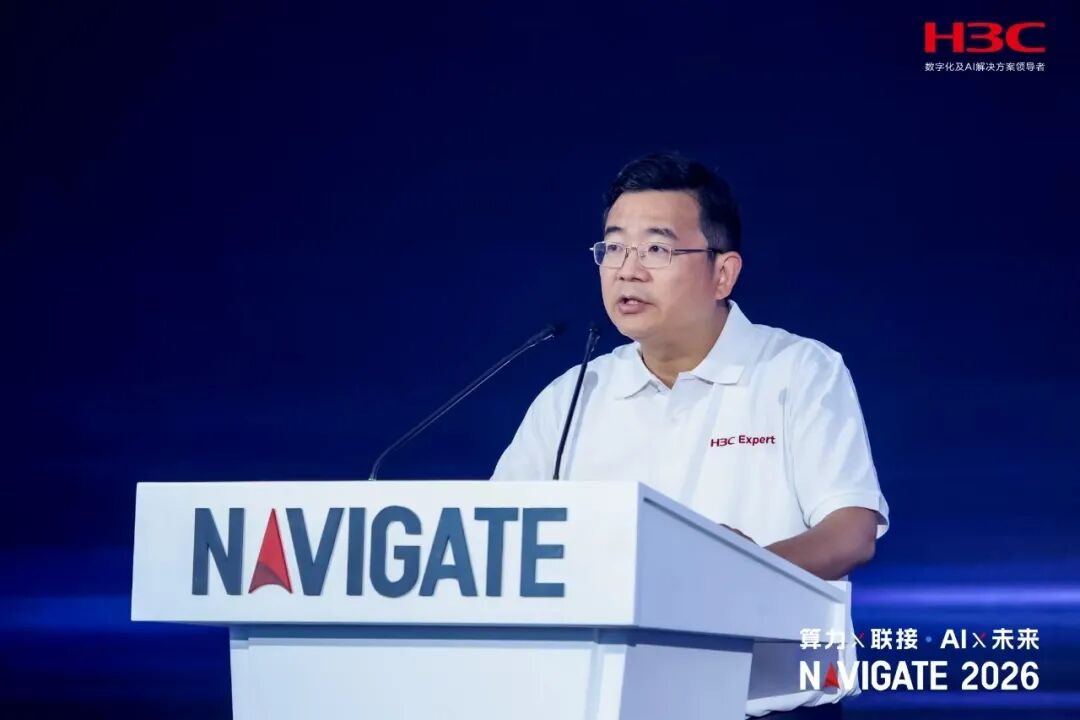
Zhang Tao, Chief Technology Officer and Chairman of the Technical Committee at H3C
Even more critical is cooling. H3C has evolved from initial CPU cold plate products to liquid-cooled rear door technology, then to cold plate integrated systems, and now introduces an all-liquid-cooled, fanless integrated system. All heat-generating components on the motherboard are incorporated into a high-density flow channel cold plate cooling loop, improving computing node cooling efficiency by over 10%. The all-liquid-cooled, fanless design achieves a PUE as low as 1.04. The cabinet supports high-power centralized power supply, with the entire architecture natively compatible with 800V high-voltage DC power.
The computing power swordplay continuously pushes limits, ushering in a new era of higher-density, more efficient, and greener computing power, moving from 'usable' to 'optimal.'
2 Networking 'Shangyang Sword': Ingenious Flexibility, Making Connections a Performance Multiplier
Certainly, robust computing power requires networking support, as networking is the meridian connecting computing power and data.
Especially in clusters of tens of thousands of cards, network congestion can lead to over 30% computing power loss. Facing the networking challenges of intelligent computing, it is urgent to unblock the data connection meridians.
In constructing an interconnected intelligent networking strategy, H3C not only adopts a parallel evolution of optical and electrical technologies to meet Scale-Up high-speed interconnection needs but also focuses on multi-dimensional optimization of networking key technologies for computing-network synergy, achieving higher bandwidth utilization in Scale-Out. Through network optimization techniques, H3C increased bandwidth utilization to 92.5% in a customer's cluster of tens of thousands of cards. Even in an internet customer's intelligent computing project, GPU single-card bandwidth utilization was boosted to over 96%. This skill of 'threading a needle in a data stream' is as ingenious and flexible as the 'Shangyang Sword,' subtly resolving network congestion challenges.
Additionally, H3C has achieved long-distance computing power collaboration in key technologies for wide-area lossless transmission.
Zhang Tao noted that, thanks to the combined effects of intelligent networking technologies, in an internet customer project, throughput between two data centers 120 kilometers apart increased by 25%. In a national key laboratory project, throughput between data centers 2,000 kilometers apart increased by 40%.
At the physical level, H3C also pursues ultimate networking flexibility. As Serdes speeds approach 224G, electrical signal transmission distances sharply decrease, necessitating optical interconnections between cabinets. However, H3C does not simply replace electrical with optical but innovates extensively in optical interconnection technologies like CPO and NPO, addressing manufacturing precision, cooling, and maintenance challenges to achieve high-density, reliable interconnections. The newly launched full-series single-chip 102.4T intelligent computing switches achieve the industry's highest single-chip bandwidth. H3C also released DCI switches and computing power router products, increasing interconnection distances by 50 times under equivalent effective bandwidth.
Thus, H3C can handle both electrical connections within cabinets and connections across data centers 2,000 kilometers apart. The ingenious flexibility of H3C's intelligent networking truly makes networking a 'multiplier of computing performance.'
3 Storage 'Zhongchong Sword': Grand and Bold, Ending 'Data Waiting' with Heroic Spirit
However, no matter how powerful computing power is, if data storage is inadequate, it's like having inner strength without moves, constantly constrained. High-performance computing power can only unleash its value when fully 'fed' with data. A common pain point today is that computing power is 'either computing or waiting for data.' According to statistics, in clusters of tens of thousands of cards, data I/O bottlenecks cause GPUs to idle over 40% of the time. Insufficient data bandwidth during model training leaves GPUs idle, while soaring KV Cache in inference scenarios poses microsecond-level latency challenges.
To address this, H3C has developed a high-performance distributed storage engine and proposed the concept of 'trading storage for computing,' fundamentally resolving storage bottlenecks affecting intelligent computing efficiency and ensuring computing no longer waits for data.
Zhang Tao analyzed that the core of 'trading storage for computing' is elevating storage from a 'background support' role to a 'performance engine' on par with computing power. The newly launched AI-native storage X20000 series achieves single-node bandwidth of 200GB/s and up to 3 million IOPS through technologies like zero-copy across the entire link and intelligent data prefetching, while maintaining latency as low as 100 microseconds.
More notably, H3C innovated the KV Cache inference acceleration system and launched XCache acceleration software. Facing challenges where KV Cache data volumes far exceed GPU memory limits in long-text, high-concurrency scenarios, H3C built a multi-level cache system spanning shared memory, CXL memory pools, and X20000 storage, expanding cache capacity and significantly boosting response speeds in long conversations.
Through these series of storage technology innovations, H3C can reduce first-Token latency by 90% and increase concurrency by 10 times.
This means storage is no longer just a 'warehouse' for data but a 'cache accelerator' determining Token generation efficiency. H3C enables storage to directly participate in accelerating computing processes, fundamentally alleviating the prominent challenge of 'storage bottlenecks causing computing power idling.'
Meanwhile, H3C also introduced the industry's highest-density all-flash storage, with 18 disks per U, combining ultra-high density with ultimate performance. Additionally, the 60-disk hybrid-flash storage offers an effective single-frame capacity of up to 1.3PB. Through a comprehensive range of storage product combinations, AI training and inference scenarios can significantly reduce GPU data waiting times, resembling the grand and bold 'Zhongchong Sword' technique, like a rainbow piercing the sun, heroically helping intelligent computing users end the dilemma of 'data waiting.'
4 Six Pulses United, Full-Stack Synergy: Innovating a New Paradigm for AI Infrastructure
With computing power, networking, and storage as the three inner forces, a nimble and swift 'brain' for unified scheduling, an AI security system covering the entire lifecycle of intelligent agents, and an intelligent operations management system ensuring 'five nines' reliability for business continuity are also needed to fully unleash the industry value of AI infrastructure.
As the nimble and swift 'brain,' H3C's AI-intelligent cloud, capable of managing over 100,000 nodes, leverages key technologies like the 'integrated intelligence architecture' and 'intelligent computing acceleration engine' to make every unit of computing power responsive to demand, serving as a unified scheduling hub for Token production.
When AI applications evolve into autonomous intelligent agents, H3C treats them as 'digital employees' and has tailored three lines of defense: an intelligent agent identity management engine, a three-tier dynamic permission engine, and a full-link audit engine. Simultaneously, H3C launched three core new products for its intelligent agent security protection system, covering the entire lifecycle of intelligent agents, eliminating AI security risks, and making security the 'guardian of Token production.'
As AI infrastructure scales and becomes increasingly complex, H3C, leveraging its deep-rooted expertise in operations, has launched the Lingxi intelligent operations agent, which runs through the entire lifecycle of 'planning, construction, maintenance, and optimization,' comprehensively ensuring stable AI infrastructure operation. H3C can now save 60% in initial deployment time, compress 90% of repeated alerts, and improve fault troubleshooting efficiency by 90%. Operations have shifted from 'experience-driven' to 'intelligence-driven,' delivering 'five nines' system reliability to users.
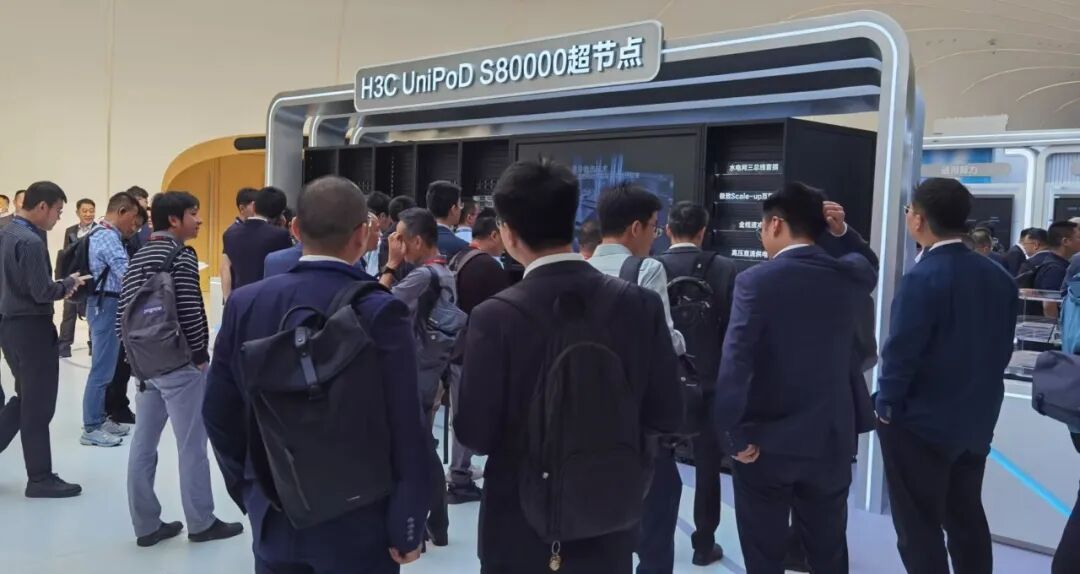
However, facing the ever-changing AI landscape, H3C's masterstroke in its full-stack synergy strategy is the UniPoD S80000 super-node, which integrates the inner forces of six technology stacks: computing, networking, storage, cloud, security, and operations. Global Cloud Observer analysis points out that as the ultimate engineering manifestation of the 'computing power × connection' concept, the S80000 super-node has become the 'Six-Pulse Swordplay' in the AI realm.
The S80000 super-node covers a full range from 32 to 1,024 cards, with a single cabinet housing up to 128 cards in high-density deployment, and can be elastically expanded to 16,384 cards based on actual user needs. This is the technical culmination of H3C's full-stack capabilities.
Moreover, all six technological pieces are indispensable. It is pluralistic open, compatible with different computing power chips. It boasts ultra-high computing density, supporting up to 128 cards in a single cabinet. It features ultimate interconnection, with non-blocking cell switching that enhances effective inter-card bandwidth. It offers elastic redundancy, with an N+M redundancy design that allows up to 8 cards to fail simultaneously in a 64-card super-node single cabinet. It is green and energy-efficient, relying on H3C's megawatt-level efficient power supply technology and higher-density liquid cooling flow channel design to achieve ultimate PUE. It supports intelligent operations, with simplified deployment, proactive issue prevention, and self-healing faults.
As the industry's deployable UniPoD S80000 full-series super-node, through deep software-hardware synergy optimization, training performance can be improved by 70%, and inference performance by 3 times.
Behind every Token produced lies a mighty computation, a clever connection, a grand storage operation, a nimble scheduling, a precise security verification, a reliable operations commitment, and the realization of business value.
With the six pulses united and full-stack synergy, H3C innovatively defines a new paradigm for AI infrastructure, ensuring every Token delivers ultimate cost-effectiveness!
5 Conclusion: The Full-Stack Navigator: Laying the Foundation for the Token Era
In the AI realm, top experts do not win with just one move or style but with deep inner strength, extensive martial arts knowledge, seamless move coordination, and integration.
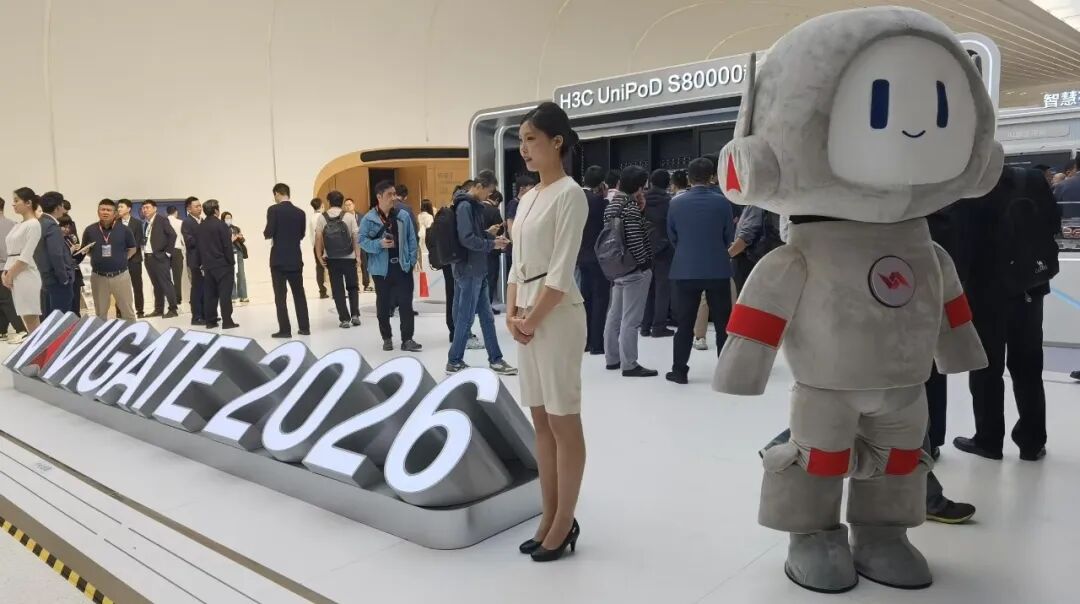
In the AI era, marked by both excitement and anxiety, H3C has adopted the mindset of 'computing power × connection, AI × future,' cultivating the six full-stack swordplay techniques of 'computing, networking, storage, cloud, security, and operations' to strive to resolve the numerous challenges of the Token economy.
Indeed, experts always consider the big picture to achieve great success. In the current Token era, the same holds true. H3C sets no technological boundaries, establishes no ecological boundaries, and, with an open stance as a foundation builder, collaborates with industry forces to progressively unleash this 'Six-Pulse Swordplay' strategy for AI infrastructure, committed to realizing the vision of 'optimal Token cost-effectiveness.'
Facing the intelligent future of all industries, only full-stack navigators can lay the foundation for the Token era.",
-
Ofilm Teams Up with ADSensE to Propel Large-Scale Deployment of All-Solid-State LiDAR Powered by ADS6311 Chip!
-
![]()
Loss of 2.5 Billion Yet Facing Strong Demand for Shares? Another Battle for Control of Lianchuang Electronics
-
![]()
Huawei’s Enjoy Series Flies Off the Shelves, Prompting Xiaomi to Double Down on Budget Smartphones
-
![]()
Beijing Hyundai's Top Executive Criticizes Industry Disorder: Certain Brands Treat Customers as Beta Testers
-
![]()
The domestic mobile phone market has declined for five consecutive quarters! Huawei defies the trend with significant growth: maintains its top market share
-
Annual Revenue Surpasses 3 Billion: An Automotive Trim 'Little Giant' Makes Its Debut on the Beijing Stock Exchange
-
![]()
The Space Force Wants to Spend $30 Billion on Rocket Launches: Is Trump Doubling Down, and Is SpaceX the Big Winner?
-
![]()
Going Crazy! One out of Every Three Plug-in Hybrids Sold in Europe is a Chinese Vehicle