Alipay Unveils the Globe’s Pioneering Token-Based Payment Service: Will the AI Era Revolutionize How We Pay?
 05/27 2026
 517
517

NEW THINKING
This marks the 65th original article from the Thinking AI Society.
With a total of approximately 1,500 words, the estimated reading time is 5 minutes.
Let's be honest—when it comes to making payments, we've grown accustomed to scanning QR codes, using facial recognition, and tapping NFC.
But have you ever pondered: as AI agents begin to run errands and make purchases on our behalf, how will the payment process adapt?
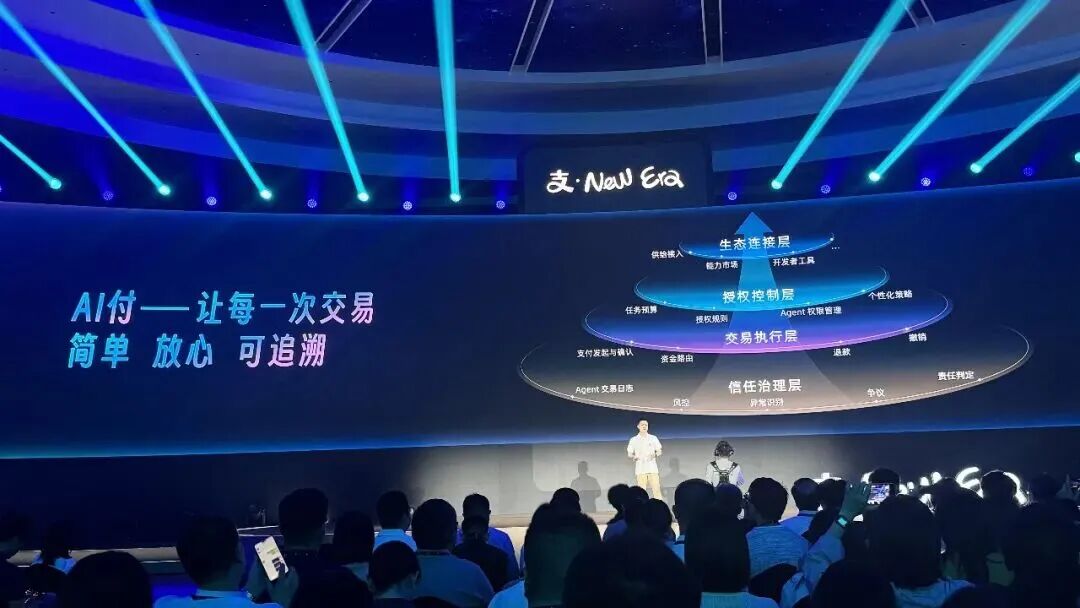
On May 26, Alipay made waves by introducing the world's first Token Pay service. In essence, it's a payment solution tailored specifically for the AI era's "recharging" needs.
What exactly is Token Pay?
Tokens, also referred to as "word units," are a staple in the daily operations of AI practitioners. They serve as the "fuel" for AI models—every time a large model answers a query, generates an image, or executes code, it consumes Tokens.
The challenge? Purchasing Tokens was previously a complex, costly, or unsatisfactory user experience.
Alipay's Token Pay aims to address all these issues simultaneously: large model companies can leverage it to manage global user subscriptions, Claw (client-side) users can top up Tokens with a single click, and users can recharge anytime, anywhere, ensuring that agent tasks don't grind to a halt due to insufficient funds.
MiniMax and StepFun have already officially integrated, with several AI products under their umbrella utilizing Alipay's customized solutions for Token recharges, membership subscriptions, and marketing scenarios.
Zhu Lin, General Manager of AI Payments at Ant Group, drew a parallel: AI Pay addresses "who pays," AI Receive tackles "who receives," and Token Pay resolves "the basis for charging." Together, they form a comprehensive payment ecosystem.
It's not just about Token Pay—it's a complete suite.
A closer look at this launch reveals that Alipay actually unveiled four products simultaneously.
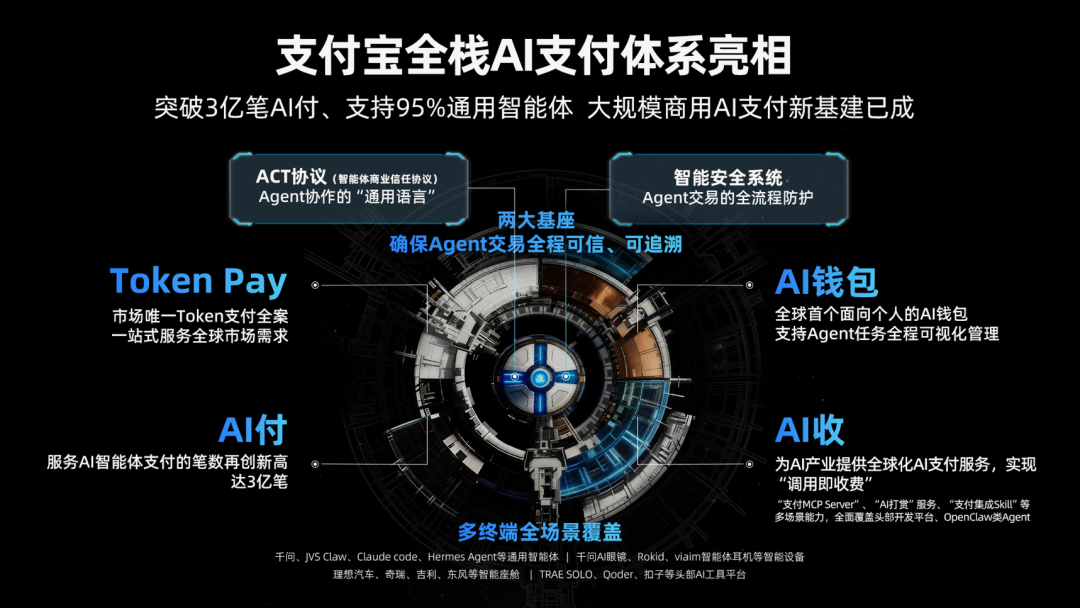
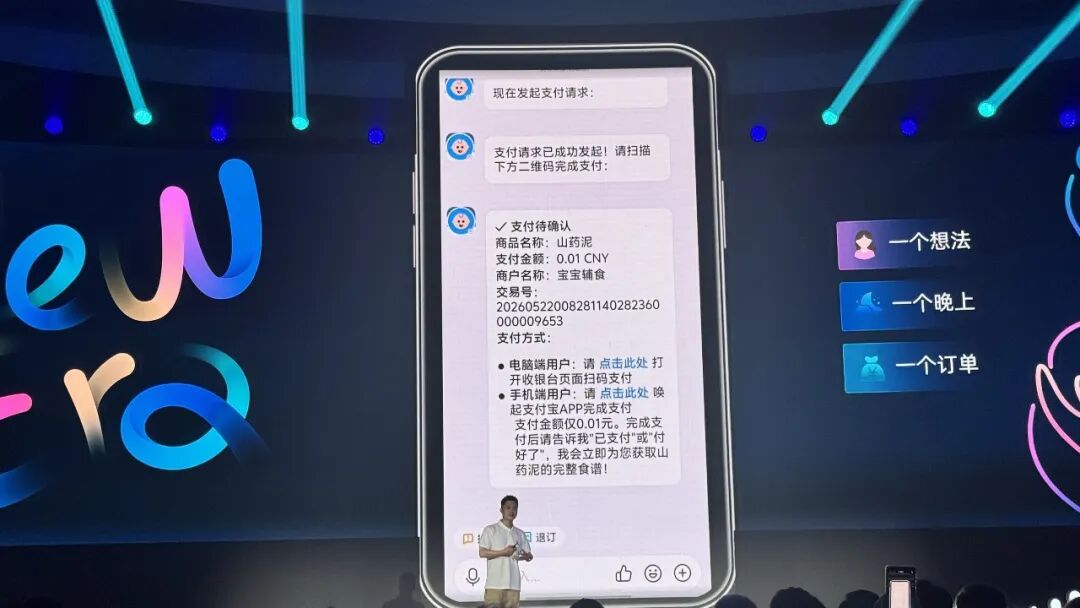
AI Pay—empowers agents with payment capabilities, enabling AI agents to directly complete order payments on behalf of users. The payment process is streamlined from four steps to one, with the loss rate reportedly plummeting to one in a hundred million. It covers 12 major scenarios and supports 95% of general-purpose agent frameworks, including mainstream products like Claude Code, Coze, and TRAE SOLO.
AI Receive—facilitates easier merchant operations in the AI realm. After integrating AI Receive, agents across the web can purchase your goods.
An intriguing example shared at the launch event: a mother encapsulated her years of parenting experience into an intelligent service and earned her first dollar through Agent-based automatic transactions. Personal expertise can now be monetized—a previously unimaginable feat.
Token Pay—the sole model payment solution on the market, claiming to boost subscription success rates by 70%.
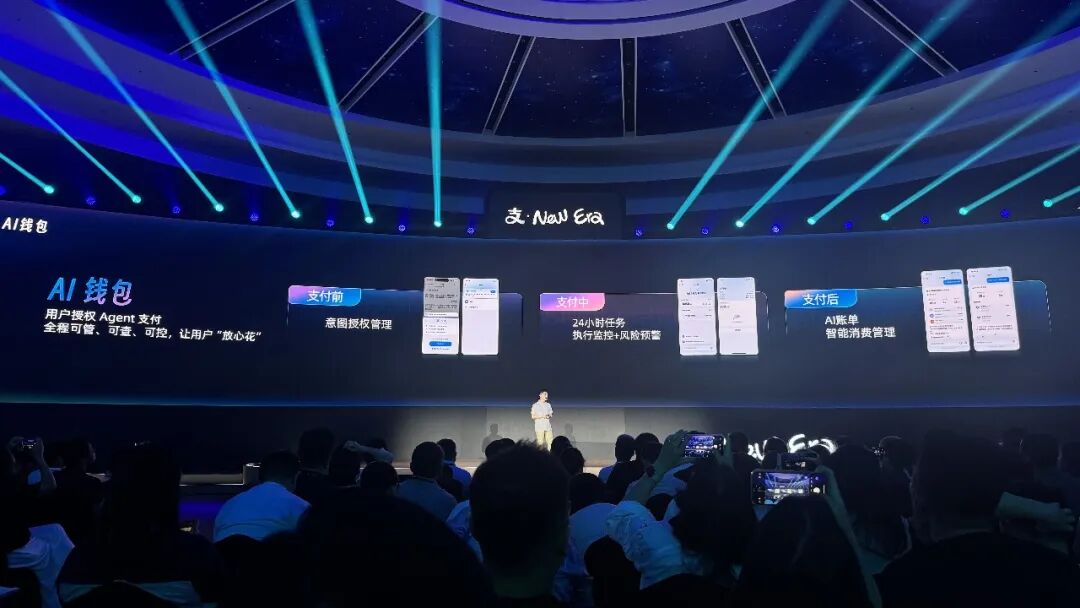
AI Wallet—designed for individual users to manage agent authorizations. Before payment, boundaries can be set; during payment, 24-hour monitoring and risk alerts are in place; after payment, AI billing statements can be reviewed. In short, it upgrades from "can pay, can receive" to "can manage, can control."
In fact, the core of innovating and restructuring payment chains revolves around two questions: Why can users trust Agents to spend money (payment security)? How can merchants enable Agents across the web to make purchases (marketing)?
Some may inquire: What's the advantage of letting AI select products and spend money on your behalf? Not only do you lose the sensation of spending, but could it also deplete your already slim wallet in minutes? Will Agents find it even more challenging to break out of information bubbles?
Payment logic is undergoing a transformation.
Han Xinyi, CEO of Ant Group, made an insightful remark: "The essence of commerce remains unchanged in the AI era, but new agent roles are refactoring (restructuring) everything."
Upon closer examination, this holds true. Traditionally, when we purchased goods, subscribed to memberships, or ordered food, the payment targets were clear.
However, in the AI era, the unit of charging has shifted—a model call, a piece of content generated, an image, or an API access could all become billing points.
When charging transitions from "one item" to "a set of Tokens," payment products must adapt accordingly.
Interestingly, overseas players are exploring similar directions.
Coinbase launched x402 for HTTP-native payments, while Stripe introduced Shared Payment Tokens to enable AI Agents to make payments without exposing payment credentials.
Although Alipay's Token Pay takes a distinct approach, it essentially addresses the same question: As AI services transition from "free trials" to "pay-as-you-go," how should payment interfaces evolve?
Alipay also upgraded the ACT Protocol 2.0, collaborating with over 20 ecosystem partners to create payment capability frameworks for A2A (Agent-to-Agent) and A2M (Agent-to-Machine) transactions.
In simpler terms, it's about establishing a "universal language" for transactions between agents, enabling them to recognize and pay each other.
Significant efforts have also been made in security. The AI Pay intelligent security system has passed two authoritative certifications from China Telecommunication Technology Labs (CTTL), achieving the highest Level 5 security standard.
The slogan "You dare pay, we dare compensate" has been upheld for 20 years this time around.
Looking back, Alipay has consistently made the right moves: Express Pay capitalized on e-commerce growth, QR Code Pay rode the mobile internet wave. Now, it's betting on payment opportunities in the agent era.
The numbers speak volumes: 300 million AI agent-based payments, covering 95% of general-purpose agent frameworks, and a network of "Tap & Pay" terminals across millions of physical stores forming offline touchpoints.
Alipay's strategy essentially involves laying down infrastructure before the agent economy truly takes off.
As for how payments will evolve in the future, that hinges on how the agent economy unfolds.
But one thing is certain: in the future, the ones prompting you to spend money may not just be humans—they could be AI.

All content in this article is sourced from publicly available information.
Written casually in my spare time for sharing, representing only my personal views.
-
Ofilm Teams Up with ADSensE to Propel Large-Scale Deployment of All-Solid-State LiDAR Powered by ADS6311 Chip!
-
![]()
Loss of 2.5 Billion Yet Facing Strong Demand for Shares? Another Battle for Control of Lianchuang Electronics
-
![]()
Huawei’s Enjoy Series Flies Off the Shelves, Prompting Xiaomi to Double Down on Budget Smartphones
-
![]()
Beijing Hyundai's Top Executive Criticizes Industry Disorder: Certain Brands Treat Customers as Beta Testers
-
![]()
The domestic mobile phone market has declined for five consecutive quarters! Huawei defies the trend with significant growth: maintains its top market share
-
Annual Revenue Surpasses 3 Billion: An Automotive Trim 'Little Giant' Makes Its Debut on the Beijing Stock Exchange
-
![]()
The Space Force Wants to Spend $30 Billion on Rocket Launches: Is Trump Doubling Down, and Is SpaceX the Big Winner?
-
![]()
Going Crazy! One out of Every Three Plug-in Hybrids Sold in Europe is a Chinese Vehicle