Ant Group CEO Han Xinyi's Latest Speech: The Emergence of 'Trust Logic' in the AI Era
 05/27 2026
 603
603
Author|Lin Yi
Editor|Focus Editor
Over the past 22 years, Alipay has undeniably played a pivotal role in shaping and advancing payment tools in China. From enabling the prosperity of e-commerce through swift payment solutions to invigorating the mobile internet landscape with QR code payments, it has consistently been at the forefront of innovation.
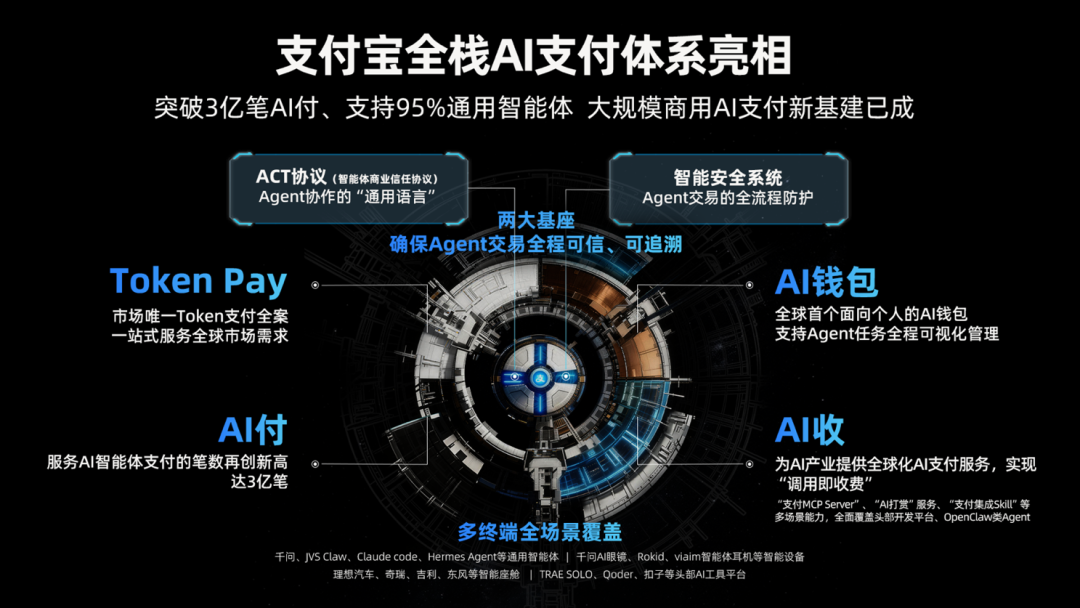
On May 26, Alipay unveiled a series of groundbreaking data points: AI-driven payments have successfully completed a cumulative total of 300 million agent-based transactions and now support 95% of the general-purpose agent frameworks available in the market. This achievement positions Alipay as the world's pioneer in large-scale, commercially viable AI-native payment infrastructure. With the introduction of the world's first Token Pay service and AI Wallet, complementing the previously launched AI Pay and AI Receive, a comprehensive AI-native payment system has officially taken shape, covering all aspects from authorization to management, and from security to trust.
At this pivotal moment, Ant Group CEO Han Xinyi, in his latest speech, systematically shared his profound insights on the agent economy and AI payments: AI is set to bring about numerous transformations, but ultimately, it is designed to serve people and enhance their lives.
Unlike many industry leaders who fervently advocate for technological utopias and assert that AI will disrupt every facet of our lives, Han Xinyi firmly believes that AI is a tool for serving humanity. Amidst the cacophony of discussions about AI revolutionizing everything, he maintains a remarkably clear perspective on what will change, what will remain constant, and what truly signifies the future. By identifying the 'unchanged' amidst the 'changes,' he provides much-needed clarity in this era of technological fervor and anxiety.
Han Xinyi's speech centered around three key themes: Has the core essence of business evolved in the agent era? What will agents reconstruct? How can AI payments bolster the new business ecosystem?
Here are the key takeaways from his speech:
1. The fundamental nature of business in the agent era remains intact, but the competitive advantage has shifted from 'traffic access points' to 'agent ecosystems.'
Han Xinyi emphasizes that in the agent era, the core of business remains unchanged. The mechanism of value creation—delivering products and services to customers who acknowledge their value and are willing to pay for them—persists. Trust mechanisms, transaction costs that delineate corporate boundaries, and the scale and network effects that define business moats also remain relevant.
The most significant shift lies in interaction dynamics. Traditionally, interactions occurred between individuals and between individuals and businesses. In the future, they will transition to interactions between individuals and agents and among agents themselves. With China's current population of 1.4 billion, the future could witness 14 billion or even 140 billion agents actively participating in economic activities.
Consequently, the 'traffic is king' mentality that dominated the mobile internet era, built on human-generated traffic, will become obsolete. Instead, the 'agent ecosystem' will emerge as a formidable business moat. In this ecosystem, not only users and merchants but also AI model providers and developers will collectively contribute to a critical network effect.
In essence, traffic access points determined by human relationships are being replaced by 'agent ecosystems' determined by agent trust networks. In the mobile internet era, human relationships were confined within specific apps, making them resistant to disruption. However, agent relationships are based on value networks, which are still evolving, offering immense possibilities for new entrants. Only with a new perspective can one discover new opportunities.
2. Agents are reshaping decision-making processes, steering business operations towards 'service finding people' and 'task-based transactions.'
Han Xinyi believes that decision-making authority in business is undergoing a fundamental transformation, shifting from solely human decision-making to 'joint decision-making by humans and agents.'
This transfer of decision-making power leads to a profound reconfiguration of business models:
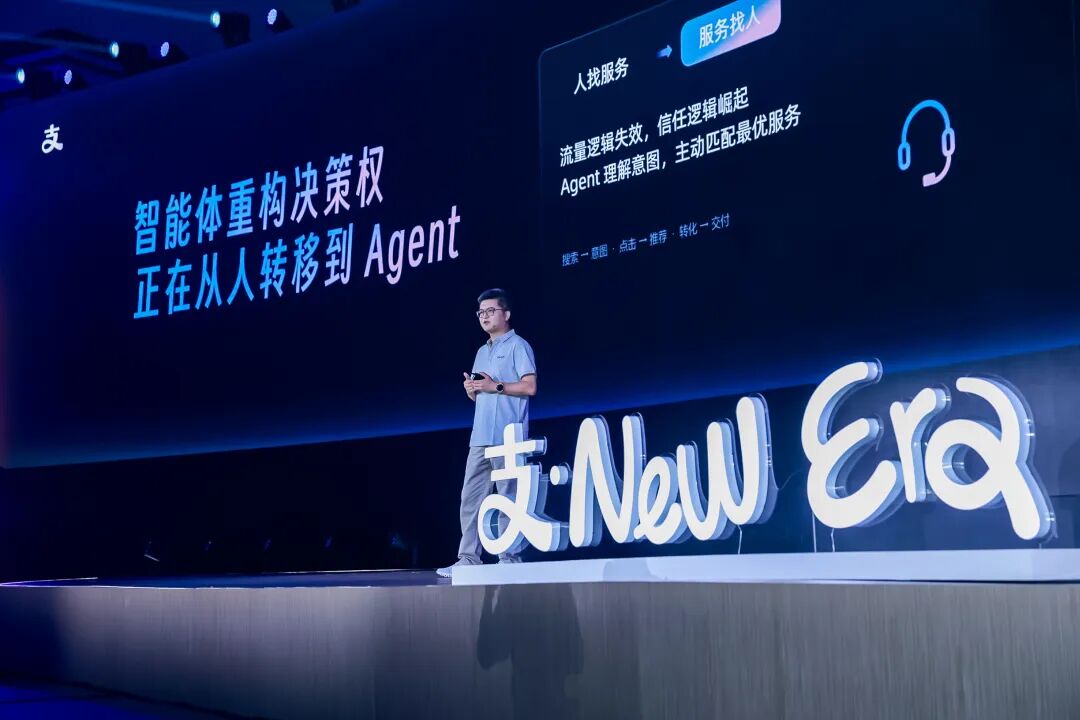
Firstly, from 'people seeking services' to 'services finding people': Once agents comprehend user intent, they will proactively engage with other agents to deliver suitable services directly to users. The traditional traffic logic becomes obsolete, and the trust logic takes center stage.
Secondly, from 'commodity and service transactions' to 'task-based transactions': Previously, users had to independently book flights and hotels for travel. Now, with a single instruction, agents can arrange everything seamlessly and deliver the final results. Business operations will evolve from focusing on individual stock-keeping units (SKUs) to providing comprehensive solutions.
Finally, from 'bilateral markets' to 'multilateral networks': Market structures will transform into ecological networks involving multiple collaborations among agent service providers, payment networks, and data providers.
In the past, the internet revolved around people connecting with people, with relationship chains holding the utmost value. In the future, it will be about agents connecting with agents, focusing solely on matching and delivery, with countless digital representations eliminating the need for ineffective social interactions. This signifies that in the agent era, the traditional traffic logic will falter, and the trust logic will prevail. Whoever can effectively address trust issues may dominate the agent ecosystem.
Previously, merchants offered single-point services; now, users demand comprehensive result delivery. This mirrors the paradigm shift in cloud computing: Users seek computed results, whereas vendors in the past only provided computing power centers. By extension, many single-point commodity models today may be bypassed in the agent era, integrated, consolidated, and processed before being delivered in the form users truly require.
3. The essence of AI payments lies in leveraging two key components: 'agents' and 'tokens.'
In Han Xinyi's view, in the AI era, the executing entity for payments has transitioned from humans to agents capable of autonomous decision-making and tool invocation. To address issues of error identification and accountability during data interactions, the entire process must be traceable and auditable. This necessitates the establishment of a comprehensive trust traceability system using technologies like blockchain, forming the 'trust layer' of the entire business ecosystem. To this end, Alipay has upgraded the Agent Business Trust Open Protocol Framework (ACT Protocol 2.0) in collaboration with partners and independently developed the 'AI Pay Intelligent Security System.'
In terms of value carriers, payments are now token-based. Agents, requiring no rest, can engage in economic activities around the clock, significantly reducing the minimum payment unit to the token level. Future payment forms will carry not only legal tender but also points, rights, and marketing coupons via tokens. Alipay's newly launched Token Pay and personal AI Wallet are designed to meet these new token-based payment and management needs, shifting from merely facilitating payments to enabling comprehensive management and control.
The relationship between tokens and agents is crucial for understanding the AI era. We cannot project agent behavior based on human limitations. Firstly, their numbers will be vast; secondly, they will operate continuously. Once agents achieve a high degree of network connectivity with other agents, the possibilities are limitless. If agents require a traceable technology, blockchain is the most suitable. In this regard, Alipay clearly holds a significant advantage.
4. Alipay aims to excel as a trust layer, connector, and enabler in the agent era.
So, how will Alipay's AI payments specifically support the new business ecosystem in the intelligent economy era? Alipay's strategy is to establish open standards and protocols, fully embracing the roles of trust layer, connector, and enabler:
Firstly, establishing new trust mechanisms. Alipay's AI payments will assist the entire business ecosystem in building a trust layer, addressing the fundamental challenges of trust between humans and machines and among machines themselves. Secondly, enabling agents to better participate in consumer decision-making by acting as a 'connector.' Thirdly, fully strengthening its role as an 'enabler.' This means not only assisting large model providers and leading enterprises but also deeply serving and expanding small and medium-sized merchants.
Looking back over the past 22 years, Alipay has been a trailblazer in every commercial transformation. Escrow transactions facilitated the e-commerce era, and mobile payments drove merchant digitization in the mobile internet era.
Standing at the forefront of a new era, Alipay's ultimate goal is to leverage AI payments to help all merchants and ecosystem partners transition from the mobile internet era to the intelligent economy era, jointly constructing a new agent-based business ecosystem. Facing the unknown agent era, we can place our trust in Alipay, which has a proven track record over the past 22 years.
5. Regardless of the rapid advancements in AI, its ultimate purpose is to serve people and enhance their lives.
Although the agent economy era will bring about profound changes in business processes and the essence of payments, the ultimate focus of technology remains unaltered.
As Han Xinyi demonstrated at the beginning of his speech, while AI tools can swiftly create a high-quality PPT, the final decision-making and choice always rest with humans.
Whether there may be 14 billion or even 140 billion agents actively participating in economic activities in the future, or whether AI helps reduce transaction costs in search, negotiation, and other areas to expand corporate boundaries, the essence is to empower every merchant to better serve more users, preserving the 'human touch' and ensuring that technology ultimately fully returns to and serves human life.
Below is the full text of Han Xinyi's speech:
As we step into the agent economy era, I would like to delve into three key aspects: 1. Has the core essence of business changed? 2. What will agents reconstruct? 3. How can AI payments bolster the new business ecosystem?
I. The Core Essence of Business Remains Unchanged
We believe that the core essence of business in the agent era remains steadfast.
1. Value creation remains unchanged. It still revolves around delivering products and services to customers, having them recognize the value, and paying for it. Simultaneously, merchants must receive more revenue than their costs.
2. Trust mechanisms also remain unaltered. In the past, interactions were between individuals, fostering trust between them and between individuals and businesses. Consequently, people tended to trust big brands and platforms. However, what will change? Firstly, in the agent era, there will be a surge in participants. Today, China has 1.4 billion people; in the future, there could be 14 billion or even 140 billion agents actively participating in economic activities. Interactions will shift from human-to-human to human-to-agent and agent-to-agent. Ensuring that agents are trusted by humans and other agents is a paramount consideration and task for the new intelligent agent era.
3. Transaction costs still dictate business models. According to 'Coase's Theorem,' corporate boundaries are determined by transaction costs. In the AI era, AI can significantly aid in reducing costs in search, negotiation, execution, and supervision. With greater reductions in production and service costs, we believe every merchant can better serve more users, leading to enhanced business growth—meaning corporate boundaries will further expand.
4. Finally, scale and network effects remain unchanged; they still define business moats. However, the past 'traffic access points' determined by humans will give way to 'agent ecosystems.' We used to say 'traffic is king' in the mobile internet era, with human-generated access traffic as the moat. But in the agent era, the 'agent ecosystem' will be a formidable moat, with the scale of agents and the network effects they generate being crucial. Here, not only users, merchants, and their agents but also AI model providers, developers, and various participants will become part of the 'agent ecosystem' network.
II. Agents Reconstruct Decision-Making Power, Shifting from Humans to Agents
What has fundamentally transformed? We believe that agents will reconstruct decision-making power, shifting from solely human decision-making to joint decision-making by humans and agents.
1. From 'people seeking services' to 'services finding people.' In the past, whether through search or recommendations, it was essentially people seeking services. But in the agent era, it will become services finding people. Agents understand intent, interact with other agents, find suitable products and services for users, and deliver them directly. Trust is paramount in this process. Therefore, we believe that in the agent era, the traditional traffic logic will falter, but the trust logic will rise. Whether you trust your agent and whether your agent can be trusted by others and other agents will determine more business opportunities and growth.
2. From 'commodity transactions and service transactions' to 'task-based transactions.' Previously, users had to independently book flights, hotels, and ride-hailing services when traveling. But agents can now assist users by simply saying, 'Plan a perfect business trip,' and agents can arrange everything seamlessly to complete the task—this is a solution. Wanting to prepare a warm and romantic candlelit dinner for a partner's birthday used to require ordering flowers, buying candles, and shopping for groceries yourself. But now, with a single instruction, agents will handle all the related preparations for you. The difference lies in the shift from single-point commodity and service transactions to task result delivery. Business operations will also upgrade from focusing on individual SKUs to providing comprehensive solutions.
3. Finally, from 'bilateral markets' to 'multilateral networks.' Previously, user-merchant interactions formed bilateral networks and markets, which could occur on platforms or offline. But in the future, agent service providers, payment networks, and even data providers will collaborate within an ecosystem. This multilateral collaboration will break the original human-to-human interactions, creating more new opportunities while also bringing many new demands and challenges.
III. AI Payments Bolster the New Business Ecosystem
How can AI-powered payment systems better cater to the needs of the new business ecosystem? To answer this, we must first delve into the core nature of AI payments. Traditionally, payments involved the transfer of funds between individuals. However, in the age of agents, we anticipate the following transformations:
1. The execution medium will transition from humans to agents. Agents will autonomously make decisions and utilize tools and APIs to carry out tasks. Nonetheless, at pivotal moments, they will seek confirmation—be it from other agents or humans. A critical aspect is that the entire process must be traceable and auditable. When you assign a task to an agent, the interaction between two agents is grounded in data exchange. Should an error arise during this process, pinpointing which agent provided missing or inaccurate data and determining responsibility allocation becomes pivotal for the agent economy. This is no longer a straightforward information exchange between humans. Hence, a robust trust traceability system is imperative. Blockchain technology offers an excellent framework for this purpose.
2. The value medium will evolve into tokens. Payments in the AI era will operate continuously, as agents do not require sleep like humans. With sufficient tokens and computational power, they can function non-stop. The minimum payment unit will transition from cents to tokens, with one token potentially being worth 0.00001 cents, significantly slashing costs. Ultimately, our payments may encompass not only legal tender but also points, rights, and marketing coupons, all facilitated by tokens.
We posit that in the AI era, the essence of AI payments hinges on firmly grasping the two key mediums: agents and tokens. This represents a fundamental divergence between payments in the AI era and those in the mobile internet era.
IV. How AI Payment Facilitates the New Business Ecosystem
1. AI payment necessitates the establishment of a novel trust mechanism. Alipay's AI payment should aid the entire business ecosystem in constructing a trust layer.
2. AI payment should empower agents to better engage in consumer decision-making. In the AI era, Alipay should serve as a bridge between consumers and merchants, connecting consumers with agents, agents with agents, and agents with merchants, thereby fulfilling its role as a connector.
3. AI payment should act as an enabler. It should not only empower model providers and leading enterprises but also assist small and medium-sized merchants. These merchants are the primary contributors to vibrant community life. To maintain the vitality of communities, it is crucial to serve these merchants effectively. Hence, AI payment functions as an enabler.
4. AI payment should establish open standards and protocols. It should act as a connector for the entire agent business ecosystem.
In essence, we must ensure that Alipay operates effectively as a trust layer, connector, and enabler in the agent era.
V. Alipay as a Pioneer in Every Business Transformation
Reflecting on the past 22 years, Alipay has consistently been at the forefront of every business transformation.
Escrow transactions paved the way for the rise of the e-commerce era.
Mobile payments propelled the digitization of the mobile internet and merchants.
In the era of the intelligent economy, Alipay aspires to leverage AI payment to assist all merchants and partners in transitioning from the mobile internet era to a genuine intelligent economy era.
Let's collaborate to construct a new ecosystem for intelligent business!
-
Ofilm Teams Up with ADSensE to Propel Large-Scale Deployment of All-Solid-State LiDAR Powered by ADS6311 Chip!
-
![]()
Loss of 2.5 Billion Yet Facing Strong Demand for Shares? Another Battle for Control of Lianchuang Electronics
-
![]()
Huawei’s Enjoy Series Flies Off the Shelves, Prompting Xiaomi to Double Down on Budget Smartphones
-
![]()
Beijing Hyundai's Top Executive Criticizes Industry Disorder: Certain Brands Treat Customers as Beta Testers
-
![]()
The domestic mobile phone market has declined for five consecutive quarters! Huawei defies the trend with significant growth: maintains its top market share
-
Annual Revenue Surpasses 3 Billion: An Automotive Trim 'Little Giant' Makes Its Debut on the Beijing Stock Exchange
-
![]()
The Space Force Wants to Spend $30 Billion on Rocket Launches: Is Trump Doubling Down, and Is SpaceX the Big Winner?
-
![]()
Going Crazy! One out of Every Three Plug-in Hybrids Sold in Europe is a Chinese Vehicle