"AI + Energy": A Systematic Shift from Central SOEs to Private Enterprises! Three Key Signals Unveiled at the NEA Closed-Door Meeting
 05/28 2026
 442
442
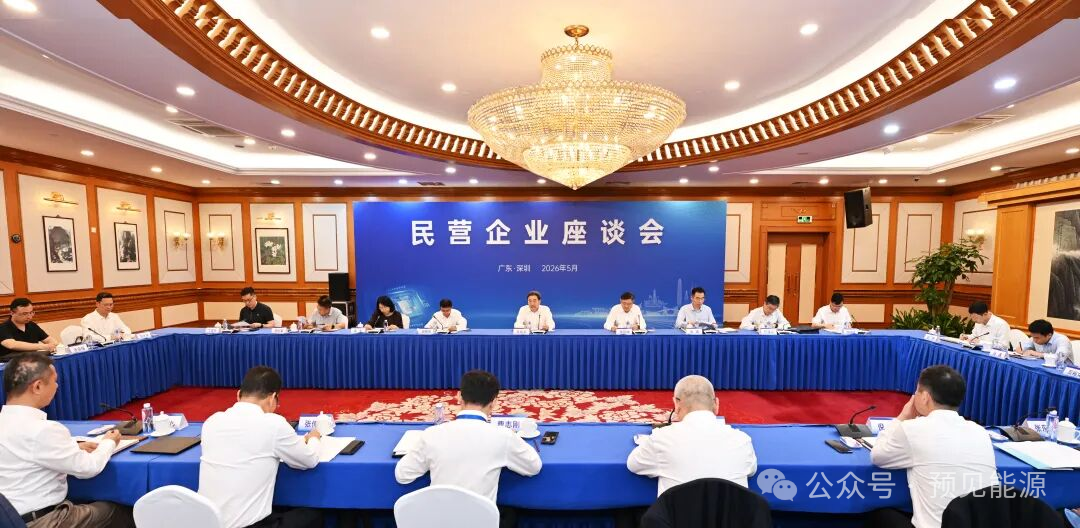
NEA Invites Private New Energy Enterprises for Discussions, Unveiling Three Major Development Signals
Foresee Energy has learned that on May 25, leading private entrepreneurs in China's new energy sector, including Gao Jifan, Chairman of Trina Solar; Li Zhenguo, Chairman of LONGi Green Energy Technology; and Zhang Chuanwei, Chairman of Mingyang Smart Energy, were invited to the NEA's conference room.
The following day, the NEA held a national on-site promotion meeting for "AI +" energy in Shenzhen. Six companies, namely China National Petroleum Corporation, State Grid Corporation of China, China Energy Investment Corporation, Envision Energy, Alibaba Cloud, and Tencent, delivered keynote speeches and unveiled a list of 51 high-value application scenarios for "AI +" energy. Additionally, the NEA issued the
The symposium was not merely an isolated "listening session" but should be seen as a crucial briefing held just before the release of the implementation plan.
At the meeting, Wang Hongzhi, Secretary of the Party Leadership Group of the NEA, attentively listened to the entrepreneurs' challenges and addressed each one, stating that they would "intensify research on each issue" and "strive to facilitate coordinated solutions." Among the information released simultaneously, three key signals stood out prominently.
These signals indicate a systematic opening of the "AI + energy" landscape from central SOEs to private enterprises, structural opportunities in overseas markets, and the institutionalization of government-enterprise communication mechanisms. Foresee Energy interprets these as pivotal variables for private new energy enterprises in the years ahead.

Central SOEs Offer More Than Just Application Scenarios This Time
Previously, the primary concerns of private enterprises participating in such meetings revolved around preventing internal competition and vicious price wars. For instance, the China Photovoltaic Industry Association spearheaded the signing of the
However, this time, the NEA's approach shifted! Instead of regulating supply, it focused on creating demand.
It is understood that central SOEs have accelerated their exploration in the "AI + energy" field. In September 2025, State Power Investment Corporation signed a strategic cooperation agreement with iFLYTEK to jointly establish an "AI +" energy joint laboratory, engaging in comprehensive strategic cooperation in industry large model construction and high-value scenario exploration. China Energy Investment Corporation's "Qingyuan" large model has been integrated into 15 power plants, enhancing the efficiency of technical supervision, inspection, and evaluation by over 100%, and reducing the time for violation identification from prediction to alert delivery to just 15 seconds.
The day after the meeting, on May 26, 2026, the NEA unveiled a list of high-value scenarios for "AI +" energy, openly offering 51 scenarios at once, including "intelligent coordinated operation of virtual power plants across multiple time-space scales" and "intelligent scheduling and operation of green power direct connection with computing power."
Foresee Energy believes that the true focus should be on the design of this application mechanism.
The notice clearly states that energy enterprises can "form industry-university-research-application innovation consortia with AI technology providers" and submit pilot construction plans for recommendation and application through provincial energy authorities or the headquarters of central energy enterprises.
This means that private enterprises no longer need to navigate through the procurement systems of central SOEs individually but instead have an institutionalized docking channel.
Central SOEs' own AI applications cannot fully address the "last mile" problem. Scenarios such as intelligent operation and maintenance, computing power coordination, and load forecasting ultimately hinge on data closed-loop and iteration speed, which happen to be the strengths of private enterprises.
It is foreseeable that the model of central SOEs opening up scenarios and private enterprises providing solutions is becoming—and will undoubtedly become—a highly operable institutional channel in the future.

Entrepreneurs in the Meeting Room Are Quietly Reshaping Global Market Rankings
On May 25, the companies in the conference room were rapidly ascending the global market rankings. In 2025, Chinese wind turbine manufacturers secured the top six positions in BloombergNEF's global market share rankings for wind turbine manufacturers for the first time. Among them, Goldwind maintained its global leadership with 29.3 GW of newly installed capacity, followed by Envision Energy with 20.9 GW, nearly a quarter of which came from markets outside China. Mingyang Smart Energy ranked third with 18.9 GW.
However, the outlook for the wind power industry's overseas expansion is not optimistic, as the path is narrowing.
Previously, Mingyang Smart Energy planned to invest £1.5 billion (approximately 14.2 billion yuan) to build an integrated wind turbine manufacturing base in Scotland, with the first batch scheduled for production by the end of 2028. In March 2026, the UK Secretary of State for Energy stated in parliament that the government did not support the use of Mingyang Smart Energy's wind turbines in UK offshore wind projects. Trade barriers are escalating from single tariffs to systematic market access reviews, and the traditional path of "selling products" to "building factories" is rapidly narrowing.
Meanwhile, the other side of the coin presents new opportunities for private enterprises.
According to the International Energy Agency's (IEA) May report,
Over 50% of global AI data center projects under construction or announced are located within existing clusters, and the proportion of data center capacity within global clusters is expected to rise to 65% when all projects under construction are completed.
In this context, enterprises have two key opportunities: whether green power capacity can be efficiently aligned with AI computing power and whether they can overcome the compliance thresholds for overseas factory construction.
Scenarios such as "intelligent scheduling and operation of green power direct connection with computing power," which were the focus of the symposium, provide replicable solutions for overseas expansion. If the "green power supply for AI" model can be successfully piloted domestically, it can be directly replicated in new data center projects in Southeast Asia, the Middle East, and Latin America.
Whoever first secures long-term green power procurement contracts with AI giants is likely to gain a favorable position in the new global market landscape.

"Strengthening Research on Difficult Issues Item by Item" Is Not Just a Cliché but a Response to Long-Standing Grievances
At the symposium, Wang Hongzhi pledged to "intensify research on the difficult issues raised by enterprises item by item and strive to facilitate coordinated solutions." Behind this statement lies a list of long-standing grievances from private new energy enterprises: hidden market access thresholds, unequal resources when competing with state-owned enterprises in bids, lengthy approval processes, inadequate intellectual property protection, and high financing costs.
The meeting further clarified that the NEA would "continue to deepen government-enterprise communication and consultation in the energy sector and maintain regular communication with private enterprises." Compared to previous "one-time symposiums," if a regular communication mechanism can truly be established, enterprises' policy expectations can shift from "waiting for notices" to "negotiable."
Returning to the symposium at the beginning of the article, the first-quarter 2026 data clearly reflects the accelerating differentiation within the industry. Trina Solar's performance improved with energy storage, reporting revenue of 16.83 billion yuan, a year-on-year increase of 17.40%; a net profit attributable to shareholders of -283 million yuan, a significant year-on-year reduction in losses by 78.55%; and net cash flow from operating activities reaching 4.092 billion yuan, turning from negative to positive.
LONGi Green Energy Technology, another photovoltaic giant, reported a net profit attributable to shareholders of -1.92 billion yuan in the first quarter, a year-on-year increase in losses by 34%, and a net cash outflow from operating activities of 2.449 billion yuan, making it the only leading enterprise with worsening profits and cash flow year-on-year.
The demand for green power from AI computing power is expanding at a faster-than-expected rate. The IEA predicts that by 2030, global data center electricity consumption will account for 3% of total global electricity consumption. Global new photovoltaic installations are expected to reach only 550 to 600 GW in 2026, while silicon material capacity will exceed 3.5 million tons, resulting in a supply-demand ratio exceeding 2:1.
In other words, the massive electricity demand brought by AI is highly likely to become a long-term variable for absorbing excess new energy capacity.
In summary, Foresee Energy believes that the symposium overall released positive signals. For private new energy enterprises, whoever can secure substantial orders in "green power direct connection with computing power coordination" and whose energy storage systems can be the first to pass certification in overseas AI data center supporting projects will have the opportunity to reprice in the next round of competition.
-
Ofilm Teams Up with ADSensE to Propel Large-Scale Deployment of All-Solid-State LiDAR Powered by ADS6311 Chip!
-
![]()
Loss of 2.5 Billion Yet Facing Strong Demand for Shares? Another Battle for Control of Lianchuang Electronics
-
![]()
Huawei’s Enjoy Series Flies Off the Shelves, Prompting Xiaomi to Double Down on Budget Smartphones
-
![]()
Beijing Hyundai's Top Executive Criticizes Industry Disorder: Certain Brands Treat Customers as Beta Testers
-
![]()
The domestic mobile phone market has declined for five consecutive quarters! Huawei defies the trend with significant growth: maintains its top market share
-
Annual Revenue Surpasses 3 Billion: An Automotive Trim 'Little Giant' Makes Its Debut on the Beijing Stock Exchange
-
![]()
The Space Force Wants to Spend $30 Billion on Rocket Launches: Is Trump Doubling Down, and Is SpaceX the Big Winner?
-
![]()
Going Crazy! One out of Every Three Plug-in Hybrids Sold in Europe is a Chinese Vehicle