Jensen Huang Now Shares a 'Brotherly' Bond with Richard Liu
 05/28 2026
 518
518
Liu Treats All Employees Like Family
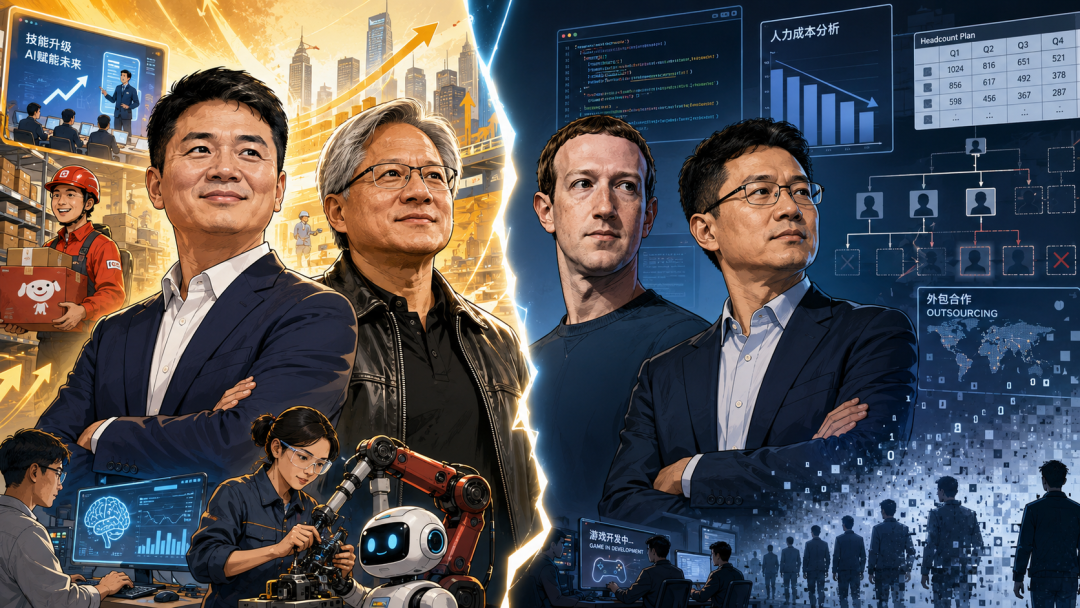
On May 27, Richard Liu, the founder of JD.com who has maintained a low profile for quite some time, made a rare and resolute pledge: 'Faced with the impact of new technologies, we must explore every avenue, be it through business model innovation or the development of new businesses, to safeguard the livelihoods of our hundreds of thousands of employees, including our blue-collar workers—our brothers.'
He underscored, 'JD.com will not lay off a single frontline employee displaced by machines.'
Had these remarks been uttered two or three years ago, they might have been dismissed as mere rhetoric from a corporate leader. However, in 2026, amid Meta's recent layoffs of 8,000 employees, ongoing downsizing at Microsoft and Google, and Zuckerberg even urging employees to 'compete with AI,' Liu's commitment to 'not laying off a single person' starkly contrasts with the prevailing ethical approaches within the tech industry in the face of AI disruption.
What's even more fascinating is that, amid widespread speculation in Silicon Valley about AI-driven mass layoffs of white-collar workers, NVIDIA CEO Jensen Huang has recently made a series of statements that surprisingly align with Liu's perspective—AI is not a tool for job cuts but for enhancing human potential.
These two leaders, representing the tech industries of China and the United States, respectively, have found rare common ground on the 'AI and employment' conundrum.
01 AI's Arrival: What Becomes of Our Brothers?
Richard Liu and Jensen Huang have both conveyed a consistent message—no layoffs.
In November 2025, during an NVIDIA all-hands meeting, an employee, concerned about job security in the AI era, sought reassurance from the boss. Huang responded with a promise: 'I guarantee you, your job is secure.'
Huang's words were not mere platitudes—the facts support his claim. NVIDIA has not laid off employees due to AI; instead, it added thousands last quarter, to the extent that parking spaces are becoming scarce. He even added, 'Frankly, I think we might still need around 10,000 more people.'
This might seem counterintuitive. Isn't AI supposed to enhance efficiency? If so, why the need for more people?
On May 26, 2026, during an interview with Singapore’s Channel NewsAsia, Huang directly criticized CEOs who attribute layoffs to AI, labeling it a 'lazy' narrative. He posed a pertinent question: AI only became truly efficient and useful six months ago—how could layoffs due to AI have occurred two years ago?
This remark is incisive because it exposes a convenient excuse. When companies need to cut costs, reorganize, or streamline operations, AI can easily serve as a face-saving justification. 'It's not that I want to lay people off; times have changed.' 'It's not company pressure; AI has improved efficiency.' 'It's not management's choice; technology naturally replaces jobs.'
Huang dismissed such claims as 'overly simplistic.' Some executives do this 'just to appear intelligent,' he said. 'I truly dislike this behavior.'
His core argument is this: AI boosts productivity, and after productivity rises, companies have two options. One is to accomplish the same work with fewer people, leading to layoffs. The other is to undertake more work with the same number of people, leading to expansion.
Technology itself does not inherently determine which outcome occurs—management does.
For companies with vision and ambition, AI-driven efficiency gains are not a reason to lay off employees but a catalyst for expansion. With higher efficiency, they can pursue more businesses, enter more markets, and serve more users—all of which require more people, not fewer.
NVIDIA's own practices serve as compelling evidence. Within a year, its workforce grew from 29,600 to 36,000, a net increase of over 6,000, and Huang said, 'We probably still need about 10,000 more.' This is not retrenchment in the face of AI—it's expansion.
That's why Huang says layoffs in the name of AI only reveal a 'lack of imagination' among these CEOs. When they see efficiency gains, their first thought is, 'We can hire fewer people.' When Huang sees efficiency gains, his first thought is, 'How much more can we accomplish, and how many more people can we hire?'
The difference between these two management styles is not about technical judgment—it's about ambition and imagination.
Liu's main arguments are threefold: 'In 20 years, JD.com will still be one of China’s largest employers by headcount,' 'Not a single frontline employee replaced by machines will be laid off,' and 'We must minimize the impact of new technologies on our more than 500,000 blue-collar workers and their families.'
These remarks exude a brotherly sentiment but align perfectly with Huang's logic.
JD.com's 'Project Nirvana' has established over 80 robotic bases nationwide, training blue-collar workers to repair robots, perform maintenance, and manage smart warehouses. This is not charity—it's a strategic decision: When AI and robots arrive, JD.com will not choose to 'accomplish the same work with fewer people' but to 'undertake more and higher-level work with the same people.'
Liu said, 'The work our brothers do shouldn't be work for humans'—he acknowledges that toiling in harsh conditions is grueling, but the solution isn't to replace people with machines and then push them out. Instead, it's to use machines to free people from grueling tasks and then train them to operate the machines. Blue-collar workers become robot maintenance technicians and smart warehouse operators, earning higher incomes, acquiring stronger skills, and becoming more indispensable.
This is expansion through AI, not contraction.
These two leaders—one in chips, one in e-commerce and logistics—start from different points but arrive at the same conclusion: When AI arrives, visionary companies will retain and upgrade their workforce, then undertake more and hire more.
Both are making the same calculation. Huang's math: With AI, NVIDIA’s business scope can expand far beyond its current limits, so it needs 10,000 more people. Liu's math: With AI and robots, JD.com’s fulfillment capabilities and service scope can grow, so 900,000 employees isn't the endpoint.
As for CEOs who use AI as an excuse for layoffs, Huang's verdict is 'lack of imagination'—meaning they only see costs, not opportunities. They calculate 'how to spend less,' not 'how to earn much more and then distribute the gains.'
These are two diverging paths for leaders.
02 AI's Arrival: How Are Workforce Numbers Calculated?
Of course, reality is not all warmth and sentiment.
If Liu and Huang represent the idea that 'AI should amplify humans,' then Zuckerberg and Meta represent a colder alternative: Once AI enters a company, labor costs are recalculated.
Last January, Zuckerberg publicly made a provocative claim: AI will soon handle code work similar to that of mid-level engineers. This sent shockwaves through the tech industry.
Programmers were once considered among the least replaceable high-skill roles, especially in internet companies where engineers were often the core, most expensive, and most protected group. But when large models can write code, fix bugs, run tests, generate documentation, and even complete relatively full development tasks, the value chain of software engineering begins to unravel.
What work involves creative architectural design? What work is merely repetitive coding? What requires senior engineers’ judgment? What can be delegated to AI agents first?
Once companies start dissecting roles in this manner, 'people' are no longer whole entities but are broken down into tasks, processes, and costs.
Meta’s recent adjustments are happening against this backdrop.
On one side is massive AI investment: computing power, data centers, model training, and top AI talent all cost money—and increasingly expensive money. On the other side is labor cost. In the past, people were the most expensive part of internet companies, but in the AI era, the most expensive elements might now be GPUs, data centers, and model teams.
When Meta pours more resources into AI infrastructure, it must inevitably reexamine its labor budget. Organizational adjustments, role consolidations, low-performance culls, and transitions to AI workflows then occur simultaneously. This is what makes Meta’s case truly noteworthy.
It's not simply 'AI replacing people' but 'AI altering the company’s cost structure.'
Previously, an internet company’s expansion logic was to hire more people, build more products, and reach more users. Now, a new logic is emerging: Use stronger models, greater computing power, and fewer but more capable people to accomplish what a large team once did.
For companies, this is an efficiency revolution. For employees, it's the collapse of job security.
Domestic rumors about NetEase have struck a similar chord.
In March, rumors of layoffs in NetEase’s game outsourcing roles exploded on social media. A response citing 'normal business adjustments and personnel turnover' (combined with) industry debates about 'AI horror stories going local' kept the conversation about AI replacing human labor in the gaming industry alive.
Although NetEase denied claims that it was using AI to 'clear out all outsourcing,' it admitted to recent business adjustments and personnel turnover in some projects, with plans to gradually phase out outsourced workers in certain basic skill roles.
This statement must be viewed from two angles. It doesn't mean NetEase is truly 'using AI to clear out all outsourcing'—the company officially denied that. But it does indicate that basic skill roles, outsourced positions, and project-based roles are indeed the first to be reassessed.
Why were outsourced workers laid off?
Because outsourced roles are typically farther from core business decisions, have weaker bargaining power, and involve tasks more easily standardized, streamlined, and projectized. Once AI tools improve efficiency in tasks like concept art, modeling, animation, audio, level design, and testing, companies will first consider reducing external capacity—not formal employees.
This is the true sequence of AI replacement.
It doesn't start by replacing CEOs or core R&D leaders. It first impacts roles that are 'process-describable, tool-assisted, and project-outsourcable.' In other words, AI doesn't impact everyone equally. It first hits those on the organizational periphery, those with low bargaining power, and those without long-term corporate commitments protecting them.
This is why NetEase’s rumors resonated across the industry.
What people truly fear isn't whether one company lays off outsourced workers but the emerging trend: When AI tools mature into industrial chains, companies will first target the easiest roles to cut. Outsourcing, art execution, basic testing, operational review, customer service, junior coding, and low-complexity content production—all these roles could be repriced.
This isn't a problem specific to one company but a 'dividend' of overall AI development.
When we view Zuckerberg’s approach alongside NetEase’s rumors, a common logic emerges: In these companies’ AI narratives, the question isn't 'how can people upgrade?' but 'do we still need this many people?' and 'which roles can be replaced more cheaply?'
This is the opposite direction of Liu and Huang’s path. One direction involves upgrading people and expanding together. The other involves dissecting roles and repricing labor costs.
The technology is the same, but management’s choices determine whether people are treated as assets to invest in or costs to optimize.
- END -
-
Ofilm Teams Up with ADSensE to Propel Large-Scale Deployment of All-Solid-State LiDAR Powered by ADS6311 Chip!
-
![]()
Loss of 2.5 Billion Yet Facing Strong Demand for Shares? Another Battle for Control of Lianchuang Electronics
-
![]()
Huawei’s Enjoy Series Flies Off the Shelves, Prompting Xiaomi to Double Down on Budget Smartphones
-
![]()
Beijing Hyundai's Top Executive Criticizes Industry Disorder: Certain Brands Treat Customers as Beta Testers
-
![]()
The domestic mobile phone market has declined for five consecutive quarters! Huawei defies the trend with significant growth: maintains its top market share
-
Annual Revenue Surpasses 3 Billion: An Automotive Trim 'Little Giant' Makes Its Debut on the Beijing Stock Exchange
-
![]()
The Space Force Wants to Spend $30 Billion on Rocket Launches: Is Trump Doubling Down, and Is SpaceX the Big Winner?
-
![]()
Going Crazy! One out of Every Three Plug-in Hybrids Sold in Europe is a Chinese Vehicle