Smart China Expo | The Next Tough Battle in the AI Industry: Who Can Boost Token Efficiency More Effectively?
 05/28 2026
 572
572
By 2026, tokens have broken free from the confines of the tech sector, emerging as a novel form of production resource in the AI era.
The survival and growth of every business and individual are now inextricably linked to tokens. The evolution of AI models hinges largely on the caliber of tokens they generate. The practical success of AI implementation within enterprises is profoundly connected to the efficiency of token usage. Enhanced token efficiency equates to heightened productivity and greater creation of commercial value.
Data from the National Data Bureau reveals that China's average daily token invocation volume has skyrocketed from roughly 100 billion in early 2024 to 140 trillion by March of this year, marking a staggering thousandfold surge over two years.
Nevertheless, prevalent issues such as 'high token costs, low efficiency, and unstable invocation' persist. The current bottleneck in China's AI industry is not a scarcity of tokens but rather challenges related to token quality, efficiency, and value conversion. This systemic hurdle cannot be cleared by a single enterprise alone and demands collaborative breakthroughs across the entire industry ecosystem.
At the recently concluded 2026 World Intelligent Industry Expo, HGCO explicitly introduced the open computing token spectrum. This spectrum integrates the entire industry chain, spanning domestic chips, whole-machine clusters, supercomputing internet scheduling, AI models, industry agents, and scenario applications, forming a complete closed loop of 'computing power production-scheduling circulation-value transformation.'
This initiative is reshaping the competitive landscape of the AI computing power industry: previously, the focus was on amassing greater computing power; now, it's on organizing a superior-quality and more efficient token system.
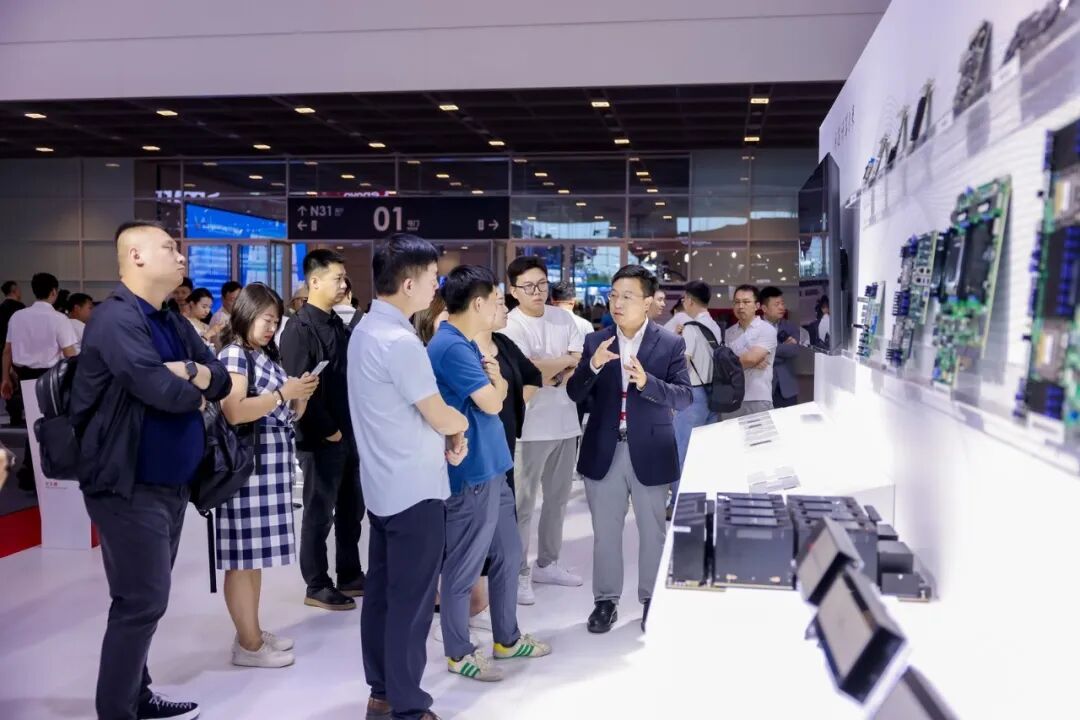

Dismantling the 'Four Barriers' of Token Value: Why Industry-Wide Collaboration is Imperative
The surge in token demand stems fundamentally from a profound transformation in AI utilization.
In the past, AI applications primarily consisted of one-question, one-answer human-machine dialogues, with relatively modest token consumption.
Nowadays, large models are scaling up to trillion-parameter and even ten-trillion-parameter levels, with multimodal models rapidly gaining traction. A single task can now devour millions of tokens. Agents like OpenClaw can operate continuously in the background, invoking models and tools around the clock.
More significantly, AI is accelerating its integration into education, healthcare, finance, manufacturing, and other sectors, shifting token consumption from individual to organizational and industrial scales. These shifts have rapidly driven up token consumption across society.
Token anxiety, on the surface, manifests as high prices, low efficiency, and unstable invocation. Deeper down, it reflects the AI computing power supply side lagging behind the explosive growth in demand. A tidal wave of token demand has suddenly crashed into several 'barriers' of AI infrastructure.
The first is the architectural barrier. Significant disparities in underlying architectural design, interconnection protocols, and performance characteristics among different chips lead to varying token production quality and stability, posing high integration challenges for downstream manufacturers.
The second is the ecological barrier. High adaptation costs exist among different computing power platforms, software frameworks, and model toolchains. Some platforms deeply bind hardware, software, toolchains, and services, making migration difficult and costly for enterprises once they join a particular ecosystem.
The third is the scheduling barrier. Computing power resources are currently dispersed across different platforms, architectures, and ecosystems, preventing efficient token flow between multiple platforms and further exacerbating supply-demand mismatches.
The fourth is the value barrier. The industry has traditionally measured computing power by card count, peak performance, and cluster size, but these metrics do not directly indicate token value. Without a clear token efficiency and value evaluation system, enterprises easily fall into the dilemma of 'spending money without knowing the return.'
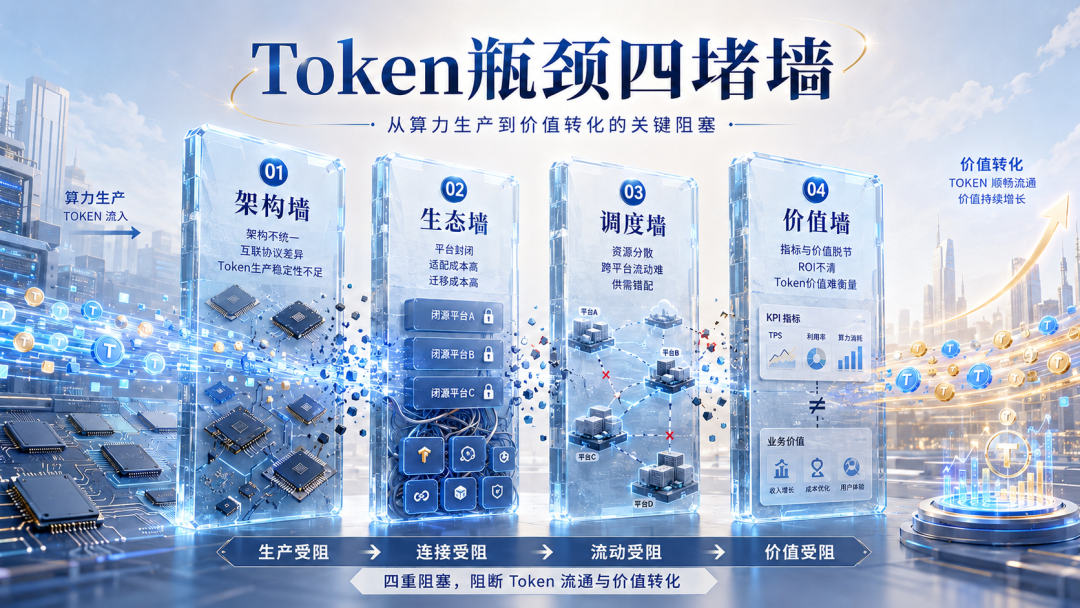
It is evident that token production, circulation, and value realization naturally connect the entire AI industry chain, including chips, whole machines, clusters, software, models, applications, and security.
Therefore, resolving token anxiety cannot rely on isolated breakthroughs or closed alliances among a few vendors; it must follow an open ecosystem path.
This is precisely the industrial significance of the open computing token spectrum. It aims to organize dispersed computing power resources, software capabilities, model capabilities, and application scenarios into a systematic architecture centered around token production, circulation, security, and monetization. Its emergence signifies that China's AI computing power industry is transitioning from isolated breakthroughs to holistic advancement.

Who Will Optimize Token Efficiency? HGCO's Industrial Strength
The open computing token spectrum addresses efficiency issues across the entire token production, circulation, and value transformation chain. Who can assume this role hinges on three key factors: industry chain aggregation capability, open architecture capability, and sustained collaborative capability.
First is the comprehensive industry chain aggregation capability.
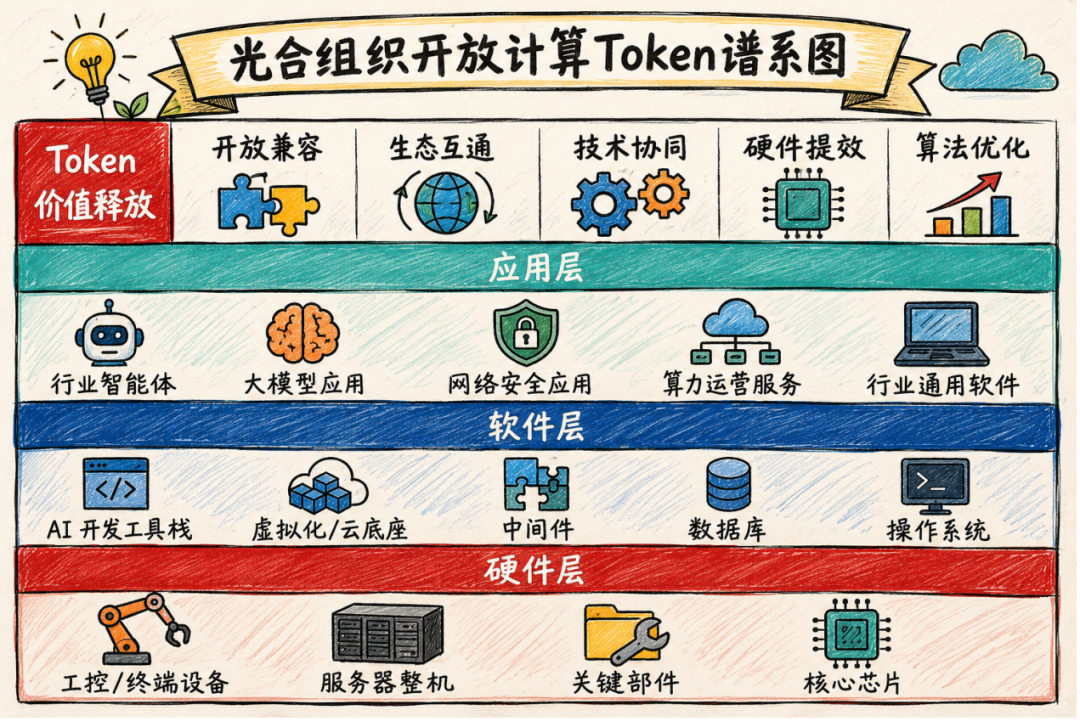
HGCO, established under the guidance of the National Advanced Computing Industry Innovation Center, has gathered over 6,000 ecological partners as an open computing ecosystem platform, accumulating more than 15,000 software and hardware adaptation achievements. It covers chips, key components, whole machines, terminals, operating systems, databases, middleware, virtualization, AI development tool stacks, general-purpose software, computing power services, agents, and security.
This means HGCO is not a simple vendor alliance or product collection but an ecological network covering the entire AI computing chain. For the token economy, this coverage capability is particularly crucial.
Second is the underlying open architecture capability.
The open computing token spectrum does not merely bring enterprises together but truly connects different links through open interfaces, standards, and architectures. Without a unified technical foundation, the larger the ecosystem, the higher the collaboration costs.
At the 2025 Chongqing Smart China Expo, HGCO's core member Sugon led over 20 upstream and downstream enterprises in launching the AI computing open architecture to enable collaborative innovation among chip, whole-machine, software, and application vendors under a unified architecture. This is also a key differentiator between HGCO and ordinary industry alliances.
Third is the sustained open industrial posture.
The AI computing power industry is not a static system. As large models, agents, multimodality, and industry applications continue to evolve, underlying architectures, software toolchains, and scenario demands are rapidly changing. If openness remains limited to partial adaptation or short-term cooperation, it can hardly support the long-term growth of the token economy.
From the AI computing open architecture to the open computing token spectrum, HGCO has gathered the most forward-thinking upstream and downstream partners across the entire industry chain to enhance token efficiency with full-chain capabilities.

Open Computing Token Spectrum: Unlocking the Full Lifecycle Value of Tokens
From the perspective of systematically organizing token efficiency, the value of the open computing token spectrum manifests in four aspects.
1. Enhancing Token Production Quality with Domestic Chips as the Foundation
The open computing token spectrum first addresses how to stably and efficiently produce high-quality tokens.
Large model training, agent inference, multimodal generation, industrial simulation, scientific computing, and other scenarios have varying computing power requirements, making it difficult for a single architecture to cover all workloads. The advantage of the open computing token spectrum lies in incorporating multiple types of domestic chips, whole machines, clusters, and software capabilities into a unified ecosystem, enabling collaborative supply through open architectures.
Take Hygon as an example. Its CPU+DCU dual-chip collaborative system simultaneously covers general-purpose computing and AI high-density computing needs, adapting to diverse application scenarios and providing stable, efficient, and low-loss computing power support for upper-layer businesses.
2. Reducing Industrial Friction Through Full-Chain Collaboration to Enhance Token Efficiency and Value
The true cost of AI adoption for enterprises lies not only in hardware procurement but also in hidden aspects such as migration, tuning, testing, deployment, and maintenance. The value of the open computing token spectrum lies in pre-digesting these dispersed costs through ecological collaboration.
Based on a unified open computing architecture, chip, whole-machine, software, model, and application vendors no longer optimize in isolation but collaborate around token production and value transformation. The underlying computing power ensures stable supply, the middle-layer software and scheduling system reduces circulation losses, and the upper-layer models and industry applications amplify token value.
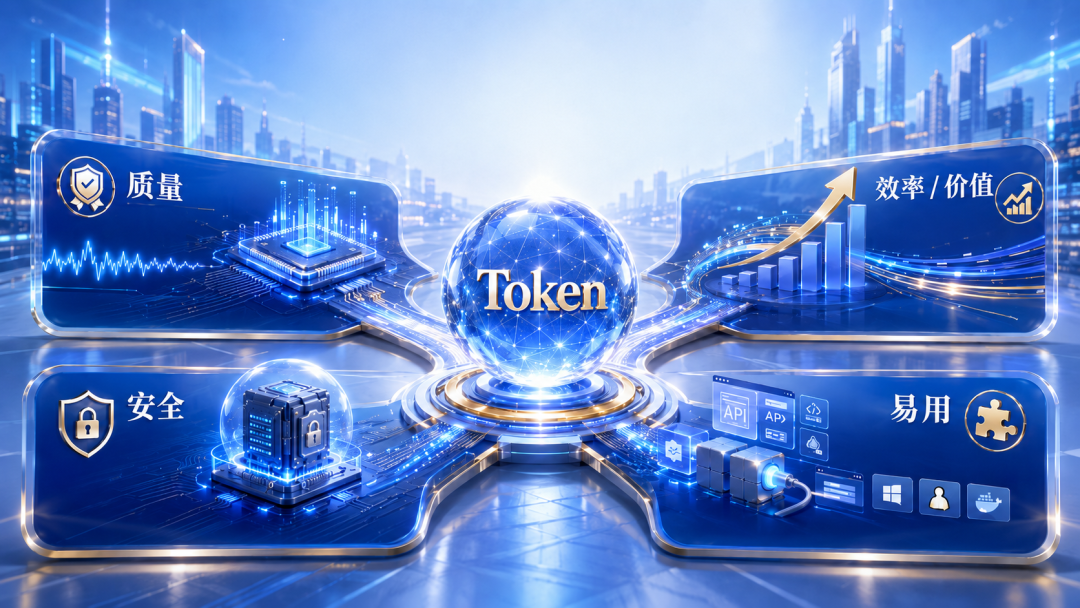
3. Ensuring Token Security with a Full Lifecycle Protection System Based on a Fully Domestic Supply Chain
For scenarios like finance, government affairs, energy, and manufacturing, if tokens are not trustworthy, AI cannot truly scale.
A key advantage of the open computing token spectrum is its reliance on a fully domestic supply chain to form full lifecycle security capabilities. This security is not a standalone add-on but integrates trusted foundations from underlying hardware, secure scheduling from software and platforms, and compliance protection from applications and data, ultimately forming a security system covering the entire token lifecycle.
Take Hygon as an example. Its chip-level inherent security capabilities integrate national cryptographic algorithms, trusted computing, and confidential computing into the underlying architecture, making security a native attribute of the computing power foundation. Recently, Hygon's new-generation DCU series was included in the latest round of security and reliability evaluations by the China Information Technology Security Evaluation Center and the National Security Technology Evaluation Center, receiving an I-level rating. This authoritative evaluation further confirms the security and reliability of the domestic AI computing power foundation.
4. Lowering Migration and Invocation Thresholds Through Open Compatibility to Enhance Token Usability
Enterprises adopting AI have very practical concerns: Can existing systems migrate smoothly? Are mainstream frameworks compatible? How high are the code modification costs? How long are model deployment cycles? Will application launches be delayed by underlying adaptation issues?
The open compatibility of the open computing token spectrum aims to address these issues. It does not force users to bind to a specific route but reduces migration costs among different chips, software, models, and applications through an open ecosystem.
Take Hygon as an example. Its C86 CPU is fully compatible with the x86 ecosystem, and its DCU, paired with the self-developed DTK toolkit, enables seamless migration of CUDA code. Additionally, in September 2025, Hygon officially opened up CPU core capabilities, providing direct IP connections, open protocols, and customized instruction sets to industry chain partners to help more enterprise clients achieve efficient integration with domestic AI chips.
Conclusion
The explosion of the token economy is propelling AI infrastructure competition into a new phase.
The open computing token spectrum introduces a new operational model for the computing power industry: shifting from isolated breakthroughs to full-chain collaboration, from resource supply to value transformation, and from computing power scale to token efficiency. In the future, whoever can more efficiently organize token production, circulation, and value transformation will be more likely to define the competitive rules for AI infrastructure in the next stage.
END This article is an original work by 'Intelligent Evolution Theory.' Welcome to follow us.
Intelligent Evolution Theory focuses on in-depth commentary in the fields of cloud computing and intelligent technology. We aim to interpret technology trends and gain insights into technology-driven business transformations through easy-to-understand language.
The Intelligent Evolution Theory new media dissemination matrix includes mainstream new media platforms such as WeChat Official Accounts, Toutiao, Baijiahao, Snowball Finance Column, CSDN Blog, Sina News, Sohu News, NetEase News, Tencent Content Open Platform, Yidian Zixun, Zhihu Column, UC Headlines, Weibo Long-form Column, and Tianji Self-Media Column.
Intelligent Evolution Theory
Decoding the Technological Codes Behind Business Evolution
-
Ofilm Teams Up with ADSensE to Propel Large-Scale Deployment of All-Solid-State LiDAR Powered by ADS6311 Chip!
-
![]()
Loss of 2.5 Billion Yet Facing Strong Demand for Shares? Another Battle for Control of Lianchuang Electronics
-
![]()
Huawei’s Enjoy Series Flies Off the Shelves, Prompting Xiaomi to Double Down on Budget Smartphones
-
![]()
Beijing Hyundai's Top Executive Criticizes Industry Disorder: Certain Brands Treat Customers as Beta Testers
-
![]()
The domestic mobile phone market has declined for five consecutive quarters! Huawei defies the trend with significant growth: maintains its top market share
-
Annual Revenue Surpasses 3 Billion: An Automotive Trim 'Little Giant' Makes Its Debut on the Beijing Stock Exchange
-
![]()
The Space Force Wants to Spend $30 Billion on Rocket Launches: Is Trump Doubling Down, and Is SpaceX the Big Winner?
-
![]()
Going Crazy! One out of Every Three Plug-in Hybrids Sold in Europe is a Chinese Vehicle