Can AI Be Used for Computer Cleanup? Our Hands-On Experience with Marvis Reveals Agents Aren't Ready to Take Over Computer Management Just Yet
 05/28 2026
 683
683
AI is 'capable,' but certainly not 'all-powerful.'
Recently, a user on platform X (formerly known as Twitter) shared that he attempted to use Codex to declutter his MacBook's hard drive. The AI identified a significant number of files that could be removed, potentially freeing up to 500GB of storage space. His post sparked widespread discussion on X, seemingly suggesting that in the age of AI, we can already rely on AI to replace traditional computer maintenance tools and cleanup software.
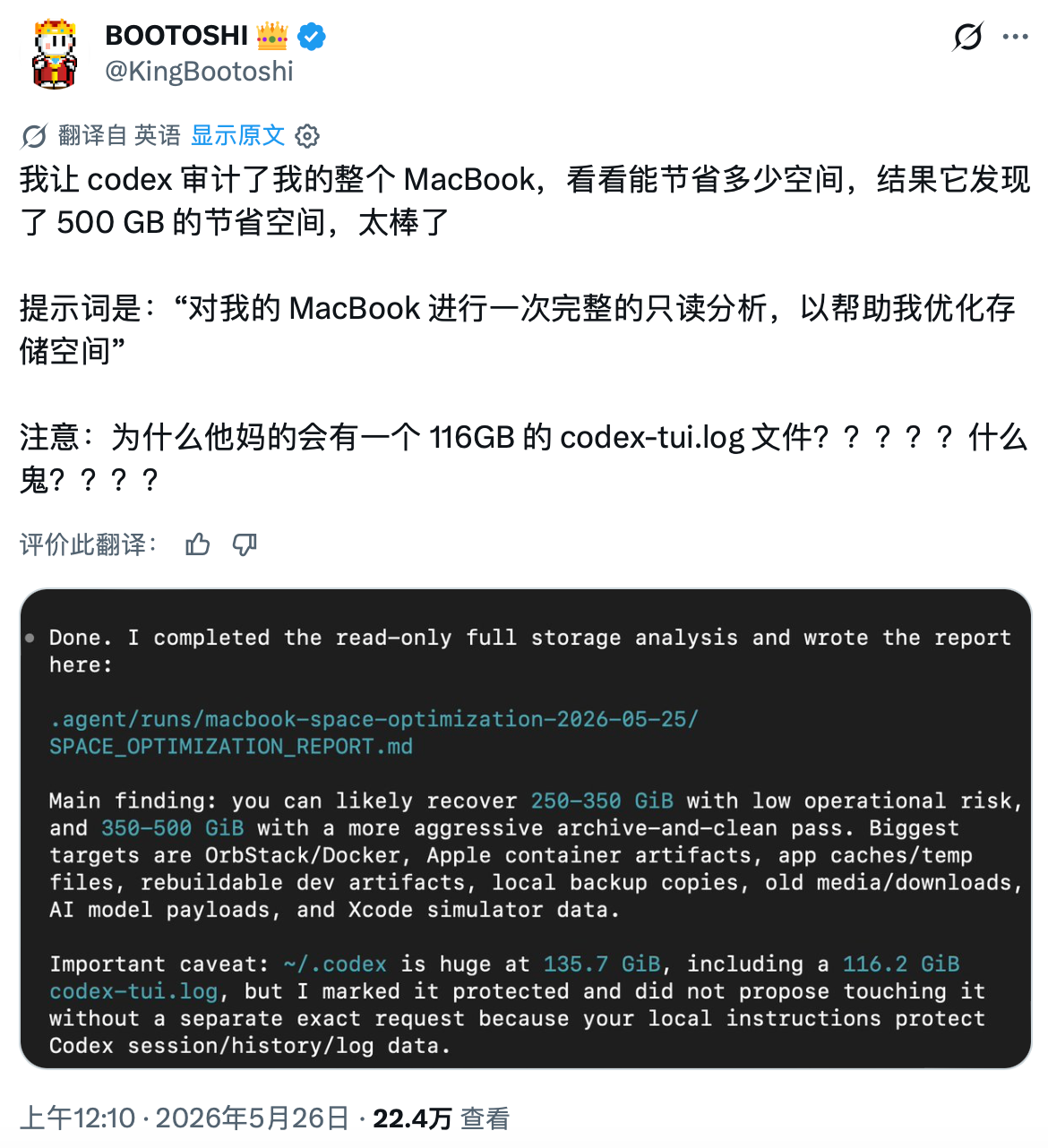
(Image source: X)
Does this imply that by granting AI certain system permissions, we can have AI-powered computer assistants to replace traditional computer maintenance tools? With this question in mind, Leikeji AGI (ID: leikejiagi) conducted a series of tests on computers to determine whether these AI tools could outperform traditional computer maintenance tools.
Using Marvis for System Cleanup: A Less-Than-Impressive Experience
Firstly, it's crucial to understand that merely having a large AI model is insufficient for local AI operations. We need to equip these cloud-based large models with the capability to read and manipulate the local file system. In simpler terms, we need to install an agent or a "Claw" tool locally.
The good news is that most leading domestic internet companies have launched their own Claw tools, with a plethora of "lobsters" flooding the market. We can simply download and install them, and most offer free quotas that seem adequate for basic file cleanup tasks.
Coincidentally, Tencent recently introduced an AI tool called Marvis, positioned as a system-level AI assistant capable of invoking multiple agents based on user commands.
I installed Marvis on my daily-use MacBook and issued the command, "Help me organize and clean up junk files to free up hard drive space." Marvis promptly invoked the File Agent based on the command and began scanning and identifying local files.

(Image source: Leikeji)
Ultimately, Marvis identified files that could be cleaned up and categorized them. First were installation packages, including 21 file installation packages totaling 4.2GB in size. Upon closer inspection, I discovered that these were mostly installation packages that I had neglected to delete after installing software, primarily in formats like PKG, DMG, and ZIP, which are common in macOS.
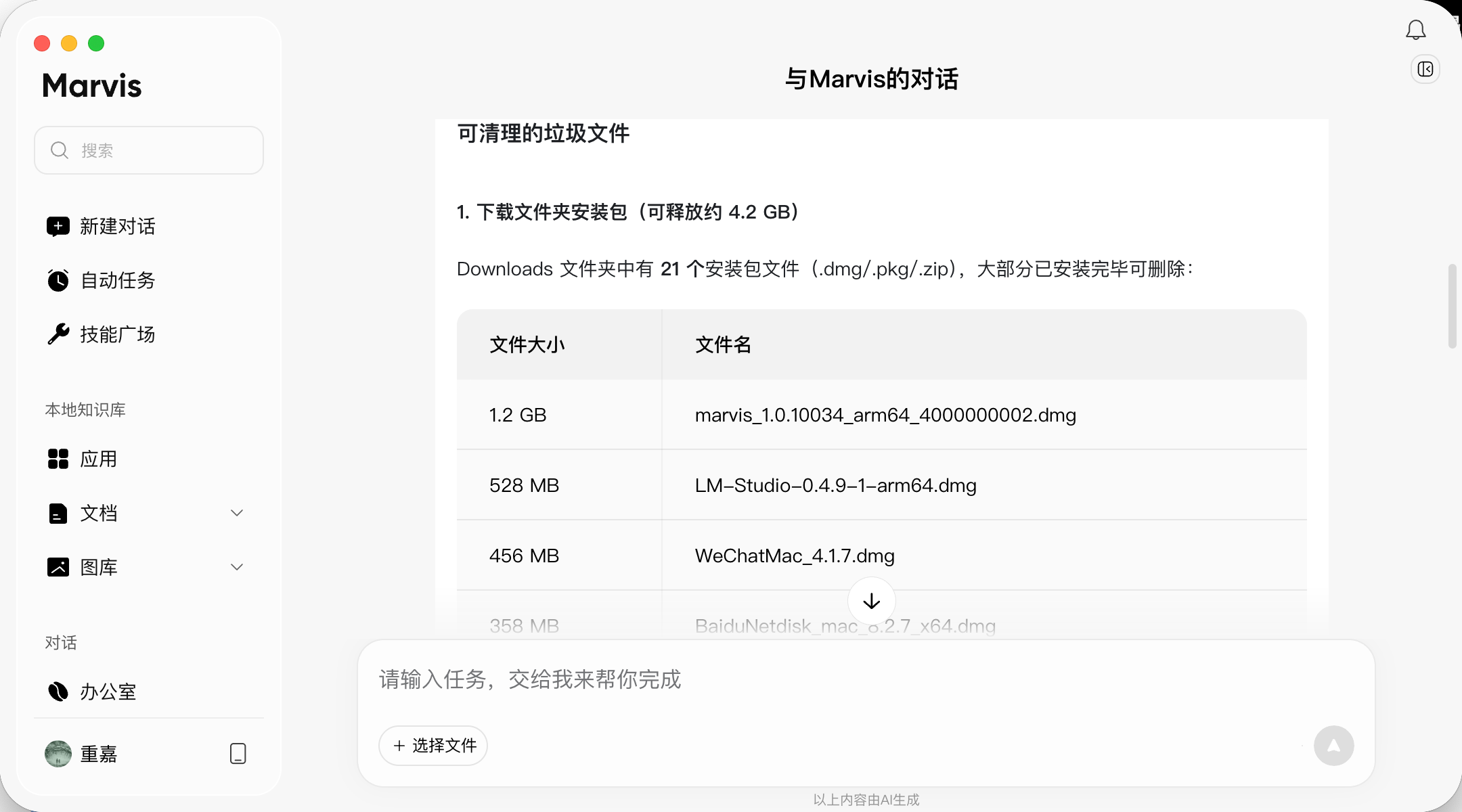
(Image source: Leikeji)
Next were file caches, mainly from WeChat, Google, and Apple Music, occupying 3.5GB of storage space. Then there was the space occupied by the application software itself, with Marvis itself taking up 2GB.

(Image source: Leikeji)
Marvis offered two cleanup options: a safer, more conservative one that only deleted installation packages and caches, and a more aggressive one that deleted everything possible. Overall, Marvis's cleanup mode was nearly identical to Codex's, except that it featured a graphical interface, making it more user-friendly for novices.
We also attempted similar operations with other lobster tools, and the results were surprising. Firstly, DingTalk Wukong and NetEase LobsterAI, for security reasons, did not support system-wide global cleanup and could only operate within the file directory of the workspace.
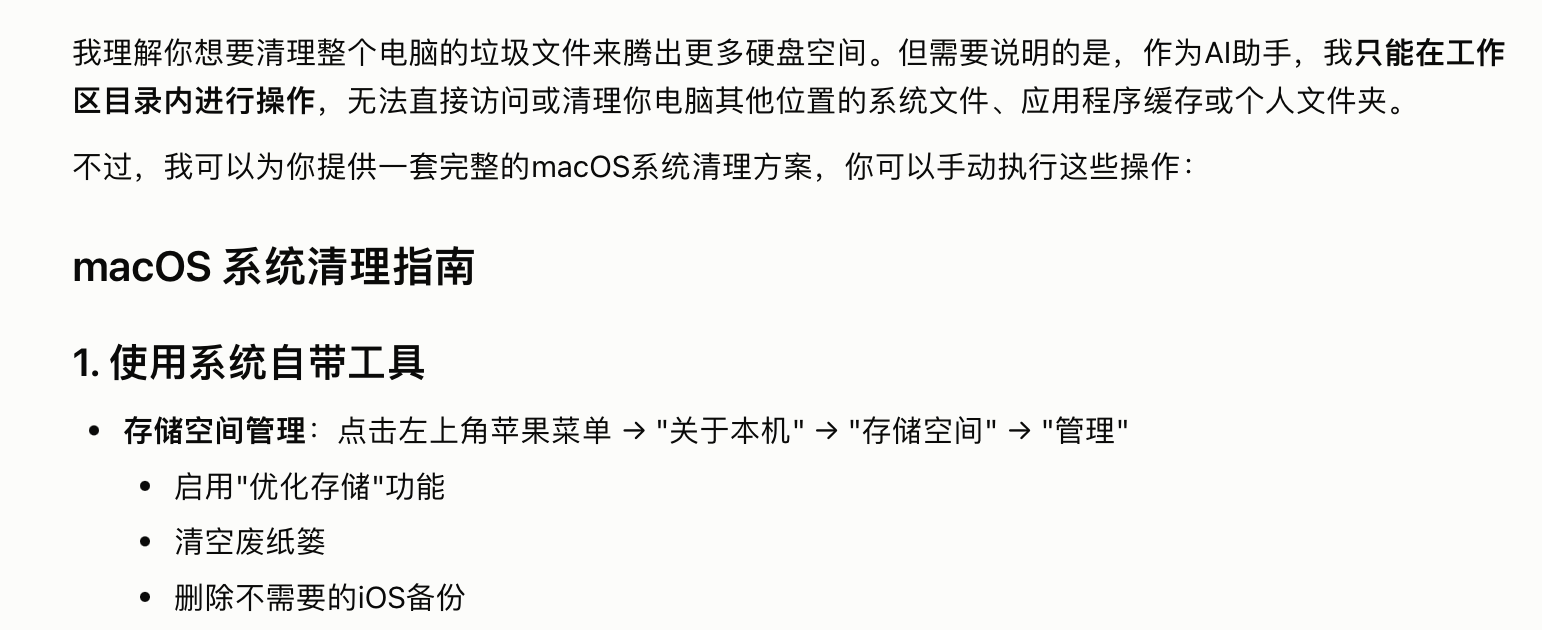
(Image source: Leikeji)
Then there was 360's 'Secure Lobster,' which, despite promoting itself as an 'all-powerful lobster,' was essentially a cloud-based virtual computer. When asked to clean up files, it actually searched the file system of the cloud computer, leading to absurd outcomes.
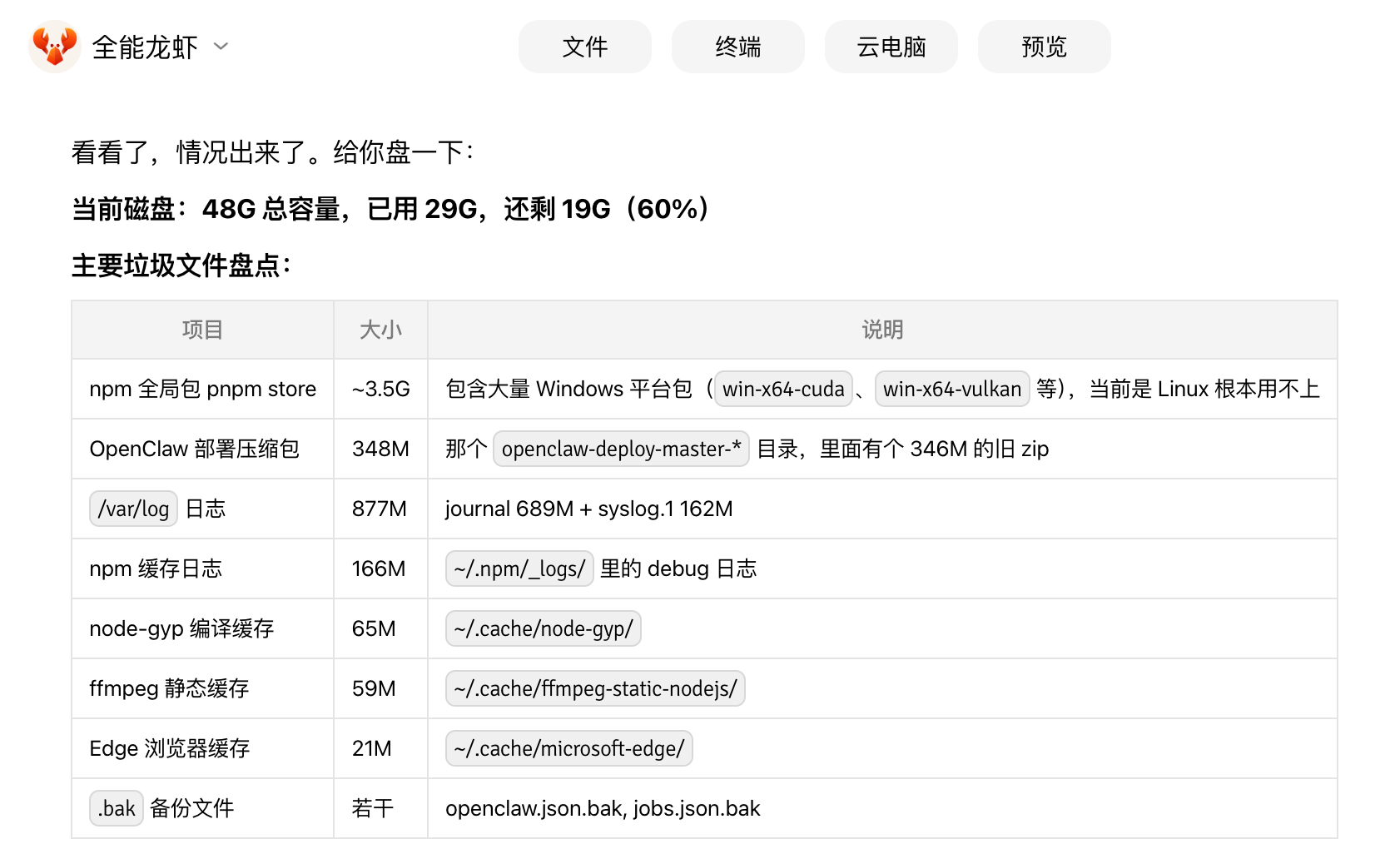
(Image source: Leikeji)
It's evident that tasks like cleaning up junk files pose little challenge for AI. However, mainstream Claw tools are cautious in utilizing file permissions, with most only handling file directories in the workspace and avoiding system files.
It's understandable why internet companies adopt such a stance. After all, there have been numerous instances of user data being accidentally deleted or even financial losses caused by decentralized tools like OpenClaw. Naturally, domestic Claw tools exercise extreme caution in this regard.
Moreover, cleaning up junk files with AI is clearly not a core function of AI tools. When designing AI products, internet companies prioritize programming and workflow-related tasks. They never envisioned that someone would use AI as a computer maintenance tool, so it's unsurprising that they haven't adapted corresponding agents and functions.
Tencent's Marvis can perform this task effectively mainly because it's positioned as a global AI assistant to help users handle various problems, rather than a pure Claw tool in the traditional sense.
Computer Maintenance Software: An Underestimated Gateway to PC AI?
Many people may have observed that when purchasing domestic Windows computers, regardless of the brand, the product usually comes with its own built-in computer maintenance tool, such as Xiaomi Computer Maintenance, Huawei Computer Maintenance, Lenovo Computer Maintenance, and Honor Computer Maintenance.
The core functions of these computer maintenance software include providing software installation and download services, as the Microsoft official store is indeed challenging to use; building brand ecosystem components to enable PCs to collaborate and interconnect with their own smartphones, tablets, and other devices, which is a fundamental operation for smartphone manufacturers; and providing system cleanup, security protection, toolboxes, and other functions, which overlap with traditional software like 360 Security Guard.
Simultaneously, we find that amid the AI wave, hardware brands are accelerating the AI integration of their hardware. For PC manufacturers, an important entry point for computer AI is the built-in computer maintenance tool. Not long ago, Leikeji (ID: leitech) reviewed the Honor Notebook X16 Plus, which incorporated numerous AI functions.
In Honor's PC products, the YOYO assistant is directly integrated, capable of invoking various agents. When we directly request to clean up system files in the AI dialog box, it provides a direct entry point to the computer maintenance tool's cleanup function, allowing us to jump to it with a click.

(Image source: Leikeji)
Lenovo's computer maintenance software, on the other hand, integrates a plethora of AI modules, including Zhipu Qingyan, Kimi, AI writing assistants, and more. Basic functions like system file cleanup and network optimization only occupy a small portion of this computer maintenance tool, with various AI assistants and agents becoming important components.

(Image source: Leikeji)
Additionally, 360 Security Guard, which once dominated most domestic PC devices, is also taking AI-powered actions amid the AI wave. The latest version of 360 Security Guard has integrated some AI tools. However, 360 Security Guard's AI integration is still relatively rudimentary, and the AI experience is stiff.
It merely includes a software called 360AI Office. Moreover, many functions of this AI software require payment, and its UI design and layout are mediocre. There is still significant room for improvement in 360 Security Guard's integration of AI capabilities.

(Image source: Leikeji)
Overall, computer maintenance tools have become a key gateway for PC manufacturers to build ecosystems and inject AI capabilities. As for traditional functions like file cleanup and network optimization, AI-powered computer maintenance tools can perform them better, enhancing the user experience.
Of course, as PC manufacturers place increasing importance on computer maintenance tools, the living space for third-party security software like 360 is diminishing. 360's focus on AI office is essentially an attempt to transform in the AI era.
Agents Are Versatile but Can't Manage Your Computer Just Yet
Returning to our initial question, can the various AI tools and agents flooding the market completely replace traditional computer maintenance tools? In our view, the answer is clearly no.
Although our tests on the MacBook demonstrated that with sufficient permissions, AI assistants like Marvis can indeed perform basic tasks like junk cleanup and file categorization effectively, 'sufficient permissions' itself is a challenging threshold to overcome.
For the sake of system stability and privacy security, mainstream AI tools will not arbitrarily read or write bottom-level system files. This is why when testing most 'lobster' tools, they often only operate within restricted work areas and behave very cautiously.
In contrast, the computer maintenance tools pre-installed by major PC manufacturers have unique advantages—they have system-level bottom-level permissions from the moment they leave the factory and are deeply integrated with their own hardware ecosystems. In the era of AI PC's full outbreak, these local computer maintenance tools will not be eliminated; instead, they are being rejuvenated by the integration of large models.
They are evolving from mere security tools into AI central control consoles for the entire computer. As mentioned earlier with Honor and Lenovo, native AI maintenance tools can not only perform system maintenance tasks more safely and efficiently but also seamlessly connect with smartphones and tablets to provide deeper cross-device AI experiences. This level of scheduling capability is difficult for third-party AI tools to achieve currently.
In conclusion, the future trend is not for AI tools to replace computer maintenance tools but for computer maintenance tools to become fully AI-powered. Pure AI agents will continue to play a role in professional fields like programming, content generation, and workflow automation. Tasks like maintaining system security and smoothness and managing device ecosystems will still be handled by local computer maintenance tools that are becoming AI-powered.
AI large model, PC, computer maintenance tool, agent
Source: Leikeji
All images in this article come from: 123RF Royalty-Free Image Library. Source: Leikeji
-
Ofilm Teams Up with ADSensE to Propel Large-Scale Deployment of All-Solid-State LiDAR Powered by ADS6311 Chip!
-
![]()
Loss of 2.5 Billion Yet Facing Strong Demand for Shares? Another Battle for Control of Lianchuang Electronics
-
![]()
Huawei’s Enjoy Series Flies Off the Shelves, Prompting Xiaomi to Double Down on Budget Smartphones
-
![]()
Beijing Hyundai's Top Executive Criticizes Industry Disorder: Certain Brands Treat Customers as Beta Testers
-
![]()
The domestic mobile phone market has declined for five consecutive quarters! Huawei defies the trend with significant growth: maintains its top market share
-
Annual Revenue Surpasses 3 Billion: An Automotive Trim 'Little Giant' Makes Its Debut on the Beijing Stock Exchange
-
![]()
The Space Force Wants to Spend $30 Billion on Rocket Launches: Is Trump Doubling Down, and Is SpaceX the Big Winner?
-
![]()
Going Crazy! One out of Every Three Plug-in Hybrids Sold in Europe is a Chinese Vehicle