Will the AI Bull Market Collapse?
 05/29 2026
 399
399

Who Pays for the Extravaganza?
Text | Global Business Leadership Chen Siwen
$34.6 billion. That's the amount SoftBank has poured into OpenAI in cold, hard cash. To raise the funds, Masayoshi Son has liquidated his stakes in NVIDIA, Deutsche Telekom, Alibaba, and T-Mobile.
But he's still not satisfied and plans to add another $30 billion this year, boosting his stake from 11% to 13%, even going so far as to take on debt to do so.
The driving force behind this 69-year-old investor's bold move is simple—as OpenAI's valuation surged to $852 billion in February, SoftBank's paper gains have exceeded $45 billion.
The enormous and rapid creation of paper wealth has led capital to scramble for AI stakes at any cost. Three months after OpenAI's latest funding round, media outlets including CNBC and Bloomberg reported that Anthropic is in talks with investors for a new funding round, targeting a valuation of approximately $900 billion. Just a year ago, its valuation was a mere $61.5 billion.
From Silicon Valley to Wall Street, the assumption is that AI's future will unfold as straight and fast as a rocket launch. But is this a reasonable valuation for a great technological revolution, or is it a trillion-dollar gamble on the AI concept?
[01 The Yahoo Moment]
Twenty-six years ago in Silicon Valley, there was a familiar scene.
That year, the internet was at its peak, and a company that had been public for just four years saw its market cap soar to $128 billion, surpassing Berkshire Hathaway.
It didn't lay fiber-optic cables or manufacture routers. It was Yahoo, the number one portal site.
Yahoo's business model was clear: everyone who went online had to go through Yahoo first. With perpetual growth in internet traffic, Yahoo, as the gateway, would forever collect tolls from users and advertisers.
This was the underlying logic behind Wall Street's high valuation of Yahoo, and it lived up to expectations, with its stock price surging from its IPO price of $13 to nearly $500. Alongside numerous ".com" companies, it helped push the Nasdaq index to 5,132 points.
Wall Street got the big trend right—the internet did change the world, and traffic did explode—but it made a fatal mistake:
They believed the moat around portal sites was impenetrable.
The market overlooked one thing: as internet infrastructure became widespread, users would always find more precise entry points. Yahoo's broad, all-encompassing directory model, once confronted with precise ad recommendations, would see its original ad distribution model fundamentally shaken.
On March 11, 2000, Yahoo's stock price peaked and then began a steady decline; a year later, the Nasdaq fell below 2,000 points; in 2017, Yahoo was acquired by Verizon for just $4.8 billion.
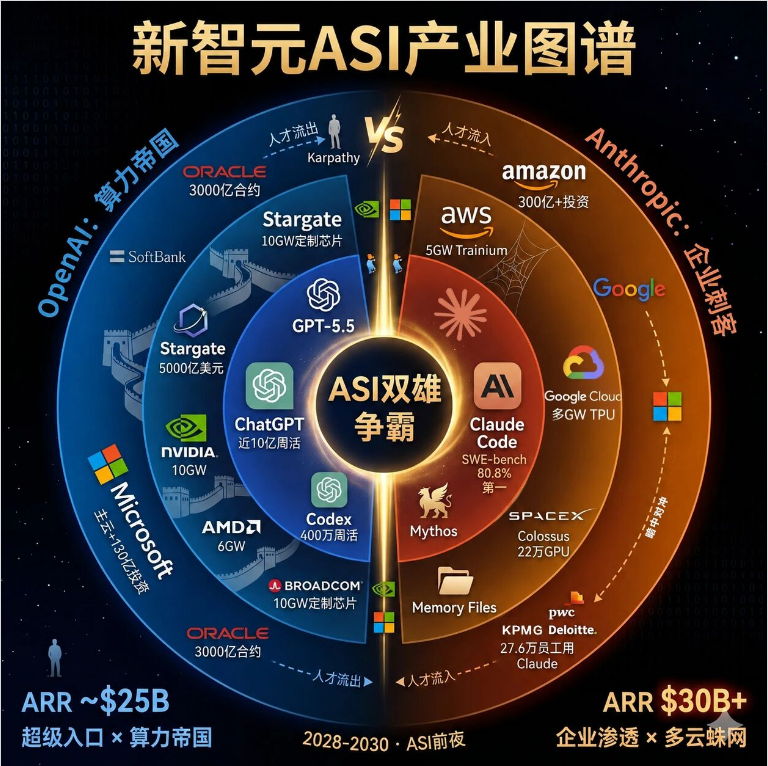
Today, OpenAI and Anthropic, selling Tokens, resemble Yahoo in the AI era.
These trillion-dollar giants provide API access to enterprises and sell Tokens to developers. The underlying logic behind their trillion-dollar valuations is identical to Yahoo's back then: all AI applications must purchase computing power and intelligence from large model companies; these large models are the tollbooths of the future AI era, and these tollbooths will always exist.
▲Source: Xinzhiyuan
This oversight is identical to what happened back then. Large models are turning AI into a cheap, ubiquitous utility at an astonishing pace.
Just as Yahoo couldn't stop the internet from evolving, when AI is everywhere and numerous large models compete simultaneously, a mere "model gateway" will have no pricing power over AI.
[02 The Trillion-Dollar Arithmetic]
Historical cases serve only as mirrors for reference; financial arithmetic is the needle that truly bursts bubbles.
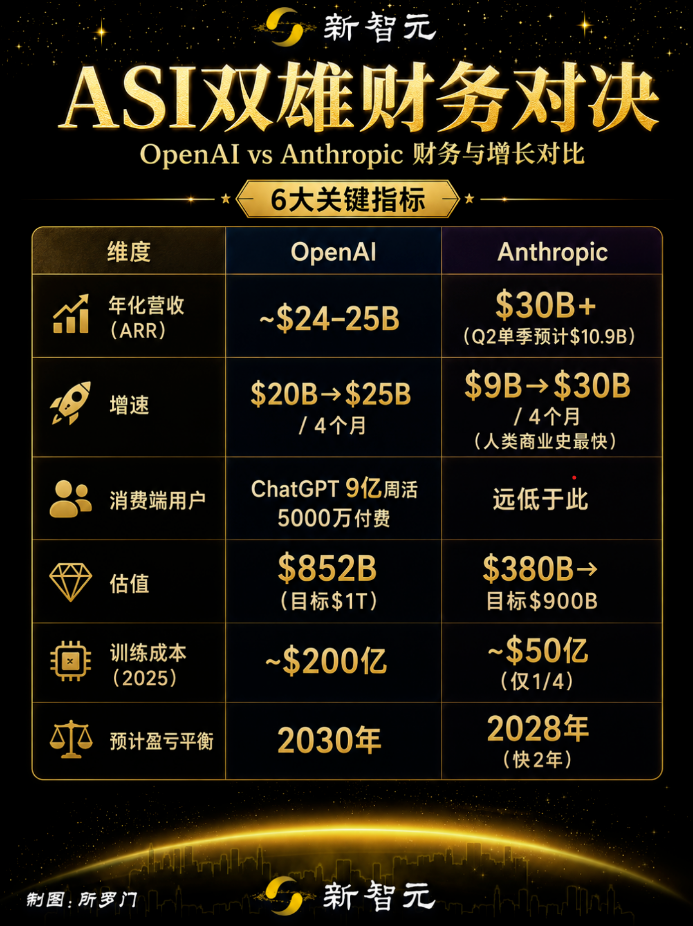
▲Source: Xinzhiyuan
If we consider OpenAI and Anthropic as future tech giants and assign them high price-to-earnings ratios of 30-40 times, then to support a trillion-dollar market cap, these two companies must earn $25 to $30 billion annually, corresponding to $50 to $80 billion in revenue.
But reality falls far short of expectations.
A key metric for evaluating the operating performance of these subscription-based AI companies is called ARR (Annual Recurring Revenue). In April 2026, OpenAI's ARR was $25 billion, while Anthropic's was $30 billion.
If a company's ARR reaches $30 billion, it doesn't mean it earned $30 billion in the past year. It means that in the past month, it generated $2.5 billion in revenue from user subscriptions, multiplied by 12.
Moreover, ARR is largely calculated based on the current consumption rate of API calls, which includes a significant amount of short-term, exploratory development demand and even promotional giveaways of compute power with Tokens. The stickiness of this revenue is far inferior to the software services subscribed to annually during the SaaS era.
What makes profitability even more elusive is the promotional activities of large model companies. To compete and capture the developer ecosystem, OpenAI and Anthropic have significantly lowered Token prices over the past year.
Back then, Yahoo, to maintain its status as a traffic gateway, had to provide vast amounts of free content, only to find that traffic couldn't be converted into equivalent profits. Today, large model companies, to preserve their developer ecosystem, actively turn intelligence into a cheap commodity while still enjoying monopoly-level high valuation premiums.
Behind these similar scenarios lies a brutal law of industrial chain profits:
The total profit of the entire AI industrial chain is ultimately determined by the commercialization of the terminal application layer. The high valuations of large models are essentially an advance overdraft ( overdraft can be translated as "advance drawdown" or "premature extraction") of the future profits of the downstream application layer.
Looking at today's application layer, aside from programming and some copywriting assistance, AI has yet to spawn "super apps" generating massive revenue. Most enterprise payments for AI still remain in the exploratory phase of cost reduction and efficiency gains—using AI to replace some junior copywriting or customer service tasks—rather than the explosive phase of creating incremental revenue by generating entirely new markets worth billions or hundreds of billions of dollars.
This is a link fraught with significant risk. If downstream application companies find that purchasing AI computing power fails to deliver abnormal returns ( abnormal returns can be translated as "excess returns" or "above-market returns"), they can hit the pause button at any time. This could stem from a performance bottleneck in a model iteration, a wave of public opinion, a decision made by a group of executives on a whim, or a new economic downturn or oscillation ( oscillation can be translated as "volatility" or "turbulence") that leads to a collective pause in AI acquisition budgets among downstream application companies...
Whichever scenario occurs, once downstream demand dries up, the foundation of upstream trillion-dollar valuations will collapse instantly.
[03 The Final Showdown]
At the peak of capital frenzy, any slight disturbance can trigger an avalanche.
Like Yahoo back then, when the growth story can no longer be sustained, trillion-dollar valuations will face the ruthless squeeze of mean reversion. This means large model companies must embark on a path to a final showdown.
The first path is a Yahoo-style collapse.
Because the application layer fails to form a closed business loop and the Token price war spirals out of control, intelligence becomes a cheap commodity. Impatient capital begins to seek liquidity, and trillion-dollar valuations are cut in half or even more.
Large model companies, stripped of their capital halo, are forced to retreat, lay off staff to cut losses, and revert to the profit margins of ordinary software infrastructure.
Just as portal sites still exist today and Yahoo is still operational, it is no longer the darling of the capital markets and can only earn reasonable operating profits. Large model companies will become "normal businesses" like cloud storage and cloud computing.
The second path is reconstructing a closed business loop.
Perhaps one day, large model companies will truly find a final model that prompts enterprises to pay heavily. Maybe it's replacing entire industry-specific SaaS software and taking a cut based on the value created; maybe AGI truly arrives and takes over the global digital workforce...
If this path succeeds, trillion-dollar valuations will have solid support. This will take time and is filled with uncertainty. But capital markets, centered on VC funding, lack patience the most. Before dawn arrives, they may already be trampling each other in the dark to exit.
However, no matter which path is taken, we must remain vigilant about a common sense easily obscured by frenzy: the certainty of macro trends never equals the certainty of individual fates.
Most people believe AI will ultimately change the world, just as most people believed the internet would change the world back then. But the issue is, the industry's prospects are one thing, and being able to run the marathon to the finish line and claim the crown is another.
In 2000, many people correctly identified the direction of the internet but invested in Netscape, Yahoo, and Pets.com, ultimately losing everything. Today, OpenAI and Anthropic, while leading the pack, still face a massive unknown: whether they can cross the commercial closed-loop chasm and whether they will be disrupted by more vertical, efficient newcomers, just as portal sites were back then. Prematurely discounting the industry's final dividends to today's leaders is the most typical characteristic of a bubble.
What's even more alarming is that while the bursting of the early internet bubble did not halt the internet's progress in the long run, it did cause the Nasdaq to lose more than three-quarters of its value, leading to widespread corporate closures and employee layoffs, inflicting considerable long-term damage on the U.S. and even the global economy.
As OpenAI, Anthropic, and other large model companies breach trillion-dollar valuations, as SoftBank doubles down with leverage regardless of cost, and as the entire Silicon Valley capital chain becomes tethered to the expectation that "AI must deliver immediately," the potential systemic risk has reached a moment of heightened alertness. Once trillion-dollar valuations collapse, the resulting negative wealth effect and credit contraction will have a far more severe backlash on the macroeconomy than twenty years ago.
Technological revolutions are never smooth upward trajectories; they are formed by the rise and fall of countless bubbles.
In 2000, Yahoo plummeted by over 80%, wiping out the fortunes of countless investors, but the internet did not die—it reshaped the world in deeper, more efficient ways. Today, if the trillion-dollar valuations of AI large models collapse, it does not mean the end of AI. It only means AI will shed its financial speculation and truly integrate, silently yet profoundly, into every industry as a general-purpose technology.
The future is bright, but the road is bumpy. Artificial intelligence is destined to become as ubiquitous and indispensable as utilities like electricity, water, and coal in this era, but the journey will inevitably have ups and downs. When the rise is too rapid and too steep, it's necessary to guard against the crisis of a fall.
——THE END——
Welcome to follow [Global Business Leadership] to learn about influential figures and read legendary strategies.
All rights reserved. Unauthorized reproduction is prohibited.
Some images are sourced from the internet.
If infringement is involved, please contact us for removal.
-
Ofilm Teams Up with ADSensE to Propel Large-Scale Deployment of All-Solid-State LiDAR Powered by ADS6311 Chip!
-
![]()
Loss of 2.5 Billion Yet Facing Strong Demand for Shares? Another Battle for Control of Lianchuang Electronics
-
![]()
Huawei’s Enjoy Series Flies Off the Shelves, Prompting Xiaomi to Double Down on Budget Smartphones
-
![]()
Beijing Hyundai's Top Executive Criticizes Industry Disorder: Certain Brands Treat Customers as Beta Testers
-
![]()
The domestic mobile phone market has declined for five consecutive quarters! Huawei defies the trend with significant growth: maintains its top market share
-
Annual Revenue Surpasses 3 Billion: An Automotive Trim 'Little Giant' Makes Its Debut on the Beijing Stock Exchange
-
![]()
The Space Force Wants to Spend $30 Billion on Rocket Launches: Is Trump Doubling Down, and Is SpaceX the Big Winner?
-
![]()
Going Crazy! One out of Every Three Plug-in Hybrids Sold in Europe is a Chinese Vehicle