Meta Conducts a 'Major Purge': 7,800 Employees Laid Off at 4 AM; $76.9 Billion Lost on Metaverse in Five Years as Zuckerberg Pivots to AI
 05/29 2026
 597
597
On May 20th, at 4 AM, for nearly 78,000 Meta employees worldwide, dawn was replaced by a chilling notification email in their inboxes.
Zuckerberg delivered a special '520 gift' (a play on the Chinese term for 'I love you', used here ironically) — a layoff notification email that sent shockwaves through the company.
This time, the axe fell harder. About 10% of the workforce, roughly 7,800 people, were affected. Meta's Chief People Officer Janelle Gale's internal memo attempted to convey 'dignity': In addition to employees facing unemployment, 7,000 were 'reassigned' to new AI-related projects, some management positions were eliminated, and 6,000 open positions were simply closed.
In simpler terms: Those who can work and align with the new direction are shifted into AI teams; those who can't, are let go; those who haven't joined yet, need not apply.
But no matter how dignified the memo sounded, it couldn't mask the real panic among employees. According to former Meta staff, even before the first large-scale layoffs in 2022, the office atmosphere resembled a doomsday scenario. Employees frantically grabbed free snacks, drinks, and even chargers, treating the night before layoffs as their 'last supper'.
Now, this scene is repeating itself on an even grander scale, with a deeper sense of dread.
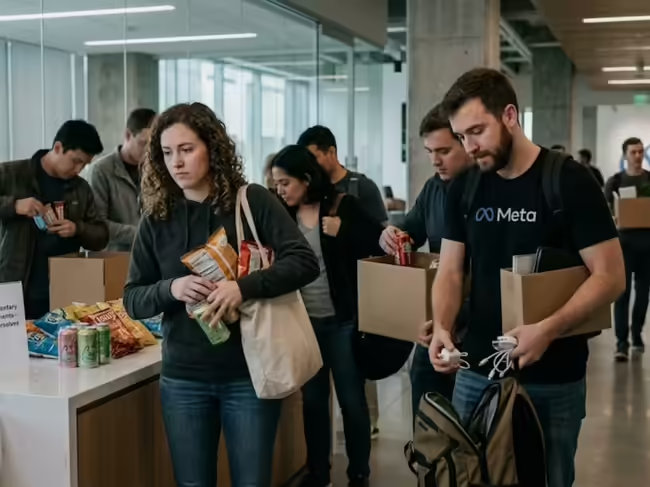
Image Source: The Economic Times
This isn't just a layoff — it's a 'blood transfusion'
Adel Wu, a former employee who left Meta in 2024, experienced four or five rounds of layoffs at the company. But she bluntly stated that this wave in May was 'unprecedented'.
She recalled that on the night before the 2022 layoff announcement, fear drove employees to take everything they could carry — 'company assets' — afraid they wouldn't be able to access their accounts the next day. This deep fear, uncertainty, and anxiety had lingered since 2021, intensifying with each round of layoffs, engulfing the entire office.
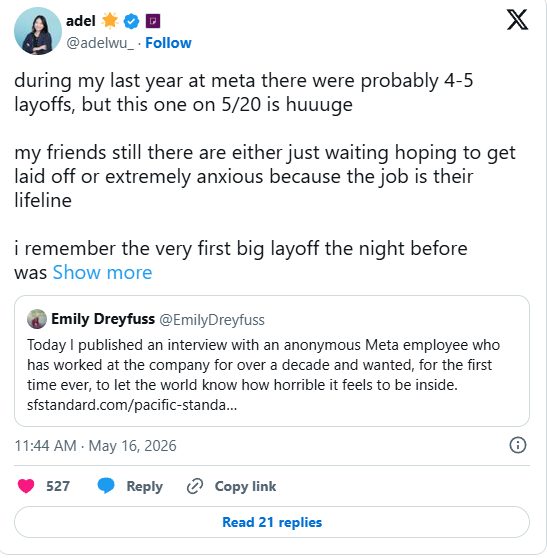
This sentiment quickly resonated on social media:
One X platform user said they had experienced all of Meta's layoffs, and while this time might not be the worst, the office was still filled with anxiety, dissatisfaction, and stress.
Another netizen said they had woken up in the middle of the night and immediately checked their email to see if they had received a layoff notice.
Even more telling, during Meta's first round of layoffs, a colleague received a termination notice while on a business trip, and the subsequent continuous layoff plans completely destroyed team morale.

Meanwhile, resistance was brewing inside Meta. Employees protested by posting flyers and writing posts on the internal platform Workplace. Over 1,000 employees signed a petition opposing the installation of mouse-tracking software on employee computers for training AI models. In the UK, a group of Meta employees had begun organizing a unionization campaign with a trade union.
The illusion of Silicon Valley's 'lifetime employment' had been shattered, replaced by an extremely ruthless transactional employment relationship. Employees no longer believed loyalty would be rewarded, and the company no longer promised long-term stability. The real torture wasn't the layoffs themselves but the sword of Damocles hanging overhead, unsure of when it would fall.
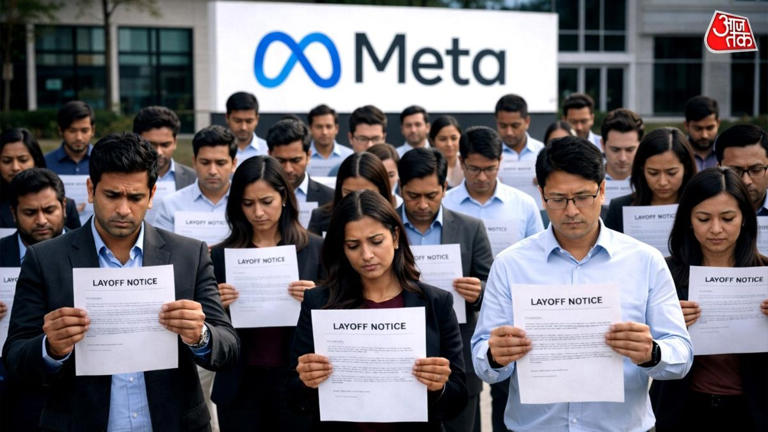
Image Source: IndiaToday
Climbing from the metaverse's corpse to the AI gambling table: Zuckerberg's 'anxiety disorder'
To understand why Meta chose to act at 4 AM, we must look back at the ruins left by Zuckerberg's last gamble.
In October 2021, on the stage of the Connect conference, Zuckerberg stood between virtual volcanoes and sunsets, announcing that Facebook would be renamed Meta. Wearing a gray T-shirt, his virtual avatar stood stiffly behind him. Then, he jumped into that virtual world.

Subsequently, Reality Labs became the most expensive 'money-burning machine' in tech history:
2021 loss: $10.19 billion
2022 loss: $13.72 billion
2023 loss: $16.1 billion
2024 loss: $17.729 billion
2025 loss: $19.193 billion
Five years, $76.9 billion, reduced to ashes. But what about the returns? Horizon Worlds had fewer than 200,000 monthly active users and never surpassed 300,000. Quest 3 had a weak launch, and the release of Apple's Vision Pro directly proved that Zuckerberg's chosen path might have been technically misguided.

Who paid for these massive losses? It was the employees who were laid off round after round during the 'efficiency year.' From 11,000 layoffs in November 2022 to 21,000 in 2023, and then about 3,600 in early 2025... Each layoff was a financial correction for the metaverse's failures.
The gambler's red eyes:
All in on AI, or all in on survival?
Yet, even before the metaverse's corpse had cooled, Zuckerberg had already switched gambling tables.
In the second half of 2023, the large language model wave swept in. Zuckerberg reacted swiftly, stating clearly in internal meetings that AI infrastructure was Meta's most important strategic bet for the next decade, at any cost.
And so, we see everything now: Llama open-sourced, AI agent strategic deployment, AAI team formation, and the controversial mouse data tracking training, along with the 4 AM layoff axe swung at 7,800 people.
Consider this logic chain: The metaverse burned $50 billion, proving that 'All in on the future' was a financial disaster but also proving that the 'dare to All in' posture was a plus in Wall Street's eyes → So when AI arrived, it had to be an even harder All in → A harder All in required lower labor costs and more AI computing power → Result: 4 AM, 7,800 people, out.
But the paradox of this gamble is: If AI develops as Zuckerberg envisions — with agents replacing engineers, product managers, and even middle management — could the last person replaced be Zuckerberg himself?
After all, the UK's Financial Times had previously reported that Meta was developing an AI virtual version of Zuckerberg, capable of interacting with employees in real-time, providing dialogue and feedback, and substituting for Zuckerberg in some settings.
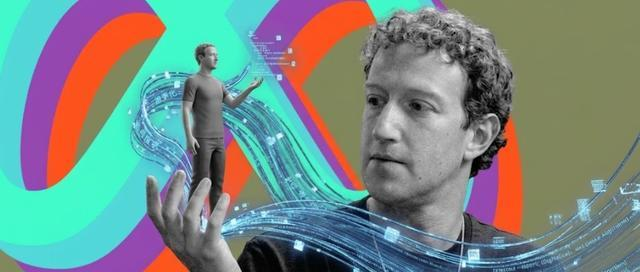
Imagine this: When AI can automatically generate strategies, make decisions, and manage teams — when an AI agent can operate a company 24/7 without emotional fluctuations — do you still need a person in a gray T-shirt standing on stage saying, 'We are an AI company'?
Zuckerberg is using the 4 AM moments of 7,800 people to gamble on a tomorrow where he might not even have a place.
Taking it a step further, the irony deepens: When the entire tech circle is obsessed with using AI to replace human labor, pushing people off their workstations, who will buy the products you produce? Will those constantly worried about being laid off have purchasing power and consumption capacity? When products don't sell, you press harder on labor costs, needing AI to replace employees even more... creating a vicious cycle.
Conclusion: A wrong path
Some say tech industry layoffs are just 'metabolism' — the old must go for the new to arrive. But this time is different.
This isn't 'the old must go for the new to arrive' but 'the old just left, the new hasn't arrived yet, but the old has already been used to train the new.'
The image of Meta employees grabbing snacks resonated so deeply on social media because it struck at the ultimate pain point of contemporary workers: individual vulnerability and powerlessness in the face of a massive system.
As 7,800 employees left with backpacks full of snacks, they took with them not just company supplies but also Meta's once-proud culture of innovation and employee loyalty.
AI might improve code efficiency and optimize ad algorithms, but can it rebuild the human cohesion needed for a great company?
For Meta, this might be a financially sound calculation; but for society as a whole?
Both the metaverse and AI are meant to serve real life — not to be twisted into tools that exploit real life, and certainly not to drive people to a dead end. We firmly believe: Exploiting people for AI, sacrificing their real lives, is a wrong path that leads everyone to their doom.
By Vivi
All uncredited images are sourced from the internet.
-
Ofilm Teams Up with ADSensE to Propel Large-Scale Deployment of All-Solid-State LiDAR Powered by ADS6311 Chip!
-
![]()
Loss of 2.5 Billion Yet Facing Strong Demand for Shares? Another Battle for Control of Lianchuang Electronics
-
![]()
Huawei’s Enjoy Series Flies Off the Shelves, Prompting Xiaomi to Double Down on Budget Smartphones
-
![]()
Beijing Hyundai's Top Executive Criticizes Industry Disorder: Certain Brands Treat Customers as Beta Testers
-
![]()
The domestic mobile phone market has declined for five consecutive quarters! Huawei defies the trend with significant growth: maintains its top market share
-
Annual Revenue Surpasses 3 Billion: An Automotive Trim 'Little Giant' Makes Its Debut on the Beijing Stock Exchange
-
![]()
The Space Force Wants to Spend $30 Billion on Rocket Launches: Is Trump Doubling Down, and Is SpaceX the Big Winner?
-
![]()
Going Crazy! One out of Every Three Plug-in Hybrids Sold in Europe is a Chinese Vehicle