US$725 Billion! Tech Giants Pour Money into Infrastructure, Chinese Suppliers Secure Orders
 05/29 2026
 687
687

"Computing Power Race Hits Thermal Bottleneck, Liquid Cooling Becomes Key"
Editor | Yun Shu
Produced by | Jixin
In 2026, an arms race centered around AI computing power is unfolding with unprecedented intensity. Four tech giants—Google, Amazon, Microsoft, and Meta—plan to spend a staggering US$725 billion this year on AI infrastructure, a 77% surge from last year. In the first quarter alone, their related capital expenditures reached US$130.65 billion, nearly one-fifth of the annual plan.
This frenzied infrastructure investment stems from a simple yet urgent reality: with the explosion of generative AI applications like ChatGPT and Sora, global demand for computing power is growing exponentially. Amazon CEO Andy Jassy revealed that OpenAI alone has booked computing resources equivalent to the power output of two large power plants. However, as these giants wave their checkbooks, a sharp (sharp) question arises: with the power consumption of a single AI chip nearing the kilowatt level and traditional air cooling pushed to its limits, how can the physical bottleneck of this computing power race be overcome? An overlooked "heat" issue is propelling a critical technology—liquid cooling—from an "optional solution" to the center stage as a "must-have."
More notably, amid this infrastructure frenzy dominated by Western giants, a force from the East is quietly rising. Leveraging mature manufacturing capabilities, rapid response to non-standard customization, and significant cost-effectiveness advantages, Chinese liquid cooling supply chain enterprises are accelerating their entry into the global core supply chain, transforming from mere "supporting players" to indispensable "infrastructure participants."
01 The Frenzied Race: Why Pour in Colossal Funds? Who's Leading, Who's Anxious?
The fundamental goal of the giants' heavy investments is to secure absolute dominance over the "utilities" of the AI era—computing power infrastructure. This is not just a business growth imperative but a strategic battle for future survival.
In this race, Google (Alphabet) currently stands out. Its Q1 2026 earnings report showed a 63% YoY increase in cloud business revenue, reaching US$20 billion, outpacing rivals Amazon and Microsoft. Strong performance has boosted market confidence, prompting Google to raise its full-year capital expenditure guidance to US$180-190 billion and hint at a "significant increase" in 2027 spending. Investors voted with their wallets, driving Google's stock up 7% in after-hours trading post-earnings.
In stark contrast to Google is Meta. Despite a 33% jump in Q1 revenue, declining user numbers, increased capital expenditures (raised to US$125-145 billion), and CEO Mark Zuckerberg's vague AI model release timeline collectively caused its stock to drop 6% in after-hours trading. Dirk Malachi, Managing Director at SLC Management, pointedly noted: "Investors remain concerned that Zuckerberg's money-printing machine, once capital-light, may now be evolving into a capital-intensive incinerator. They're not interested in growth at any cost."

Driving this race are not only firm beliefs in AI's future but also real-world competitive pressures and rising costs. Microsoft CFO Amy Hood admitted that US$25 billion of its US$190 billion budget is allocated to counter rising prices for components like storage chips. Meta also attributed its spending hike partly to hardware component inflation and intensified competition for land, power, and skilled workers for data center construction. Brent Thill, an analyst at Jefferies, represents the market's prevailing optimism: "The AI economy is healthy. Recent revenue growth shows major players can shoulder these massive capex costs. Bearish arguments are garbage."
Yet, can this US$100 billion-plus gamble truly yield equivalent returns?
02 The Reality After Huge Investments: Efficiency Dilemmas and Return Gaps
As capital floods into AI infrastructure, a structural contradiction becomes increasingly apparent: the frenetic surge in hardware investment contrasts sharply with the slow realization of commercial returns at the application end, creating a vast gap.
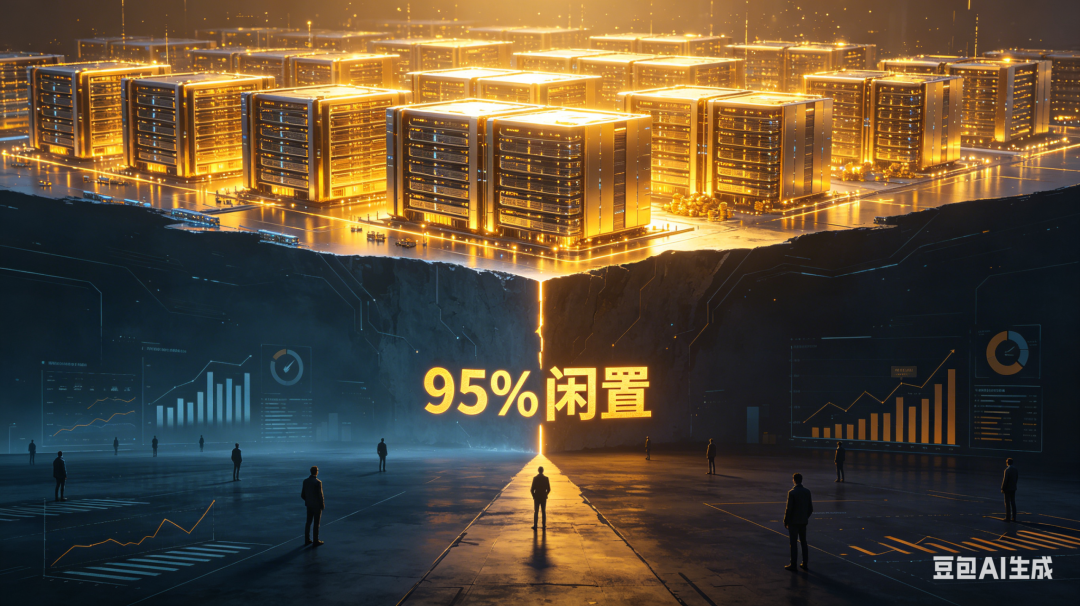
A recent analysis by Cast AI uncovered a shocking fact: in enterprise environments, GPU utilization averages just 5%, meaning up to 95% of expensive computing resources lie idle. This is not an isolated case; global data centers often see GPU utilization below 60%. Yu Yingtao, Chairman of Unisplendour, pointed out at the NAVIGATE 2026 summit that while China's daily Token calls have surged 1,400-fold in two years, the coexistence of explosive computing demand growth and resource idleness represents a systemic industry trap.
Goldman Sachs' latest report throws cold water on the hype: despite accelerated AI adoption, up to 95% of companies have seen virtually no ROI. The report highlights severe profit distribution imbalances in the AI ecosystem, with semiconductor firms (like NVIDIA) capturing most financial gains, while enterprises, model developers, and cloud providers struggle to justify their massive spending. Gartner's research is equally grim: only 28% of AI projects in infrastructure and operations fully succeed and meet expected ROI, while 20% fail completely. The most common reasons for failure are unrealistic expectations of AI capabilities and skill gaps during actual pilot stages.
Sequoia Capital's model indicates that for every US$1 invested in AI infrastructure GPUs, approximately US$4 in revenue must be generated at the application end for the entire investment chain's business logic to hold. However, capital is currently highly concentrated in underlying hardware, with value creation at the application layer lagging far behind. Analysts warn that this imbalance is "unsustainable." Once the market realizes that high-cost data centers cannot match expected returns, financing chains like private debt will face pressure first, potentially triggering liquidity crunches, forced asset sales, and other chain reactions.
03 The Cooling Revolution: Liquid Cooling Shifts from "Optional" to "Must-Have," Chinese Supply Chain Rises
Behind the explosive growth in computing density lies an unavoidable physical limit: heat dissipation. With single AI chip power consumption exceeding 1 kilowatt, traditional air cooling has become obsolete, making liquid cooling technology a rigid demand for AI infrastructure. 2026 is thus dubbed the "mandatory year for liquid cooling" by the industry.
The core driver of liquid cooling adoption is the soaring power consumption of AI chips. Google's TPU v7 consumes 980 watts per chip, explicitly requiring 100% liquid cooling. NVIDIA's GB200 system has a total power consumption of 2,700 watts, with a 72-GPU rack generating heat equivalent to 130-140 household induction cookers operating at full power simultaneously. The next-gen Rubin/Ultra chips are expected to exceed 2,000 watts. Faced with such high heat flux, the cooling limit of cold plate liquid cooling (about 1,720W-2,000W) is nearing its peak, making more efficient two-phase liquid cooling and immersion cooling inevitable choices.
The liquid cooling market currently features two main technical routes, with domestic manufacturers achieving breakthroughs and securing orders in both:
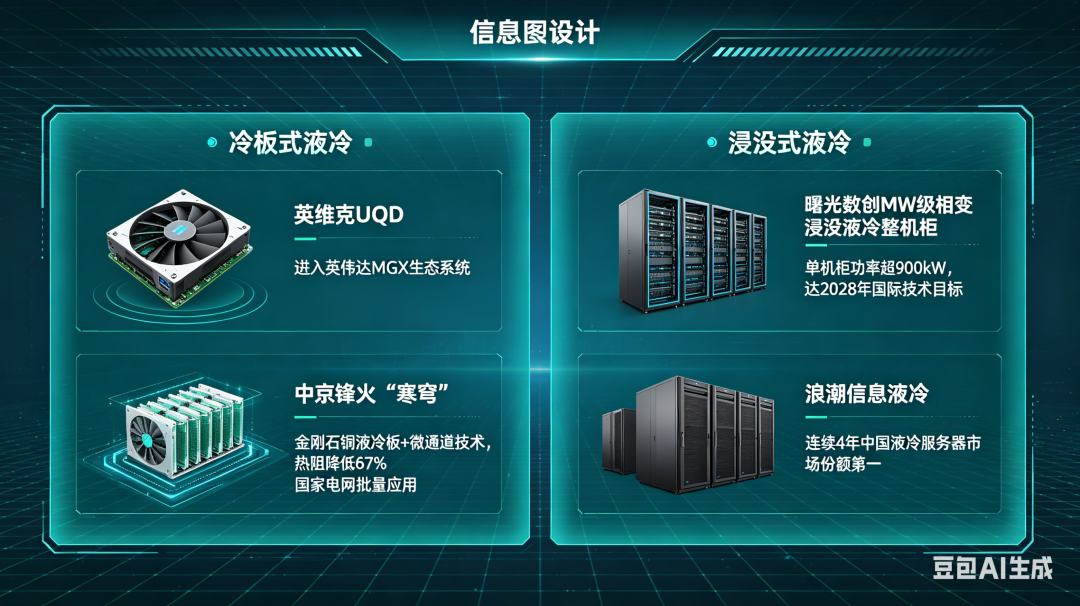
Cold Plate Liquid Cooling: Compatible with existing architectures and featuring low retrofitting costs, it is currently the mainstream approach. Inventec's UQD products have entered NVIDIA's MGX ecosystem. Zhongjing Fenghuo's "Hanqiong" series liquid cooling solution reduces thermal resistance by 67% through diamond-copper liquid cooling plates and microchannel technology, winning bulk applications from State Grid.
Immersion Cooling: Offering the strongest cooling capacity with a PUE (Power Usage Effectiveness) as low as 1.04, though initial investment is high. Sugon released the world's first MW-scale phase-change immersion liquid cooling entire rack, supporting over 900kW per rack and achieving the 2028 technical target set by international giants ahead of schedule. Inspur Information has topped China's liquid-cooled server market share for four consecutive years.
Why Has the Chinese Supply Chain Become the Protagonist?
Chinese liquid cooling firms' rapid penetration into the global supply chain is no accident, thanks to three key advantages:
Mature Manufacturing and Rapid Response Capabilities: Faced with urgent demands from Google, NVIDIA, and other giants for customized liquid cooling systems, Chinese suppliers demonstrate significant strengths in non-standard customization, rapid prototyping, and ramp-up production.
Extreme Cost-Effectiveness: While ensuring performance, Chinese solutions often offer lower total cost of ownership (TCO), highly attractive to cloud providers pursuing ROI.
Massive Domestic Market and Policy Drivers: China's "East Data, West Computing" project has invested over US$29 billion, with newly built smart computing centers now achieving nearly 100% liquid cooling coverage. This vast domestic market has nurtured industry leaders like Sugon (over 50% market share) and Inspur Information, accumulating rich experience for international competition.
J.P. Morgan predicts that the global AI server liquid cooling system market will surge from US$8.9 billion in 2025 to over US$17 billion in 2026. Currently, leading firms like Inventec and Guangdong Alfa have passed certifications from Google, NVIDIA, or Intel and entered their supplier whitelists. Listed companies such as Dingtong Technology, Fit Precision, and LY ITECH report full order books and operate at full capacity.
04 Crossroads: Corporate Choices and the Race's Side Effects
Standing before the US$725 billion computing power wall, all firms face a strategic choice: build heavy-asset infrastructure or embrace cloud services' flexibility? This frenzied infrastructure race, while driving technological progress, also brings unignorable side effects.
Corporate Dilemmas
For most firms, fully emulating tech giants by building their own smart computing centers is unrealistic. High electricity costs (several times higher in some U.S. regions than in China), infrastructure investments, and complex operations and maintenance require an ROI exceeding 13% to break even. Thus, hybrid clouds, dedicated clouds, or direct procurement of computing services become more pragmatic choices. The industry needs to shift from isolated hardware stacking to full-stack collaboration across computing power, networks, storage, cloud, security, and operations to provide cost-optimal solutions.
Three Major Side Effects of the Race
Resource Misallocation and Bubble Risks: Capital overconcentration in the hardware layer, coupled with lagging value creation at the application layer, leads to severe investment-return disconnections. Gartner predicts that over 40% of Agentic AI projects will be canceled by the end of 2027, primarily due to cost overruns and unclear business value.
Technology Path Lock-in Risks: Massive investments by giants in specific technical architectures (e.g., certain chips or liquid cooling solutions) may bind entire ecosystems to a single path, stifling diversified innovation.
Energy and Environmental Sustainability Challenges: AI data centers are already energy giants. While liquid cooling can reduce PUE to 1.1 or even lower, absolute energy consumption continues to rise, posing significant challenges to global power grids and carbon neutrality goals.
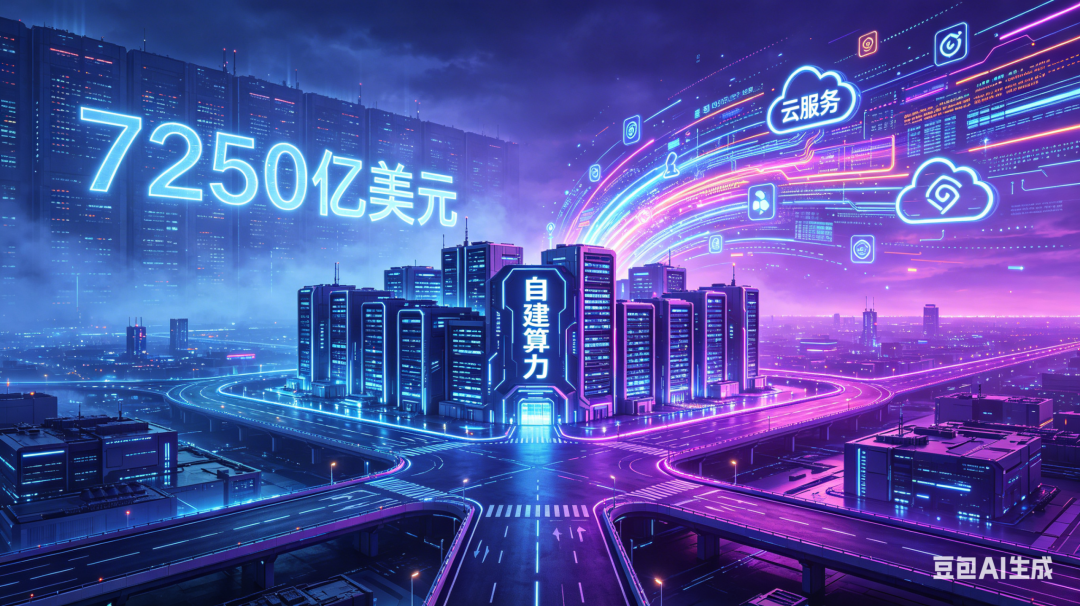
The US$725 billion in capital expenditures paints a frenetic picture of AI computing infrastructure. However, the ultimate winner may not be the biggest spender but the one most efficiently and economically converting computing power into actual productivity and commercial value.
The second half of this race will shift focus from "hardware stacking" to "efficiency improvement," from "computing power contention" to "intelligent operations." The rise of China's supply chain in critical areas like liquid cooling signifies not just orders and market share but also China's transformation from follower to important innovator and rule-maker in the global AI infrastructure value chain. Ultimately, when the tide recedes, players who can provide reliable computing power at lower costs and superior energy efficiency will become the true cornerstone builders of the AI era.
-
Ofilm Teams Up with ADSensE to Propel Large-Scale Deployment of All-Solid-State LiDAR Powered by ADS6311 Chip!
-
![]()
Loss of 2.5 Billion Yet Facing Strong Demand for Shares? Another Battle for Control of Lianchuang Electronics
-
![]()
Huawei’s Enjoy Series Flies Off the Shelves, Prompting Xiaomi to Double Down on Budget Smartphones
-
![]()
Beijing Hyundai's Top Executive Criticizes Industry Disorder: Certain Brands Treat Customers as Beta Testers
-
![]()
The domestic mobile phone market has declined for five consecutive quarters! Huawei defies the trend with significant growth: maintains its top market share
-
Annual Revenue Surpasses 3 Billion: An Automotive Trim 'Little Giant' Makes Its Debut on the Beijing Stock Exchange
-
![]()
The Space Force Wants to Spend $30 Billion on Rocket Launches: Is Trump Doubling Down, and Is SpaceX the Big Winner?
-
![]()
Going Crazy! One out of Every Three Plug-in Hybrids Sold in Europe is a Chinese Vehicle