How Far Are We from AI Payments When Agents Want to 'Take Over' Our Wallets?
 06/01 2026
 636
636
Alipay is Redoing Payments with AI.
On May 26, Alipay unveiled the world's first Token Pay service and AI wallet product. Combined with its previously launched AI Pay and AI Receive features, Alipay has now established a full-stack AI-native payment system for the AI era, offering comprehensive services from authorization to management, payment to settlement, and security to trust.
Unlike most platforms in the industry that take an incremental approach to AI payments—adding AI functionalities to traditional payment systems—Alipay's AI payment reconstruction is more thorough.
Rebuilding Trust for the Agent-Driven Economy
Alipay also released a set of highly indicative data: AI payments have completed 300 million agent-based transactions and support 95% of the general agent frameworks on the market.
This means Alipay has not only established a complete AI payment chain but also become the world's first large-scale commercial AI-native payment infrastructure.
Additionally, Alipay is investing real resources—through token subsidies and zero-fee rates for AI developers—to cultivate a commercial ecosystem for intelligent agents.
Such a bold and aggressive approach is rare in the industry.
But looking back, Alipay has always been the pioneer in China's third-party payment sector.
Over the past two decades, from escrow transactions in the PC internet era that addressed trust issues among strangers to innovations like QR code payments, facial recognition payments, and bump payments in the mobile internet era that addressed efficiency and scenario-based challenges while building on trust, Alipay has always been at the forefront.
Now, the entity executing payments is shifting from humans to 'joint decision-making by humans and agents,' marking the third paradigm shift.
For example, when users order coffee through smart devices like AI glasses or agents like QianWen, they only need to state their needs verbally—no phones required. The AI assistant embedded in these devices can automatically complete the entire transaction process, from ordering to payment.
Smart cockpits are also emerging as new payment scenarios. When a vehicle enters or exits a parking lot, the system automatically identifies the vehicle and displays a card showing the parking duration and fee. Users can simply confirm verbally to exit seamlessly.
In these real-world payment scenarios, payments have moved beyond traditional mobile QR codes or bump payments, with interaction and risk control rules becoming 'agent-ized.' Take smart earbuds as an example: the earbuds and phone are paired, so payment won't work if either is replaced. Moreover, only the voice of the Alipay account holder can successfully authorize a payment, utilizing technologies like voiceprinting.
The shift in decision-making entities for AI payments has also led to fundamental changes in business models. In the past, people sought services through search and recommendations, making relationship chains highly valuable. In the future, services will find people, and agents will interact with agents. Intelligent agents will understand intentions, break down tasks, and deliver results directly, with success hinging only on matching and delivery.
For instance, the new 'Agent-to-Agent' (A2A) transaction model connects payment receivers with service providers, enabling on-demand purchases of computing power, storage, and digital services while gradually moving away from traditional paradigms like account registration, prepayments, and fixed subscription plans.
In this chain, payment is no longer the 'final step.' It has become independent of the Alipay app and is now embedded as a capability within native AI processes.
In a sense, this can be seen as agents 'taking over' our wallets to a limited extent.
As Ant Group CEO Han Xinyi puts it, the essence of commerce remains unchanged, but the competitive moat has shifted from 'traffic gateways' to 'agent ecosystems.' Many of today's standalone product models may be bypassed in the agent era, integrated, consolidated, and processed before being delivered in forms that users truly need.
Alipay aims to serve as the trust layer, connector, and enabler in the agent era.
This is the logical starting point for Alipay's new positioning in the agent-driven economy, which essentially involves reconstructing the 'trust logic' for the AI era. While Alipay previously addressed trust between people, it now needs to address trust between humans and agents, as well as between agents themselves.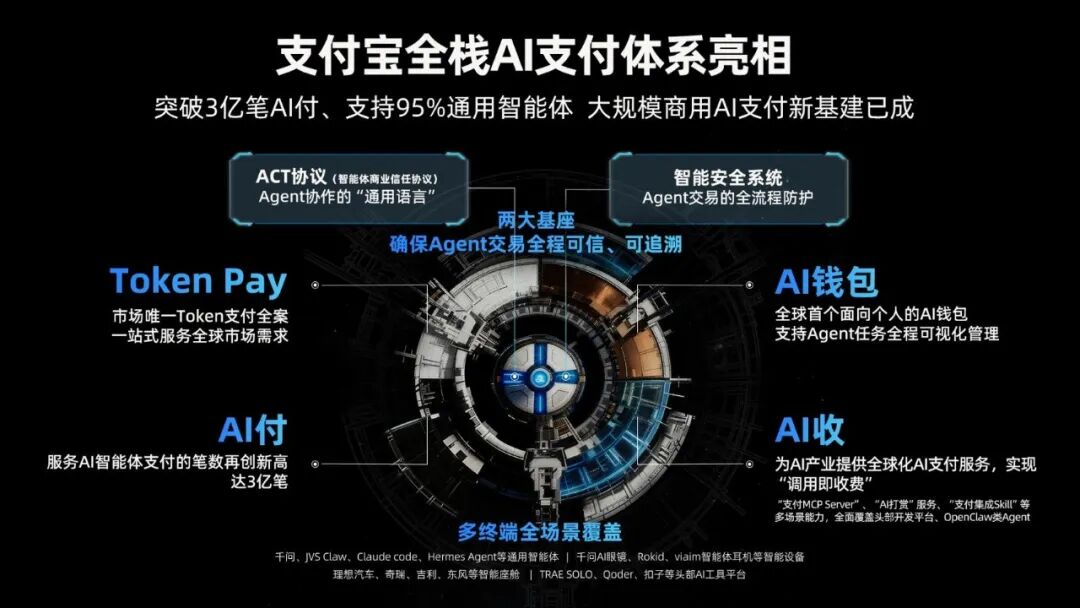
To achieve this, Alipay is doing two things: first, putting control in users' hands, and second, taking responsibility when things go wrong—the well-known 'You Dare Pay, I Dare Compensate' promise.
For the former, Alipay's AI payment system has established three types of authorization models to give users control over the rules: (1) Basic Confirmation Model, where key transactions require manual user confirmation; (2) Custom Rule Model, allowing users to set their own transaction conditions, such as automatic payment for physical goods under 200 yuan; and (3) Quota Authorization Model, enabling users to set fixed spending limits for AI agents, within which transactions can proceed autonomously.
The principle behind this rule design is to 'give users choice and control directly,' empowering them to establish mastery over AI.
For example, the newly launched AI wallet manages not just funds but also agent authorizations. Users can manage 'agent tasks' in real-time before and during payments, set budgets, limit consumption scenarios, and define authorization boundaries, with complete billing available afterward.
An Alipay spokesperson also stated, 'We're not ceding decision-making power to AI but delegating execution authority to it. For every payment, the system first verifies the user's true intent before strictly matching it with the authorization.'
For the latter, Alipay is extending and reinforcing its 'You Dare Pay, I Dare Compensate' commitment to provide users with assurance when using AI payments. This redefines the cornerstone of trust for the AI era.
How Far Are We from AI Payments?
Currently, Alipay is not the only player in the AI payment track ( track : competitive arena). The race for 'new entry points in the AI era' has already begun, with clear differentiations between domestic and international players.
Domestic players generally focus on practical scenario deployment and universal accessibility. For example, JD.com launched ClawTip, an A2A micropayment infrastructure, supporting multi-terminal scenarios like JoyAI digital humans and smart glasses while designing risk control logic specifically for AI scenarios. China UnionPay emphasizes industry compliance and standardization, releasing an open protocol for agent-based payments and collaborating with multiple institutions to build a local AI payment ecosystem foundation. WeChat Pay leverages its vast C-end user base and B-end merchant resources to rapidly enhance its AI payment capabilities. Baidu's Duxiaoman released ClawPay, a payment solution for AI Skill developers.
International giants, meanwhile, focus on reconstructing underlying technologies and exporting global standards. For instance, OpenAI partnered with Stripe to launch the ACP agent commerce protocol, integrating transaction capabilities within ChatGPT to create a pure AI-native transaction system. Google released the AP2 agent payment system, emphasizing open connectivity to meet universal smart payment needs across multiple scenarios and devices. Visa and Mastercard introduced the UCP universal payment protocol, targeting interoperability and cross-border scalability for global agent transactions.
This is not merely an upgrade of payment methods but a struggle for control over commercial transaction decision-making. Han Xinyi emphasizes that in the agent era, the logic of traffic will give way to the logic of trust. Whoever solves the trust issue may dominate the agent ecosystem.
As an indispensable part of this game, C-end users remain skeptical: Can I trust AI with my wallet? Can I share my payment password with an agent?
For most ordinary users, the answer is likely 'no' or 'uncertain.'
On one hand, Alipay's achievements cannot obscure issues like fragmented AI payment scenarios, low user awareness, and insufficient motivation for small and medium-sized merchants to upgrade. On the other hand, the public lacks confidence in deeper issues such as the liability boundaries, risk control rules, compliance risks, and standardization of AI payments.
The pace of improving AI payment rules and ecosystems lags behind technological implementation. Li Jiajia, co-president of Ant Group's Digital Payment Business Group, also noted, 'The core reason AI payments aren't taking off isn't technological barriers but consumers' reluctance to use them.'
Moreover, many people misunderstand 'AI taking over wallets,' believing it means users completely transfer fund control to AI, allowing machines to spend autonomously.
In reality, 'taking over' only means the initiator of payment instructions (the decision-making entity for payments) changes, not that wallet control is surrendered.
In AI-era transaction scenarios, such as subscription renewals and AI e-commerce, agents will act within user-authorized boundaries to enhance commercial and transactional efficiency, with humans retaining ultimate control.
Against this backdrop, Alipay's initiative to redo payments with AI and rebuild the 'trust logic' for AI payments sends a valuable signal: the biggest bottleneck for AI payments remains trust. Facing new transaction scenarios between humans and agents or among agents, the trust logic must be reconstructed from scratch.
If this hurdle isn't overcome, the changes brought by AI and its promise to serve people and improve lives will be compromised by various gray industries and vulnerabilities.
Alipay has taken a crucial step, but the industry still has a long way to go before the public will confidently entrust their wallets to agents.
-
Ofilm Teams Up with ADSensE to Propel Large-Scale Deployment of All-Solid-State LiDAR Powered by ADS6311 Chip!
-
![]()
Loss of 2.5 Billion Yet Facing Strong Demand for Shares? Another Battle for Control of Lianchuang Electronics
-
![]()
Huawei’s Enjoy Series Flies Off the Shelves, Prompting Xiaomi to Double Down on Budget Smartphones
-
![]()
Beijing Hyundai's Top Executive Criticizes Industry Disorder: Certain Brands Treat Customers as Beta Testers
-
![]()
The domestic mobile phone market has declined for five consecutive quarters! Huawei defies the trend with significant growth: maintains its top market share
-
Annual Revenue Surpasses 3 Billion: An Automotive Trim 'Little Giant' Makes Its Debut on the Beijing Stock Exchange
-
![]()
The Space Force Wants to Spend $30 Billion on Rocket Launches: Is Trump Doubling Down, and Is SpaceX the Big Winner?
-
![]()
Going Crazy! One out of Every Three Plug-in Hybrids Sold in Europe is a Chinese Vehicle