A Hackathon Reveals How AI Reshapes a Company with Ten Thousand Employees
 06/01 2026
 411
411
AI Takes Root, Innovation Soars
When Workday’s CTO Peter Bailis stepped down from his executive role to join Anthropic as an engineer (MTS), the vibration (shaking) wasn’t confined to Silicon Valley’s HR circles—it redefined the career ladder.
Over the past year, tech leaders like Instagram co-founder Mike Krieger and Tesla’s former AI director Andrej Karpathy have collectively abandoned management to get closer to models.
This isn’t just personal choice—it’s an organizational paradigm revolution. In the AI era, “how many people you manage” is ceding to “how much intelligence you harness.” The foundational logic of corporate structures is being rewritten.
From OpenAI and Anthropic abroad to DeepSeek and Moonshot AI in China, a handful of companies are disrupting market caps of established giants.
Meanwhile, domestic tech giants are establishing independent AI departments reporting directly to top leadership, such as ByteDance’s Seed and Alibaba’s ATH.
From Silicon Valley’s CTO “demotions” to domestic giants’ independent units and virtual teams, AI is forcing every company to answer: How can AI become an organizational innovation capability? And what should an AI-native organization look like?
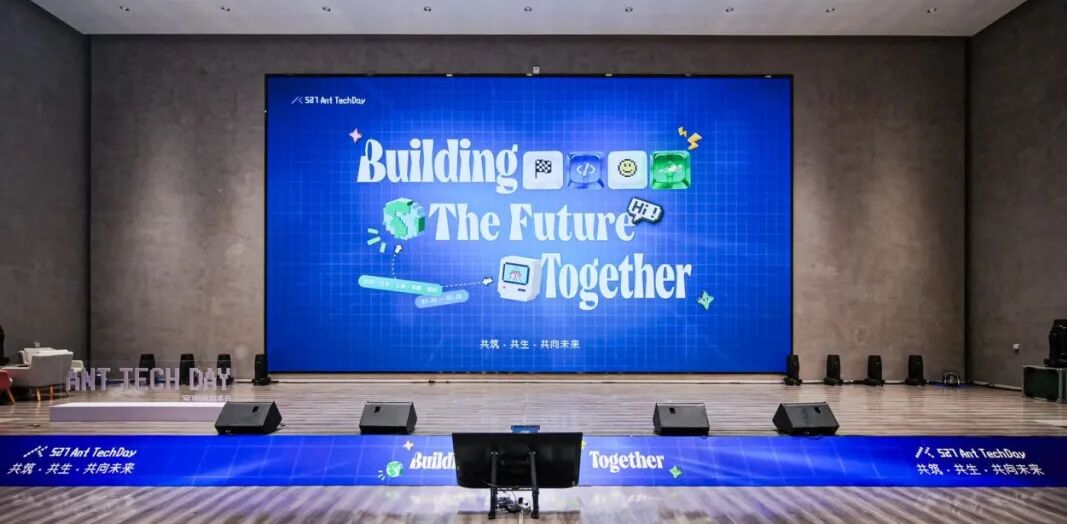
On May 27, at Ant Group’s Tech Day, we found a reference point.
During a hackathon, an operations engineer, a product manager, and an algorithm specialist—three strangers from different departments—spent 48 hours turning a casual idea (“Wouldn’t it be cool to flip PPT slides mid-meeting with gestures?”) into a gesture-controlled system running on Macs.
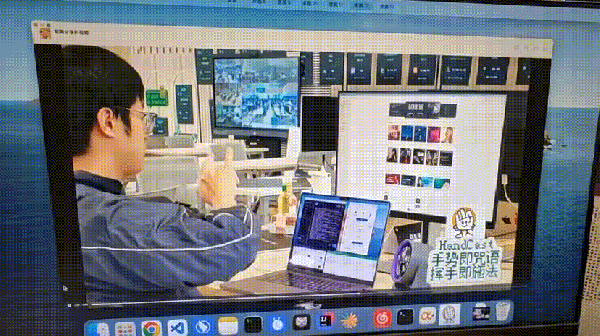
A few years ago, this “non-business-critical, non-tech-led, unofficial” idea would’ve stood no chance in development queues.
But in 2026 Ant Group, it’s not just possible—it’s common. No orders, no KPIs—just ordinary people identifying real workplace issues, grabbing AI tools, and solving them themselves.
527 Tech Day served as a window: As AI shifts from tool to infrastructure, how is a 20-year-old tech giant undergoing genetic restructuring?
The Problem-Solvers Take Charge
In this AI wave, innovation no longer emerges solely from formal R&D pipelines—it bubbles up closer to real-world problems.
In September 2025, Moonshot AI engineers launched an internal project, Ensoul, to make code files “come alive” in command lines—later known as Kimi, the smart assistant. OpenClaw (the Lobster Agent), which went viral globally, was built by one person.
This highlights traditional corporate innovation’s biggest flaw: It’s typically top-down. Strategy sets direction, business units raise needs, products design solutions, R&D schedules development, and testing launches.
Long chains, high barriers, and distance from frontline needs mean only “must-dos”—not necessarily “should-dos”—get implemented.
At Ant’s hackathon, the first thing you notice is “disorientation.”
Traditionally, this was a stage for algorithm engineers and architects to showcase skills. But this year, many participants weren’t from R&D.
For example, a team of three—two with zero coding experience—lured a versatile developer (their “work buddy”) to build a cat care assistant. Even a non-tech participant competed solo, using AI to develop an affordable communication aid for ALS patients.
Hackathon rosters revealed cross-departmental, cross-functional temporary (ad-hoc) teams, including many non-tech members bringing AI-powered products to compete.
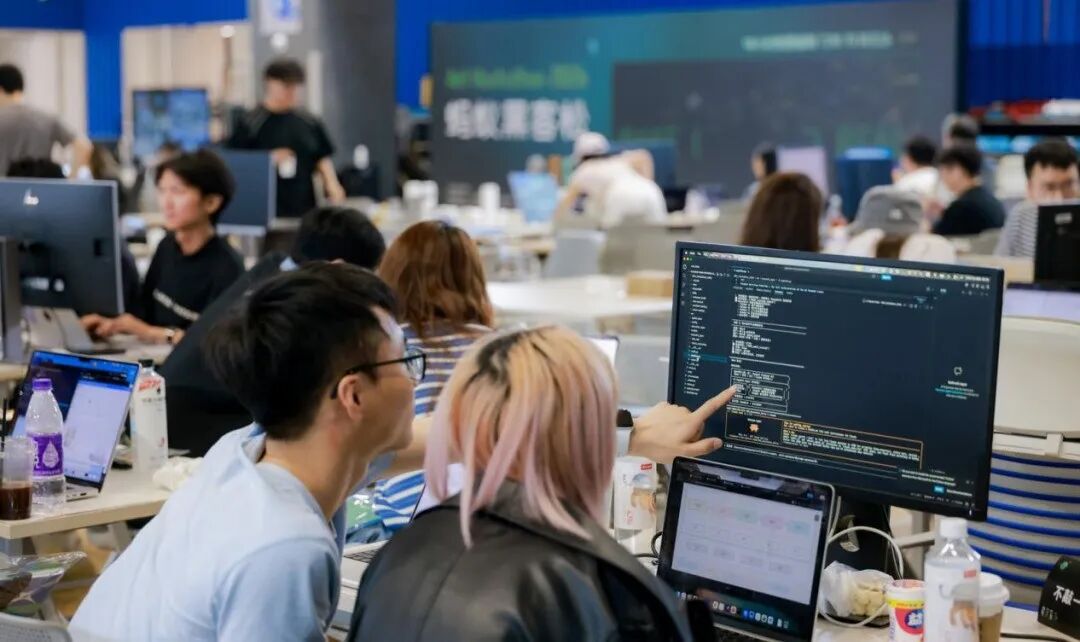
When asked about cross-team collaboration, participants gave candid answers: “Fixed teams had narrow perspectives; now, diverse roles tackle problems from entirely new angles.” “As an algorithm person, I never understood how engineering used AI—this opened everything.”
These comments reveal Ant’s organizational shift: AI lowers creation barriers and breaks collaboration silos.
Ant’s data shows 1,122 hackathon registrants, 18% non-tech. These numbers reflect AI’s democratizing power—not turning everyone into engineers, but empowering anyone with an idea to solve problems in their most painful, itchy, or intuitive areas.
From Special Zones to Small Units: The Birth of AI-Native Organizations
In the AI era, a company’s innovation capacity may depend less on headcount and more on talent and computational density.
Consider model startups: DeepSeek’s core team numbers ~100, Moonshot AI maintains ~100+, and while OpenAI has thousands, its core research remains Pod-based (small teams).
“This is an era where anyone can be a CTO—with Tokens, you can manage large tech teams,” says Ant Group CTO He Zhengyu.
More tech giants are adopting AI Builder Pods—small, autonomous cross-functional teams.
“Our product launched using a ‘special zone’ model,” an Ant Group Homi product engineer told Guangzhui Intelligence. “Built from spring, version 1.0 released March 19.”
Homi, an AI office platform for Ant employees, lets non-tech users build Agents via natural language to automate workflows.
Its “special zone” approach integrates product, R&D, and testing roles. Everyone uses large models to code, design features, and debug, flattening workflows.
Product managers now develop and test products directly, writing front-end code while R&D handles interactions—all becoming AI engineers. This “special zone” model enables rapid iteration.
The Homi team, just 10+ strong, built a platform serving 20,000+ Ant employees across document writing, R&D analysis, data review, and project management, delivering tangible efficiency gains.
For example, offline payment merchants used Homi to build two skills: one for government coupon activity reviews, another for ODPS SQL query reports. What previously took BI teams half a day now takes one question—“over 90% efficiency gains.”
Traditionally, supporting company-wide office tools required dozens or hundreds of R&D staff. In the AI era, small teams + AI engines + universal architectures can drive scalable innovation.
This isn’t unique to Ant.
Take WeaveFox: Since mid-2023, its team has broken ground on AI application development and intelligent R&D, translating breakthroughs into products like WeaveFox-Vibe, which lets non-developers create AI apps via natural language (10,000+ users).
Despite its user base, WeaveFox’s organization is surprising: AI-powered small-unit iteration explores new composite talent models—technical implementation, product, and architecture as one.
Tasks once divided among roles now advance via full-stack engineering, letting team members shift from single functions to holistic product perspectives. An idea can go from prototype to validation in a day, with feedback loops enabling 3–4 daily iterations—refining feasibility and product judgment. Products evolve, and teams grow.
For AI-era organizations, small teams (3–5 people) can operate efficiently without dedicated PDs or designers, reducing organizational complexity for agile, AI-driven innovation.
Ant also has teams like GPASS, which focuses on integrating Alipay’s payment and lifestyle services into AI glasses (QianWen, Xiaomi, Rokid, Thunderbird, Huawei).
“95% of current code is AI-generated. We aim for 100%,” says GPASS’s technical architect.
Three projects, three scales, all point to one conclusion: AI doesn’t replace people—it reorganizes human-organization relationships. Job boundaries blur, expertise barriers lower, small teams achieve big things, and non-tech people innovate.
This answers industry questions: Do giants still need massive R&D teams in the AI era?
No—focus on “intelligence density,” not headcount.
Ant Group now offers AI Token policies, encouraging employees to use AI in R&D and office scenarios with generous daily Token allocations. Employees can purchase additional Tokens via channels (reimbursed by the company).
Tokens become a new organizational resource, accessible to all—including non-tech staff.
At Ant, AI-native organizational forms—special zones, full-stack engineers, small-unit operations—are emerging, proving that extra large (hyper-scale) organizations can decompose into agile, innovative units.
This “special zone” model may be the optimal solution for giants in the AI era: small teams, full-stack roles, flattened hierarchies, rapid iteration.
Finally, let’s clarify a misconception.
When we discuss “everyone building,” we’re not advocating for tech nihilism or predicting engineers’ extinction. Instead, Ant’s practice reaffirms engineers’ value.
AI generates code but can’t define problems. It optimizes processes but can’t understand human needs. It accelerates iteration but can’t replace strategic technical judgment or user experience craftsmanship.
AI isn’t a panacea. It won’t automatically drive innovation or overcome organizational inertia. Change begins with individuals making concrete attempts in specific contexts.
These small, specific, even clumsy moments define organizational evolution in the AI era.
When employees face problems, their first thought shifts from “Whose job is this?” to “Can I try solving it?”
That, perhaps, is an AI-era organization’s most precious asset.
-
Ofilm Teams Up with ADSensE to Propel Large-Scale Deployment of All-Solid-State LiDAR Powered by ADS6311 Chip!
-
![]()
Loss of 2.5 Billion Yet Facing Strong Demand for Shares? Another Battle for Control of Lianchuang Electronics
-
![]()
Huawei’s Enjoy Series Flies Off the Shelves, Prompting Xiaomi to Double Down on Budget Smartphones
-
![]()
Beijing Hyundai's Top Executive Criticizes Industry Disorder: Certain Brands Treat Customers as Beta Testers
-
![]()
The domestic mobile phone market has declined for five consecutive quarters! Huawei defies the trend with significant growth: maintains its top market share
-
Annual Revenue Surpasses 3 Billion: An Automotive Trim 'Little Giant' Makes Its Debut on the Beijing Stock Exchange
-
![]()
The Space Force Wants to Spend $30 Billion on Rocket Launches: Is Trump Doubling Down, and Is SpaceX the Big Winner?
-
![]()
Going Crazy! One out of Every Three Plug-in Hybrids Sold in Europe is a Chinese Vehicle