Users’ Willingness to Pay for Office Intelligent Agents Is Taking Shape, with Business Model Validation and Experience Optimization as Key Challenges for the Next Phase
 06/02 2026
 472
472
Analysys Insight: The recently released "China Office Intelligent Agent Platform Market Research Report 2026" by Analysys provides an in-depth analysis of user behavior and selection criteria for office intelligent agents. The report reveals that both current paying users and potential paying users constitute the commercial bedrock of the product, with the payment mindset evolving from a "trial-based" approach to one rooted in "value recognition." At the business model level, multiple charging approaches coexist, with different products forging distinct monetization paths based on their positioning and user demographics.
1. Business Models
When AI can autonomously execute and complete workflows, users' payment rationale shifts from paying for functional access to paying for time saved and outcomes achieved. This transformation in the value exchange paradigm necessitates that vendors continually demonstrate the quality of delivered results, rather than merely offering functional access. Consequently, data accumulation, scenario comprehension, and model evolution capabilities emerge as the cornerstone for business model success—because users are willing to pay only for results, not for functions they might use in advance.
Table 1: Business Models and Payment Models for Office Intelligent Agents
| Business Model | Payment Model | Typical Users | Usage |
|---|---|---|---|
| Subscription-Based | Monthly/Yearly Fixed Fee | General Users, SMEs | Continuous delivery of agent capabilities, with users paying in tiers based on usage depth |
| Token-Based Usage Billing | Billing Based on Consumption | Deep Users Such as Individual Developers | Users who deploy agents themselves pay directly to the model API for tokens or purchase additional token packages through the agent platform |
| Skill/Plugin Payment | Subscription or Usage-Based Revenue Sharing for Skills | Long-Tail/Vertical Scenario Users | The platform enables third-party developers to supplement long-tail scenarios by opening skill standards, with users paying or subscribing separately for specific Skills |
| Private Deployment | One-Time License + Ongoing Maintenance | Large Government and Enterprise Clients | Fully deployed locally or in a private cloud |
● Subscription-Based Model
The subscription-based model currently dominates the office intelligent agent market. Platforms typically offer tiered functionality between free and paid versions, with paid versions charging a fixed monthly or yearly fee. The core selling points revolve around model capabilities, usage limits, queue response, and custom agent features. The key distinction between office intelligent agent subscriptions and traditional SaaS subscriptions lies in the fact that users are no longer paying for "functional access" but for "continuously evolving capabilities." Subscription fees are directly tied to the quality of tasks completed by the agent, compelling vendors to continually invest in model training and product iteration.
● Token-Based Usage Billing
Token-based billing directly links costs to actual consumption, targeting deep users such as individual developers with higher usage intensity and task complexity. These users typically recharge tokens after deploying agents themselves and pay directly to the model API. For mainstream office intelligent agent platforms, multiple foundation models are commonly integrated, automatically invoking the optimal model to complete instructions. Currently, the platform absorbs the token costs of the underlying models, with users perceiving payment units more as "tasks/limits" rather than tokens, while the platform also offers flexible options for additional purchases.
● Open-Source Framework: Skill/Plugin Payment
By opening a plugin marketplace, the platform allows official or individual developers to publish skills, which users can purchase or subscribe to individually or based on the number of times the agent invokes the skill. Users make purchase decisions only in specific scenarios, but their requirements for effectiveness are extremely clear, attracting users with precise needs for vertical capabilities. These users often already have stable tool usage habits and are willing to pay separately for specific capabilities. Once foundational model capabilities become homogeneous, the richness of the Skill ecosystem will become a core differentiator for platforms.
● Private Deployment
Primarily aimed at B-end clients with stringent demands for data security and customized workflows, ensuring data remains within the domain, models are customizable, and interfaces can be deeply integrated. Additionally, domestic large models have a more pronounced cost advantage in private deployment scenarios, allowing platform vendors to commercialize through one-time licensing fees plus annual maintenance fees. From a usage perspective, private deployment emphasizes deep integration with internal IT infrastructure, with agents often embedded into existing enterprise R&D platforms, knowledge management systems, or business processes.
2. User Payment Methods and Willingness
The conversion of office intelligent agent users to paid users is still in its nascent stages, but the foundation for payment willingness has been firmly established.
Among surveyed users, 36% are already paying users, 5% are experiencing paid versions, and 59% are free users.
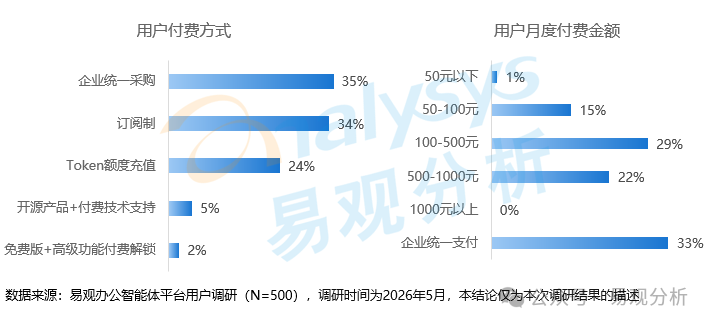
Figure 1: Payment Situation of Paid Users for Office Intelligent Agent Products
Among paid users, enterprise procurement and subscription-based models prevail. The proportion of organization-driven B-end procurement is roughly equivalent to that of individual consumer spending, with monthly payment amounts concentrated above the 100-yuan level. The value delivery of intelligent agents has gained recognition from paid users, who have stable expectations for continued use rather than one-time trial payments.
The core drivers for paid users can be distilled into two points: First, efficiency-driven demand, where users encounter specific problems in their work that traditional tools cannot solve, and intelligent agents provide quantifiable efficiency improvements. Second, capability expansion-driven demand, where users view intelligent agents as tools to expand personal or team capability boundaries and are willing to pay for access to more advanced model reasoning capabilities, richer functional plugins, or more stable performance.
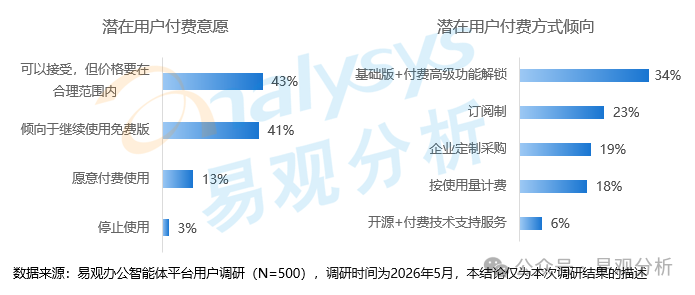
Figure 2: Payment Situation of Potential Users for Office Intelligent Agent Products
Among non-paying users, the majority maintain an open attitude, with the Freemium model being the most favored. Over 60% of users have not directly paid for the product but are willing to pay a reasonable price, with the Freemium model of "basic version + paid unlocking of advanced features" being highly popular. This reflects users' willingness to first establish usage habits and value perception through the free version before selectively paying based on their needs. Only 3% of non-paying users explicitly stated they would "stop using," with the vast majority maintaining an open attitude towards payment.
From an overall perspective on user payment conversion, the current office intelligent agent market is still in the exploratory phase for payment conversion. The key variables for future payment rate improvements lie in: First, whether product capabilities can establish irreplaceability in more in-depth scenarios, thereby strengthening users' payment motivation. Second, whether pricing strategies can precisely match users' price sensitivity and value perception.
3. Understanding Discrepancies and Unstable Output Quality Are Current Core Pain Points
Among surveyed users, problems reported during the use of office intelligent agents are concentrated at three levels: instruction communication costs at the interaction level, result quality reliability at the output level, and task completion at the capability level.
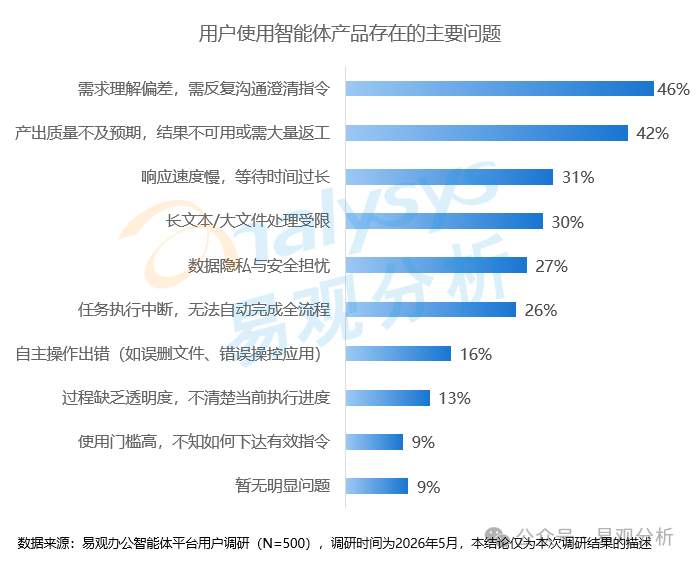
Figure 3: Main Problems Users Encounter When Using Office Intelligent Agent Products
● Understanding Discrepancies and Output Quality Constitute Primary Obstacles
46% and 42% of users cite "understanding discrepancies in requirements" and "output quality falling short of expectations" as major pain points. On one hand, current agents' ability to grasp complex contexts is still limited, making it difficult for users to fully convey implicit information such as project background, format preferences, and business constraints in brief instructions. On the other hand, some users have not yet established interaction habits for collaborating with agents, with vague instruction descriptions and missing key constraints also leading to output deviations. These two factors intertwine, resulting in frequent instruction clarifications and result revisions throughout the usage process, increasing the actual communication costs.
● Product Performance Still Falls Short in Matching Heavy-Duty Office Scenarios
Approximately 30% of users believe the product's "response speed" and "long text/large file processing" capabilities are insufficient. When tasks involve multi-step reasoning, toolchain invocation, or large-scale context retrieval, model reasoning delays become significantly amplified. From an evolutionary perspective, reasoning acceleration and context window expansion are deterministic directions for industry technological iteration, but current performance bottlenecks still pose practical resistance to users transitioning agents from auxiliary roles to core workflows.
● Autonomous Execution Capabilities Remain a Weak Link, with Trust Building Constrained by Execution Reliability and Transparency
Autonomous execution capabilities are a core proposition for agents to move from auxiliary tools to deep workflows. At the current stage, this more tests the product's engineering design capabilities in terms of process controllability and result predictability. When agents need to independently execute multi-step complex tasks, a complete self-correction mechanism and visualization of the execution process become key prerequisites for users to establish trust—users need to perceive the task progress status in real-time, locate abnormalities in intermediate steps, and intervene for adjustments when necessary. The higher the transparency of the execution process, the more willing users are to cede control to the agent, thereby truly unlocking the efficiency gains brought by autonomous execution.
Analysys has released the "China Office Intelligent Agent Platform Market Research Report 2026." If you are interested in the Agent industry, please promptly communicate with Analysys. Click the link below to access the relevant report: https://mp.weixin.qq.com/s/duAZfb_ivZTlmMaJ1iRS0A
-
Ofilm Teams Up with ADSensE to Propel Large-Scale Deployment of All-Solid-State LiDAR Powered by ADS6311 Chip!
-
![]()
Loss of 2.5 Billion Yet Facing Strong Demand for Shares? Another Battle for Control of Lianchuang Electronics
-
![]()
Huawei’s Enjoy Series Flies Off the Shelves, Prompting Xiaomi to Double Down on Budget Smartphones
-
![]()
Beijing Hyundai's Top Executive Criticizes Industry Disorder: Certain Brands Treat Customers as Beta Testers
-
![]()
The domestic mobile phone market has declined for five consecutive quarters! Huawei defies the trend with significant growth: maintains its top market share
-
Annual Revenue Surpasses 3 Billion: An Automotive Trim 'Little Giant' Makes Its Debut on the Beijing Stock Exchange
-
![]()
The Space Force Wants to Spend $30 Billion on Rocket Launches: Is Trump Doubling Down, and Is SpaceX the Big Winner?
-
![]()
Going Crazy! One out of Every Three Plug-in Hybrids Sold in Europe is a Chinese Vehicle