AI-Driven Shopping Frenzy Unfolds at This Year's 618 Festival
 06/02 2026
 407
407
Author | Cheng Yu
Disclaimer | The featured image is sourced from the internet. This article is originally published by Jingzhe Research Institute. For reprinting, please leave a message to apply for permission.
The 618 shopping festival has commenced this year, with e-commerce platforms venturing into uncharted territories beyond traditional retail.
On June 1, 36Kr reported, citing insiders, that Doubao is slated to introduce paid content services by late June. If all proceeds as planned, Doubao will further integrate e-commerce features to enhance its paid offerings in the third quarter, drive traffic to Douyin Mall through subsidies, and enter the operational phase in the fourth quarter. Earlier, in April, Doubao incorporated the 'Doubao Helps You Choose' feature into its app navigation bar, allowing users to seamlessly experience core online shopping functions—such as product selection, ordering, payment, order management, and after-sales services—within the Doubao app.
Coincidentally, on May 11, Qianwen announced its full integration with Taobao, enabling users to select and purchase products on Taobao through AI-driven conversations within the Qianwen app. Previously, at the end of December last year, JD.com launched a standalone app, 'JD AI Shopping,' and officially commenced its beta testing. Even Xiaohongshu, known for its weaker e-commerce attributes, announced the establishment of its AI-first department, Dots, at the end of April this year.
Such synchronized actions by major platforms cannot be merely dismissed as 'proactive AI deployment.' Instead, these moves signal a clear trend: the era of AI-driven e-commerce is on the horizon, set to arrive by 2026.
For most consumers, the concept of AI-driven e-commerce may still be vague. However, the groundwork was laid in 2014 when Amazon introduced its smart speaker, Amazon Echo, featuring the built-in AI voice assistant Alexa, which allowed users to place orders through voice commands. Later, in 2017, Alibaba followed suit with smart hardware products like Tmall Genie, which similarly leveraged AI voice interactions for online shopping.
From a technological standpoint, early AI applications merely innovated interaction methods without significantly influencing consumers' purchasing decisions. However, as AI continues to gain popularity, ordinary users' awareness and frequency of using AI have increased, making the integration of AI in e-commerce scenarios more tangible. Currently, Qianwen and Doubao's transformation into 'AI shopping assistants' represents a primary form of AI integration into e-commerce.
When comparing the 'AI shopping' experiences across different applications, Jingzhe Research Institute observed that the app interfaces of Qianwen and Doubao remained largely unchanged after integrating e-commerce functions. Public information indicates that the 'Doubao Helps You Choose' button, previously featured in Doubao's navigation bar, has since been removed.
In contrast, the JD AI Shopping app proactively separates its functional pages into 'Dialogue' and 'AI Shopping,' with the 'AI Shopping' page primarily featuring product recommendations—akin to bringing over the homepage of the JD app. The 'Dialogue' page, similar to Qianwen and Doubao, retains a natural conversation input box but also includes functional buttons in the navigation bar that clearly guide shopping behavior, such as 'Special Price on Milk Tea,' 'Find Discounts,' and 'AI Try-On.' This design language conveys a strong sense of urgency for users to place orders.

*Screenshot of the JD AI Shopping APP
Returning to the conversational scenario, Jingzhe Research Institute sent the message 'Recommend a pair of clip-on earphones under 500 yuan for me' to Qianwen, Doubao, and JD AI Shopping to compare their AI shopping experiences. The responses from the AI assistants varied.
Qianwen's approach resembled that of a trendy and energetic shopping guide, recommending one product each from the perspectives of cost-effectiveness, brand endorsement, and sound quality, providing reasons for each recommendation, and finally summarizing the recommendations into a 'Quick Shopping Advice' table for user reference.
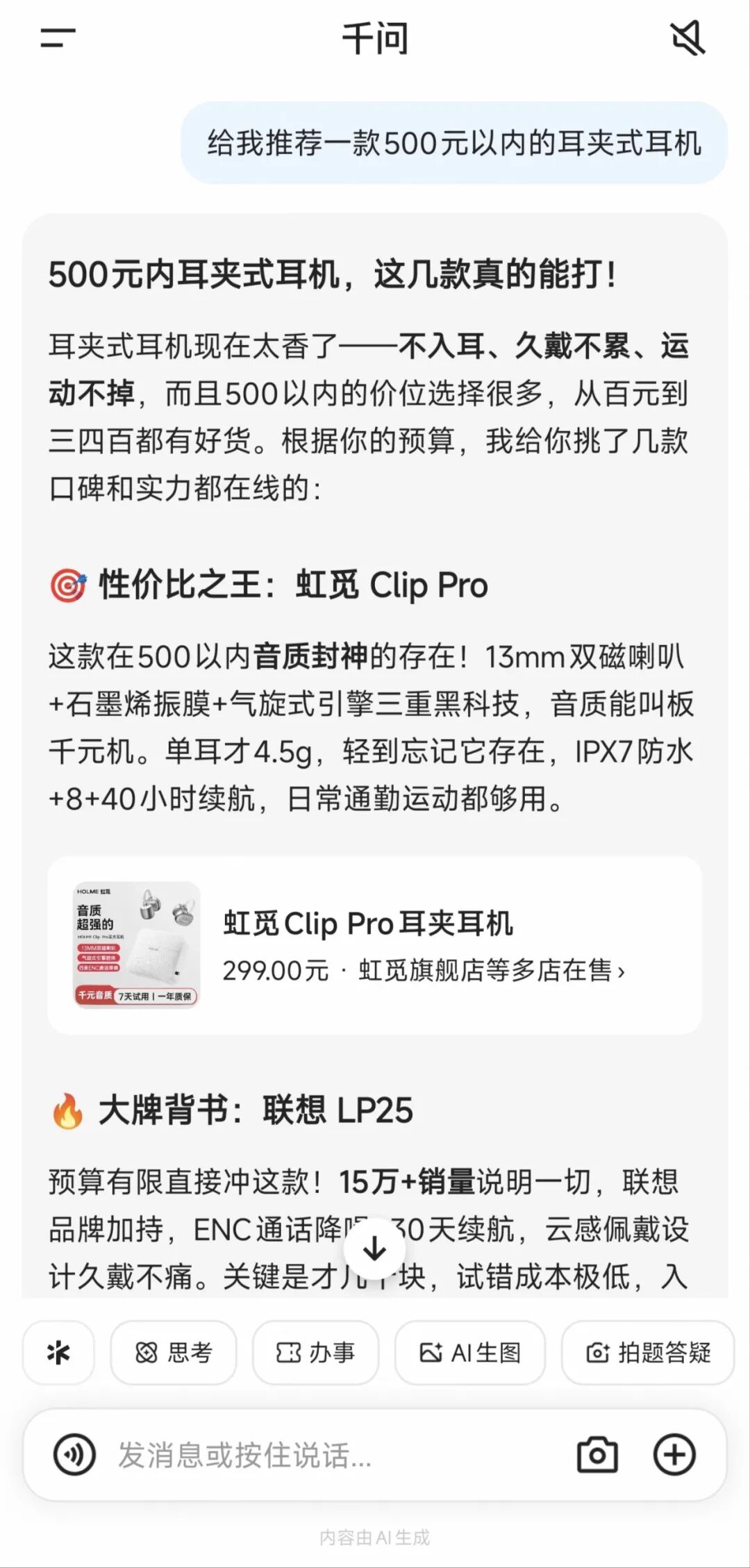
*Screenshot of the Qianwen APP
Doubao, on the other hand, recommended one product each from three perspectives: 'Best Entry-Level Option Under 100 Yuan' (cost-effectiveness), sound quality, and functional experience. Unlike Qianwen, Doubao's responses listed the strengths and weaknesses of the products and adopted a more objective and rational tone. At the end, Doubao also extracted (refined) the purchasing needs from the consumer's perspective, re-emphasizing the reasons for recommending each product to assist users in their purchasing decisions.
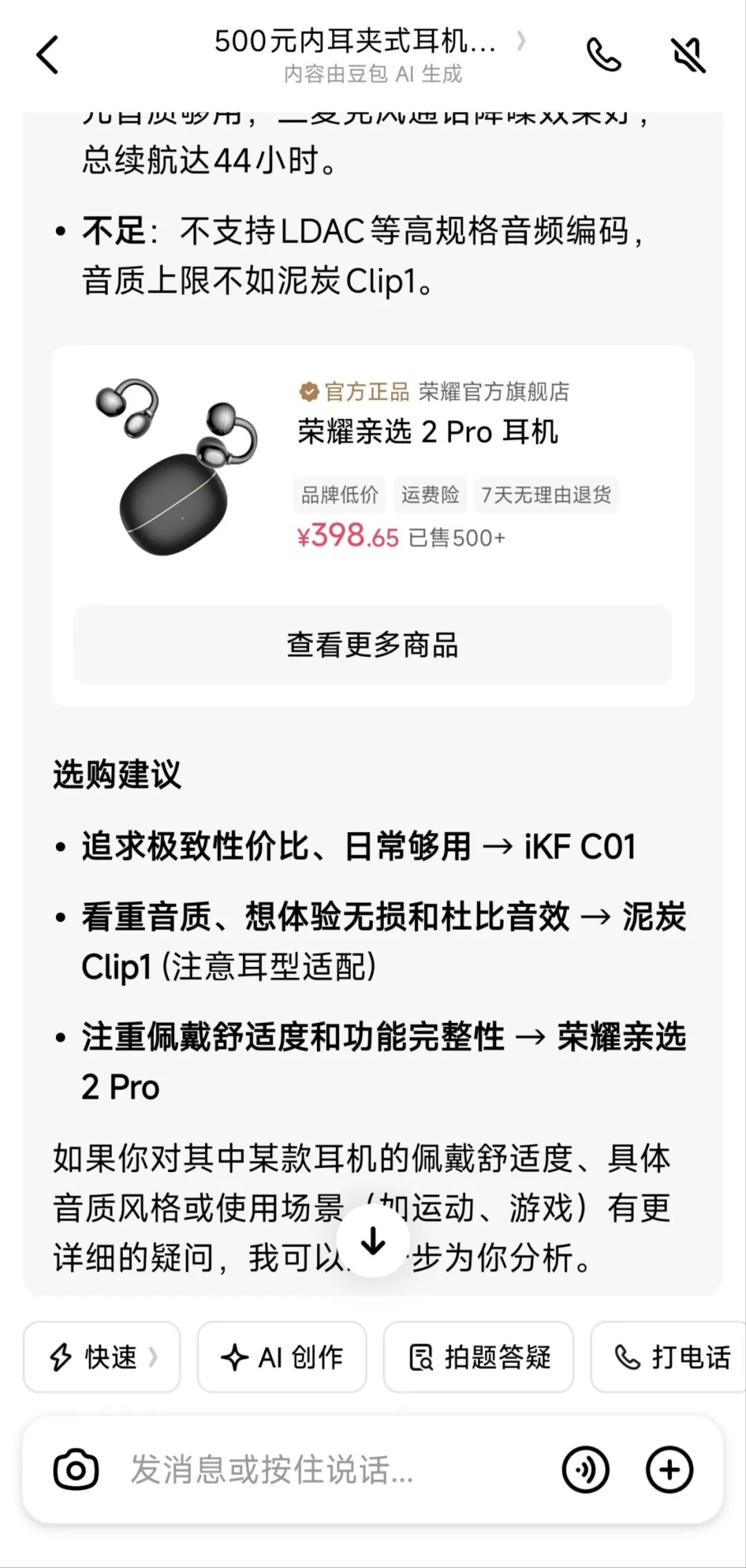
*Screenshot of the Doubao APP
JD AI Shopping provided the most recommendations and categories, with five categories and a total of 15 recommended products. However, except for 'cost-effectiveness,' the other dimensions focused on functional demands such as 'comfortable, unnoticeable wear,' 'sports sweat resistance,' 'high-definition call noise reduction,' and 'long battery life,' with each recommendation category containing three products.
Another detail: Qianwen proactively asked the user at the end of the conversation, 'Do you value sound quality, battery life, or price more?' and indicated that it could help further select products. Doubao asked at the end of the conversation, 'Do you have more detailed questions about the comfort, specific sound quality style, or usage scenario of a particular pair of earphones?' and offered to provide answers. JD AI Shopping, however, did not offer further analysis after providing the recommended products.
On the surface, the differing response styles from the three platforms may stem from variations in AI capabilities, but they actually reflect distinct understandings of the functional positioning of 'AI shopping' among the platforms.
In actual experience, Jingzhe Research Institute found that Qianwen and Doubao, being multi-scenario AI intelligent assistants before integrating e-commerce functions, were accustomed to analyzing and judging users' actual needs through dialogue, then providing solutions, and continuously revising their 'answers' based on user feedback. JD AI Shopping, on the other hand, seemed to be an AI assistant specifically developed to facilitate transactions, treating the user's chat box as equivalent to the e-commerce platform's search box, then extracting keywords and matching products from the user's dialogue.
To verify whether AI could further understand user needs and accurately recommend products, Jingzhe Research Institute continued to ask, 'Can you recommend several earphones with good sound quality?' The results showed that Qianwen, based on the three dimensions of cost-effectiveness, brand endorsement, and sound quality from the previous round of dialogue, provided new recommendations according to three segmentation (sub-) dimensions: Top 1 in Sound Quality, Cost-Effective Sound Quality King, and Big Brand Safe Choice.
Doubao focused on the sound quality dimension, providing new product recommendations from three segmentation (sub-) dimensions: Best Sound Quality Under 100 Yuan, Spatial Sound Advanced, and Dolby Sound Flagship. Both Doubao and Qianwen, when providing recommendations, explained the products to varying degrees in terms of principles and functions, with Doubao still reminding users of the products' shortcomings.
On the other hand, JD AI Shopping still provided five recommendation categories based on 'sound quality,' with a total of 15 products. However, upon closer inspection, Jingzhe Research Institute found that the Edifier Comfo Clip Q clip-on earphones from the same store appeared in both the 'High Cost-Effective Sound Quality' and 'Bone Conduction Sound Quality' categories. Additionally, the same model of moto buds clip clip-on earphones from two different stores appeared in both the 'Long Battery Life Portable' and 'High-Resolution Sound Quality' categories.
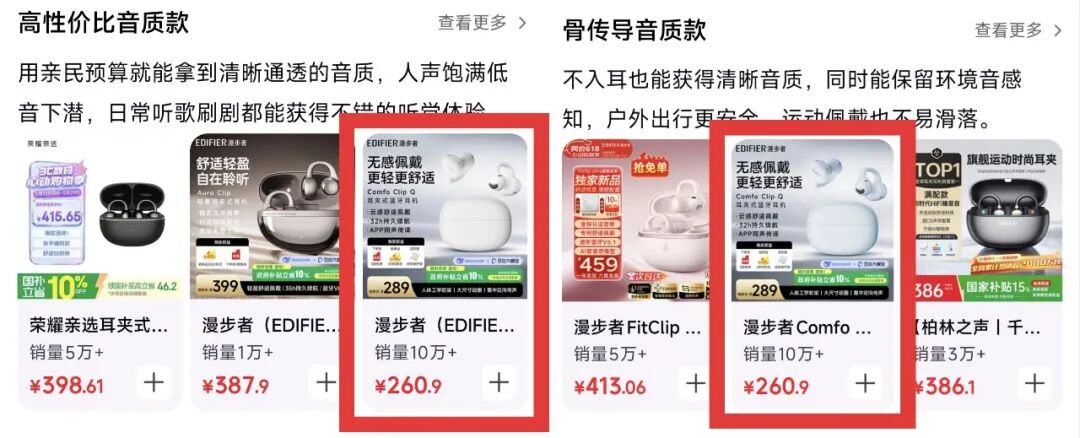
*Screenshot of the JD AI Shopping APP
Jingzhe Research Institute also noticed that in the 'Bone Conduction Sound Quality' category recommendations from JD AI Shopping, the product detail pages of the two Edifier clip-on earphones ranked at the top did not mention that the products featured 'bone conduction' functionality. Subsequently, Jingzhe Research Institute inquired with the store's customer service and received a reply confirming that the conduction method of both earphones was 'air conduction.'
Combining the actual usage experiences of the three platforms, it is not difficult to find that the process thinking behind Qianwen and Doubao's 'AI shopping' is for users to propose their needs first, then through dialogue, guide users to refine their needs, and then the AI provides recommended products along with as many rich reasons as possible. In this process, because the AI accurately understands user needs in the conversation, although the actual number of recommended products is not large, they are sufficiently precise.
On the contrary, JD AI Shopping's process thinking does not seem to start from understanding user needs but rather presupposes a purchasing scenario, having users tell the AI 'what to buy' through inputting dialogue, then providing consumers with enough choices and filtering conditions but not directly answering 'which one to buy' or 'why to buy.' Essentially, this is still the traditional shelf e-commerce's product thinking and operational logic.
Therefore, from Qianwen and Doubao, it can be seen that in the AI e-commerce scenario, the AI's capabilities are first reflected in completing multi-condition cross-screening through user dialogue to help users clarify their purchasing needs. Second, when users' purchasing needs are unclear or they lack knowledge about the products, the AI can accurately recommend products through fragmented information in the conversation to assist in purchasing decisions.
Additionally, AI e-commerce has another distinctive and imaginative capability: unearthing scenario-based needs from non-transactional conversational content and providing combined product recommendations. This capability is very similar to the interest e-commerce's business path of first completing content seeding and then achieving conversion. The difference is that AI e-commerce's 'seeding' is initiated by users and achieved through AI dialogue.

For example, when a user who habitually uses an AI assistant wants to try hiking, they will most likely first inquire about route and strategy-related information. When the AI responds, it can fully combine the outdoor attributes of hiking and proactively unearth potential needs such as hiking shoes, sunscreen, backpacks, and walking sticks in the form of tips through the conversation. Users may even directly ask the AI assistant to recommend suitable hiking gear.
Jingzhe Research Institute also found during testing that for a clear need like 'Can you recommend a set of hiking gear for me,' Qianwen, Doubao, and JD AI Shopping could all provide product combinations. However, when answering non-transactional questions like 'Recommend hiking routes,' only Qianwen and Doubao provided warm tips for outdoor hiking, with Doubao specifically mentioning that professional equipment such as non-slip shoes and hiking poles may be needed for certain special routes.
This natural conversational seeding method transforms the action of unearthing needs into useful content for consumers, enhancing the shopping experience. 'Conversational shopping' also brings new variables to the competitive landscape between platforms and merchants.
From a purely functional perspective, the role of AI in providing product recommendations and explaining 'why to buy' is essentially that of a 'buyer.' Xiaohongshu, which once played the 'buyer e-commerce' card, has also made early deployments in 'conversational shopping.'
In 2024, Xiaohongshu launched an AI search assistant app called DianDian. Public information shows that DianDian's product feature is the deep integration of Xiaohongshu's massive real notes and life experience data from across the internet, providing users with query, answer, and planning services for life scenarios such as food, travel, shopping, and transportation. Currently, DianDian's product functions have been deeply integrated into Xiaohongshu's main content ecosystem. When users input questions in the search box, AI-summarized content appears on the results page. Further clicking on the page leads to the 'Ask' conversational interface.
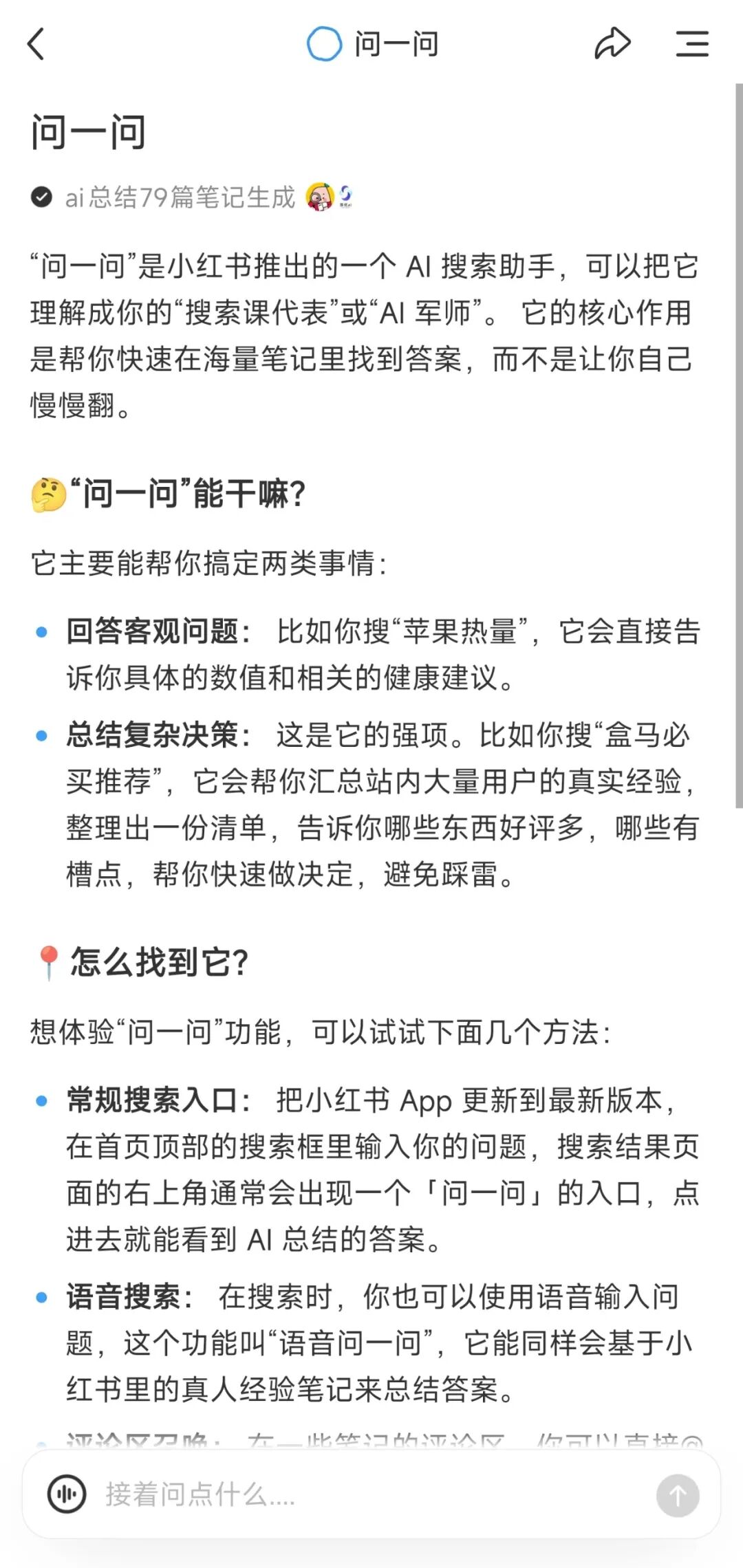
*Screenshot of the Xiaohongshu APP
Jingzhe Research Institute noticed that in contrast to the AI assistant's relative restraint in providing seeding information when answering questions, the answers provided by Xiaohongshu's 'Ask' feature have some product names highlighted, with a magnifying glass icon in the top right corner representing a search redirect. Clicking on the product pops up a new search results page, where users can directly select to enter the 'Product' display page. This means that Xiaohongshu has established a complete pathway from AI conversational content seeding to e-commerce conversion.
In fact, from Xiaohongshu's product practice, it can be seen that AI shopping essentially transforms 'search-based e-commerce' into 'conversational e-commerce.' AI helps users sort out their own needs, provides solutions, and simultaneously offers a path to place orders during the conversation, making shopping more convenient and decision-making less stressful for consumers. However, it is worth noting that this product logic may not have a high technical barrier but still requires certain basic conditions.
AI is tasked not only with answering the question of "what to buy" but also with elucidating "why to buy." This challenge tests AI's capabilities in natural language comprehension and logical reasoning, while also necessitating a wealth of product feedback from genuine users. Given that product experience transcends theoretical analysis, AI cannot solely rely on reasoning to conduct effective product evaluations. Instead, it must glean valuable insights about various products from a multitude of real-world experiences.
The Jingzhe Research Institute observed that when Qianwen responded to inquiries about "hiking routes," it included a video link from Bilibili. Doubao's reply drew on content from Toutiao accounts and provided corresponding Douyin video links when suggesting hiking gear. Similarly, Xiaohongshu's "Ask" feature offered note links in the "Reference Sources" section at the end. Notably, only JD AI Shopping's response lacked reference materials.
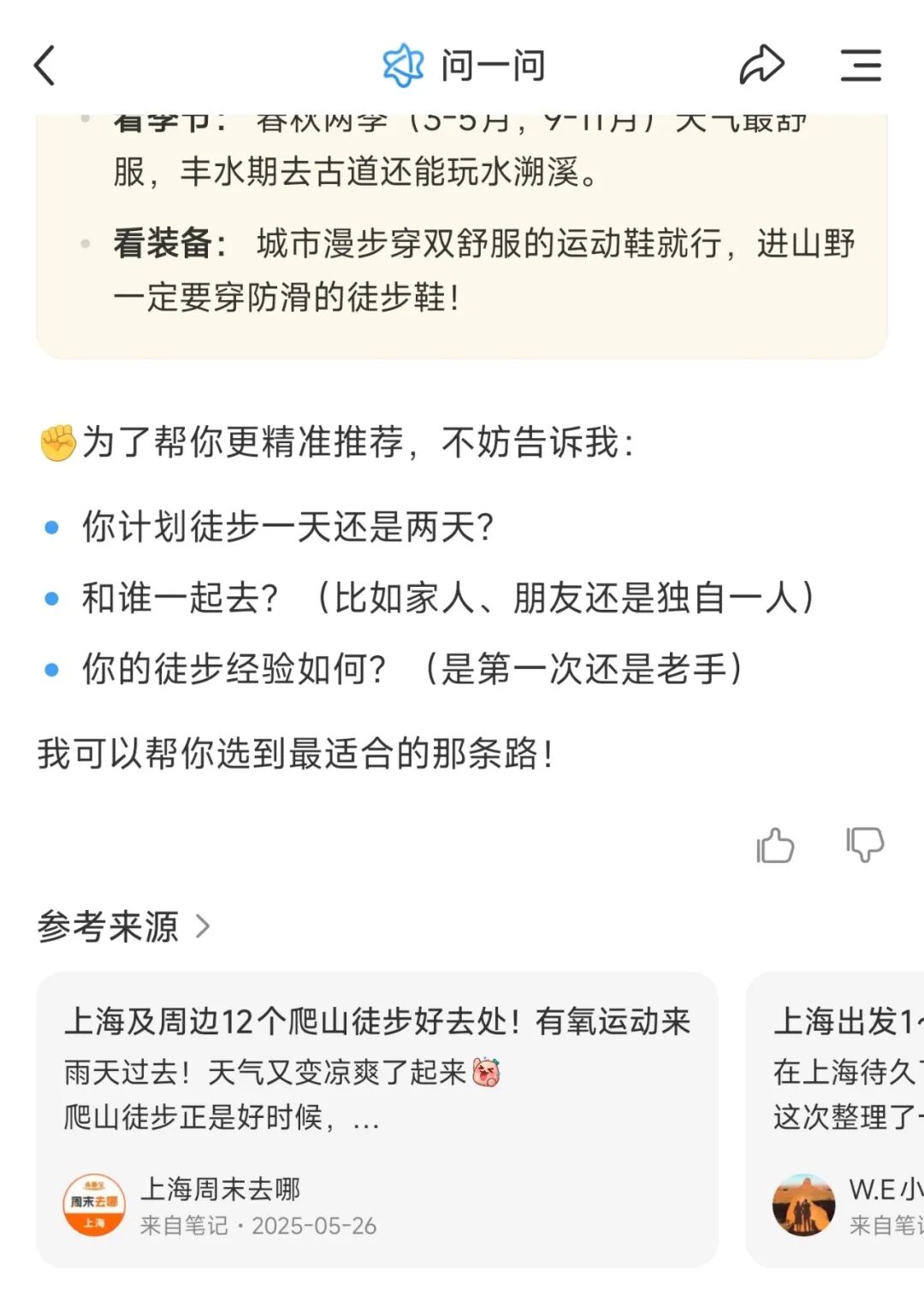
*Screenshot from the Xiaohongshu APP
From a practical standpoint, a wealth of reference content not only furnishes AI recommendations with a "practical analysis" data foundation but also empowers users to gain a deeper understanding of products and their own needs. This, in turn, enables them to make informed decisions based on rational analysis rather than impulsive buying.
It is important to acknowledge that AI e-commerce is not without its shortcomings. Due to competitive relationships, natural information barriers exist between platforms, making real-time price comparisons temporarily unattainable for AI. The accuracy of AI-generated content is also contingent on the timeliness of its sources. Furthermore, AI-recommended content may inadvertently become new traps for "bid-based advertising." Nevertheless, these potential drawbacks should not overshadow the positive impact of AI e-commerce initiatives.
To a certain extent, AI-driven e-commerce has, from its inception, guided users to identify suitable products based on their actual needs. Whether users are swayed by recommendations or ultimately make a purchase, the fundamental reason for consumer buying behavior is "need" and "fit," rather than low prices.
Building upon this foundation, the core objective of AI—or more precisely, the operational focus of the e-commerce platforms leveraging AI—is no longer merely to provide users with a vast array of SKUs and then drive transactions through promotional activities. Instead, the emphasis is on ensuring that AI-provided answers are more closely aligned with users' genuine needs, while also utilizing platform resources to offer more comprehensive, bundled product assortments. Henceforth, content depth and product breadth form the twin pillars of "AI-driven e-commerce."
From an industry perspective, it is evident that each innovation and iteration in e-commerce formats, from traditional shelf-based e-commerce to content-driven e-commerce, has been a commercial shift propelled by changes in user behavior patterns. For e-commerce platforms, the primary motivation for deploying AI-powered shopping may be to capture new traffic entry points. However, the true value of AI-driven e-commerce does not reside in mere user data growth on paper; rather, it lies in accurately discerning user needs and exploring entirely new e-commerce scenarios.
Both consumers and e-commerce platforms are reverting to the core essence of e-commerce: "efficiently meeting consumer needs." This also disrupts the industry's long-standing "price-only" competitive logic: for platforms to make AI-driven solutions more rational, they must place greater emphasis on uncovering user needs and enhancing their ability to match those needs; for merchants to be recommended by AI, they must invest more energy in product quality. Only in this manner can the e-commerce industry embark on a trajectory of healthy development.
-
Ofilm Teams Up with ADSensE to Propel Large-Scale Deployment of All-Solid-State LiDAR Powered by ADS6311 Chip!
-
![]()
Loss of 2.5 Billion Yet Facing Strong Demand for Shares? Another Battle for Control of Lianchuang Electronics
-
![]()
Huawei’s Enjoy Series Flies Off the Shelves, Prompting Xiaomi to Double Down on Budget Smartphones
-
![]()
Beijing Hyundai's Top Executive Criticizes Industry Disorder: Certain Brands Treat Customers as Beta Testers
-
![]()
The domestic mobile phone market has declined for five consecutive quarters! Huawei defies the trend with significant growth: maintains its top market share
-
Annual Revenue Surpasses 3 Billion: An Automotive Trim 'Little Giant' Makes Its Debut on the Beijing Stock Exchange
-
![]()
The Space Force Wants to Spend $30 Billion on Rocket Launches: Is Trump Doubling Down, and Is SpaceX the Big Winner?
-
![]()
Going Crazy! One out of Every Three Plug-in Hybrids Sold in Europe is a Chinese Vehicle