How Should We Interpret the Collaboration Between "Xiaomei" and "Yuanbao"? In the AI Era, Access Points Don't Equate to Capabilities
 06/02 2026
 590
590

No matter how the times change, people's fundamental needs for "clothing, food, shelter, and transportation" in the physical world remain unchanged.
Author: Wang Bin
Cover Design: Arrival
On June 1, after the Hong Kong stock market closed, Meituan released its financial report for the first quarter of 2026, revealing a nearly 10 billion yuan reduction in losses, significantly surpassing market expectations.
The primary contributor to Meituan's loss reduction was the stabilization of its core local commerce business. During that quarter, Meituan's core local commerce business reported an operating loss of 2 billion yuan, a substantial improvement from the staggering 10 billion yuan loss in the previous quarter. New ventures, including Xiaoxiang Supermarket and Keeta, reported a loss of 2.1 billion yuan, a notable decrease from the 4.6 billion yuan loss in the preceding quarter.
After multiple regulatory interventions and several quarters of sustained losses across the industry, the market may have grown tired of endless subsidy wars. Buoyed by the news of loss reduction, Meituan's stock price surged by 9.27% at the close of Hong Kong trading today, with a market capitalization of approximately 527.9 billion Hong Kong dollars.
However, the food delivery war has long lost its novelty, and the current mainstream topic is AI.
During the financial report conference call, Wang Xing unveiled a new AI development: the collaboration between Meituan's AI assistant "Xiaomei" and Tencent's "Yuanbao" is set to launch. Users will be able to directly input their requests in Yuanbao, which will then utilize Xiaomei to access food delivery and other local life services.
In essence, users can order food delivery through Xiaomei within Yuanbao.
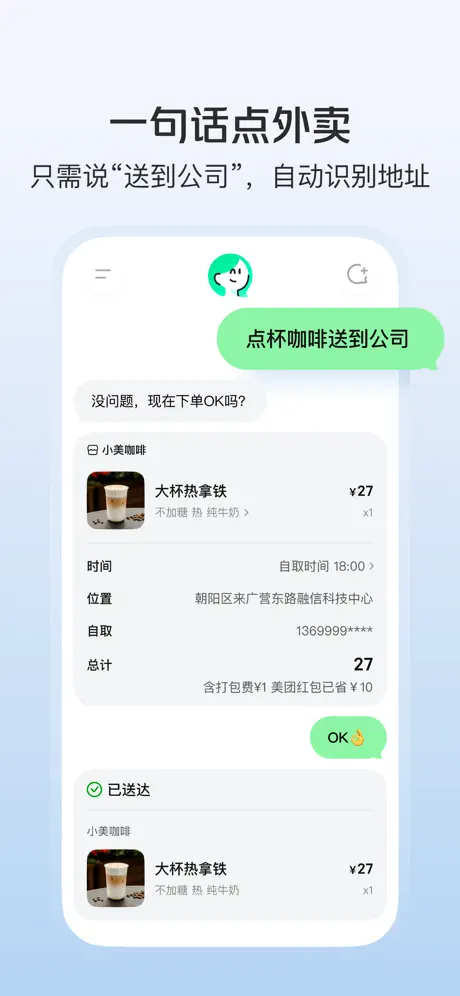
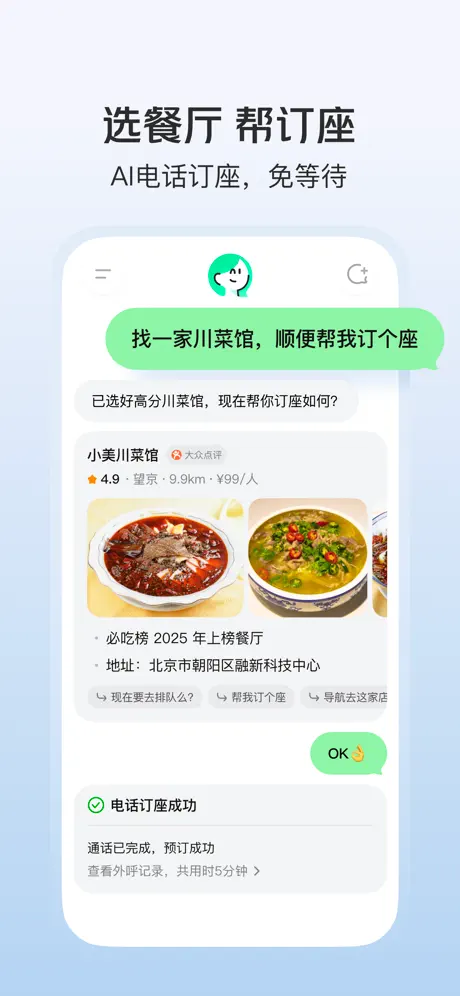
Meituan's AI Assistant "Xiaomei"
Xiaomei has always been capable of handling food delivery orders, but Yuanbao couldn't perform this function before.
Another noteworthy point is that both Xiaomei and Yuanbao are AI Agents. Traditionally, AI Agents directly interact with users. However, the collaboration between Xiaomei and Yuanbao signifies an interaction between two AI assistants, an Agent-to-Agent interaction.
The Logic of "Access Points" Has Evolved in the AI Era
In the traditional internet era, traffic access points were synonymous with service capabilities; whoever had the users held the power. But in the AI era, the access layer and the application layer are distinct.
For instance, AI Agents like Yuanbao, Doubao, and Kimi have conversation access points but lack fulfillment capabilities. They cannot truly assist users in completing actions in the physical world. Yuanbao can comprehend a user's request to "order me a food delivery," but it cannot actually complete the transaction due to a lack of physical world information, such as a food delivery network, merchant details, real-time inventory, and delivery scheduling.
Therefore, it must rely on Meituan's Agent to accomplish the task.
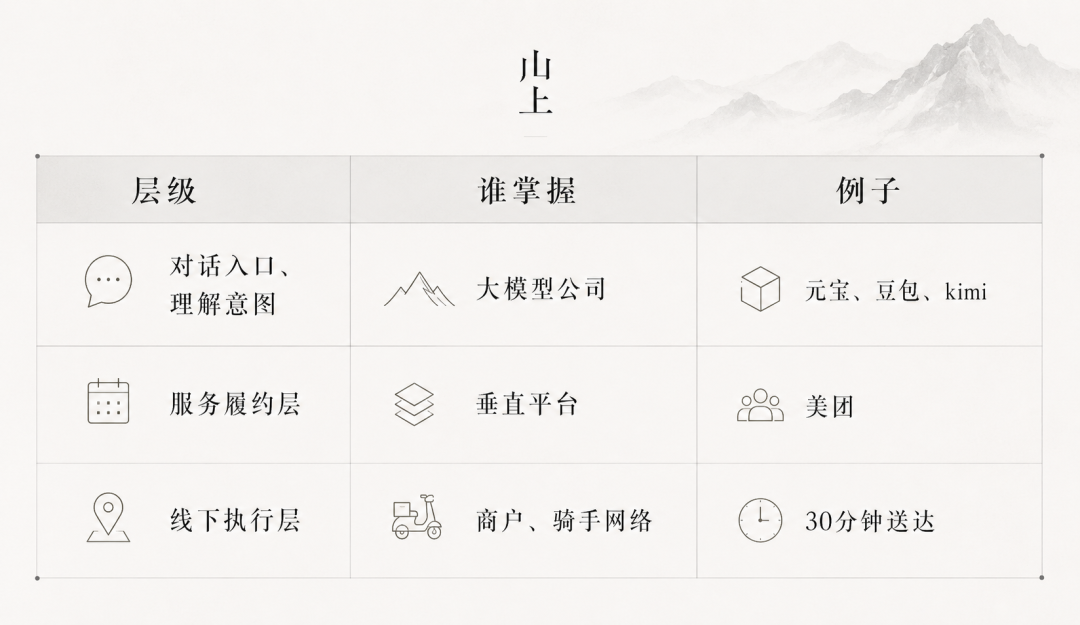
The collaboration between Meituan's Xiaomei and Yuanbao is akin to Meituan opening up its local life services to other AI assistants, enabling them to handle tasks like ordering milk tea or coffee.
The collaboration with Yuanbao may just be the beginning.
Wang Xing stated during the financial report conference call that in the future, in addition to serving consumers (To C) and merchants (To B), serving AI Agents is becoming increasingly crucial. He remarked, "In the AI field, Meituan has always opted to take the offensive rather than the defensive."
One might argue that Meituan has finally realized that sharing the joy is better than enjoying it alone. But in reality, the traffic funnel is reversing. In the AI era, Meituan is assuming the role of a "provider of foundational capabilities" in the local life services sector.
Just as WeChat Pay serves as the infrastructure for e-commerce, in the AI era, Meituan has effectively become the "utilities" for local life services. Any other AI that aims to cater to users' needs for clothing, food, shelter, and transportation will ultimately have to go through Meituan.
It's Not About Intelligence; It's About Information
Examining the current AI market, aside from players like NVIDIA that sell the essential tools, the competition primarily revolves around two approaches: one pursues model superiority, selling Tokens to B-end services; the other pursues C-end application scenarios, attempting to connect all services with AI.
The competition at the model level is intense (let's not delve into that now), as the strategies are fairly uniform across the board—investing heavily in money, talent, and computing power. However, in the AI service scenarios, each player encounters unique challenges and frustrations.
Take OpenAI, the industry leader, for example. Over the past two years, it has been striving to use ChatGPT to connect with physical services, whether it's shopping, hailing a ride, or ordering food delivery. But it hasn't made significant headway, and this year it has even temporarily abandoned its shopping endeavors.
The situation is no better domestically. Every now and then, news emerges about users attempting to book restaurants or other services through AI, only to be met with ridicule from merchants upon arrival. Consumers are left dissatisfied, being told by merchants to "go to XX for reservations, just go to XX."
Ultimately, it's because other AI assistants lack the support of actual local life services. AI can assist you in writing articles, modifying code, or telling jokes, but when it comes to specific life service scenarios, even the most intelligent AI is helpless without the necessary information.
This has resulted in current AI assistants being mostly confined to chatbot functionality.
And this is precisely where Meituan excels, to a point where no other platform can replace it.
The reason is not difficult to comprehend. Meituan has been deeply cultivating offline service scenarios for over a decade, amassing data, scenarios, and information. Whether it's in-store or home delivery, Meituan's coverage of the local life sector is nearly comprehensive, boasting more complete and authentic merchant information, user reviews, and a more reliable fulfillment system.
These service capabilities, built up over many years, are challenging to cultivate through short-term investment. Other AI assistants that aim to truly serve users may have to rely on Meituan's Agent capabilities.
The biggest issue with current AI assistants is that they don't generate revenue. Each query consumes computing power, and the more they are used, the higher the cost. It's hard to reconcile this with the logic of the past internet era, where costs could be infinitely diluted. Even cash-rich companies like ByteDance are now considering introducing paid features for Doubao. For To C AI assistants, it's essential to intervene in real transaction scenarios.
If such attempts were previously constrained by various factors, those issues are now being resolved with Meituan actively opening up its local life Agent to external AI.
Not to mention that Meituan has a robust AI network. From AI large model players like Zhipu and Yuezhi Aiyan to embodied intelligence companies like Unitree and Galaxy General, and even down to computing power chip players like Moore Threads and Muxi Corporation, Meituan has a presence behind many of China's AI unicorns.
Meituan's strategy is clear. It won't blindly pursue becoming a "Token factory." Instead, it focuses on "physical AI," using AI to connect with the real physical world offline. This is where Meituan's strength lies. Considering that the AI industry is increasingly extending into offline physical services, Meituan's AI path may hold even greater potential in the future.
In the AI era, each Agent will establish its own user access point. But in the local life services sector, all transaction closures will have to go through Meituan. Meituan may become the underlying access point for all other AI Agents. Because no matter how the times change, people's needs for "clothing, food, shelter, and transportation" in the physical world generally remain constant.


© All rights reserved by Shanshang. No reproduction without authorization.
-
Ofilm Teams Up with ADSensE to Propel Large-Scale Deployment of All-Solid-State LiDAR Powered by ADS6311 Chip!
-
![]()
Loss of 2.5 Billion Yet Facing Strong Demand for Shares? Another Battle for Control of Lianchuang Electronics
-
![]()
Huawei’s Enjoy Series Flies Off the Shelves, Prompting Xiaomi to Double Down on Budget Smartphones
-
![]()
Beijing Hyundai's Top Executive Criticizes Industry Disorder: Certain Brands Treat Customers as Beta Testers
-
![]()
The domestic mobile phone market has declined for five consecutive quarters! Huawei defies the trend with significant growth: maintains its top market share
-
Annual Revenue Surpasses 3 Billion: An Automotive Trim 'Little Giant' Makes Its Debut on the Beijing Stock Exchange
-
![]()
The Space Force Wants to Spend $30 Billion on Rocket Launches: Is Trump Doubling Down, and Is SpaceX the Big Winner?
-
![]()
Going Crazy! One out of Every Three Plug-in Hybrids Sold in Europe is a Chinese Vehicle