Don't Just Focus on Loss Reduction—Let's Talk About Meituan's 'Physical AI'
 06/04 2026
 424
424

Short-term loss reduction repairs the foundation. Long-term technological layout (Chinese for strategic planning) determines the company's future.
Author | Liu Shanshan
Editor | Cindy
On the evening of June 1, Meituan delivered a financial report that left the market breathing a sigh of relief.
In the first quarter of this year, Meituan's revenue reached 91.039 billion yuan. Its operating loss narrowed from 10 billion yuan in the previous quarter to 2 billion yuan, half of what investment banks had expected. New businesses such as Xiang Supermarket and overseas Keeta also saw losses narrow, from 4.6 billion yuan to 2.1 billion yuan.
But to be honest, loss reduction is just the most superficial signal of performance.
There is no true winner in the food delivery war. After last year's brutal close-quarters combat, the three major platforms as if by prior agreement (Chinese idiom meaning "all coincidentally") withdrew this year, easing the pressure of subsidy wars. Loss reduction was naturally expected.
Meituan's ability to lose less than its competitors essentially comes down to its strong foundation—Meituan focuses on mid-to-high-priced formal meals, with high average order values and stable demand. By transaction volume, Meituan's food delivery GTV share remains stable at over 60%, with a healthier order structure.
After the food delivery war, the diminishing marginal returns of subsidies have become an industry consensus. Wang Xing candidly stated at the earnings call, 'Order growth driven solely by subsidies is unsustainable.'
What the market and outsiders truly care about is: What will drive Meituan's next phase of growth?
Meituan's answer is to increase investment in technology and physical AI. 'We will continue to ramp up AI investment, continuously iterating our AI Agent and large model capabilities,' Wang Xing said. In the first quarter, Meituan invested 7 billion yuan in R&D, a 22% year-over-year increase, accounting for 7.7% of total revenue.
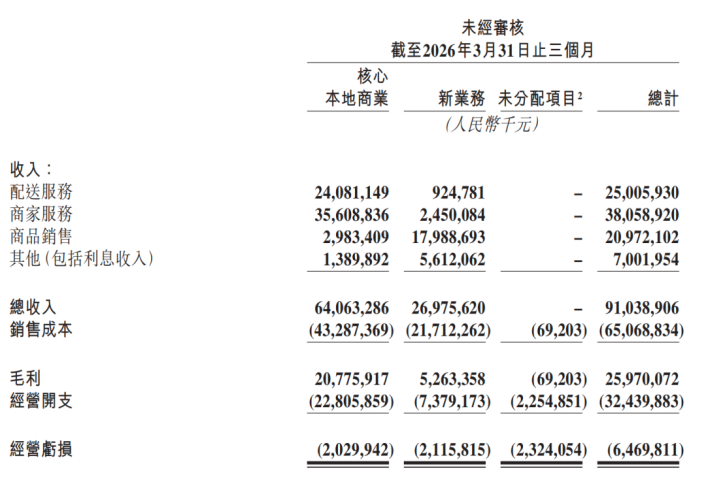
Meituan Q1 Financial Report
Another noteworthy development is that Meituan's AI assistant, 'Xiaomei,' will integrate with Tencent's Yuanbao, allowing users to order food directly within Yuanbao. This multi-AI Agent collaboration will help Meituan expand its access points for real-world transactions and lifestyle services, telling a new AI story.
Meituan's move toward an AI-driven narrative is not surprising. Its hard tech investments, however, may far exceed many people's expectations—from foundational computing power and semiconductors to large models and embodied intelligence, Meituan has invested in unicorns across nearly every sector, quietly weaving a vast ecosystem covering more than half of China's AI landscape.
Unitree Robotics, which recently applied for an IPO and is set to become the 'First Embodied Intelligence Stock' on the A-share market, is just one piece of this iceberg. Meituan-affiliated entities hold a combined 9.65% stake, making them Unitree's largest external shareholder.
1. Investing in More Than Half of China's AI Ecosystem
In 2021, Meituan upgraded its strategy from 'Food + Platform' to 'Retail + Tech,' openly prioritizing frontier tech trends like drones, embodied intelligence, semiconductors, AI, and autonomous driving.
Since then, Meituan's investment focus has accelerated from consumer tech to hard tech. In 2022, while industry-wide corporate investments plummeted by 70%, Meituan doubled down, with hard tech investments accounting for 64% of its portfolio. Even during the fiercest phase of the 2025 food delivery war, when Meituan's core business swung from profit to loss, its tech investments continued to grow.
Today, Meituan is China's most active hard tech investor. Its vast investment portfolio spans five core sectors—embodied intelligence, large models, semiconductors, smart hardware,ing and autonomous driving—cover over 50 unicorns.
But Meituan's approach to investment differs from other tech giants.
Hard tech R&D cycles are long, and returns are slow. Many investors lack patience, but Meituan doesn't. During Unitree's Series B2 round, when its valuation was just 1 billion yuan, Meituan led the investment and followed up in Series B3. By June 2025, when Unitree appeared on the CCTV Spring Festival Gala, its valuation soared to 12 billion yuan, prompting Tencent, Alibaba, and others to join in. The strategic difference between betting on the future and buying defensive tickets is clear.
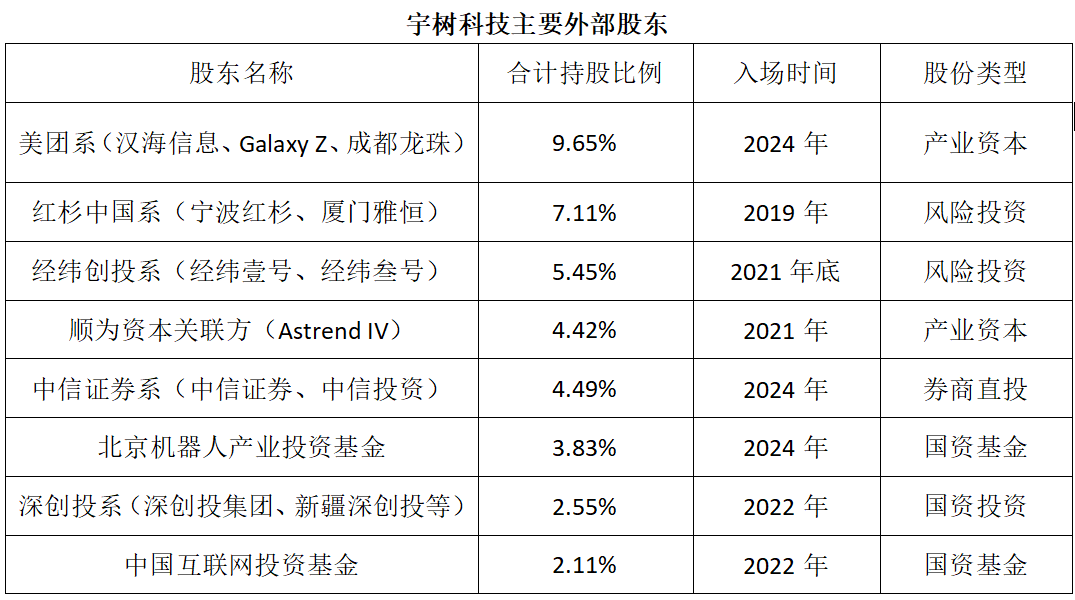
A similar script has played out repeatedly. In the embodied intelligence sector alone, Meituan has invested in at least 16 companies, all early-stage, with 10 becoming unicorns—including Yinhe General, Xinghaitu, Sharpa, and others, each valued at over 10 billion yuan.
In autonomous driving, Meituan has been Li Auto's largest external shareholder since its Series B investment in 2018, now valued at over 100 billion yuan. In semiconductors, Moore Threads debuted with a market cap exceeding 300 billion yuan, while Muxi Corporation (Muxi Semiconductor) surpassed 280 billion yuan. Star firms like Zhipu AI and Yuezhi Anmian, whose market caps once exceeded JD.com's, all counted Meituan as an early investor. Even 'national team' chip firms like Unisoc saw Meituan investments.
Unicorns like Hesai Technology, Jiushi Intelligence, Qingzhou Zhihang, Deer Technology, and Guangzhou Zhongshan, all valued at over 10 billion yuan, have secured significant stakes through Meituan's capital injections.
By investing in more than half of China's AI ecosystem, Meituan has also demonstrated patience. Moreover, unlike typical corporate financial investments, Meituan doesn't just provide capital—it offers real-world scenarios.
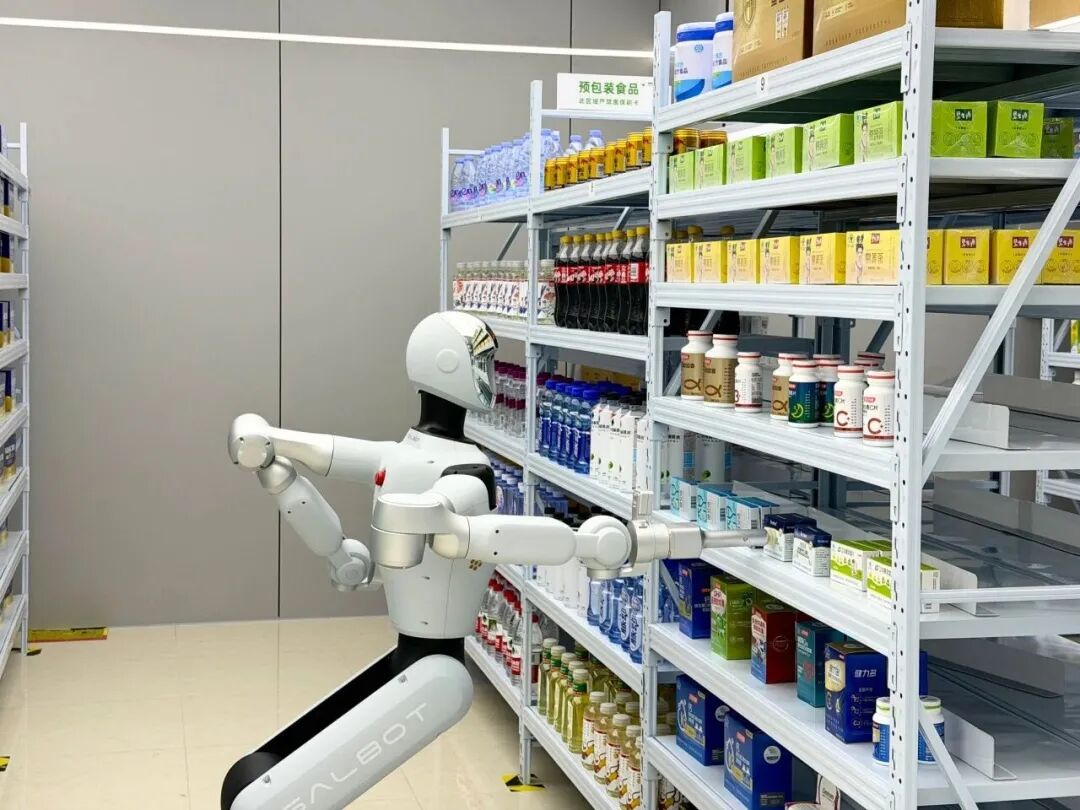
Yinhe General Robotics
Hesai's LiDAR has secured production orders for Meituan's drones. LiBiao's sorting robots operate 100 units each in Meituan's Guangzhou and Wuhan pharmaceutical warehouses. Yinhe General's robots now work 24/7 in pharmacies.
This lifestyle services platform has long since delved into the foundations of hard tech, becoming its most steadfast supporter.
2. While Others Build AI, Meituan Builds 'Physical AI'
The AI era has arrived.
As the industry enters its second half, the 'shovel-selling' boom (GPU sales, data center construction) has peaked. The next opportunities lie in two directions: tech companies that make Tokens cheaper, and platform companies that can ground AI in real-world scenarios.
Anthropic exemplifies this. Less famous and later to market than OpenAI, it has achieved annualized revenues of 30 billion USD by deep cultivation (Chinese for "deeply cultivating") B2B scenarios, surpassing OpenAI. This proves a truth: Virtual AI detached from physical scenarios has limited long-term value.
This is Meituan's playbook.
On every occasion, Wang Xing repeats, 'Digitizing the physical world is the most critical foundation for AI.' Meituan aims to connect the digital and physical worlds, ultimately grounding AI in real life—not just as chatbots, but as true servants of everyday consumer needs.

External hard tech investments and internal efforts to upgrade the Meituan App into an AI-powered platform—both pursue the same goal: connection. Meituan's AI strategy has always been offensive, not defensive.
Breaking it down, Meituan's 'Physical AI' strategy has three layers:
At the base lies real-world data. In the AI era, authentic data is most valuable. Meituan operates China's most authentic and complex offline interaction scenes—billions of users, residential buildings, streets, and diverse crowds. Non-standardized operations generate tens of millions of daily fulfillment data points, unique globally and impossible to simulate. Even OpenAI or Doubao can't access this.
The middle layer integrates software and hardware. Its self-developed LongCat large model upgraded to 2.0-Preview in April 2025, surpassing 1 trillion parameters, runs entirely on domestic computing power. Drones entered regular operations in May 2025, accumulating over 900,000 commercial orders—second globally. Autonomous vehicles and low-altitude logistics are also being deployed to cover scenarios beyond human capacity.
The top layer focuses on user and merchant experience. Meituan's C-end AI assistant, 'Xiaotuan,' embedded in the Meituan App, served over 100 million users during the May Day holiday, covering dining, entertainment, travel, medical consultations, and more.
Meituan's 'Xiaomei' collaborating with 'Yuanbao' means it will open local lifestyle services to other AI Agents, inching closer to becoming the 'utilities' infrastructure for local life.
On the B-end, the 'Smart Shopkeeper' service supports over 700,000 merchants, while 'Digital Employees' cover over 300,000. 'Helping every merchant use their own AI assistant.'
For AI assistants, dialogue and tool functions alone cannot cover soaring computing costs—even ByteDance considers paid tiers for Doubao. Sustainable commercial loops require intervene (Chinese for "intervening in") real transaction scenarios. Thus, ChatGPT and domestic AI assistants cultivate 'conversation as service' habits while trying to connect offline through acquisitions.
Most, however, stumble. User complaints about poor experiences stem from a simple truth: Traffic portals ≠ service delivery capabilities. The fundamental gap lies in infrastructure—they lack Meituan's local life ecosystem and fulfillment network.
As Wang Xing previously said, this isn't an intelligence issue but an information one. 'Even if Einstein were a secretary trying to book a restaurant, he wouldn't know if seats were available.' This scarcity (Chinese for "scarce") resource is Meituan's core strength—and why Tencent's AI Agent will integrate with 'Xiaomei' when it launches.
3. Has the Market Underestimated Meituan?
Many believe Meituan's hard tech investments are merely ecological positioning for the future, unrelated to its main business. However, some investors argue this is a misreading: 'Meituan's investment logic is industrial synergy, not financial returns. They're not chasing trends but building infrastructure for the next decade.'
A neglected detail: Meituan uses FVOCI accounting for strategic investments in Zhipu, Unitree, etc.—meaning stock fluctuations don't hit Meituan's income statement but are treated as assets, akin to cash. This avoids exaggerating core business performance.
Analyst data suggests Unitree's initial market cap will be at least 42 billion yuan, giving Meituan a stake worth over 4 billion yuan. Zhipu's unrealized gains exceed 20 billion HKD.
This differs from Alibaba, which books external equity investments directly into profits. In Q1, Alibaba's operating profit showed a loss, but 'interest income and net investment gains' added 41.3 billion yuan in profit, turning net income positive—driven by stakes in Zhipu, MiniMax, etc.
Moreover, the synergistic value of invested companies remains untapped.
Unitree's IPO raised 4.2 billion yuan, with nearly half earmarked for 'robot brain' R&D. Wang Xingxing noted: 'The biggest bottleneck for robots is insufficient generalization, requiring massive real-world physical data.'
Investments in large models, semiconductors, autonomous driving, etc., follow the same logic. Beyond financial returns, the key is ecological synergy and strategic positioning in critical sectors.
Meanwhile, the market may not yet grasp the valuation logic of physical AI.
Scalable deployment of physical AI takes time. Variables include drone regulations, embodied intelligence generalization, and commercialization pace of invested firms. But the direction is clear.
History repeatedly confirms a pattern: In tech waves, shovel-sellers profit first, but platforms that ground tech in real demand go furthest. Reuters in the telegraph era, Yellow Pages in the telephone era, Tencent and Alibaba in the internet traffic era—all followed this path.
The AI era is no different. GPU vendors have already peaked; DeepSeek, Yuezhi Anmian, and Zhipu are now surging. The bigger explosion—grounding AI in local real-world needs—has just begun.
As the largest local life portal, Meituan possesses data, scenarios, software-hardware integration, and ecological/tech synergies with half of China's hard tech sector. Its physical AI foundation doesn't just help users write poems—it delivers meals, medicines, and cost savings for merchants.
Short-term loss reduction repairs the foundation. Long-term technological layout (strategic planning) determines the company's future. For Meituan, success depends on technical grounding pace and execution. Once the physical AI loop closes, how should its value be reassessed?
END
Producer: Huang Qiangqiang
-
Ofilm Teams Up with ADSensE to Propel Large-Scale Deployment of All-Solid-State LiDAR Powered by ADS6311 Chip!
-
![]()
Loss of 2.5 Billion Yet Facing Strong Demand for Shares? Another Battle for Control of Lianchuang Electronics
-
![]()
Huawei’s Enjoy Series Flies Off the Shelves, Prompting Xiaomi to Double Down on Budget Smartphones
-
![]()
Beijing Hyundai's Top Executive Criticizes Industry Disorder: Certain Brands Treat Customers as Beta Testers
-
![]()
The domestic mobile phone market has declined for five consecutive quarters! Huawei defies the trend with significant growth: maintains its top market share
-
Annual Revenue Surpasses 3 Billion: An Automotive Trim 'Little Giant' Makes Its Debut on the Beijing Stock Exchange
-
![]()
The Space Force Wants to Spend $30 Billion on Rocket Launches: Is Trump Doubling Down, and Is SpaceX the Big Winner?
-
![]()
Going Crazy! One out of Every Three Plug-in Hybrids Sold in Europe is a Chinese Vehicle