The Market Still Judges Meituan by Food Delivery Standards, Yet It Has Invested in Over Half of China’s AI Unicorns
 06/05 2026
 626
626

On June 1, Meituan released its Q1 financial results, revealing a near 10 billion yuan reduction in losses compared to the previous quarter, while revenue from new business segments continued to grow rapidly. On the same day, Unitree Technology received approval for its IPO on the STAR Market. Buried in the prospectus was a detail that could easily be overlooked: the Meituan ecosystem is Unitree's largest external shareholder, holding a combined 9.65% stake. Many immediately speculated on how much Unitree's stock might rise after listing, but I prefer to draw attention to another figure: 2023. Meituan invested in and supported Unitree Technology in 2023, one to two years before Unitree's viral appearance on the CCTV Spring Festival Gala in 2025.
Meituan has backed a number of tech firms similar to Unitree, including Zhipu AI, GalaxyCore General Robotics, and Moonshot AI. It is fair to say that Meituan stands behind half of China's cutting-edge tech companies.
A brief note on the financial turnaround.
According to the latest financial report, Meituan's Q1 revenue reached 91 billion yuan, up 5.6% year-on-year. Operating losses narrowed from 16.1 billion yuan last quarter to 6.5 billion yuan, a quarterly improvement of 9.6 billion yuan. Losses in core local commerce shrank to 2 billion yuan, while losses in new businesses halved to 2.1 billion yuan. New business revenue surged 21% year-on-year to 27 billion yuan. Much has already been said about these figures. What truly deserves deeper analysis is the following.
The key to Meituan's investment in Unitree lies not just in 'investing,' but in 'investing early.' During Unitree's Series B2 funding round, when its valuation stood at just 1 billion yuan, Meituan led the investment. It later participated in Series B3. In contrast, Tencent, Alibaba, and ByteDance invested in Unitree only in June 2025, after its humanoid robots had already graced the Spring Festival Gala stage, pushing its valuation to 12 billion yuan with a clear path to IPO. Among all major firms, Meituan provided the earliest and most substantial support.
Unitree is just the tip of the iceberg.
In the field of embodied intelligence alone, Meituan has invested in at least 16 startups at early stages, with 10 now valued at over $1 billion as unicorns. GalaxyCore General Robotics, a leader in industrial, medical, and retail applications, now has a $21 billion valuation. Meituan was its angel investor and has participated throughout its growth. For star startups like Xinghaitu, Zibianliang, and Sharpa, Meituan entered at Series A.
Expanding the scope, Meituan's hard-tech investment portfolio spans five domains: AI large models, embodied intelligence, semiconductors, autonomous driving, and AI-powered hardware.
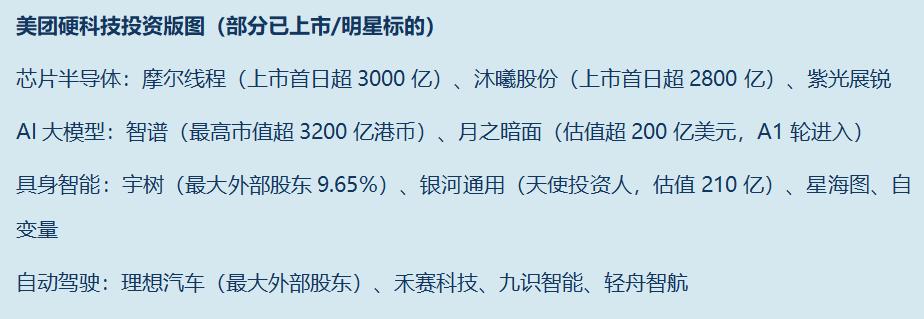
Simply put, Meituan fully covers the most challenging tech tracks—chips, AI large models, and embodied intelligence—and has nurtured a cohort of leading startups from their early stages to the present day.
A tally shows Meituan has backed over 28 unicorn tech firms, with 7 already listed. The market value of its listed holdings exceeds 35 billion yuan; including unlisted ones, its tech portfolio's book value tops 60 billion yuan.
Why Meituan? That's the crux of the matter.
Chipmakers, large model firms, and robotics companies have recently enjoyed policy support and public attention, never short on funding. Meituan's key edge lies in three words: early, persistent, and substantial. It invested before the sectors heated up, shifted its focus from consumer tech to hard tech after its 2018 IPO (eight years and counting), and offers more than just capital—it provides real-world scenarios for technology testing.
For tech startups, money alone is not enough; they need environments to test their technologies. GPUs require large-scale testing, and robots need trial fields. As one of China's platforms with the most consumer scenarios, Meituan offers what others cannot.
After Zhipu AI's IPO, its stock soared over tenfold, adding over 20 billion Hong Kong dollars to Meituan's unrealized gains. Yet this did not boost Meituan's profits.
There are two reasons for this: First, FVOCI accounting rules. For strategic investments like Zhipu, Meituan uses 'fair value through other comprehensive income' accounting. Rising valuations flow into owners' equity on the balance sheet, not the income statement. This isolates investment gains from core business profit fluctuations, preventing misinterpretation of Meituan's operational performance.
Second, these strategic stakes have not been sold, so no realized gains exist. In fact, Meituan has not cashed out any of its tech investments, maintaining long-term support.
This contrasts with Alibaba, which books market-value changes in profits directly. Hence, Alibaba's Q1 operating profit was negative 850 million yuan, but net profit hit 23.5 billion yuan (up 96% year-on-year), propped up by 33.8 billion yuan in investment gains.
Both hold tech stakes, but one books volatility into profits (attractive but volatile), while the other accumulates it as assets (clean profits but long-term value).
Meituan's logic: It has scenarios, and the invested firms have technology—combining them creates an unbeatable moat. This is not hypothetical; it is already happening.
GalaxyCore's Galbot robots now sort medications 24/7 in over ten Beijing pharmacies, with plans to expand nationwide. Hesai Technology's LiDAR secures mass production contracts for Meituan drones, integrating LiDAR into low-altitude logistics. In January 2026, Zibianliang demonstrated a VLA end-to-end model robot fetching orders from Meituan delivery boxes, folding cartons, navigating indoors, and pressing elevators to deliver on time. Meanwhile, Meituan's lifestyle service 'E-Life' is integrating with Unitree for robot rentals.
Unitree founder Wang Xingxing noted at the 2026 Yabuli Forum that robots' biggest bottleneck is insufficient generalization, requiring 'video-generated world models' and massive real-world physical data.
For robots to serve daily life, they must first precisely understand the physical world—far more complex than 'chatbots.' Meituan operates instant delivery networks across 2,800 Chinese cities and counties, covering the nation's most complex physical environments, local services, reliable fulfillment networks, and offline operational data.
If investments are the outcome, 'physical AI' is the eight-year thread behind Meituan's bets.
In the AI era, Meituan aims to dominate the largely untapped physical world.
Chairman Wang Xing believes digitizing the physical world will be a crucial AI foundation. This reflects Meituan's unique strength: a tech firm bridging offline and online, holding vast real-world physical data. Connecting digital and physical worlds is Meituan's forte.
OpenAI pioneered this AI wave, but Anthropic later surpassed it by serving enterprises, with annualized revenue once soaring to $30 billion—surpassing OpenAI. This proves: AI competition is shifting from 'who has the best model' to 'who can embed AI into real client needs.'
AI will not just chat, write poems, or make PPTs. Its future lies in transforming households, lifestyles, and real-world transactions—becoming humans' daily helper.
Through 'physical AI' exploration, Meituan seeks to secure its place in this track.
Meituan's physical AI strategy has three layers.
The base layer is its in-house large model, LongCat. In April, LongCat-2.0-Preview opened testing, with over 1 trillion parameters trained and inferred solely on domestic computing clusters.
The middle layer is AI hardware, led by drones. In May 2026, Meituan's autonomous 'urban low-altitude air network' began regular operations, open to industry partners. It now handles regular deliveries in Beijing, Shanghai, Shenzhen, Hong Kong, and Dubai, with over 900,000 commercial orders—second globally.
The top layer is human-facing AI products: 'Xiaomei' and 'Xiaotuan' for consumers, 'Daisu Advisor' and 'Smart Shopkeeper' for merchants, aiming to equip every business with its own AI assistant.
Tech investments and in-house R&D are Meituan's dual paths for 'physical AI,' with potential for further synergy. The market still judges Meituan by food delivery standards, but beneath the surface, it holds two trump cards: the richest physical-world business scenarios and cutting-edge tech from half of China's hard-tech sector.
The AI era has arrived. To envision AI enhancing life in the physical world, perhaps the market should expand its imagination.
This article is original to BT Finance. Unauthorized use, copying, dissemination, or adaptation is prohibited and may result in legal action.
Author | Jiang Xu
-
Ofilm Teams Up with ADSensE to Propel Large-Scale Deployment of All-Solid-State LiDAR Powered by ADS6311 Chip!
-
![]()
Loss of 2.5 Billion Yet Facing Strong Demand for Shares? Another Battle for Control of Lianchuang Electronics
-
![]()
Huawei’s Enjoy Series Flies Off the Shelves, Prompting Xiaomi to Double Down on Budget Smartphones
-
![]()
Beijing Hyundai's Top Executive Criticizes Industry Disorder: Certain Brands Treat Customers as Beta Testers
-
![]()
The domestic mobile phone market has declined for five consecutive quarters! Huawei defies the trend with significant growth: maintains its top market share
-
Annual Revenue Surpasses 3 Billion: An Automotive Trim 'Little Giant' Makes Its Debut on the Beijing Stock Exchange
-
![]()
The Space Force Wants to Spend $30 Billion on Rocket Launches: Is Trump Doubling Down, and Is SpaceX the Big Winner?
-
![]()
Going Crazy! One out of Every Three Plug-in Hybrids Sold in Europe is a Chinese Vehicle