Beating OpenAI at Its Own Game: How Anthropic Pulled It Off
 06/05 2026
 420
420
Choices Matter More Than Effort
As the AI trendsetter that ignited this wave of large-scale AI models, OpenAI has seen many of its 'firsts' overtaken by Anthropic this year.
On June 1, Anthropic confidentially submitted its IPO filing materials, while OpenAI, expected to go public in September, has yet to file. In late May, Anthropic completed its Series H funding, raising its post-money valuation to $965 billion, surpassing OpenAI's $852 billion valuation. In April, Ramp statistics showed Anthropic's enterprise adoption rate surpassed OpenAI's for the first time, reaching 34.4%. That same month, Anthropic's estimated annualized revenue hit $30 billion, compared to OpenAI's $24 billion.
OpenAI, which trails in revenue, valuation, and IPO filing, was sitting in the same building as Anthropic's founders just five years ago.
In 2021, due to disagreements over model safety, then-Vice President of Research Dario Amodei left with his sister and several core researchers to co-found Anthropic.
Five years later, Anthropic is not only catching up but also increasingly confrontational in public statements.
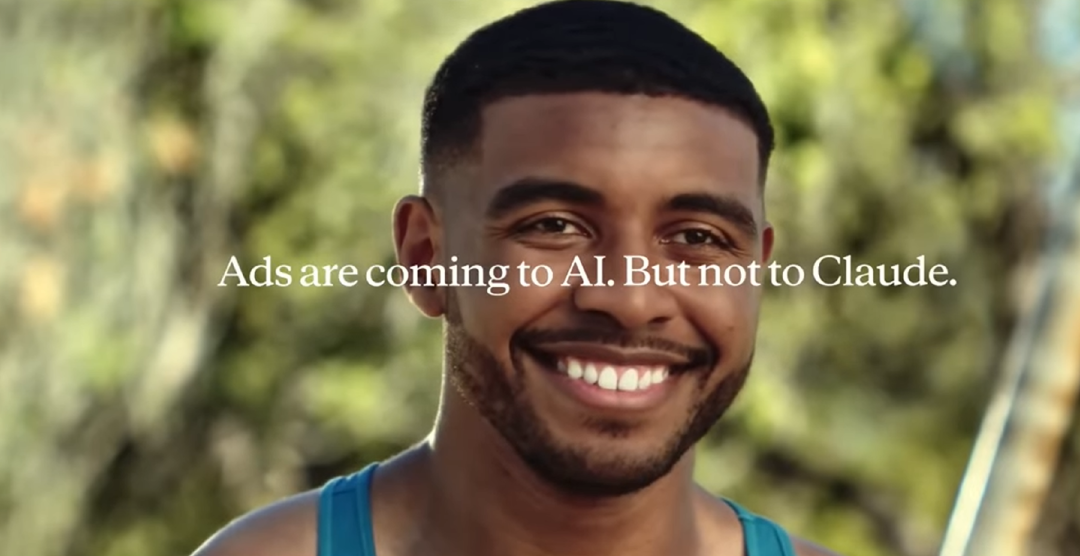
In this year's Super Bowl ad, Anthropic ran a campaign stating, 'Ads are coming to AI, but not to Claude.' Though unnamed, this was a clear jab at OpenAI, which had just announced plans to test ads in ChatGPT a few weeks earlier. Sam Altman immediately refuted the claim as inaccurate on X.
Over the past five years, Anthropic's rise can be attributed to its leading model capabilities and early bet on the coding sector, driving explosive growth. Now, it's targeting the next frontier—AI agents for non-developers—while OpenAI aims to reclaim the top spot by capturing enterprise revenue and coding users.
A Steepening Growth Trajectory
Judging by Anthropic's revenue data over the past two years, the company is experiencing meteoric growth.
From its inception to 2025, Anthropic's revenue base has grown from tens of millions to billions, maintaining consistently rapid growth. According to founder and CEO Dario Amodei, 'Since the company's first revenue, annual growth has been around 10x.'
This description holds true, with revenue jumping from tens of millions in late 2022 to over $1 billion by late 2023, exceeding $10 billion by late 2024, and reaching an annualized $90 billion in 2025. While ARR (Annual Recurring Revenue) is calculated by multiplying monthly revenue by 12 and may not reflect actual annual revenue, it indicates the company's growth momentum.
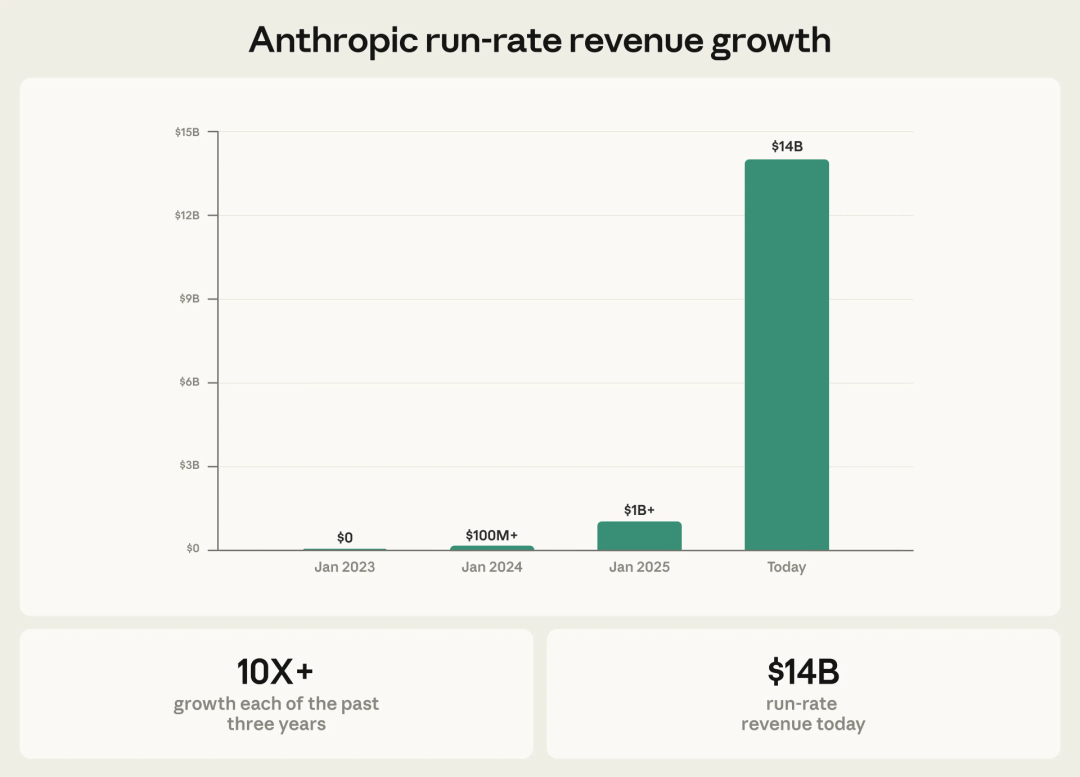
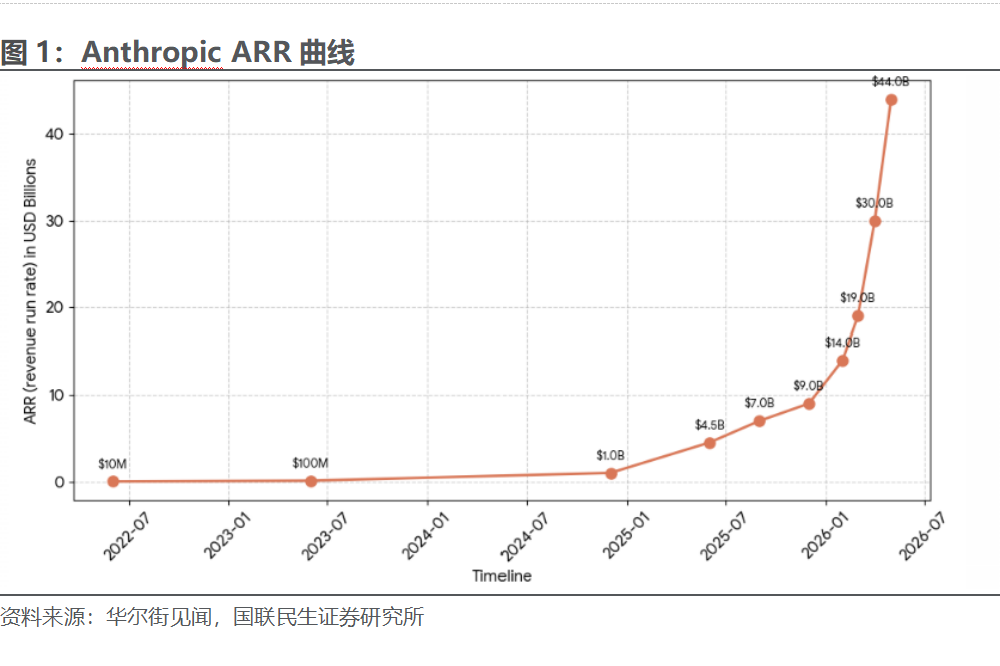
But starting this year, Anthropic broke through the 10x growth ceiling, with growth expected to exceed 80x.
At its developer conference, Dario stated that based on Q1 growth, Anthropic's revenue and user engagement would surge 80x annually. To meet this demand, Anthropic, short on computing power, is seeking partnerships with companies like SpaceX. He joked, half-seriously, that he hopes this growth rate doesn't continue.
Anthropic's success hinges on strategic choices rather than sheer effort. Employees note that Anthropic has long focused on three areas: enterprises, security, and programming.
The bulk of Anthropic's revenue comes from enterprises. While its user base is smaller than OpenAI's, its clients have higher spending power:
Anthropic CEO Dario predicted that over 80% of this year's revenue would come from selling AI models to enterprises. Currently, eight of the Fortune 10 are paying customers, with enterprise clients spending over $1 million annually growing from a dozen two years ago to over 1,000 today. Clients spending over $100,000 annually have increased sevenfold in the past year.
Equally impressive is Claude Code, launched just a year ago, which has been key to Anthropic's growth.
In February, Claude Code's annualized revenue exceeded $2.5 billion, doubling from a month earlier. Weekly active users and GitHub content generated by Claude Code also doubled, with the latter rising from 2% to 4%.
As the most widely applied B2B direction, Claude Code's launch has boosted Anthropic's enterprise revenue, eventually surpassing OpenAI's.
Ramp's report shows that in April, 34.4% of enterprise clients paid for Anthropic's AI products, surpassing OpenAI's 32.3% for the first time. The accelerated growth in Anthropic's enterprise adoption since January aligns with Claude's doubling in the same period.
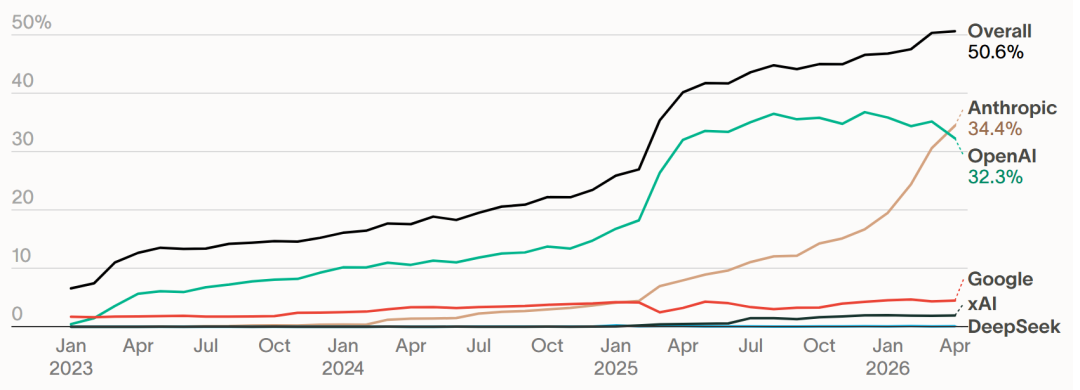
In other words, Anthropic captured more market share from OpenAI and other competitors in the enterprise sector within two years than OpenAI's existing share.
Amid soaring demand and computing shortages, Anthropic indirectly raised Claude Code's pricing by removing it from the $20/month Pro tier for new users and restricting it to the $100/month Max plan and higher subscriptions. Though officially a pricing test for 2% of new users, a price hike seems inevitable given the updated pricing in official documentation.
If Claude Code is Anthropic's trump card, Cowork, launched this year, could be its next ace.
As an AI agent for non-developers, Cowork targets a far larger user base than coding tools.
'Cowork's adoption rate in its first few weeks has already surpassed Claude Code's performance a year ago,' said Anthropic CBO Paul Smith.
However, whether Cowork can replicate Claude Code's success remains to be seen.
OpenAI's B2B Push to Counter Anthropic
Anthropic's rapid growth has intensified competition.
In February, Anthropic aired a Super Bowl ad showing an AI recommending supplements during a fitness query.
'Ads are coming to AI, but not to Claude,' the ad stated. Though unnamed, this targeted OpenAI, which had just announced ad tests in ChatGPT's free tier and $8/month Go subscription.
With revenue primarily from APIs and a B2B focus on developers and enterprises, Anthropic's revenue remains healthy without relying on ads.
Revenue projections from late last year show Anthropic's API revenue could reach $3.8 billion in 2025, more than double OpenAI's $1.8 billion. In Q1, OpenAI's revenue was over 50% from user subscriptions and about 40% from enterprises.
This B2B-heavy structure makes Anthropic's revenue appear healthier than OpenAI's.
Comparing Q1 revenue, Anthropic's $4.8 billion lags OpenAI's $5.7 billion, but Anthropic projected Q2 revenue at $10.8 billion, potentially its first profitable quarter. As a private company, Anthropic's profit estimates may be inflated, but compared to OpenAI's -122% adjusted operating margin in Q1 (a $6.95 billion loss), OpenAI faces greater funding pressure.
OpenAI's losses stem from higher R&D spending and costs to support free users.
ChatGPT, with 920 million weekly active users, incurs significant inference costs for free users. With only 55 million paying users (a 5% conversion rate), OpenAI's inference costs remain undisclosed, but its ad trials suggest urgency to monetize.
To boost revenue, OpenAI is focusing on AI programming and enterprises to reclaim market share.
To expand enterprise revenue, OpenAI raised its target from 40% to 50% by year-end and restructured its management, including acquisitions.
According to The Information, in January, OpenAI appointed Barret Zoph to lead AI commercialization for enterprise clients, making 'enterprise growth' a core strategy for the year.
Once overlooked 'heavy assets'—AI deployment services—are now being pursued by OpenAI and Anthropic, albeit through external ventures.
In May, OpenAI announced a $4 billion investment in OpenAI Deployment Company and acquired AI consulting firm Tomoro, bringing in 150 FDE (Frontline Deployment) engineers to help enterprises adopt AI. Anthropic similarly partnered with Blackstone, H&F, Goldman Sachs, and others to form a joint venture for in-house AI deployment.
The reason for these separate ventures is IPO valuation. CITIC Securities noted that if Anthropic included FDE operations in its parent company, its valuation could differ by hundreds of billions of dollars.
On the coding front, OpenAI is integrating Codex into ChatGPT, combining ChatGPT's user base with Codex's coding capabilities.
This week, OpenAI announced embedding Codex into ChatGPT's interface, allowing developers to write code directly in the chat. It also introduced mobile and browser access, addressing remote usage pain points.
This year's competition between Anthropic and OpenAI resembles a battle for territory and defense.
Conclusion
Focusing on enterprises, coding, and security has paid off for Anthropic, while OpenAI's diversification into areas like AI hardware and robotics—and its shutdown of Sora—has caused it to miss high-growth opportunities.
Anthropic's rise proves that with low C-end conversion rates, B2B offers greater growth potential.
This is evident in OpenAI's shift: Sam Altman acknowledged that Enterprise's growth has outpaced C-end, prompting OpenAI to prioritize enterprise services this year.
To fuel expansion, AI firms need more resources. The race is now not just for products and clients but also for IPO timing.
With few AI large-model companies listed, 2026 will see SpaceX, Anthropic, and OpenAI—all valued in the hundreds of billions—go public. U.S. stock liquidity could be strained.
IPO order matters: investors may allocate funds to earlier filers, leaving less for later ones, potentially widening the valuation gap between the two.
By late 2026, both companies will face scrutiny in the public market.
-
Ofilm Teams Up with ADSensE to Propel Large-Scale Deployment of All-Solid-State LiDAR Powered by ADS6311 Chip!
-
![]()
Loss of 2.5 Billion Yet Facing Strong Demand for Shares? Another Battle for Control of Lianchuang Electronics
-
![]()
Huawei’s Enjoy Series Flies Off the Shelves, Prompting Xiaomi to Double Down on Budget Smartphones
-
![]()
Beijing Hyundai's Top Executive Criticizes Industry Disorder: Certain Brands Treat Customers as Beta Testers
-
![]()
The domestic mobile phone market has declined for five consecutive quarters! Huawei defies the trend with significant growth: maintains its top market share
-
Annual Revenue Surpasses 3 Billion: An Automotive Trim 'Little Giant' Makes Its Debut on the Beijing Stock Exchange
-
![]()
The Space Force Wants to Spend $30 Billion on Rocket Launches: Is Trump Doubling Down, and Is SpaceX the Big Winner?
-
![]()
Going Crazy! One out of Every Three Plug-in Hybrids Sold in Europe is a Chinese Vehicle