The Second Half of AI: It's Time for 'Liberal Arts Students' to Shine
 06/05 2026
 443
443
Those who can translate complex AI technical logic into accessible, user-friendly products and content will gain a competitive edge in the long run.
Author | Yu Xi
Editor | Liu Shanshan
In the spring of 2026, China's AI industry undergoes a profound yet understated transformation. The change isn't about parameters multiplying but AI transitioning from a 'trending topic' to an 'everyday tool.'
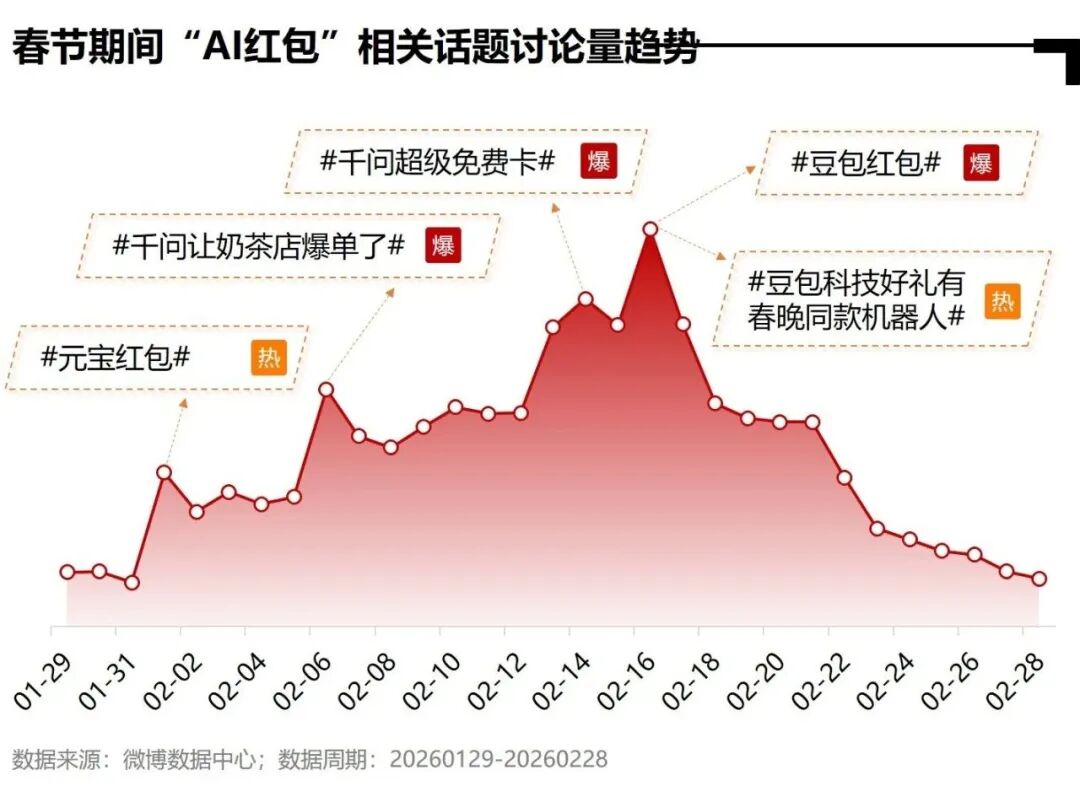
Looking back at the first half of the year, the 'AI Red Packet Craze' swept across the internet, Seedance 2.0 sparked a wave of user-generated video remixes, and OpenClaw (aka 'Longxia') went viral. These events share a common trait: their driving force is no longer tech influencers and industry media but hundreds of millions of ordinary users.
This shift points to a core question: When technologies become homogeneous, how do you retain users? The consensus in Western circles is that social media's public opinion sphere plays a decisive role in bridging AI from labs to the mainstream market, with X (formerly Twitter) serving as the epicenter for overseas AI discourse.
For China's AI industry to amplify its impact and achieve societal-wide cognitive upgrades, social ecosystems are equally indispensable.
The recently released '2026 Weibo AI Content Ecosystem Report' (hereinafter referred to as the 'Report') clearly outlines current industry trends: AI is evolving from a technical foundation to a universal tool. The current bottleneck isn't technology itself but popularize (popularization), application (application), trust (trust), and Humanistic Link (humanistic connection). Those who understand, connect, and serve people will hold the key to the next era.
This highlights the rising value of 'liberal arts-style translation'—not producing technology but making it understandable, trustworthy, and usable. This translation works both ways: creators simplify technical jargon, while ordinary users learn to articulate needs and issue clear commands. From this perspective, communication-savvy 'liberal arts students' have become the greatest common denominator in AI's mass adoption.
1
The 'Linguistic Turn' in User Mindset
The first barrier to AI mass adoption isn't computational power but 'language.'
Without shared language, users remain distant and disinterested. The Report reveals that after ChatGPT's 2022 launch, it took 138 days for Weibo's AI-interested user base to surpass 10 million. DeepSeek in 2025 shortened this to 3 days, while Seedance 2.0 in 2026 achieved it in just 5 days.
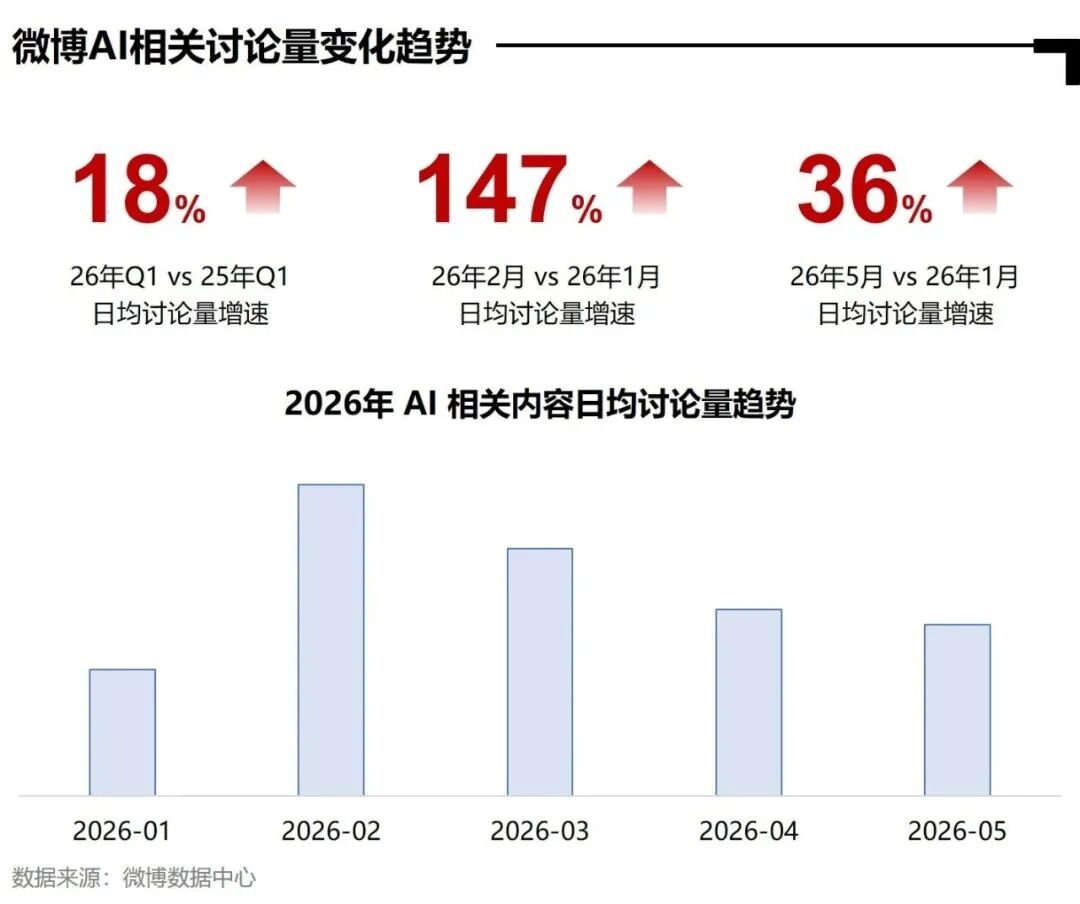
Today, ordinary people are flooding AI discussion spaces. In Q1 2026, Weibo's AI-interested users grew 328% compared to Q4 2024, with AI-related discussions up nearly 18% year-on-year. QuestMobile data confirms this trend: during OpenClaw's March 2026 viral phase, Weibo's active user penetration rate hit 79.2%.
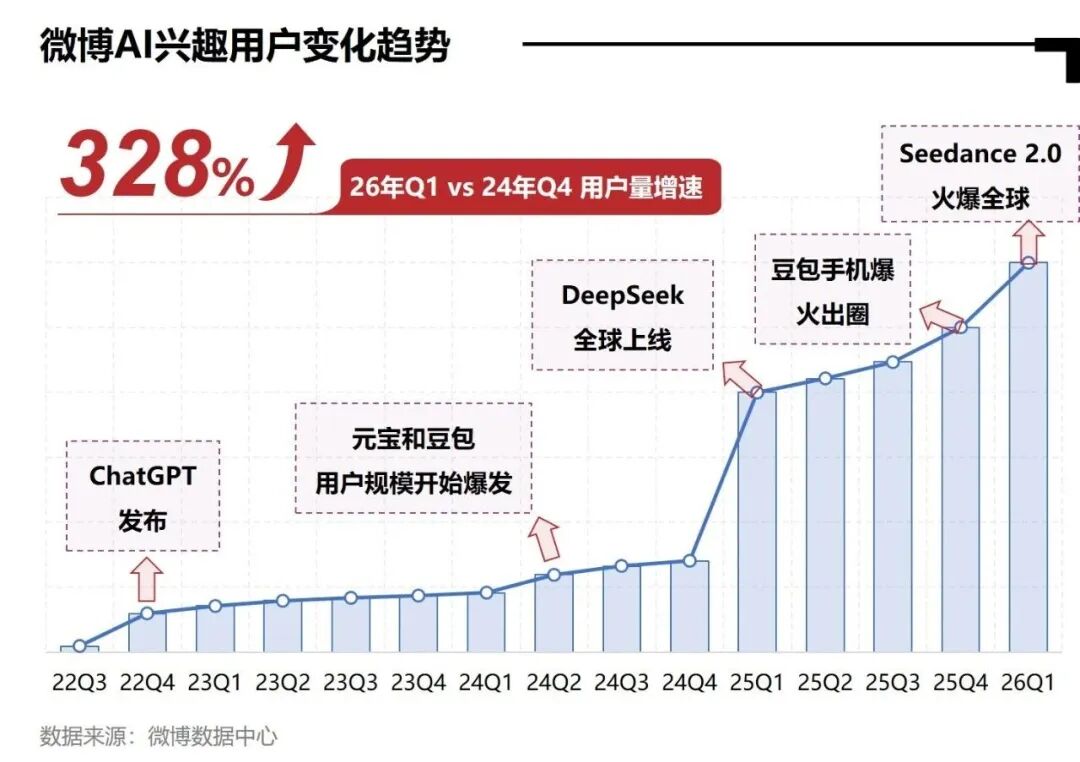
The accelerating pace of AI acceptance and expanding participant demographics reflect two key shifts:
1. **Shift in Discussion Focus**: Social media has become AI's primary discussion arena. In 2025, high-frequency AI topics on platforms included terms like 'China's AI,' 'tech rise,' and 'astonishing,' reflecting awe and admiration. By 2026, mainstream terms shifted to 'how to use,' 'tutorials,' and 'installation.' This attitude transformation—from 'what is it' to 'how to use it'—directly embodies the public's 'linguistic (cognitive) turn.'
2. **Democratization of Participation**: AI is no longer exclusive to first-tier city professionals. After DeepSeek's breakthrough, discussion rates among users over 40 and under 18 surged, with seniors actively engaging with AI applications. Some generated Spring Festival couplets using DeepSeek, others created New Year videos via Doubao, and some interpreted medical reports with AI tools. Technical barriers are dissolving through social dissemination.
In this process, social media's role as a 'translator' cannot be overlooked.
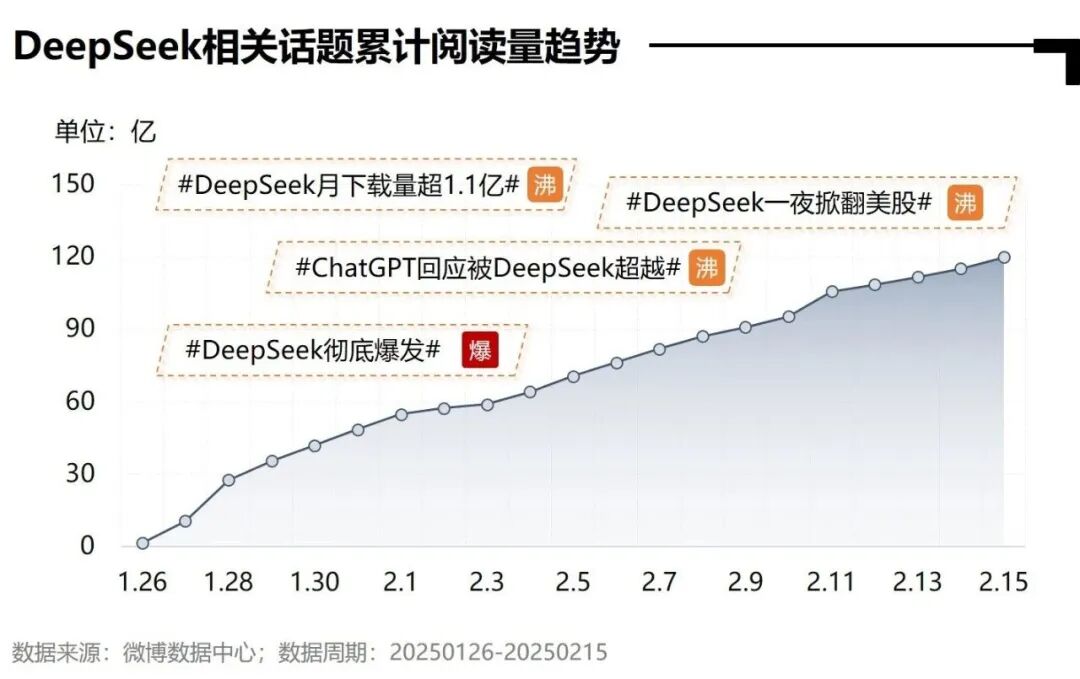
From DeepSeek's 32 hours generating 28 trending topics to Spring Festival AI red packets sparking 317 trending topics, and user-driven Seedance remixes—these events achieved mass attention rapidly due to social media's core functions in hotspot aggregation, viral dissemination, user education, and mindset shaping.
Platforms like Weibo transform technical events into multidimensional public discussions through trending topics, KOL amplification, and diverse content formats: expert deep dives and 'dummy guides,' ordinary user experiences, and cross-disciplinary creative remixes. This inclusive atmosphere drastically lowers comprehension barriers and stimulates participation.
Overseas, X Platform aggregates geeks, researchers, and entrepreneurs, becoming a hub for AI frontier discussions. This proves that while social media doesn't produce technology, it enables its discussion and dissemination.
Domestically, where AI application scenarios are far richer than overseas, platforms that 'translate technology into daily life' are crucial. Such platforms require distinct 'liberal arts' strengths: acute sensitivity to user emotions, rapid response to social trends, and organizational capabilities for diverse content ecosystems.
2
Hot topics may ignite conversations, but for AI to evolve from geek toys to universal tools, accessible 'user manuals' are essential.
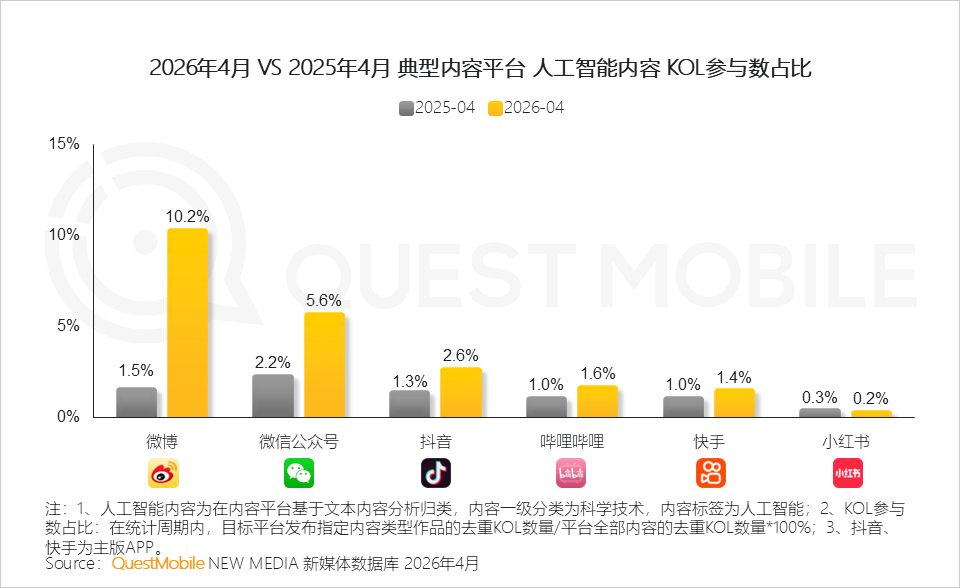
These contents predominantly originate not from official propaganda but from a growing community—cross-disciplinary creators who produce them voluntarily. QuestMobile data shows a sharp rise in AI content KOL participation across platforms:
- On Weibo, AI content KOLs increased from 1.5% in April 2025 to 10.2% in April 2026 (6x growth).
- On WeChat Public Accounts, the ratio rose from 2.2% to 5.6% during the same period.
- On Douyin, it grew from 1.3% to 2.6%, doubling its share.
This reflects AI content creation's rapid expansion across mainstream platforms, concentrating on leading social media.
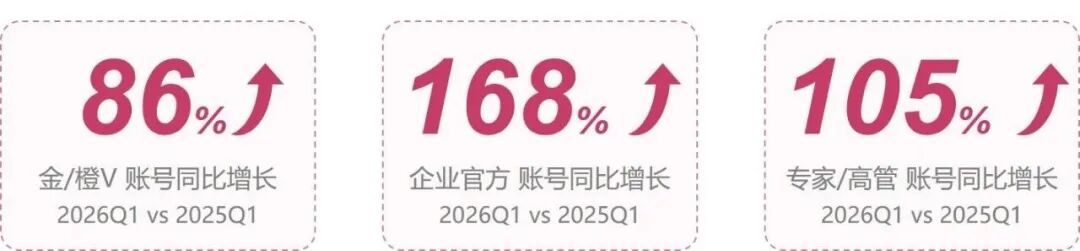
The chasm between niche technical jargon and mass discourse is bridged by 'translators.' The Report reveals that in Q1 2026, gold/orange V-certified AI accounts on Weibo grew 86% year-on-year, while corporate official accounts increased by 168%. The influx of influencers and brands focuses not on technical evangelism but on translation—through reviews, case studies, and scenario demonstrations, they transform arcane technical logic into relatable content.
An interesting phenomenon is that creators from entertainment, society, and tech sectors lead AI video production. Military bloggers use AI to simulate 'robot target practice'; film fans adapt the comic 'The Blade' into dynamic blockbusters using Seedance 2.0, boosting box office revenue. These creators, who best understand public sentiment and storytelling, are becoming AI content's core producers.
Celebrities also fuel AI's mass appeal. Wang Luodan released AI-created short films, while Wang Leehom collaborated with bloggers to produce interactive AI music, introducing AI creativity to broader audiences.
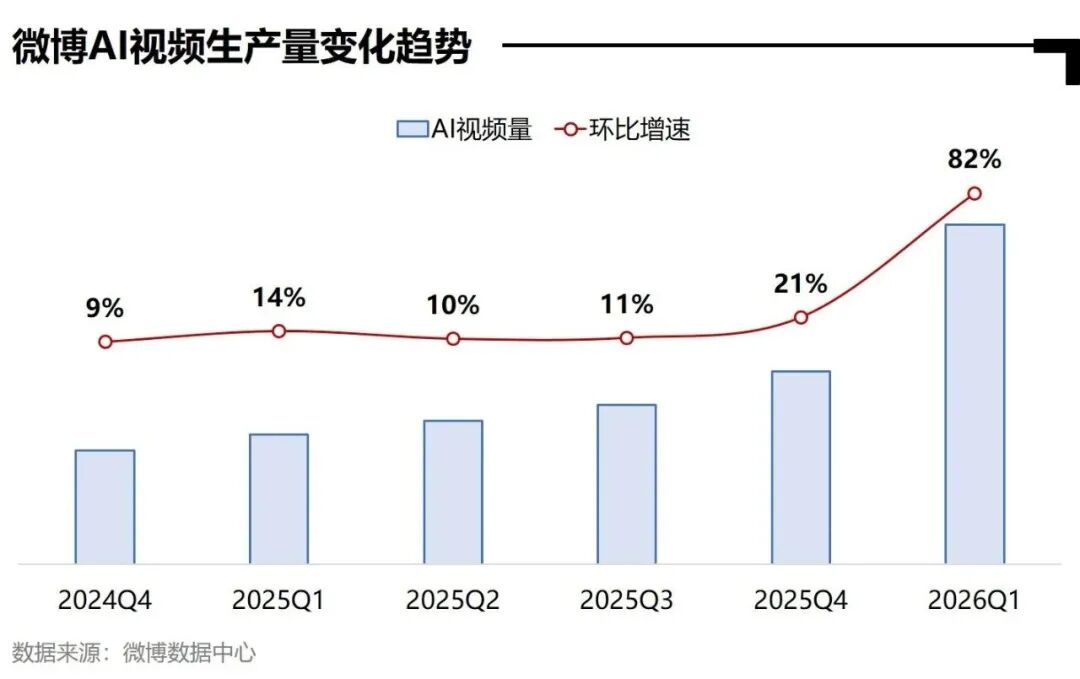
The surge in cross-disciplinary creators correlates with AI's reshaping of content production. AI tools assist in scripting, storyboarding, digital human creation, and editing, enabling graphic bloggers to transition to video without new skill acquisition. Lowered production thresholds trigger content explosions. The Report notes an 82% QoQ increase in AI video output on Weibo in Q1 2026.
As tools homogenize, content creation competition shifts to creativity, topic selection, and narrative—areas where 'liberal arts' creators excel. Cases like @Sanhoujun using AI to fulfill his childhood dream of hearing 'Monkey King' sing, @Li Ziyi dressing up his cat in AI-generated New Year costumes, and @Aton Digital creating dream concept machines with Seedance 2.0 demonstrate the 'liberal arts' value in the AI era: technology is the industry's lever, while humanities are the fulcrum of mass interest.
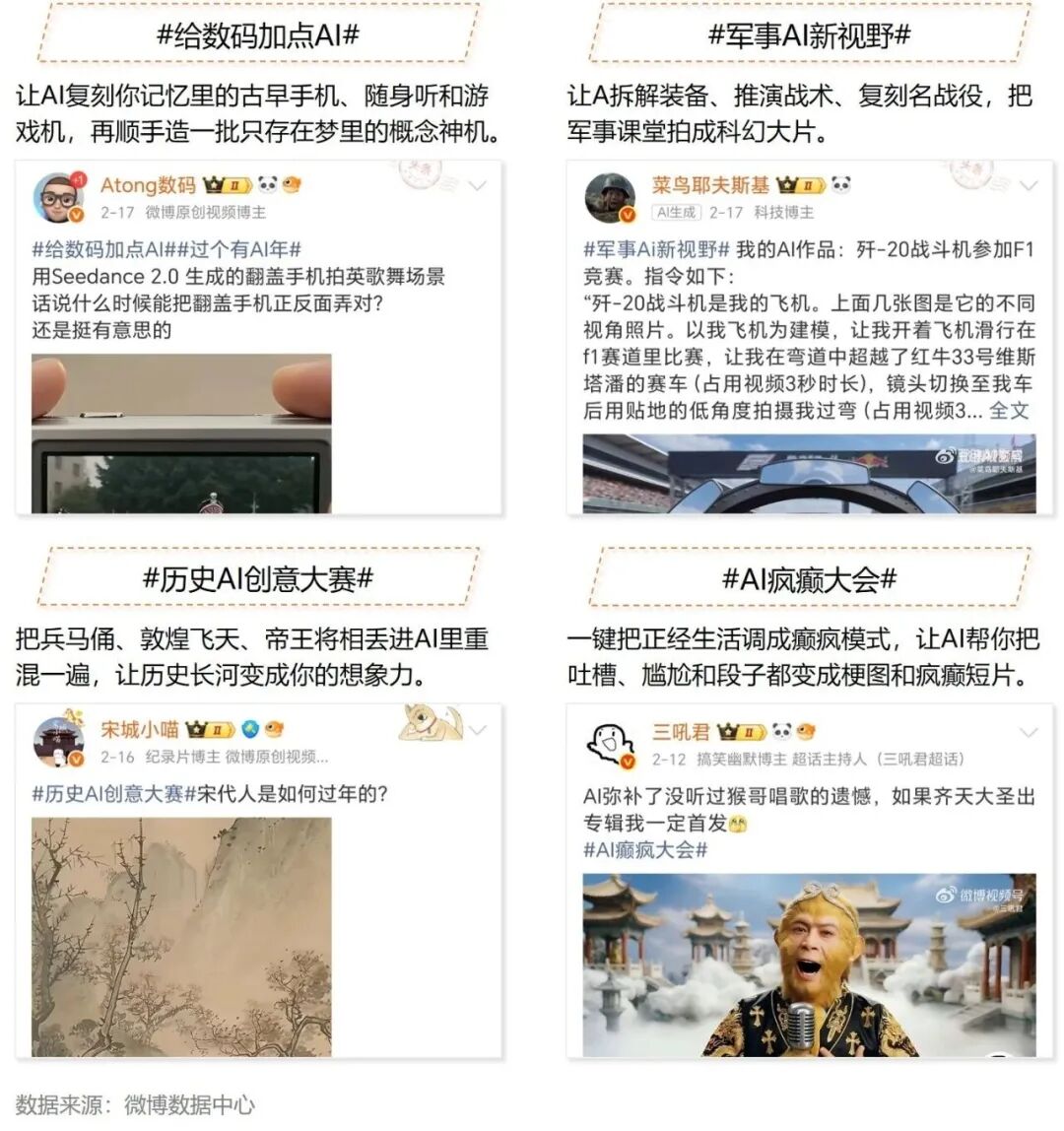
Platforms also act as 'enablers.' Many social platforms reduce creation barriers through tool empowerment and traffic guidance. For example, Weibo's 'V Creation Center' shifted core metrics from 'views' to 'watch time' to enhance creator efficiency and invigorate the AI content ecosystem.
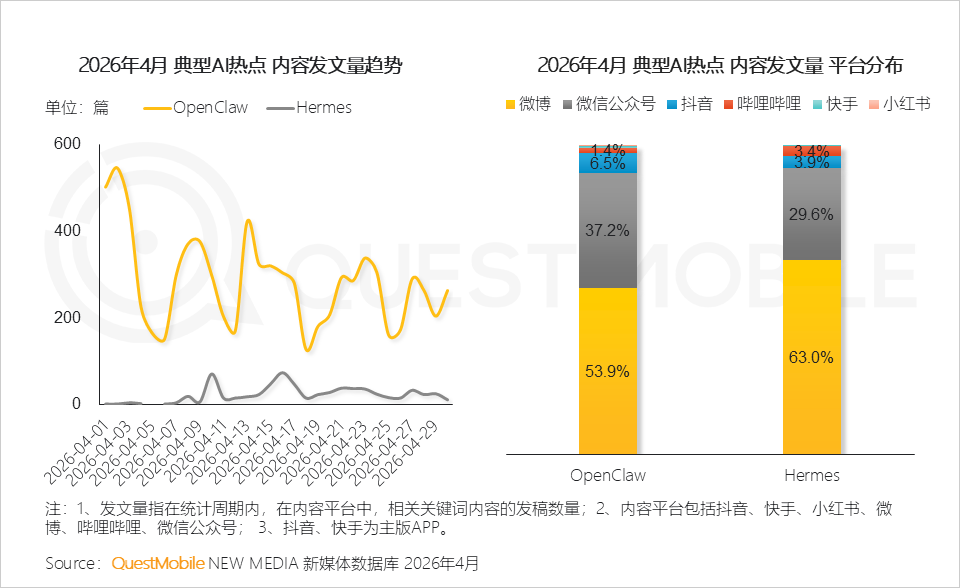
QuestMobile data supports this. In April 2026, Weibo accounted for 53.9% and 63% of content posts on trending topics 'OpenClaw' and 'Intelligent Agents,' respectively. Similar to overseas markets, high-quality remix content remains crucial for AI's mainstream adoption.
3
From Spectators to Consumers: The Efficiency Revolution of Closed Commercial Loops
Sustainable technological development hinges on commercialization.
Globally, AI monetization remains challenging. C-end users show low willingness to pay, while B-end customization costs are high, leaving many AI firms popular but unprofitable.
However, a new trend emerges: AI's consumer ecosystem is organically forming.
Take 'Longxia' as an example. Despite its technical complexity, its social media virality spawned a complete supporting economy: installation services, hardware leasing, and token consumption. From February to March, related content trended 80 times on mainstream hotlists and 226 times on tech-specific lists, reflecting genuine consumer demand.
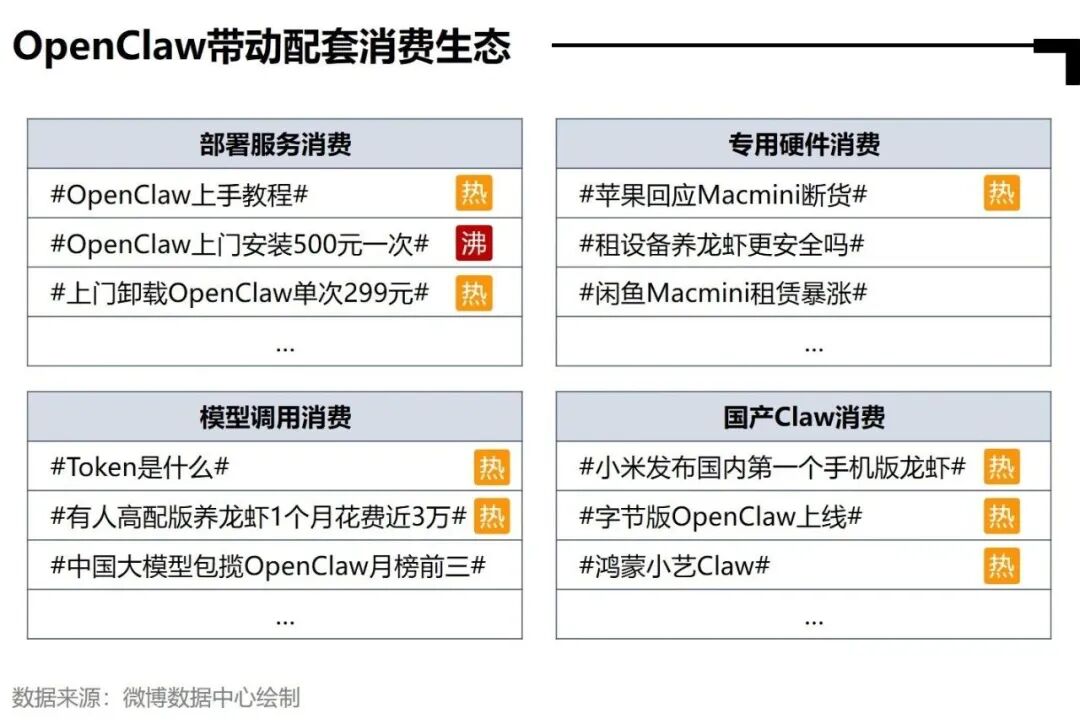
This case reveals a critical logic: In the social media era, discussion is the starting point for consumption. Comments, usage experiences, and casual interactions continuously convert into commercial value.
For AI firms, marketing strategies are adjusting accordingly. Social platforms are no longer just brand showcases but frontlines for audience reach, demand mining, and value conversion.
The closed loop of 'discussion → seeding → usage → feedback' has become a proven path for domestic AI products to scale rapidly: hot topics ignite interest, tutorials lower barriers, user sharing drives secondary dissemination, and manufacturer (manufacturers) iterate promptly. This approach yields precise customer acquisition, lower costs, and deeper user mindset penetration. Viral phenomena like 'red packet giveaways' and 'milk tea orders' exemplify this model.
Observers note that social media is evolving into AI's core development hub. Platforms serve as integrated carriers for market education, user operations, and commercial conversion. This model has global relevance—X overseas, Weibo domestically. Chinese platforms distinguish themselves through diverse discussion topics, broader participant demographics, and influence spanning B-end industrial services and C-end personal experiences across industries.
Different platforms' ecological DNA defines their boundaries. Short-video platforms excel in traffic distribution but lack depth in discussions. Weibo's uniqueness lies in its simultaneous capability for trend ignition, in-depth discourse, and commercial acceleration.
This represents China's unique AI ecosystem. China's AI competitiveness doesn't rely on singular technical superiority but on a holistic system integrating 'technology + scenarios + content + social interaction.' The trillion-yuan commercial potential unlocks not through selling raw computational power or tokens but via 'understandable, participatory, and shareable' experiences, forging a unique path for mass adoption in the Chinese market.
4
Conclusion: The Second Half of AI Depends on 'Translation Capabilities'
As AI enters its second half, a core consensus emerges: AI has become a vital force driving economic growth and new productive forces.",
In a vast industrial ecosystem, no one can handle everything alone. Some delve deep into technology, pushing its boundaries, while others focus on knowledge dissemination or expanding application scenarios—each role is indispensable.
Among them, social media, as the 'liberal arts student,' increasingly highlights its value in interpretation and connection. Combining insights from the QuestMobile and Weibo ecosystem reports, it becomes evident that in this new phase of the industry, transforming complex technological logic into products and content that ordinary people can understand, are willing to use, and can use smoothly will confer a competitive edge in the long run.
When the brilliance of technology truly illuminates the daily lives of ordinary people, we may discover that the core force driving AI into the era of universal adoption may not necessarily be the model with the highest computational power or the largest parameters, but rather the 'translator' who best understands how to communicate with ordinary people.
END
-
Ofilm Teams Up with ADSensE to Propel Large-Scale Deployment of All-Solid-State LiDAR Powered by ADS6311 Chip!
-
![]()
Loss of 2.5 Billion Yet Facing Strong Demand for Shares? Another Battle for Control of Lianchuang Electronics
-
![]()
Huawei’s Enjoy Series Flies Off the Shelves, Prompting Xiaomi to Double Down on Budget Smartphones
-
![]()
Beijing Hyundai's Top Executive Criticizes Industry Disorder: Certain Brands Treat Customers as Beta Testers
-
![]()
The domestic mobile phone market has declined for five consecutive quarters! Huawei defies the trend with significant growth: maintains its top market share
-
Annual Revenue Surpasses 3 Billion: An Automotive Trim 'Little Giant' Makes Its Debut on the Beijing Stock Exchange
-
![]()
The Space Force Wants to Spend $30 Billion on Rocket Launches: Is Trump Doubling Down, and Is SpaceX the Big Winner?
-
![]()
Going Crazy! One out of Every Three Plug-in Hybrids Sold in Europe is a Chinese Vehicle