Kuaishou and ByteDance Engage in a "Second Round" of Competition.
 06/05 2026
 473
473
When the dust settles on the short video landscape, the ceiling of Kuaishou's closed ecosystem becomes visible. Currently, from product experience and service support to business model innovation, AI holds high hopes. Even if it means going head-to-head with ByteDance, and even if the technology still lags behind, this is Kuaishou's best path forward.
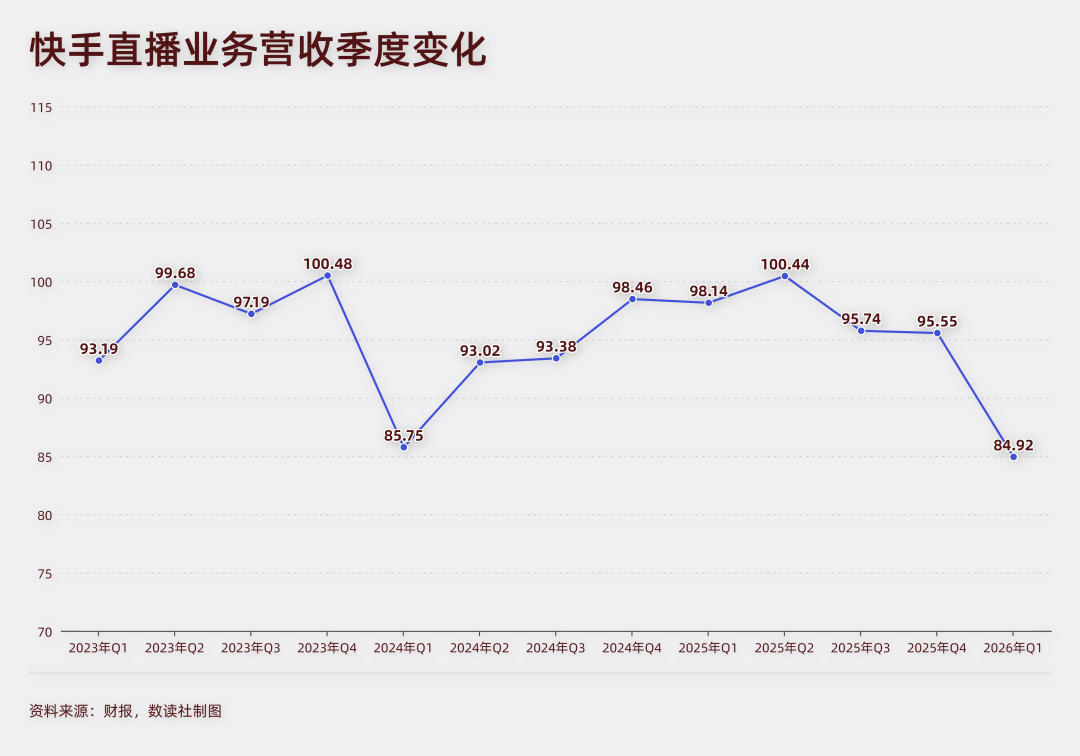
In the first quarter of 2026, Kuaishou's live streaming revenue was 8.49 billion yuan, a year-on-year decline of 13.5%.
This marks a new low in 16 quarters, almost returning to levels seen during the initial public offering period.
Like other live streaming platforms, Kuaishou's loyal users, known as "Lao Ties," are also less inclined to tip.
The stagnation in the second-largest business has triggered new changes in Kuaishou's ecosystem. Kuaishou has no choice but to break out and penetrate ByteDance's encirclement.
Part.01 Declining Live Streaming
The live streaming business is already on a downward trajectory, evident on many platforms.
Momo's revenue has declined for six consecutive years, Douyu for five years, YY Inc. for four years, and Huafang Group has delisted. Whether it's show hosts or game streamers, the phenomenon of audiences being unwilling to tip is widespread.
Kuaishou is no exception. In the first quarter of 2026, Kuaishou's live streaming revenue saw a significant decline, with 8.49 billion yuan, marking a new low since the second quarter of 2022.
Even excluding the first quarter, Kuaishou's live streaming revenue has consistently hovered between 9-10 billion yuan in recent years, with little change.
This is a broader industry trend; users have less disposable income, and after years of operation, the live streaming model is no longer novel.
However, Kuaishou also faces its own unique challenges.
Rewind to the evening of December 22 last year, when the Kuaishou platform suddenly saw a surge of vulgar content, with explicit images and language spreading unchecked. Some live streams attracted tens of thousands of viewers.
This incident ultimately resulted in Kuaishou being fined 1.191 billion yuan.
This signals a clear direction—Kuaishou will intensify its efforts to regulate the live streaming ecosystem, leading to a crackdown on late-night "edgy" live streams and other chaotic phenomena.
While this is positive for Kuaishou's ecosystem governance, the downside is the short-term impact on revenue. Kuaishou mentioned in its financial report that the decline in live streaming revenue was due to "ongoing efforts to build a rich and healthy live streaming ecosystem and diversified high-quality content."
To put it bluntly, edgy content was a key trigger for "Lao Ties" to tip, and the crackdown on this gray area has largely contributed to the decline in live streaming revenue.
Previously, platforms like Kuaishou and Bilibili relied heavily on this model to sustain their live streaming revenue.
New Huanghe once reported on the chaos of late-night "edgy" live streams. Kuaishou and Bilibili were heavily featured, with hosts on Kuaishou using edgy content to attract viewers, hinting at providing pornographic or nude performances and videos.
Additionally, Kuaishou was ordered by the court to pay 89.1 million yuan in compensation for unauthorized broadcasting of the first and second seasons of "De Yun Dou Xiao She" and the first season of "Ever Night."
The gray area is no longer viable, affecting Kuaishou's revenue. But it's not limited to that; the live streaming ecosystem has peaked, and the entire creator ecosystem is also affected.
Part. 02 Ecosystem Synergy
Kuaishou tells the story of business driven by its ecosystem.
The traffic generated by the content ecosystem, centered around traffic, generates revenue through online marketing services and live streaming businesses.
Online marketing relies on payments from creators, merchants, and other roles. Kuaishou divides it into e-commerce and non-e-commerce segments. E-commerce primarily involves live commerce, while non-e-commerce includes content consumption, lifestyle services, and AI application industries.
Kuaishou's traffic ecosystem is in the late stages of expansion.
Daily active users are growing slowly. In the first quarter, daily active users reached 413 million, a 1% year-on-year increase, with growth slowing. Monthly active users reached 772 million, an 8% year-on-year increase. While this quarter's data was impressive, the overall trend over past quarters still shows slowing growth.
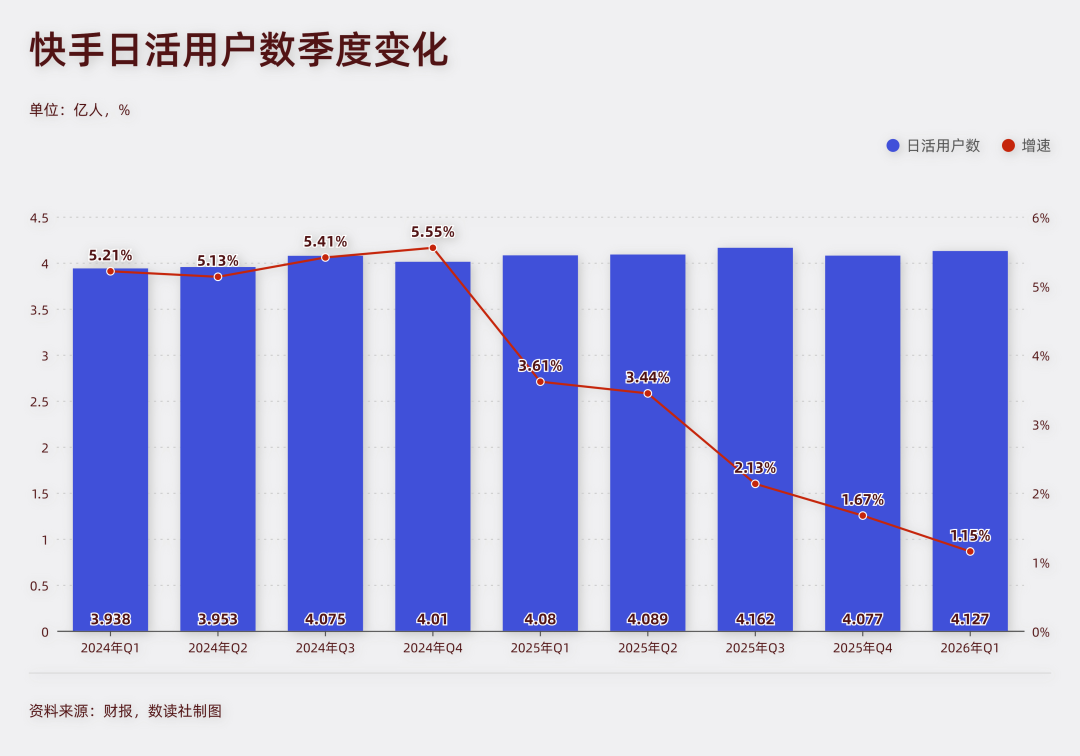
This is a challenge all platforms face at a certain stage. Once growth stalls, it affects the entire ecosystem.
Live commerce has already seen a corresponding slowdown in growth. Starting this quarter, Kuaishou no longer discloses GMV for its e-commerce business. Given its previous trajectory, Kuaishou's e-commerce is still growing at a double-digit rate, but the growth rate has dropped to 12.9% from the fourth quarter of last year.
In January this year, Kuaishou's standalone food delivery entrance was officially taken offline, less than a year after its launch. Competing with Meituan and Douyin in the local services sector was already difficult, and breaking through in a stock competition ( stock competition , inventory competition) environment is even harder.
Content marketing is the last bastion. Revenue in the first quarter was 19.64 billion yuan, a 9.3% year-on-year increase, with growth slowing to single digits.
The willingness to pay for content hinges on a key premise: each payer must achieve a return on investment (ROI) that meets their expectations.
For many content creators, as the traffic pool shifts from incremental to inventory ( inventory , inventory), acquiring traffic has become more difficult, lowering ROI.
The decline in live streaming tipping is a further signal of pressure on the ecosystem. While live streaming tipping only accounts for 25%-30% of revenue, the main contributors to this segment are the most productive guilds and the most marketing-inclined hosts.
Kuaishou operates on a revenue-sharing model for live streaming tips. The flip side of the decline from 10 billion to 8.5 billion yuan is that guilds and hosts receive fewer tips. The introduction of guilds was a crucial means for Kuaishou to stabilize its live streaming ecosystem, but if revenue sharing continues to decline, it will undermine the survival of guilds and, in turn, hosts.
For individuals, what may seem like a minor issue for the platform can translate to a significant reduction in income, like a "mountain" of pressure.
The contraction of the live streaming ecosystem could lead to hosts leaving or guilds facing difficulties, impacting the short video and live commerce ecosystems. Thus, while Kuaishou achieved growth in the first quarter, the 3.4% growth rate was a new low.
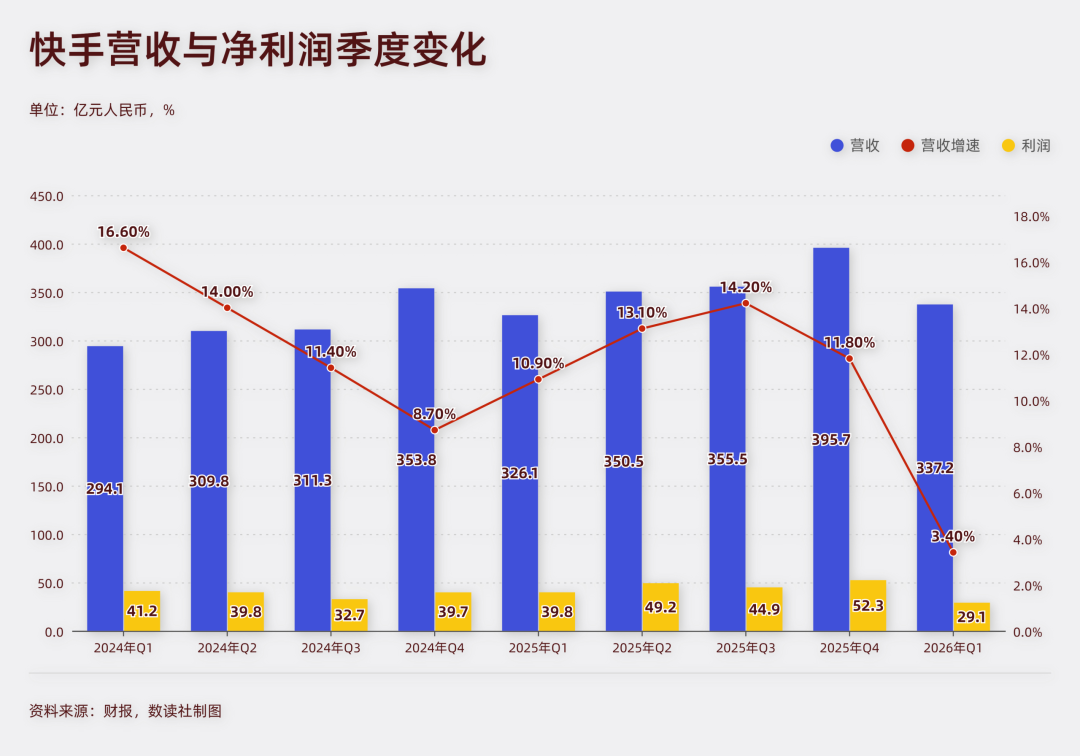
The core issue is the overall slowdown in traffic growth, with the decline in live streaming tipping revenue serving as the catalyst for ecosystem problems, triggering survival issues for guilds and hosts.
Part.03 Going Head-to-Head with ByteDance
During the transition from incremental to inventory ( inventory , inventory) growth, increasing user spending is a key strategy for platforms.
Kuaishou has been relatively successful in this regard, with average revenue per daily active user consistently growing year-on-year, reaching 47.6 yuan in the first quarter, an increase of 3.5 yuan, maintaining a relatively high growth rate.
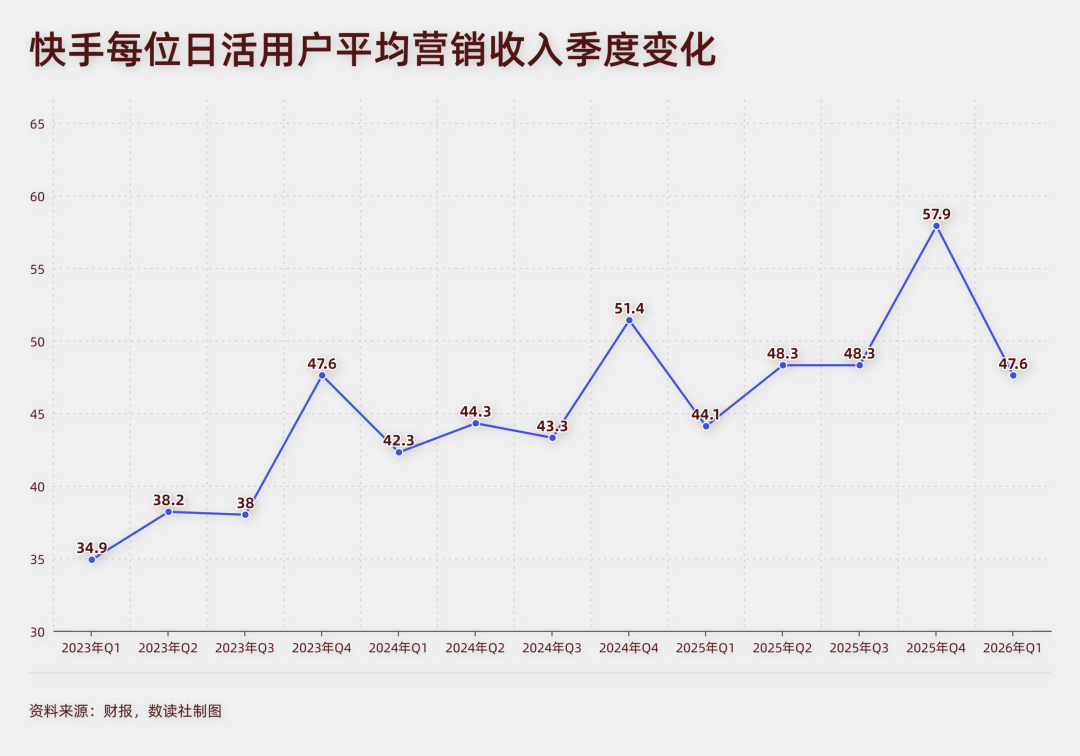
The key driver of this metric's growth is AI.
AI primarily functions as a tool, integrated into every aspect of the business. For example, in content creation, it lowers barriers, enriches forms (such as AI-generated comics and virtual scenes), increasing content supply and, consequently, marketing demand. In marketing services, AI empowers the entire marketing lifecycle, reducing merchant labor costs and improving service efficiency. In live streaming, AI assists hosts in interaction, provides digital avatars, and enriches gameplay.
Currently, Kuaishou's AI does not directly generate revenue; it operates on a logic beyond tokens. Instead, it provides the platform with more solutions, enriching content and service offerings, thereby boosting willingness to pay.
However, this effect is still too slow to provide substantial support for Kuaishou.
Kuaishou is also exploring ways to break free from conventional thinking. Kling is the most significant breakthrough.
In June 2024, Kling officially launched, with a technical roadmap comparable to Sora, offering text-to-video, image-to-video, and other functions, along with creative tools like video continuation and multimodal editing. Kling adopted a direct pay ( pay , paid) model, with the platform offering three categories based on generated video costs, breaking away from the old business model.
In the first quarter of 2026, Kling AI generated over 650 million yuan in revenue, a year-on-year increase of over 300%. In March 2026, Kling AI's annualized revenue run rate (ARR) approached 500 million USD. Achieving such scale in two years is a significant success. However, the current ARR only accounts for about 2% of Kuaishou's annual revenue. Kling needs more room to grow.
According to previous media reports, Kuaishou is considering spinning off Kling AI and initiating financing at a valuation of 20 billion USD. Kuaishou subsequently announced that its board is evaluating a restructuring plan for Kling AI's assets and business, which may involve external financing but is still in the preliminary stages, with no final agreements signed.
This indicates that Kuaishou is transitioning from a short video platform to an AI-focused entity.
At this juncture, Kling and ByteDance are once again on opposing sides of competition.
In February this year, ByteDance released Seedance 2.0, which gained popularity overseas and domestically, becoming the hottest AI product during the Spring Festival. Kuaishou responded by launching the Kling 3.0 series models. Together, they sparked a nationwide creative wave centered around the "AI Director Revolution."
Kling will find it challenging to outcompete Seedance 2.0. ByteDance's advantages lie in its broader market appeal, larger user base, and stronger foundational large models. In comparison, Kuaishou's technological capabilities do not yet place it in the top tier.
This is also likely to be the case long-term. According to Kuaishou's previous disclosures, its capital expenditures for 2026 are expected to reach 26 billion yuan. In contrast, ByteDance's capital expenditures are as high as 200 billion yuan, not on the same scale.
However, this is not detrimental to Kuaishou's development. On one hand, Kling is genuinely generating revenue through AI and growing rapidly, potentially becoming a new growth driver for Kuaishou. On the other hand, Kling expands Kuaishou's imagination, positioning it as an AI concept stock while also offering the potential for breakthroughs overseas with AI tools. In its financial report, Kuaishou mentioned that Kling topped the App Store charts in 42 countries and regions, including Brazil and Germany.
When the short video landscape stabilizes, the ceiling of Kuaishou's closed ecosystem becomes apparent. Currently, with declining user willingness to pay and peak traffic growth, finding new support points is Kuaishou's top priority. From product experience and service support to business model innovation, AI holds high hopes. Even if it means going head-to-head with ByteDance, and even if the technology still lags behind, this is Kuaishou's best path forward.
-
Ofilm Teams Up with ADSensE to Propel Large-Scale Deployment of All-Solid-State LiDAR Powered by ADS6311 Chip!
-
![]()
Loss of 2.5 Billion Yet Facing Strong Demand for Shares? Another Battle for Control of Lianchuang Electronics
-
![]()
Huawei’s Enjoy Series Flies Off the Shelves, Prompting Xiaomi to Double Down on Budget Smartphones
-
![]()
Beijing Hyundai's Top Executive Criticizes Industry Disorder: Certain Brands Treat Customers as Beta Testers
-
![]()
The domestic mobile phone market has declined for five consecutive quarters! Huawei defies the trend with significant growth: maintains its top market share
-
Annual Revenue Surpasses 3 Billion: An Automotive Trim 'Little Giant' Makes Its Debut on the Beijing Stock Exchange
-
![]()
The Space Force Wants to Spend $30 Billion on Rocket Launches: Is Trump Doubling Down, and Is SpaceX the Big Winner?
-
![]()
Going Crazy! One out of Every Three Plug-in Hybrids Sold in Europe is a Chinese Vehicle