Masayoshi Son Should Cool Down This Time
 06/05 2026
 579
579
Author: Gao Linglang Editor: Wang Gefa
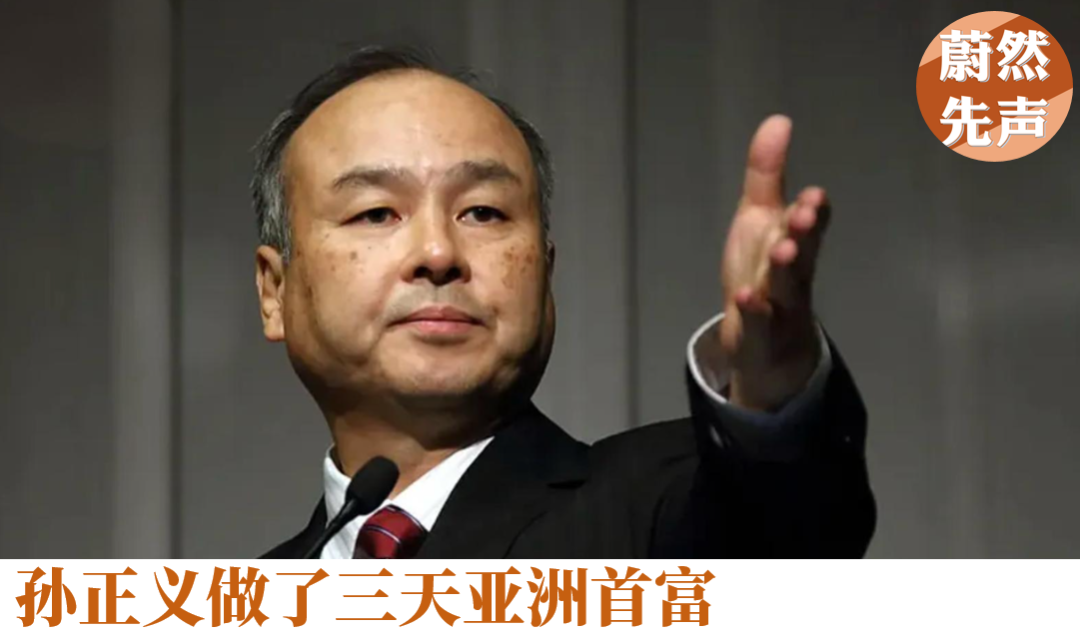
On June 4, Masayoshi Son fell from his position as Asia's richest person.
According to Forbes' real-time billionaire rankings, SoftBank Group's stock price dropped approximately 11% on that day, causing Son's personal wealth to shrink by $13.2 billion within 24 hours. His net worth fell from over $100 billion to $87.1 billion, with his ranking surpassed by Indian billionaires Ambani and Adani.
Notably, SoftBank's total market capitalization was also overtaken by Toyota Motor, losing its title as Japan's most valuable company.
Just three days earlier, on June 2, the situation was quite different. Son's net worth rose to $100.4 billion, reclaiming the title of Asia's richest person after more than a decade. SoftBank's stock price surged over 14% on June 1, with its total market capitalization briefly nearing ¥50 trillion, ending Toyota's two-decade-plus reign as Japan's most valuable company.
The events of this week are hard to explain by luck alone. Son made a series of bold bets in the AI sector, with the market initially buying in before later wavering—both reactions reflected in SoftBank's stock price within the same week.

This surge in net worth was primarily driven by two factors.
First, ARM's stock price soared. ARM is SoftBank's core holding, with AI infrastructure demand prompting a reevaluation of the value of chip IP licensing models.
According to 36Kr Finance, SoftBank invested approximately $47.1 billion to acquire controlling stakes in ARM. As of recently, ARM's market capitalization has approached $310 billion, yielding a paper gain of over $260 billion—surpassing SoftBank's historic returns from its Alibaba investment.
Second, expectations of OpenAI's IPO. According to reports from Reuters and The Wall Street Journal, OpenAI is secretly preparing IPO documents and could go public as early as the second half of 2026.
SoftBank's cumulative actual investment in OpenAI has reached $44.6 billion, with an additional $20 billion pending. Based on market projections of a $1 trillion valuation, the paper gain on this investment would range between $70 billion and $80 billion.
In late May, Son announced a major deal at the "Choose France" investment summit in Paris. SoftBank pledged to invest up to €75 billion in France to build a 5GW AI computing cluster in Hauts-de-France, with an initial €45 billion phase targeting 3.1GW capacity by 2031.
According to Son, the deal was finalized just two months after discussions began, following French President Macron's visit to Tokyo in April. When news broke in early June, SoftBank's stock price surged.
Son remains confident in his judgment. He has publicly stated that the current AI wave is at least 10 times—and possibly 50 times—larger than the internet era, with humanity currently at the initial stages of a decades-long technological transformation.

However, market confidence remains fragile.
According to media reports, some SoftBank executives have expressed concerns about the scale of bets on OpenAI, with their doubts repeatedly dismissed by Son. Over time, space for internal discussion has narrowed.
Takahide Kiuchi, executive economist at Nomura Research Institute, warned that if the market perceives AI's actual economic benefits as falling short of expectations, the AI-driven stock rally could end abruptly.
These concerns are informed by Son's own history. During the 2000 dot-com bubble burst, his personal wealth evaporated by about 90% in months, with paper losses nearing $60 billion—setting a Guinness World Record for wealth loss at the time.
Around 2017, SoftBank Vision Fund heavily invested in WeWork, approving a $10 billion investment after just a 12-minute meeting, only to face an IPO failure and $14.3 billion in equity and debt losses. Son later publicly apologized. Subsequent Vision Fund investments suffered cumulative losses of about $23 billion, with paper losses nearing 40% of the principal.
Son does not deny this history but interprets it differently. He recently stated that bubbles are merely interim episodes in long-term growth.
Citing market trends after the 2000 dot-com crash, Son argued that even after sharp corrections, markets eventually surpassed their previous peaks, with what seemed like high valuations at the time appearing as mere "foothills" in retrospect. He also referenced long-term trends after industrial setbacks during the 1929 Great Depression, asserting that short-term fluctuations cannot alter the direction of technological revolutions.
Bill Gurley, a partner at Silicon Valley venture capital firm Benchmark Capital, once remarked that Benchmark aims to make money, while Son seeks legends.
"I often bet wrong, but I don't want to regret not challenging myself," Son once said. His three-day reign as Asia's richest person validated both statements.
Disclaimer: This article is for informational purposes only. The information and opinions expressed do not constitute investment advice. Readers should exercise caution when making investment decisions. -END-
-
Ofilm Teams Up with ADSensE to Propel Large-Scale Deployment of All-Solid-State LiDAR Powered by ADS6311 Chip!
-
![]()
Loss of 2.5 Billion Yet Facing Strong Demand for Shares? Another Battle for Control of Lianchuang Electronics
-
![]()
Huawei’s Enjoy Series Flies Off the Shelves, Prompting Xiaomi to Double Down on Budget Smartphones
-
![]()
Beijing Hyundai's Top Executive Criticizes Industry Disorder: Certain Brands Treat Customers as Beta Testers
-
![]()
The domestic mobile phone market has declined for five consecutive quarters! Huawei defies the trend with significant growth: maintains its top market share
-
Annual Revenue Surpasses 3 Billion: An Automotive Trim 'Little Giant' Makes Its Debut on the Beijing Stock Exchange
-
![]()
The Space Force Wants to Spend $30 Billion on Rocket Launches: Is Trump Doubling Down, and Is SpaceX the Big Winner?
-
![]()
Going Crazy! One out of Every Three Plug-in Hybrids Sold in Europe is a Chinese Vehicle