Report | Token Economics: Envisioning a New Path for RMB Internationalization
 06/08 2026
 538
538
Preface:
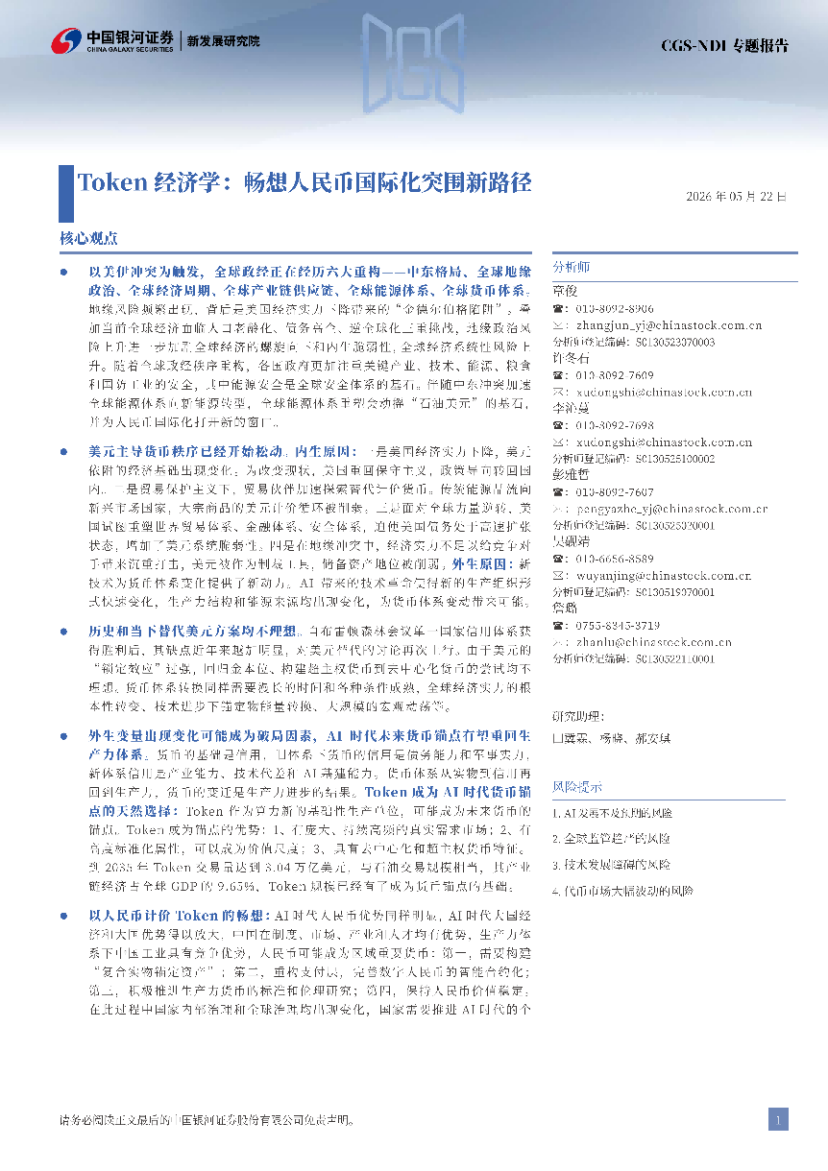
Triggered by the US-Iran conflict, the global political and economic landscape is undergoing six major restructurings—Middle East dynamics, global geopolitics, global economic cycles, global industrial and supply chains, global energy systems, and the global monetary system.
Author | Fang Wensan
Image Source | Network
Geopolitical risks are emerging frequently, driven by the "Kindleberger Trap" resulting from the decline of US economic power. Coupled with the triple challenges of an aging population, high debt, and deglobalization, rising geopolitical risks further exacerbate the downward spiral and inherent fragility of the global economy, elevating systemic risks. As the global political and economic order is restructured, governments are placing greater emphasis on the security of key industries, technologies, energy, food, and defense industries, with energy security serving as the cornerstone of global security. The acceleration of global energy system transformation towards new energy sources amid Middle East conflicts will shake the foundation of the "petrodollar" system and open a new window for RMB internationalization.
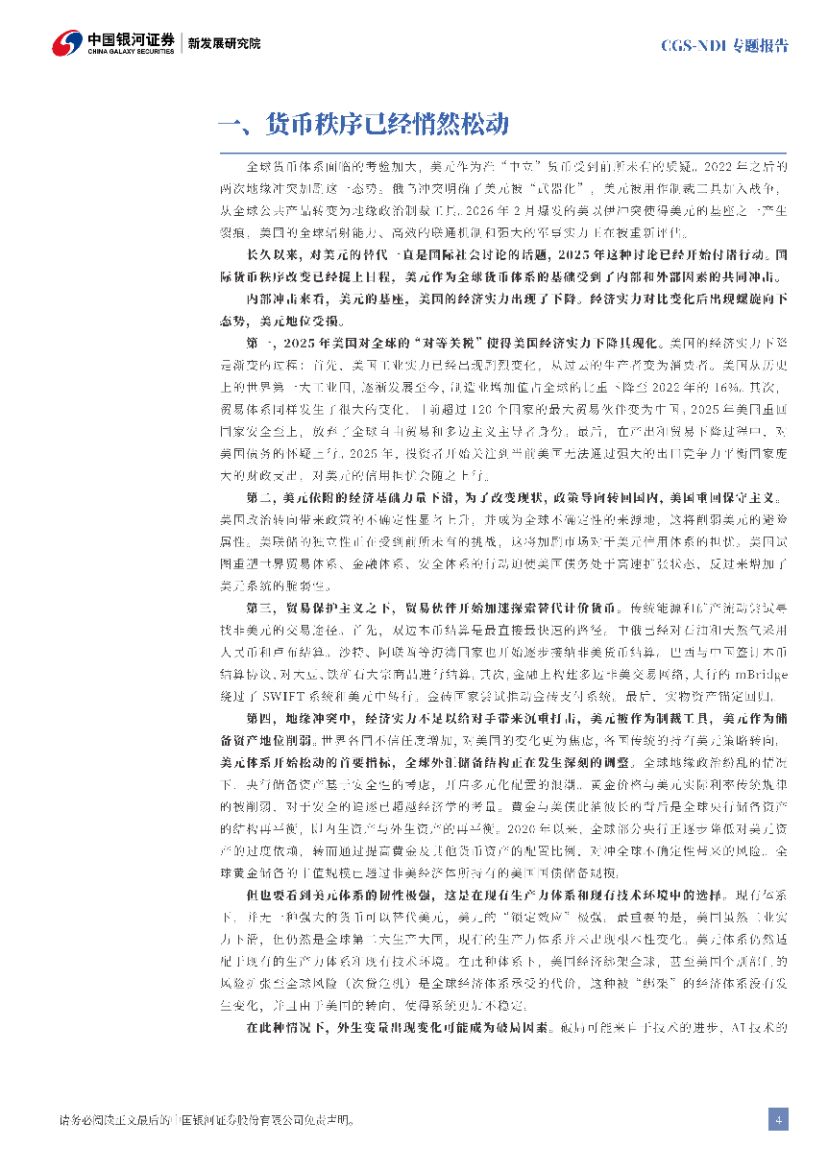
The US dollar-dominated monetary order has begun to loosen. Endogenous factors include: 1) The decline in US economic strength has altered the economic foundation on which the dollar relies. To address this, the US has reverted to conservatism, shifting policy focus domestically. 2) Under trade protectionism, trading partners are accelerating efforts to explore alternative pricing currencies. Traditional energy products are flowing to emerging market countries, weakening the dollar's pricing cycle for commodities. 3) Faced with a global power shift, the US attempts to reshape the world trade, financial, and security systems, forcing its debt into rapid expansion and increasing the fragility of the dollar system. 4) In geopolitical conflicts, the US economic strength is insufficient to inflict heavy damage on competitors, and the dollar, used as a sanction tool, has seen its status as a reserve asset weakened. Exogenous factors: New technologies provide new impetus for changes in the monetary system. The technological revolution brought by AI has rapidly transformed new forms of production organization, altering productivity structures and energy sources, making changes in the monetary system possible.
Historical and current alternatives to the US dollar have proven unsatisfactory. Since the victory of the single-country credit system at the Bretton Woods Conference, its flaws have become increasingly apparent in recent years, reigniting discussions on dollar alternatives. Due to the strong "lock-in effect" of the dollar, attempts to return to the gold standard, construct a supra-sovereign currency, or adopt decentralized currencies have all been unsatisfactory. Transitioning the monetary system also requires a lengthy process and the maturation of various conditions, such as a fundamental shift in global economic strength, an energy shift in anchoring objects due to technological progress, and large-scale macroeconomic turmoil.
Changes in exogenous variables may serve as a breaking point, with the future monetary anchor in the AI era expected to return to the productivity system. The foundation of currency is credit; under the old system, currency credit relied on debt capacity and military strength, while in the new system, it relies on industrial capacity, technological superiority, and AI infrastructure capabilities. The evolution of the monetary system from physical to credit and back to productivity reflects the progress of productivity. Token emerges as a natural choice for the monetary anchor in the AI era: As a new foundational unit of production for computing power, Token may become the future monetary anchor. Advantages of Token as an anchor: 1) A vast, continuously high-frequency real demand market; 2) Highly standardized attributes, enabling it to serve as a measure of value; 3) Decentralized and supra-sovereign currency characteristics. By 2035, Token trading volume is projected to reach US$3.04 trillion, comparable to the scale of oil trading, with its industrial chain economy accounting for 9.65% of global GDP, providing a foundation for Token to become a monetary anchor.
Envisioning RMB-denominated Tokens: The RMB also holds significant advantages in the AI era, where the economies and strengths of major powers are amplified. China possesses advantages in institutions, markets, industries, and talent, with a competitive industrial system. The RMB may become a key regional currency: First, a "composite physical anchored asset" needs to be constructed; second, the payment layer must be reconstructed to enhance the smart contract capabilities of the digital RMB; third, active promotion of standards and ethics for productivity-based currency is required; fourth, the stability of the RMB's value must be maintained. During this process, changes will occur in both domestic and global governance. Nations need to promote equity in individual access and creative rights in the AI era to achieve common prosperity. Internationally, there is a need to assist in computing power and productivity, allowing computing power to permeate globally, boosting global productivity, and achieving win-win cooperation.
Once Token becomes the anchor, regional currencies are expected to replace single-currency systems. The computing power-based system in the AI era will no longer rely on the existing SWIFT and global clearing systems, with currency issuance anchored to computing power. Token, as a new foundational unit of production for computing power, may become the future monetary anchor. As an independent computing power contract, Token could potentially reach the trading volume of crude oil. In May 2026, the Chicago Exchange officially launched the world's first computing power futures contract, marking Token's first step in realizing its commercial value. Token's physical attributes also suggest its total supply will not expand infinitely, overcoming "physical deflation" and traditional inflation. In the future, once Token becomes the anchor, regional currencies will gradually replace single-currency systems.
-
Ofilm Teams Up with ADSensE to Propel Large-Scale Deployment of All-Solid-State LiDAR Powered by ADS6311 Chip!
-
![]()
Loss of 2.5 Billion Yet Facing Strong Demand for Shares? Another Battle for Control of Lianchuang Electronics
-
![]()
Huawei’s Enjoy Series Flies Off the Shelves, Prompting Xiaomi to Double Down on Budget Smartphones
-
![]()
Beijing Hyundai's Top Executive Criticizes Industry Disorder: Certain Brands Treat Customers as Beta Testers
-
![]()
The domestic mobile phone market has declined for five consecutive quarters! Huawei defies the trend with significant growth: maintains its top market share
-
Annual Revenue Surpasses 3 Billion: An Automotive Trim 'Little Giant' Makes Its Debut on the Beijing Stock Exchange
-
![]()
The Space Force Wants to Spend $30 Billion on Rocket Launches: Is Trump Doubling Down, and Is SpaceX the Big Winner?
-
![]()
Going Crazy! One out of Every Three Plug-in Hybrids Sold in Europe is a Chinese Vehicle