What Changes Will AIPC Bring When NVIDIA Enters the Game?
 06/08 2026
 474
474
On June 1, 2026, on the stage of the GTC conference, Jensen Huang, clad in his iconic leather jacket, pulled a chip out of his pocket. He didn’t say much, but every word hit like a nail into the minds of everyone present: “For the past forty years, you’ve launched apps, clicked, and typed. With RTX Spark, you just ask a question, and the PC gets the job done.”
01. From “Two Maps” to “One Blueprint”
To grasp the significance of this, we first need to understand just how awkward today’s PCs really are. Traditional computer chips operate on a “division of labor” architecture: the CPU handles computation, the GPU manages graphics, and the NPU takes care of AI inference. Each chip sticks to its own role, with data moving between them like going through customs—every crossing requires queuing, inspection, and delays. This system has chugged along for decades in ordinary office tasks without much fuss. But when you try to run a large language model with 120 billion parameters locally, problems explode: the CPU has to shuffle data back and forth, and even top-end GPU memory maxes out at 24GB, with the model getting booted out as soon as it’s loaded. Data transfer becomes the bottleneck, with chips passing information back and forth like two mismatched maps.
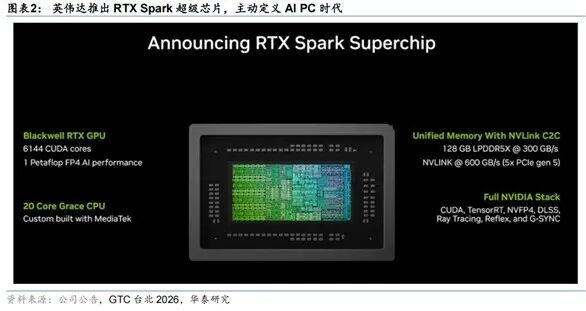
NVIDIA’s answer with RTX Spark? Stop moving the data. The CPU and GPU share the same physical memory pool, connected via NVLink-C2C high-speed interconnects with bandwidth cranked up to 600GB/s. What does that mean? The memory ceiling for your discrete GPU jumps from 24GB to 128GB. AI models no longer need to be chopped up and shuttled around—they can lounge comfortably in the entire memory pool, calling on resources whenever needed. With 128GB of unified memory, the CPU and GPU share the same data, bypassing the narrow PCIe graphics card channel.
This idea isn’t new. Apple dipped its toes in the water back with the M1, using a unified memory architecture to pull Macs out of the “big fan plus discrete GPU” industrial aesthetic. NVIDIA is simply applying the same logic to Windows PCs—but taking it even further. While Apple’s GPU remains an Apple GPU, NVIDIA has welded in its core Blackwell RTX architecture, roughly on par with a desktop-class RTX 5070. Now, a slim laptop can simultaneously wield the CPU’s logical processing, the GPU’s parallel computing, and 128GB of VRAM—three essentials to truly lay the groundwork for local large models.
02. Data Center Logic Infiltrates the PC
But if you think NVIDIA is just trying to build a CPU alternative, you’re underestimating Jensen Huang’s ambitions. RTX Spark isn’t NVIDIA’s first foray into Arm-based PC chips. Back in 2011, NVIDIA unveiled Project Denver, announcing plans to build high-performance CPU cores based on ARM architecture—at a time when ARM was mostly confined to mobile phones, and Windows on Arm seemed like a pipe dream.
As expected, it fizzled out. But NVIDIA never let go, iterating through Grace, Tegra, and GB10, feeling its way forward until 2026, when three conditions finally aligned: the Windows on Arm ecosystem was no longer a joke, Microsoft had paved the way for Copilot+ PCs, and AI applications had spawned a real demand for “local large models.”
So, let’s ask the next question: Why would NVIDIA, which has been raking in profits selling data center GPUs, suddenly pivot back to PC chips?
There are two layers to this. First, the growth ceiling for data center GPU business is looming closer by the day. AI chips are evolving far faster than applications can commercialize, leaving cloud providers increasingly cost-conscious in their procurement.
Second, and more profoundly: NVIDIA has never been content to just be a “component on the platform.” In the past, the CPU was the center of the PC, with the GPU merely an accelerator add-on. In NVIDIA’s vision, the future AI PC should revolve around AI computing power, local model capabilities, and unified memory. In other words, it wants to rewrite the rules of the AI era and redefine what serves as the PC’s “heart.” And bypassing the CPU to build a superchip that combines CPU and GPU is the most critical move on that path.
In terms of related beneficiaries, Huaxi Securities highlights areas such as unified memory upgrades, Arm/IP, memory linking, edge/end-side computing modules, and terminal ODM supply chain demand, including companies like Lenovo Group, Huaqin Technology, Softtek, Digital China, GigaDevice, ChangXin Memory Technologies (pending IPO), Jiangbo Long, BYV Storage, Wangsu Science & Technology, and Meig Smart.
03. AMD Isn’t Sitting Idle—A “Convergence Race” Is Underway
It’s worth noting that NVIDIA isn’t the only player charging down this path. AMD’s Strix Halo APU has long been doing something similar—16 Zen 5 cores plus 40 RDNA 3.5 GPU compute units, with up to 128GB of memory, capable of running a 200B-parameter model locally. While AMD lacks NVIDIA’s hardware edge in AI low-precision computing, its large language model inference can even outpace NVIDIA’s DGX Spark in certain scenarios. What does this tell us? It shows that converged architectures are becoming an industry consensus, with everyone—regardless of technical route—screwing in the same direction.
The bigger imagination lies in the software ecosystem. NVIDIA’s RTX Spark doesn’t just pack a chip—it brings the entire CUDA ecosystem, TensorRT, NVFP4 precision, DLSS 4.5, marking the first time data center AI stacks and gaming graphics stacks run natively on the same slim laptop. Adobe has announced a Photoshop and Premiere redesign with exclusive optimizations, while Blender, ComfyUI, and Riot Games have already climbed aboard, with over 100 Windows software developers pledging support.
For a new platform’s survival, cold hardware pales in comparison to a sizzling ecosystem. On this front, NVIDIA’s CUDA card weighs heavier than any rival’s.
04. Change Has Begun—We’re Just Still Sitting on Old PCs
After all this technical back-and-forth, the most practical question remains: What does any of this mean for the average user?
The first intuitive change: PC interaction will be utterly transformed. In the past, the computer was a “tool waiting for your commands”—you opened software, clicked the mouse, typed text. In the future, you’ll just tell it the outcome: “Extract the key points from this report, turn them into a three-page PPT using that template from last time”—and the computer handles the software calls, file searches, formatting, and generation. Jensen Huang compares this shift to the leap from feature phones to smartphones a decade ago. Smartphones didn’t just change a screen; they redefined the gateway to the mobile internet. Now, the PC’s gateway is shifting from “launching an app” to “summoning an AI agent.”
The second change is more tangible: Your data no longer needs to be shipped to the cloud. Previously, when you asked ChatGPT a question, your chat content, file summaries, even private info had to be bundled off to a distant data center, processed, and sent back. Now, AI can reside on your PC, running locally without uploading any data to the cloud. You won’t have to worry about privacy leaks, network dependence, or even being offline—you could run a complex plan at 30,000 feet in the air. Canalys predicts that AI-capable PCs will account for around 40% of shipments this year, doubling in two years. A true “personal AI computer” is no longer just a toolbox for professionals but a silicon companion on everyone’s desk.
05. Conclusion: The PC Ecosystem Is Poised for a New Era
Before 2026, countless articles analyzed the “far-reaching impact of CPU-GPU convergence on the PC industry,” but most approached it with caution, wait and see , and hedging their bets. But when NVIDIA crammed a 20-core Grace CPU and Blackwell GPU into a chip the size of a fingernail and stuffed it into a 14mm-thin laptop, that “outlook” had to become a “post-mortem.” Because the change isn’t coming—it’s already landed in the first orders from Dell, HP, Lenovo, and ASUS.
This isn’t just a technical upgrade race; it’s a complete overhaul from chip to ecosystem, from interaction to end-user experience. The x86 architecture’s forty-year reign is being chipped away by Arm and unified memory, while the Wintel alliance’s supposed invincibility is being pried open by NVIDIA, Microsoft, and Arm’s “new triangle.”
Perhaps this fall, when the first RTX Spark laptops reach users and AI agents truly start working on their own PCs, people will suddenly realize—that forty-year-old old computer retired for good that day.
- End -
-
![]()
800V vs. 48V: Which Reigns Supreme? Online Clash Between Executives Intensifies Debate Over Li Auto and NIO's Suspension Systems | MIRROR Pro
-
![]()
Anthropic Files, MiniMax Rushes for A-Share Listing, but What I Really Want to Discuss is the M3 Model
-
![]()
Proceed with Caution Before Entering the Indian Auto Market: Even Musk Faced Challenges, What Makes Chery Think It Can Succeed?
-
![]()
EU Intends to Engage in Trade War with China Amid Chinese Cars Nearing 10% of Monthly Sales in Europe
-
![]()
Mobile Phone Industry at the 618 Node: Price Hikes Just a 'Superficial Injury,' while Sticking to Old Ways is the 'Internal Bleeding'?
-
![]()
Shenzhen Rolls Out 'Ten Measures' for New Energy Vehicle Insurance: Integrates Innovative Risk Factors and Adopts Battery-Body Separation Model
-
![]()
If You Can’t Drive a Ferrari Yourself, What’s the Point of Owning One?
-
![]()
ByteDance Clarifies: 'No Car Production, No Investment in Saido!' Seres' Stock Price Plummets to New Lows!