Shenzhen Rolls Out 'Ten Measures' for New Energy Vehicle Insurance: Integrates Innovative Risk Factors and Adopts Battery-Body Separation Model
 06/08 2026
 441
441
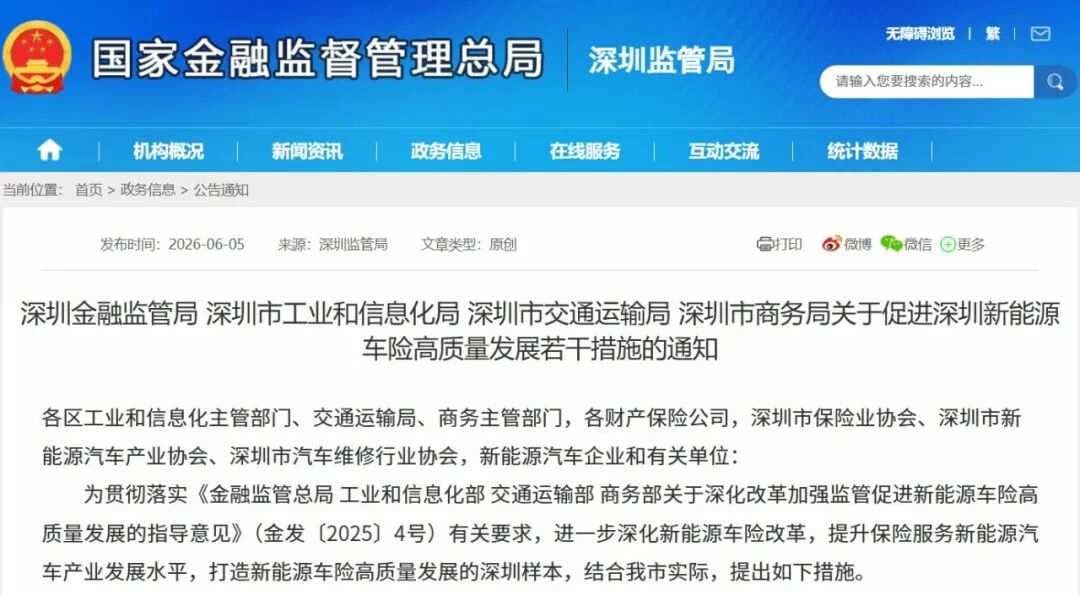
On June 5, the Shenzhen Financial Regulatory Bureau, in collaboration with the Shenzhen Industry and Information Technology Bureau, the Shenzhen Transportation Bureau, and the Shenzhen Commerce Bureau, officially released the 'Notice on Several Measures to Foster High-Quality Development of New Energy Vehicle Insurance in Shenzhen.' This policy document, dubbed the 'Ten Measures of Shenzhen,' tackles key challenges in the current new energy vehicle insurance market, such as simplistic pricing models and exorbitant maintenance costs, by introducing a series of comprehensive reform initiatives. The most significant breakthrough lies in explicitly urging property insurance companies to integrate innovative risk factors, including driving range, safety features, and power performance, into their pricing frameworks. Additionally, it encourages the exploration of incorporating traffic violation coefficients into pricing to achieve a more precise alignment between insurance premiums and the actual risks associated with new energy vehicles.
For an extended period, the new energy vehicle insurance market has grappled with the dual challenges of 'vehicle owners lamenting high costs and insurers incurring losses.' The pricing rationale for traditional fuel vehicles is not directly transferable to new energy vehicles due to their fundamentally different risk profiles. For instance, the high cost of battery replacement and its propensity for concealed faults, coupled with integrated die-casting bodywork and intricate sensor arrangements, can result in substantial repair costs even from minor collisions. Concurrently, some household new energy vehicles are frequently utilized for commercial purposes, such as ride-hailing services, thereby increasing the claims burden on insurers. The new policy introduced by Shenzhen aims to address these issues at their core. By supporting the insurance industry in leveraging empirical data to scientifically ascertain the pure risk loss rates for various vehicle models and progressively expanding the range of autonomous pricing coefficients, insurance companies will gain greater flexibility in market-oriented pricing, moving away from the previous 'one-size-fits-all' approach.
Beyond refined pricing, the policy also proactively addresses the emerging sectors of 'intelligent driving' and 'battery-body separation.' The notice explicitly encourages property insurance companies to explore and develop comprehensive insurance solutions for intelligent driving, covering autonomous taxis, buses, and logistics vehicles, as well as to create exclusive products tailored to intelligent cockpits and 'vehicle-road-cloud integration systems.' Regarding 'battery-body separation,' Shenzhen will innovate and pilot commercial vehicle insurance products in areas such as urban public transportation and zero-emission freight corridors. This model disrupts the traditional 'one-vehicle, one-insurance' paradigm by separating the coverage responsibilities for the vehicle body and the battery, with battery suppliers uniformly insuring against decay and damage risks. Initial success has been observed in pilot programs in certain regions, where logistics companies adopting this model have reduced their initial investment costs by 30% to 50% and insurance premiums by approximately 30%, effectively alleviating vehicle owners' concerns about value retention and simplifying insurers' claims assessment processes.
To ensure the implementation of precise pricing and efficient claims settlement, the new policy also underscores the importance of cross-industry data integration. Under the premise of safety and compliance, Shenzhen will establish a data-sharing mechanism for new energy vehicles, enabling automakers to access insurance claims data for vehicle risk research, while allowing property insurance companies to access battery health, driving behavior, and vehicle operation data for actuarial pricing and claims liability determination. Furthermore, data from traffic management authorities, such as vehicle nature, initial registration date, and violation records, will undergo dual verification with the insurance industry. This 'insurance + technology + risk control' model not only enhances the standardization of claims assessment and settlement but also incentivizes vehicle owners to cultivate good driving habits through premium fluctuation mechanisms, compelling automakers to strengthen safety and maintenance cost-effectiveness management.
As one of China's megacities with the highest penetration rate of new energy vehicles, Shenzhen's new energy vehicle penetration rate reached 81.7% by 2025, with its commercial insurance policy count for new energy vehicles ranking first in the country in terms of proportion. The joint introduction of these ten measures by multiple departments not only refines and implements the national-level guidance on deepening new energy vehicle insurance reform but also leverages the city's extensive industrial base to create a replicable model for high-quality development. As these measures gradually take effect, new energy vehicle insurance is accelerating its transition from mere price competition to a new era of refined operations grounded in data-driven and risk-matched approaches.
-
![]()
When European Factories Face Idle Capacity, Chinese Brands Offer a ‘Traditional Chinese Remedy’
-
![]()
SEER Robotics Passes IPO Hearing: How Valuable Is the 'First Robot Brain Stock?'
-
![]()
5 Years, 170 Billion Yuan Wealth Vanishes: Where Did Wei Jianjun Go Wrong?
-
![]()
What Exactly Has Changed with the AI That Automatically Opens a Browser to Search Xiaohongshu?
-
![]()
Over 3,000 Heat-Related Deaths Daily, Yet India Imposes Ban on Chinese Air Conditioner Imports: Unraveling the Underlying Motives
-
![]()
Second-Hand Car Prices Plummet: Are Gasoline Vehicles on the Verge of Collapse?
-
![]()
800V vs. 48V: Which Reigns Supreme? Online Clash Between Executives Intensifies Debate Over Li Auto and NIO's Suspension Systems | MIRROR Pro
-
![]()
Anthropic Files, MiniMax Rushes for A-Share Listing, but What I Really Want to Discuss is the M3 Model