New Policy for Commercial Pilot of Intelligent Connected Vehicles in Tianjin: Safety Officers in Place, RMB 5 Million Insurance Coverage as Guarantee, Autonomous Driving Robotaxi is About to Hit the R
 06/15 2026
 631
631
Introduction
On June 11, the Tianjin Municipal Transportation Commission released a significant document—the 'Tianjin Municipal Management Measures for the Commercial Application Pilot of Intelligent Connected Vehicles (Draft for Comments)' (see 'Read the Original' at the end of the article for details).
All 24 articles are packed with substance.
From how to assign safety officers and how much insurance to purchase, to who is responsible for accidents and how to manage data, this document thoroughly explains the rules for autonomous vehicles to 'hit the road and make money.'
Just half a year ago, Tianjin implemented the 'Tianjin Municipal Regulations on Promoting the Development of Intelligent Connected Vehicles,' effective from January 1, 2026, providing legal protection for the innovative application of intelligent connected vehicles.
From legislation to detailed rules, from 'being able to hit the road' to 'being able to make money,' Tianjin is pushing autonomous driving from the laboratory to the streets.
(For reference, please click: 'Tianjin Legislation Gives Green Light to Autonomous Vehicles: 2,103 Kilometers of Roads Fully Open, These Scenarios are All Allowed, L4 Paid Operation is Legal!')
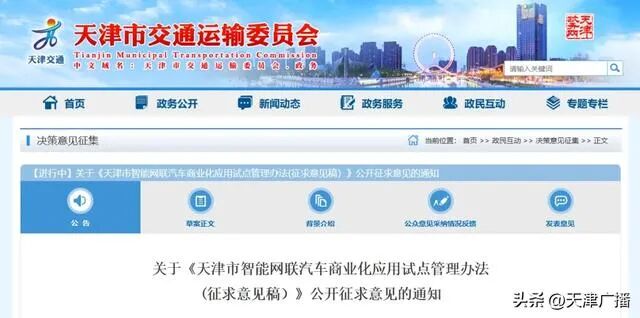
Image Source: Tianjin Broadcasting
I. Industry Anxiety: 400 Companies Waiting for an Answer to 'Being Able to Hit the Road'
Tianjin is not acting on a whim.
The city is a major automotive production base in China, with over 400 automotive parts supporting companies gathered here.
But the question arises: where can the vehicles go once they are manufactured?
The CTO of an intelligent connected vehicle startup complained, 'Every time we apply for a test route, we have to visit several departments. The approval process is long, and the routes are restricted.'
Before the regulations were introduced, although documents such as the 'Implementation Rules for Road Testing and Demonstration Applications of Intelligent Connected Vehicles (Trial)' existed, they were merely policy documents with limited legal effect. Companies invested heavily in research and development but did not know when their products could legally hit the road. This uncertainty deterred capital.
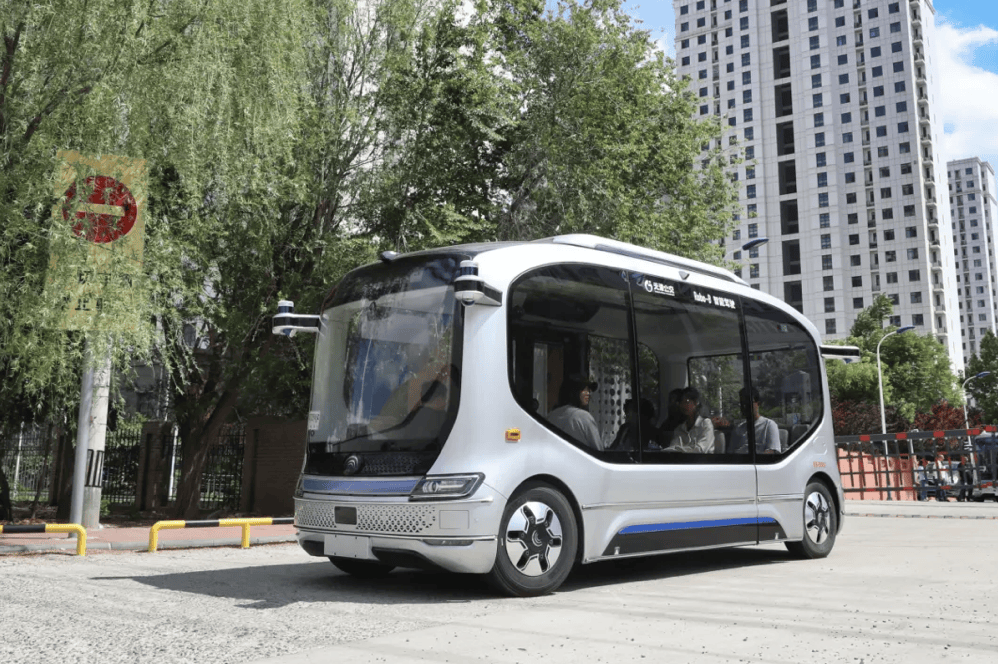
Image Source: ZOL.com.cn
The industry is pushing for policies, and policies are lighting the way for the industry.
From being included in the legislative plan in early 2025 to being reviewed and passed by the end of November, and then to being implemented on New Year's Day 2026—this speed can be described as 'rocket-fast' in local legislation, driven by the answers that over 400 companies are waiting for.
II. Full Access to 2,103 Kilometers of Road Rights: From 'Special Approval' to 'Running According to Rules'
The 'Tianjin Municipal Regulations on Promoting the Development of Intelligent Connected Vehicles,' implemented on January 1, 2026, consists of 6 chapters and 43 articles, covering the entire chain of technological innovation, industrial development, infrastructure construction, and innovative applications.
The regulations are clear: personal passenger vehicle travel, urban public transportation, taxi and other passenger services, road freight transportation (excluding dangerous goods transportation), shuttle services, sanitation cleaning, security patrols, and other urban operation support scenarios are all open.
Autonomous taxis, driverless buses, driverless freight vehicles, airport shuttle buses, sweeping vehicles, and patrol vehicles can all operate legally in Tianjin.
One detail in the regulations is worth noting:
Article 8 explicitly states, 'This municipality will strengthen collaborative innovation in the field of intelligent connected vehicles with regions such as Beijing and Hebei Province, promoting policy recognition, standard compatibility, scenario connectivity, service sharing, and industrial collaboration,' laying the institutional foundation for cross-regional operation of autonomous driving in the Beijing-Tianjin-Hebei region.
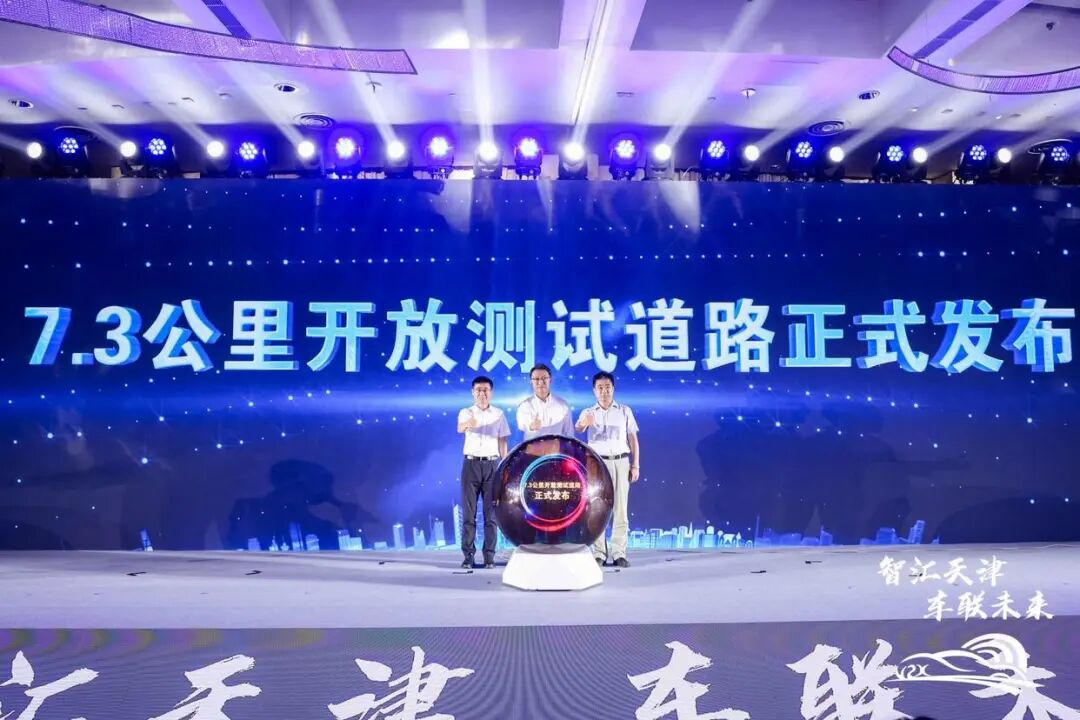
Image Source: CNR News
The infrastructure can also support it.
As of early 2026, Tianjin has fully opened 5,389 kilometers of test roads for intelligent connected vehicles, covering nearly 200 industrial parks, logistics parks, and important corridors in the Beijing-Tianjin-Hebei region.
The integrated construction of vehicle-road-cloud is also progressing rapidly. The Tianjin (Xiqing) National-level V2X Pilot Zone has taken the lead in completing intelligent upgrades at over 500 intersections, with vehicle-road coordination road mileage exceeding 400 kilometers.
III. New Regulations for Commercial Pilot: Three Key Indicators—Safety Officers, Insurance, and Data
If the regulations solved the problem of 'being able to hit the road,' then the management measures released on June 11 address the issues of 'how to run standardly, safely, and profitably.'
First, let's look at safety officers.
The measures clearly stipulate that safety officers for commercial application pilots must sign labor contracts or service contracts with the main body, obtain corresponding driver's licenses, have at least 3 years of driving experience, undergo specialized training, and possess emergency response capabilities in critical situations.
Platform safety monitoring personnel also need to undergo training and assessment. If any abnormalities are detected during monitoring, timely warnings must be issued, and takeover must be prompted.
This is not just for show; it's double insurance.
Next, let's look at insurance.
Article 8 of the measures requires that each autonomous vehicle must purchase compulsory traffic accident liability insurance and traffic accident liability insurance of no less than RMB 5 million per vehicle.
For passenger-carrying commercial pilots, necessary commercial insurance such as seat insurance and personal accident insurance must also be purchased for the passengers.
What does RMB 5 million in coverage mean? Many private cars only have third-party liability insurance of RMB 1-2 million. This is directly maxed out.
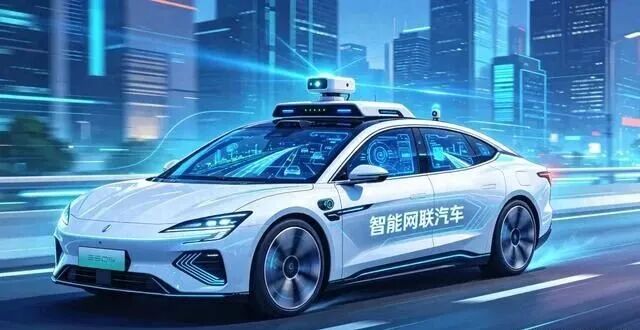
Now, let's look at vehicle management.
Passenger vehicles must undergo annual inspections for the first 5 years and then every 6 months thereafter if they exceed 5 years. Freight vehicles must undergo annual inspections for the first 10 years and then every 6 months thereafter if they exceed 10 years.
Autonomous driving functions must also undergo regular spot checks: for vehicles of the same model, system, and architecture, 1 vehicle will be spot-checked annually for every 100 vehicles.
The measures also clarify the mechanism for assuming accident liability for the first time.
Pilot entities must possess the civil compensation capacity for personal and property losses incurred during operation, the ability to handle traffic violations, and the emergency rescue capacity in the event of traffic accidents.
Even if an accident occurs, whether it is due to system failure or remote takeover errors, the responsible party is clearly identified.
IV. National Competition: What Game is Tianjin Playing?
Tianjin is not the first, but every step is well-timed.
Beijing implemented the 'Beijing Municipal Regulations on Autonomous Vehicles' on April 1, 2025, focusing on high-level autonomous vehicles of L3 and above. The Yizhuang Demonstration Zone has gathered over 120 related companies.
Shenzhen has implemented the 'Shenzhen Special Economic Zone Regulations on the Management of Intelligent Connected Vehicles,' covering all levels from L0 to L5, since 2022. As of the end of January 2026, 1,168 functional autonomous vehicles have been included in the regulatory platform.
Shanghai, Hangzhou, Hefei, Wuhan, and other cities also have their own focuses.
Where is Tianjin's differentiated competitiveness?
It has a solid manufacturing foundation. The supply chain network composed of over 400 supporting companies, coupled with 2,103 kilometers of open roads, enables Tianjin to have the 'full-process Undertaking ability (capacity to undertake)' from research and development, testing, to mass production and operation.
With the policy support of Beijing-Tianjin-Hebei collaboration, an autonomous truck can roll off the assembly line in the Tianjin Economic-Technological Development Area, complete testing and certification in Tianjin, obtain an operation license, and directly drive to Beijing and Hebei!
This industrial chain can be fully completed in Tianjin.
V. Launch of Commercial Pilot: A Leap from Testing to 'Making Money'
Article 22 of the measures clearly states: Commercial application pilot activities may charge service fees in accordance with relevant standards.
The charging standards shall be specified in the commercial application pilot plan. If fees are charged to unspecified objects, the charging standards shall be publicly announced to the society.
This means that autonomous driving Robotaxis in Tianjin can not only hit the road but also charge fees.
The pilot period shall not exceed 18 months. Upon expiration, an extension can be applied for, with each extension lasting 18 months.
This pace is designed pragmatically, giving companies enough time to verify their business models while allowing for dynamic adjustments based on actual conditions.
The measures also establish a clear exit mechanism:
Entities that conduct commercial application pilot activities without authorization shall be ordered to stop and be interviewed for rectification by the municipal transportation, industry and information technology, and public security departments;
If they refuse to rectify, their temporary vehicle license plates for test vehicles shall be revoked.
There is both entry and exit, certification and penalties. This is mature market regulation.
In conclusion, 'Autonomous Vehicles are Coming' (WeChat Official Account: Autonomous Vehicles are Coming) believes:
When an autonomous taxi drives through the streets of Tianjin without a driver in the driver's seat, but with a safety officer, platform monitor, RMB 5 million insurance, a 2-year/80,000-kilometer warranty, and Beijing-Tianjin-Hebei policy recognition standing behind it—
This is the confidence to transform autonomous driving from a 'laboratory toy' into an 'urban daily necessity.'
What do you think, dear?
References: Media reports from Tianjin Broadcasting, ZOL.com.cn, CNR News, Bitauto, GGX666, etc.
-
![]()
Registered Capital Slashed to 372 Million Yuan! Yutong Optical Finalizes Industrial and Commercial Change Registration
-
![]()
Zhuque-3 Successfully Lands, and 'Time Traveler' Secures Another ¥100 Million in Funding: China's Commercial Space Industry Experiences a 'Dynamic August'
-
![]()
Autohome Faces a Shrinking Window of Opportunity
-
![]()
Even a Titan Like Musk Has Faced Setbacks in Fulfilling Promises
-
![]()
AI Office: The End of the Racing Era, Context Becomes the Key to Success
-
![]()
Domestic Vehicle Chassis Revolution ②: The Steering Wheel Remains, But Mechanical Connections in the Steering System Are Decreasing
-
![]()
Exploring MiniMax Design: Can Video Editing Be as Simple as Speaking?
-
![]()
Why Can SenseTime Achieve Profitability While CloudWalk Still Faces Challenges, Despite Both Adopting Large Models?