Tencent is a Mirror Reflecting Alibaba's Dilemma
 06/12 2026
 331
331
A week ago, at the 2026 Tencent Cloud AI Industry Application Conference, Tang Daosheng, Senior Executive Vice President of Tencent Group and CEO of Cloud and Smart Industries Group, and Yao Shunyu, Chief AI Scientist at Tencent, engaged in an in-depth dialogue covering technology, products, industry, people, and organizations... The atmosphere was harmonious, even tinged with a touch of 'warmth.'
In contrast, the past two days have seen public sentiment stirred by DingTalk. Two posts, 'Inside DingTalk' and 'Outside DingTalk,' laid bare the management and corporate culture chaos within DingTalk to the entire industry and even the public, forcing Alibaba's top brass to step in and make a statement.
Teng Yaxin, a former AI product manager at DingTalk's Wukong Business Unit, explained her resignation in 'Inside DingTalk': 'It wasn't about money or opportunities. It was about wanting to live, to be a person, not a cog in the machine.' Ma Ruila, former Vice President of DingTalk and head of AI products, said, 'I understand that cycle of high pressure, fruitless efforts, frequent reporting, and rapid iterations with no progress.'
On June 10, the Alibaba Partnership Committee posted an article titled 'Growth with Compassion and Integrity Defines Alibaba Culture' on the company's intranet, criticizing DingTalk's management style and stating that it 'does not represent what Alibaba culture should be.' The post also emphasized that 'mutual respect, treating people as people, with compassion and integrity' are the cultural foundations of Alibaba, which 'must not change, regardless of how times or technology evolve.'
If AI truly has an upper and lower half, the first half is about parameters and training, while the second half is about applications and problem-solving capabilities. For AI companies themselves, the first half is about investment and technology, while the second half is about ecosystems and organization.
On June 8, Tencent quietly made a major move: WeChat released the 'Guidelines for Developers to Access the WeChat AI Ecosystem,' offering developers the ability to integrate with WeChat's AI ecosystem. JD.com, Meituan, Didi, Ctrip, Tongcheng, and KFC announced they would be the first batch of internal test teams to access WeChat AI.
This functionality follows the same logic as QianWen's integration with Taobao Flash Sales and Alipay AI Pay earlier in the year, except QianWen integrates with Alibaba's ecosystem, while WeChat connects externally.
The outside world has long questioned Tencent's seemingly slow pace in AI, but quietly, Tencent seems to have once again 'arrived late but ahead of the pack.' Compared to Tencent's measured approach, Alibaba's AI has seen key figures depart, frequent organizational restructuring, and internal management issues since the second half of last year, leaving it less composed.
'Moving slowly' can mean 'moving steadily,' while 'moving quickly' can lead to 'chaos.' Alibaba still needs time to find its 'comfort zone' in the AI era.
In August 2025, DingTalk 8.0 was released, with DingTalk ONE as its core feature, positioned as the world's first Agent-driven work information flow and unified AI interaction portal. This feature organizes all work scattered across chats, to-dos, meetings, documents, and approvals into information flow cards via AI, allowing users to handle work like scrolling through short videos.
In March 2026, DingTalk launched Wukong Agent, positioned as the world's first enterprise-grade AI-native work platform. According to 'Inside DingTalk,' after Wukong Agent's launch, DingTalk ONE began to be marginalized, with its homepage access reduced to the secondary screen, budget cuts, and team disbandment. In May of this year, ONE was officially shut down, disbanded, and merged into Wukong. ONE's product lifecycle was around 10 months.
Ma Ruila, head of DingTalk AI and ONE project leader, and Teng Yaxin, core product manager of DingTalk ONE, both resigned. On June 11, Alibaba announced that Chen Hang would step down as CEO of DingTalk, with Chen Yusen, a tech geek born in 1992, taking over.
Beyond the changes at DingTalk, QianWen, which carries Alibaba's more critical AI strategic responsibilities, also underwent significant changes in the first quarter of this year. In early March, Tongyi Lab officially announced the spin-off of the Qwen team, and Lin Junyang, the core technology leader of Tongyi/QianWen, promptly submitted his resignation. Qwen's core R&D personnel, Yu Bowen and Li Kaixin, also left simultaneously. Hui Binyuan, the leader of the Qwen-Coder code model, had already resigned in January this year, earlier than the others.
It can be said that the first half of this year has been a 'turbulent period' for Alibaba's AI. The departure of core personnel is closely tied to Alibaba's organizational restructuring.
Previously, Alibaba continued the '1+6+N' structure from Daniel Zhang's era. By the second half of 2025, Alibaba's disclosures began to shift toward three major segments: 'e-commerce + cloud + others.'
This year, Alibaba has undergone multiple rounds of significant organizational restructuring, with AI business at the core of the adjustments. In March, Alibaba established the ATH (Token Hub) as a first-tier business group, incorporating the original Tongyi Lab, MaaS business line (Bailian), QianWen Business Unit, Wukong Business Unit, and AI Innovation Business Unit into the ATH Business Group, on par with Alibaba Cloud Intelligence BG and directly managed by Alibaba Group CEO Wu Yongming. In April, Tongyi Lab was upgraded to the Tongyi Large Model Business Unit, and a Group Technology Committee was established to oversee AI technical roadmaps.
On June 8, Alibaba merged the original Tongyi Large Model Business Unit and Future Living Lab to form the Token Foundry (TF) Business Unit and established the AI Future Lab. Thus, Alibaba formed four major business groups: China E-commerce, International Digital Commerce, Cloud Intelligence, and ATH. Among them, AI business is primarily concentrated in the ATH Business Group, led by Wu Yongming himself, with the TF Business Unit, MaaS business line, QianWen Business Unit, Wukong Business Unit, and AI Innovation Business Unit under it.
Compared to Alibaba's bold and frequent changes, Tencent has been much more understated. The topic of 'Tencent AI is slow' has been 'hyped' for a long time within and outside the industry.
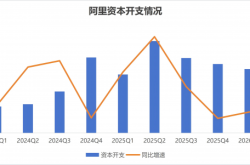
In reality, Tencent is indeed slower, with the most direct indicator being capital expenditures. Alibaba's capital expenditures began to grow significantly from the fourth quarter of 2024, maintaining over 20 billion yuan per quarter. In 2025, capital expenditures reached 123.788 billion yuan, a year-on-year increase of over 70%.
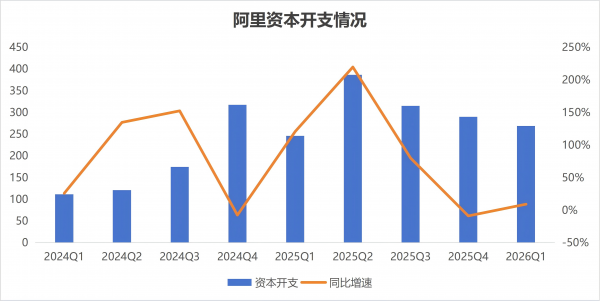
Wu Yongming announced in February last year that Alibaba would invest over 380 billion yuan in the next three years to build cloud and AI hardware infrastructure, totaling more than the past decade combined. By the end of last year, Wu Yongming stated on the Q2 FY2026 earnings call that server deployment speeds were still far behind the growth in customer orders, 'From a broad perspective, the 380 billion yuan figure we previously proposed may be too small, based on our current view of customer demand.'
In May, Wu Yongming's stance remained largely unchanged—compared to the three-year, 380 billion yuan target mentioned earlier, for the five-year goal ahead, 'we believe the funds invested to acquire these computing centers will far exceed our original 380 billion yuan.'
Although Tencent also emphasizes the need to increase AI investment and capital expenditures, its actions have been much more restrained. In 2025, Tencent's capital expenditures were 79.198 billion yuan, a slight year-on-year increase of just 3.18%.
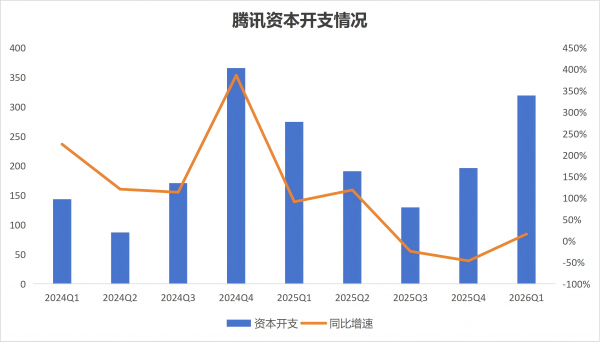
Tang Daosheng, Senior Executive Vice President of Tencent Group and CEO of Cloud and Smart Industries Group, has repeatedly stated that there is currently a severe bottleneck in computing power supply.
On June 5, during the 2026 Tencent Cloud AI Industry Application Conference, Tang Daosheng said that Tencent's infrastructure computing power has long been insufficient, and limited resources are tilted toward internal needs, including Hunyuan's training, WeChat's demands, meeting requirements, and Yuanbao, all of which consume significant computing resources.
However, in March this year, Tencent executives also stated that the company is actively increasing computing power supply, with new computing power gradually coming online this year and accelerating in the second half of the year.
The differences in capital expenditures between Alibaba and Tencent stem from their different AI development logics.
Alibaba follows a typical full-stack self-research, heavy-asset infrastructure model, with its AI strategy focusing on two core paths: one is to build QianWen's open-source ecosystem into the 'Android of the AI era,' and the other is to construct a 'Super AI Cloud' as the next-generation computing platform to support AI-era computing demands.
Relying on three core segments—Damo Academy, T-Head, and Alibaba Cloud—Alibaba has built a complete closed loop of 'chips, computing power, large models, and industry services,' with the core idea of becoming an 'infrastructure provider' in the AI era. Therefore, heavy upfront investment is essential.
Tencent lags slightly in upfront investment but does not mean it underestimates AI. In 2023, Pony Ma made a representative remark: 'We initially thought [AI] was a once-in-a-decade opportunity for the internet, but the more we think about it, the more we realize it's a once-in-a-century opportunity, similar to the industrial revolution that invented electricity.' Ma then said, 'For the industrial revolution, bringing out the lightbulb a month earlier doesn't matter much in the long run. The key is to solidly build the underlying algorithms, computing power, and data, and more importantly, to achieve scenario-based implementation.' At the time, Ma believed many companies were 'too hasty.'
Last year, Yao Shunyu, a former researcher at OpenAI, joined Tencent as Chief AI Scientist. Yao insists that the AI industry is moving from model training to applications, proposing the 'second half of AI,' where the focus shifts from 'training'—competing to feed larger parameters—to 'evaluation and definition,' i.e., how to evolve AI from a mere question-answering machine into an intelligent agent capable of solving complex real-world problems.
Baima believes that Tencent is not slow but waiting—waiting for AI to become feasible for large-scale applications from model training. At that point, it will enter the home field of Tencent, with its super APP boasting 1.4 billion daily active users.
So, while Tencent may indeed be a step behind in model development, it has never taken AI applications lightly. This year's 'lobster' craze saw the longest queues form earliest outside Tencent's building, as Tencent was the first AI giant to integrate with the OpenClaw ecosystem.
Just as Tencent's executives predicted, the AI industry is entering Tencent's 'comfort zone.'
On June 8, WeChat offered developers the ability to integrate with the WeChat AI ecosystem. JD.com, Meituan, Didi, Ctrip, Tongcheng, and KFC announced they would be the first batch of internal test teams to access WeChat AI.
This move means WeChat will become a super AI Agent, allowing users to mobilize (mobilize) mini-programs via natural language instructions to complete tasks like hailing rides, ordering food, booking tickets, shopping, and making payments.
Consider that Alibaba launched a 3 billion yuan giveaway campaign during the 2026 Spring Festival to encourage users to use QianWen Agent for transactions, 'treating everyone to milk tea.' Meanwhile, Tencent doesn't need to spend a dime—it just needs to open its interfaces to millions of merchants...
The ultimate carrier of technological competition is always people. A company's technological ceiling depends on its organizational capabilities and talent stability.
Against Alibaba's backdrop of repeated organizational restructuring and continuous core personnel departures, Tencent has largely maintained team stability.
In his conversation with Tang Daosheng, Yao Shunyu mentioned two impressions of Tencent's culture: the first is honesty, 'Everyone is very honest' about what is done well and what is not, without concealment; the second is trust, believing that Tencent is generally a company that operates based on trust rather than performance metrics.
Yao said, 'I think our culture is very low ego (humble) and very solid (reliable). I believe these cultural traits are crucial for an AI organization in the long run, including our commitment to long-termism.'
In contrast, Alibaba's 'DingTalk incident' at least partially reflects that frequent organizational and business system adjustments have affected team 'morale,' leading to internal friction and self-doubt.
Returning to the question of speed. A senior internet practitioner observed that Tencent AI focuses on how products create value, with Pony Ma daring to publicly joke that Tencent's AI ship is 'leaking.' In contrast, Alibaba seems more concerned with outpacing competitors, reflecting a degree of strategic anxiety.
Tencent has achieved nine consecutive quarters of net profit growth; Alibaba's e-commerce business just invested heavily in a 'food delivery war' with Meituan and JD.com, while its cloud business faces fierce competition, with single-quarter profits currently less than half of Tencent's.
The more Alibaba tries to hold onto something, the more its actions tend to 'deform.' Perhaps slowing down and returning to common sense and fundamentals is what Alibaba should do now.
The content and views in this article are for reference only and do not constitute investment advice. Investment involves risk, and decisions should be made with caution.
-
WeChat’s AI Evolution: Tencent’s High-Stakes Gamble
-
![]()
How did the dot-com bubble burst 26 years ago?
-
![]()
Tencent is a Mirror Reflecting Alibaba's Dilemma
-
![]()
Global Robotaxi Race Steps into Mass Production Phase
-
618 Battle Report | Weekly 3C Digital Rankings (June 1-7)
-
![]()
52,500 Square Meters: Weina Xingkong’s New Headquarters to Rise Here→
-
![]()
AI Pet Language Translator Priced at 799 Yuan: Whose Mind Can It Read?
-
![]()
Following First Loss in 70 Years, Honda Veterans Unite to Demand CEO's Resignation, Citing Three Major Failures! They Directly March into Headquarters to Demand His Dismissal