AI Pet Language Translator Priced at 799 Yuan: Whose Mind Can It Read?
 06/12 2026
 452
452
Pet Owners May Once Again Pay an 'Emotional Tax'
Written by / Li Xuanqi
Edited by / Li Ji
Typeset by / Annalee
'When it meows at an empty food bowl in the early hours, is it hungry or just being playful?' This is a daily confusion for countless pet owners. With pets having long become 'family members' for urban young people, the communication barrier between humans and pets remains one of the biggest pain points in pet ownership. For a long time, pet owners have had to rely on experience to gauge their pets' emotions, a one-way emotional effort that always leaves a layer of separation in companionship.
Since 2026, an AI pet language translator called PettiChat, priced at 799 yuan, has gone viral on social media. Leveraging the concept of 'cross-species communication' and the promotional hook of '94.6% accuracy in emotion recognition,' this collar-shaped product quickly became an online sensation. Behind it, Hangzhou Mengxiaoyi Technology Co., Ltd. has frequently appeared on social media thanks to this lightweight smart hardware.
As its popularity soared, so did controversy. Is Mengxiaoyi a tech dark horse that has cracked the 'human-pet barrier,' or is it a new type of harvester eyeing the 'pet economy' trend?
Regardless, this seemingly out-of-the-box AI pet language translator is pushing a brand-new track ( track , shàidào, meaning 'track' or 'sector')—human-pet AI interaction—to the forefront.
Millions in Funding, Pre-sales Surpass 10,000: Cutting-Edge Tech or False Proposition?
'Who's the boss in this house?'
'Enough! I'm super angry right now—let me go immediately!'
'I'm not afraid—I'll chase you away!'
In a promotional video released by PettiChat on Xiaohongshu, two 'fierce' cats' quarrel (chǎojià, meaning 'quarreling') lines are translated in real time into Chinese subtitles. Around their necks, they wear a special collar.
Recently, this AI pet language translator and the company behind it have drawn significant attention. According to official promotions, the product relies on Alibaba Cloud's Tongyi Qianwen large model and collaborates with the College of Animal Sciences at Zhejiang University for data annotation and scenario training. It has learned from over 5 million real vocal samples of cats and dogs, building a dedicated pet emotion recognition database. This enables real-time translation of cats' and dogs' emotions and needs, converting sounds like barks, whines, and purrs into human-readable emotional text prompts. In PettiChat's official introduction, it claims 'an accuracy rate as high as 94.6%.'
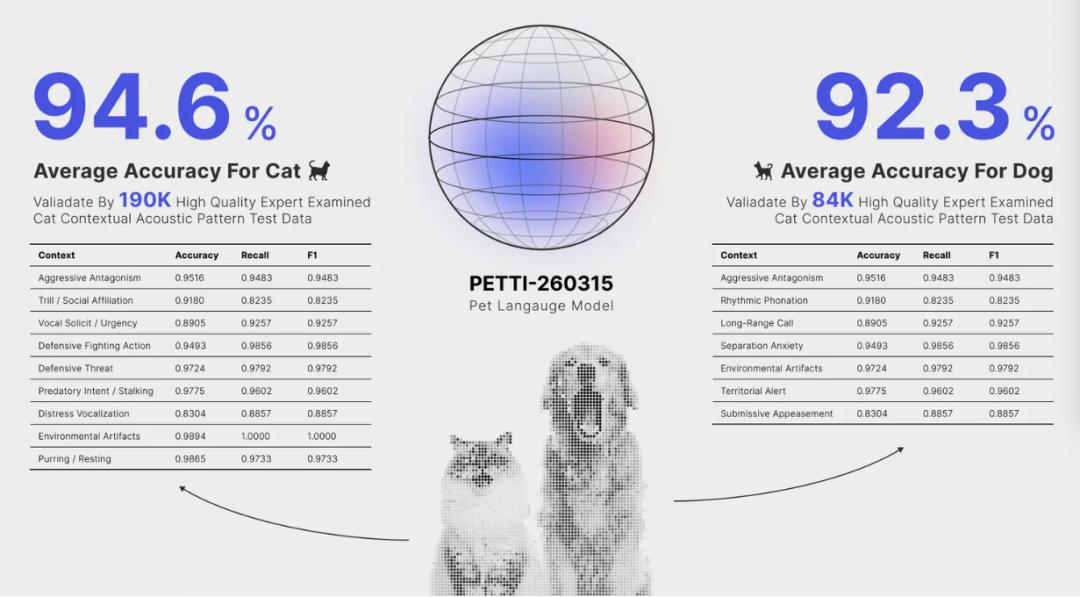
Additionally, PettiChat claims to enable two-way interaction. On one hand, it can accurately recognize over 20 common core emotions and needs of cats and dogs, covering high-frequency scenarios like hunger, sleepiness, excitement, anxiety, seeking companionship, and alertness. On the other hand, it supports converting human voices into pet language for playback, helping owners establish a standardized communication mechanism and correct pet behavior.
The device officially opened for pre-orders in early May 2026. By May 24, 2026, orders had surpassed 10,000 units, even topping the 'Social Entertainment Smart Accessories Bestsellers List' on an e-commerce platform for a time.
Meanwhile, on platforms like Xiaohongshu and Douyin, many reviews and discussions about the product have emerged. Zinc Scale noticed that quite a few (bùshǎo, meaning 'many') pet owners remain skeptical, asking questions like 'How exactly was the 94.6% accuracy rate calculated?' and 'After keeping cats and dogs for a long time, I know they often express themselves through actions and expressions, not just sounds.'
One pet owner who purchased the PettiChat pet translator shared her experience on Xiaohongshu, saying, 'I feel like I've been had. After using it for a few days, my overall evaluation is just average.' She mentioned, 'The translation accuracy is hard to say—based on my understanding of my cat, I'd estimate it's 30%-50% accurate. You still need to interpret what the cat means yourself.' She also pointed out, 'Cats not used to wearing collars may feel uncomfortable and keep scratching at it.'
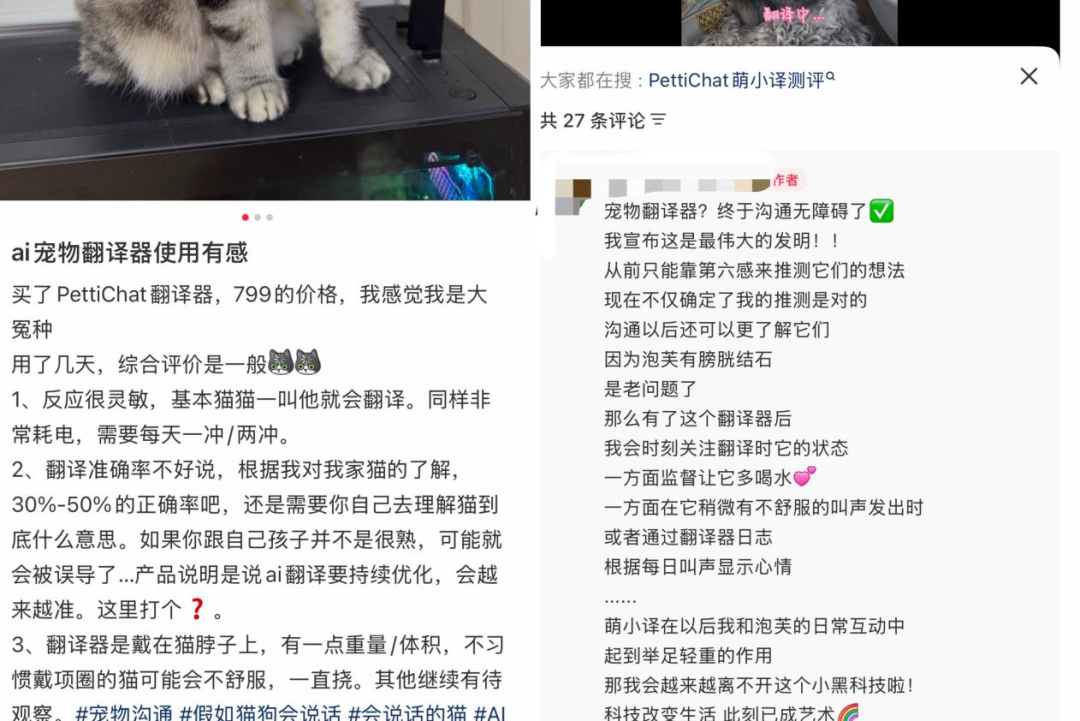
User Experience on Xiaohongshu
However, perhaps such products are less about truly understanding pets' minds and more about targeting pet owners' desire to communicate with their pets. Some bloggers have hailed it as 'the greatest invention ever,' explaining, 'Before, I could only guess my pets' thoughts based on intuition. Now, not only do I confirm my guesses are right, but I also understand them better after communicating.'
When Zinc Scale asked PettiChat's customer service on an e-commerce platform about 'how the product's accuracy is guaranteed,' the representative replied, 'The product details don't specify a guarantee method.' Regarding after-sales service, they clarified, 'Non-quality-related returns (including but not limited to unfamiliarity with the experience, mismatched translation expectations, etc.) do not support full no-reason refunds.'
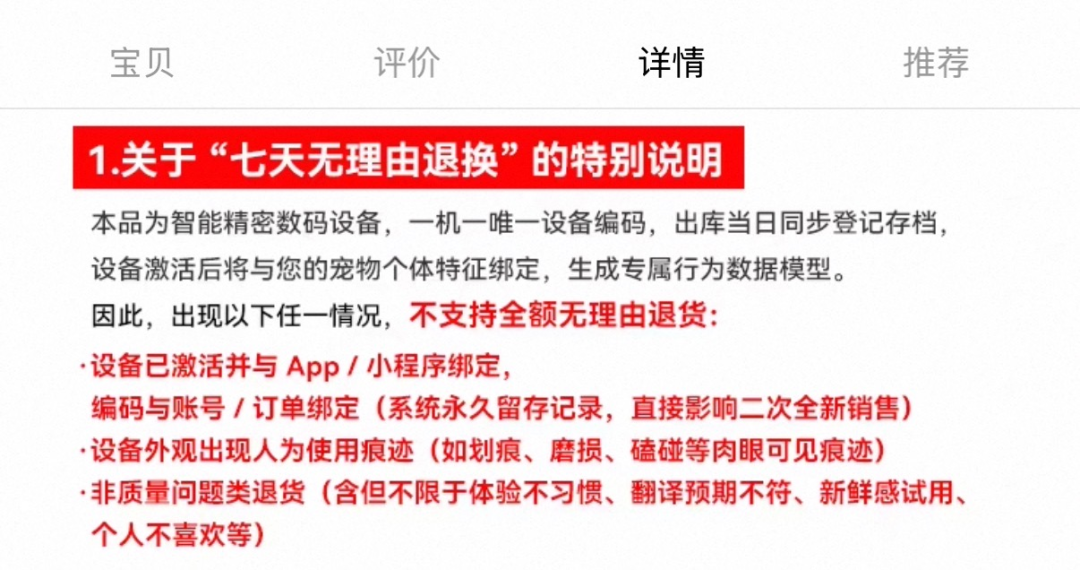
In response to question (zhìyí, meaning 'doubts') about whether it's an 'intellectual tax,' Mengxiaoyi previously told media that the product is in its early market stages, with algorithms continuously being iterated and optimized. Future OTA updates will enhance recognition accuracy in complex scenarios and refine emotion recognition dimensions. Later, a Mengxiaoyi representative also stated, 'Any new thing will face questions and debates—that's normal. Only by experiencing it yourself will you know this product isn't an intellectual tax.'
According to Tianyancha information, Hangzhou Mengxiaoyi Technology Co., Ltd. was established in January 2026 with a registered capital of 588,235 yuan. Its legal representative, Cai Hongbing, is the actual controller, holding 72.25% of the shares. Despite being registered for just four months, the founding team boasts impressive backgrounds: according to public records, core R&D members primarily graduated from Zhejiang University and the National University of Singapore.
Capital has also responded swiftly: in April this year, Mengxiaoyi completed a $1 million seed funding round under the PettiChat brand, jointly invested by Zhejiang University Alumni Fund's Oufang Angel and Huadan Angel. The funding is primarily used for R&D of an animal behavior world model, construction of high-quality datasets, and market promotion of the first hardware product.
From 'Human Mind-Reading' to 'AI Guessing'
In fact, pet language translation isn't a entirely new concept. Around 2020, a niche service of human pet translators emerged in China's domestic pet market. The model involved users uploading pet videos or audio, which experienced pet owners and animal behavior professionals would manually interpret based on years of expertise.
However, this model had critical flaws: first, its efficiency was extremely low, with each interpretation taking tens of minutes, making real-time interaction impossible. Second, it was highly subjective, lacking unified data standards, with interpretations entirely dependent on the individual experience of practitioners, leading to high error rates. Third, it was costly, with single services priced at tens to hundreds of yuan, preventing scalable popularization. Thus, human pet language translation remained a internet celebrity (wǎnghóng, meaning 'internet celebrity') fun (qùwèi, meaning 'fun') experience, never forming a normalized consumer market.
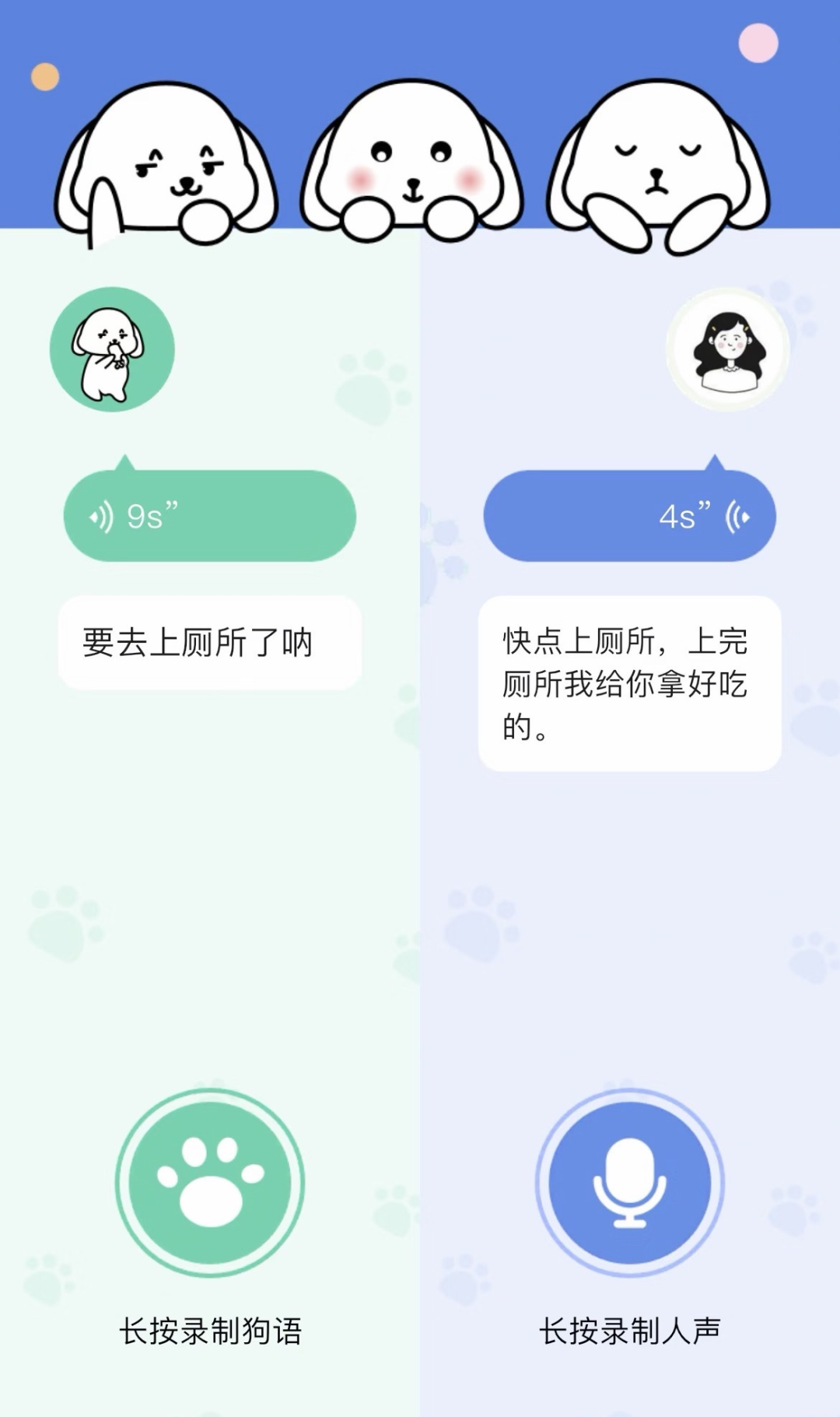
Pet Translation App Interface
Later, numerous pet translation apps emerged, analyzing phone recordings to output simple text judgments like 'hungry' or 'want to play.' However, most remained at the entertainment level, criticized by users as 'random guessing.' Previously, a reporter from News Morning Post tested a cat language translation app and found that despite the cat's food bowl still being full, the app repeatedly translated 'I'm hungry and need to eat,' making accuracy difficult to verify.
This highlights a persistent pain point in pet translators. As written in an article titled 'Pet Translation Technology: Breakthrough or False Proposition for Large Models and Voiceprint Data?' published on Baidu Developer Center, pet emotion labeling faces two unavoidable technical paradoxes. The first is the unattainability of Ground Truth: animal behavior research confirms that canine emotional expression is multimodal. Inferring emotions solely from voiceprints is akin to judging specific semantics from human vocal tone variations (e.g., being unable to distinguish 'OK' from 'OK, I guess'). The second is the cumulative effect of subjective bias: a research team independently annotated the same set of recordings three times and found that different annotators agreed on 'anxiety' emotions less than 58% of the time. When these annotated data are used for model training, the model learns human subjective biases rather than objective patterns.
However, Mengxiaoyi's emergence isn't accidental but a product of timing. According to the '2026 China Pet Industry White Paper (Consumption Report),' the 2025 urban pet (dog and cat) consumption market size reached 312.6 billion yuan, up 4.1% from 2024. Meanwhile, the urban dog and cat population exceeded 126 million.
More noteworthy than the numbers is the shift in consumption structure: pet owners' demands are transitioning from 'functional consumption' to 'emotional companionship consumption,' with the vast majority of consumers explicitly willing to pay for pets' 'emotional value.' The pet technology sector is accelerating growth amid this trend—the global pet technology market size was approximately $19.98 billion in 2025 and is expected to grow to $147.79 billion by 2034, with a compound annual growth rate nearing 25%.
When a hundred-billion-yuan market is brimming with capital and emotional momentum, AI suddenly achieved a preliminary technical pathway for 'understanding pet needs' at a critical juncture, making the human-pet AI interaction track (shàidào, meaning 'sector') an overnight battleground.

Image from PurrPurr Official Flagship Store
For instance, in December 2025, Silicon Valley pet emotion AI company Traini announced a $7.5 million new funding round, primarily for R&D of multimodal emotion models and overseas market expansion. Domestic startup PurrPurr launched an AI emotional companionship collar weighing just 17.9g, designed for cats and small dogs. It features a digital silicon microphone and six-axis IMU to collect sound and posture data 24/7, writing 'AI diaries' from the pet's first-person perspective and forming MBTI personality profiles. OMO TECHNOLOGY LTD, a startup founded by three alumni from the China Europe International Business School, focuses on proactive sensing and companionship AI pet care assistants...
Clearly, from an industry perspective, 'cross-species translation' has become one of the most important narrative themes in the AI pet sector.
Returning to the core question at the beginning: Is pet language AI translation an intellectual tax?
A rational examination of this product—priced at 799 yuan and claiming 94.6% accuracy—suggests that under current technological frameworks, achieving 'word-for-word precise' cross-species bidirectional translation by AI may still be premature. However, we can also offer a more open judgment: rather than trying to sell 'a promise of stable and accurate pet language translation,' it is shaping a new way of pet-owner interaction—using data tracking and emotional AI as its foundation to reconstruct the human-animal companionship relationship in a technological context.
Indeed, any emerging cross-species communication sector will go through a phase of technical ambiguity between real and fake. The true driving force behind this sector's acceleration has never been that technology is 100% mature, but rather pet owners' emotional desire to 'better understand their furry children'—the stronger this desire, the broader the sector's potential.
-
![]()
Tencent is a Mirror Reflecting Alibaba's Dilemma
-
![]()
Global Robotaxi Race Steps into Mass Production Phase
-
618 Battle Report | Weekly 3C Digital Rankings (June 1-7)
-
![]()
52,500 Square Meters: Weina Xingkong’s New Headquarters to Rise Here→
-
![]()
AI Pet Language Translator Priced at 799 Yuan: Whose Mind Can It Read?
-
![]()
Following First Loss in 70 Years, Honda Veterans Unite to Demand CEO's Resignation, Citing Three Major Failures! They Directly March into Headquarters to Demand His Dismissal
-
![]()
Zhu Mingming's Obsession with AI Pioneering: A Thorn in the Side of Rokid's Smart Glasses Privacy?
-
![]()
Insta360 Leads Global Market, Yet Profit Signals Remain Subdued