The End of Computing Power Lies in Bricks: After Three Years of AI Boom, the Money of the New Rich Ultimately Flows into Real Estate
 06/22 2026
 569
569
The house always wins, and AI doesn’t support idlers.
In February 2026, global memory chip giant SK Hynix announced the distribution of performance bonuses for 2025, totaling a staggering 4.72 trillion won (approximately 24 billion yuan), covering around 33,000 full-time employees worldwide. This amounts to an average of 142 million won (about 650,000 yuan) per person.
Note that this is not an annual salary but merely a single bonus payment.
In South Korea, Hynix employees received an average bonus equivalent to 18 months of their base salary, with top-performing teams earning a full 30 months’ worth. The company also introduced a thoughtful policy: employees could voluntarily convert up to 50% of their bonuses into company stock, with an additional 15% cash reward after holding it for one year.
When the news broke, all of South Korean society was stirred. On secondhand trading platforms in South Korea, SK Hynix work vests were hyped up to 40,000 won each overnight, hailed by young South Koreans as the “best outfit for blind dates.”
The popular South Korean comedy variety show SNL Korea even produced a skit overnight: a luxury brand saleswoman in a department store, who usually ignores ordinary customers, does an immediate 180-degree attitude reversal upon seeing someone in an SK Hynix uniform walk in.

Image source: Screenshot from a South Korean variety show
According to National Business Daily, on the evening of the bonus distribution, restaurants around SK Hynix’s campus in Icheon, Gyeonggi Province, were packed. Within 50 meters of the campus’s main gate, there were two real estate sales offices—one was sold out, and the other had a contract signing rate of about 85%.
Around the same time, Shenzhen’s CITIC Xinyue Bay launched 78 large luxury apartments, priced between 50 million and 77 million yuan, all of which sold out within half an hour of launch. CRIC data shows that over 30% of these luxury home buyers were born in the 1990s, with highly consistent professional labels: chips, AI, and smart manufacturing. For homes priced above 50 million yuan, 162 units were sold in the first four months of the year, 18 times the total for all of 2025.
We’ve heard enough over the past three years about AI changing the world, exploding productivity, and ushering in the Fourth Industrial Revolution. Yet, after three years of the computing power revolution, the finish line seems not to be the age of intelligence but real estate.
To understand why these young people can buy luxury homes as casually as buying cabbages, we must first look at the “money-printing machine” at the top of the AI industry chain.
As the absolute leader in global AI computing power, NVIDIA delivered a jaw-dropping performance in fiscal year 2026: revenue of $215.9 billion, net profit of $120 billion, and a gross margin holding steady at 75%—meaning for every $100 in sales, costs were just $25.
From the perspective of traditional manufacturing, such profit margins defy common sense. TSMC, the global king of chip foundries, has a gross margin of around 68%. Traditional chip giants like Intel and AMD are left in the dust by NVIDIA in this AI storm.
The core reason NVIDIA captures such staggering profits is that it doesn’t just sell chips—it sells the only ticket to the intelligent age. In the global AI chip market, whether it’s Google, Microsoft, Amazon, or Meta, these trillion-dollar overseas giants spend hundreds of billions of dollars annually building data centers, with the majority of that money ultimately flowing into NVIDIA’s pockets.
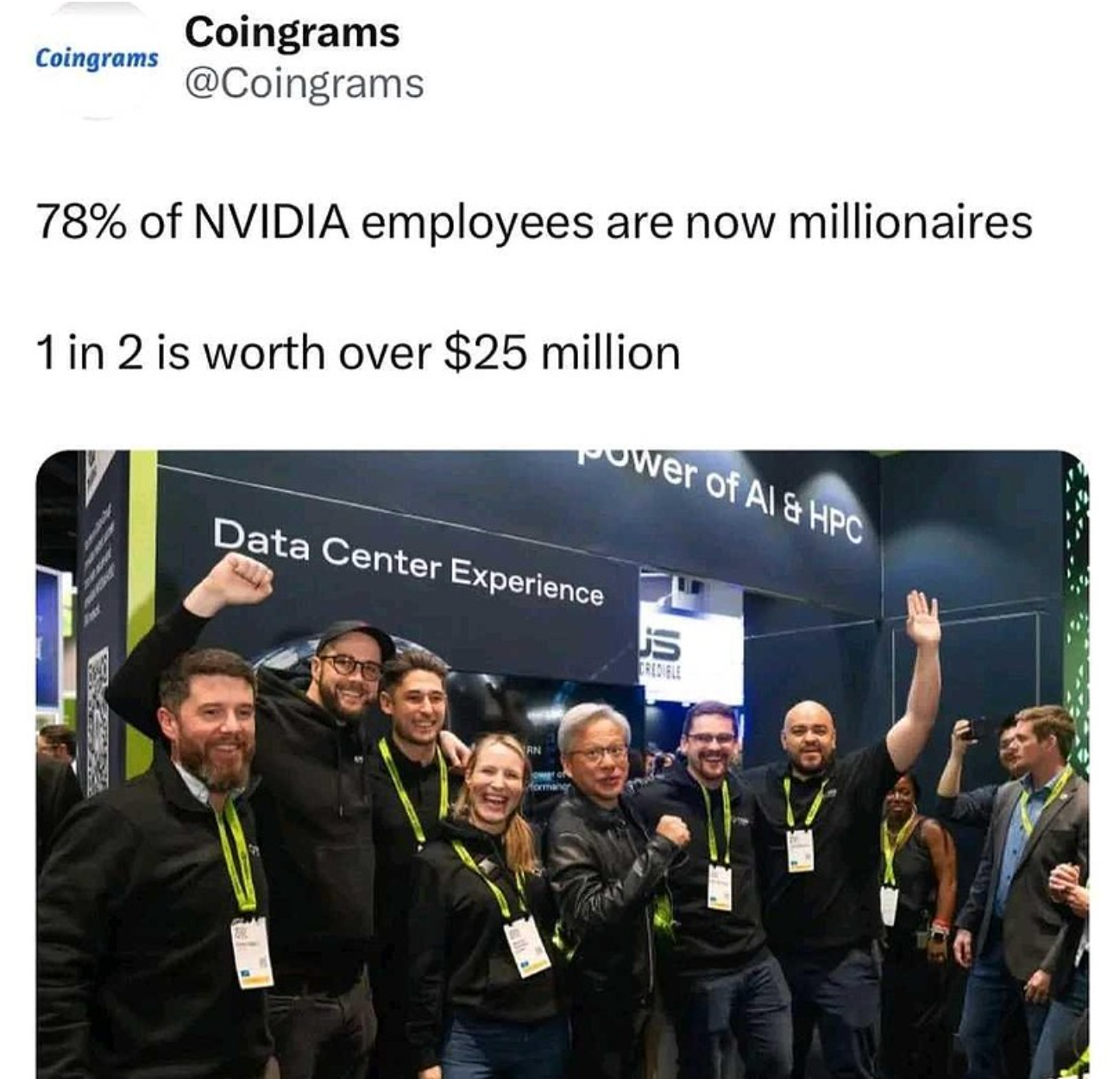
Image source: X
When the upstream players feast, the downstream doesn’t go hungry.
SK Hynix reported 97.15 trillion won in revenue and 47.21 trillion won in operating profit for 2025, exceeding 210 billion yuan. With a 61% global market share in high-bandwidth memory (HBM), essential for large-scale model training, Hynix had its 2026 production capacity snapped up by major players, with orders already booked through 2027.
In September 2025, Hynix reached a historic agreement with its union, shattering the traditional cap of “profit-sharing bonuses not exceeding 10 times base salary” by allocating 10% of the company’s annual operating profit into a bonus pool. This policy covers everyone, from core engineers to security guards, receptionists, and drivers, and will be implemented for at least ten years.
This is the monopolistic profit brought by hard tech. When global technology routes, production capacities, and major clients are locked in, profits concentrate at an astonishing rate into the hands of a tiny elite.
Just three years earlier, in 2022, Hynix posted a 7.7 trillion won loss due to industry downturns. Yet, just three years later, the same employees propelled the company to stratospheric heights. The opportunity that changed their fortunes came from one source: AI.
So, when these executives, founders, and core employees walk out the company doors with their newfound wealth, where does the money go? The answer is awkward: real estate.
Previously, those who could spend tens of millions on luxury homes in Shenzhen were mostly traditional industrial bosses or older-generation chairmen of listed companies. But according to CRIC data, the buyer profile has completely changed: the main force now consists of tech newcomers aged 35 to 50, concentrated in AI, semiconductors, and cross-border e-commerce. Even large numbers of “post-90s” technical partners and core executives are buying luxury homes outright with stock options and hefty bonuses.
In Hangzhou, the “digital economy city,” a similar wealth myth is unfolding. Aoying Century Pavilion sold 2.06 billion yuan worth of units on its opening day, with the average age of buyers a full decade younger than developers expected. To view a property, proof of assets worth tens of millions is required, yet the lobby is packed with young founders of AI startups and chip companies.
Notably, Hangzhou’s high-net-worth population has grown by 105% over the past decade, among the fastest rates globally, built layer by layer by this “tech money.” Just as when Alibaba’s Cloud Valley campus opened, nearby rents surged by over 20% in a short time.
Wherever big tech and its elites go, housing prices and consumer power are redefined. This law hasn’t failed in the AI era—it’s only become more intense.

Image source: Juwai
Shifting our gaze back to South Korea, Hynix employees haven’t just become hot commodities in the dating market—they’ve also become the “buyers of last resort” for the local property market. Last year, the average price of apartments in Seoul surpassed 1.5 billion won for the first time. Even at these lofty prices, couples both working at Hynix can save enough bonuses in two to three years to buy a high-quality apartment outright or with a low down payment in Seoul.
Even South Korea’s slumping fertility rate has seen a localized rebound thanks to these wealthy young people. The latest data from Statistics Korea shows the national fertility rate rose from 0.72 to a rare 0.8. When young people have money, they dare to marry, buy homes, and have children.
Frankly, if I were in their shoes, I’d buy property immediately too.
While the AI industry generates wealth quickly and explosively, technological iteration is brutally fast. Today’s industry leader could be obsolete tomorrow due to new algorithms. Faced with such extreme uncertainty, converting stock and bonuses into tangible “bricks” in prime locations of first- and second-tier cities is the best way to secure long-term peace of mind.
Watching Hynix employees count their money and Shenzhen’s tech elite buy luxury homes in half an hour, many ordinary people using AI tools at their computers feel a complex sense of dislocation.
We originally had high hopes for the AI era, with media constantly touting “AI empowering industries” and “AI tools enabling ordinary people to achieve wealth freedom.” But the reality is that after three years of AI hype, wealth hasn’t rapidly transformed into purchasing power for the masses, as it did during previous internet booms.
Why? Because the business logic of this AI storm is “the house always wins.”
The internet boom required massive offline collaboration, creating tens of thousands of derivative jobs (e.g., e-commerce, food delivery, ride-hailing). In contrast, AI’s core assets are computing power and servers, inherently belonging to highly capital-intensive, highly technologically monopolized industries.
This “high monopoly” creates a peculiar phenomenon: companies don’t need massive workforces to earn astronomical wealth. NVIDIA generates over $200 billion in annual revenue with just over 20,000 employees worldwide, averaging over $10 million in revenue per person. It doesn’t need to lay thousands of kilometers of pipelines or employ hundreds of thousands of workers like oil giants.
The result is that wealth concentrates at historically unprecedented speeds into the hands of a tiny elite at the top. While Hynix’s 33,000 employees do get a large slice of the pie, South Korea’s total population is 51 million. The market cap expansion of U.S. tech giants far outpaces their job creation.
This isn’t a complaint about injustice but an objective law of hard tech’s early development: the more explosive the technological growth, the more capital and resources concentrate at the top. Before wealth truly “rains on everyone,” it must first accumulate at the source of computing power, becoming cash in the hands of tech elites.
One question remains unanswered: when AI enters its second and third phases, when technology truly begins to permeate downward, will those who have already solidified their wealth in bricks participate in the next round of redistribution?
Or will the wealthy live in luxury homes near the computing power hubs, continuing to enjoy the next wave of technological dividends while most others wait outside to be “included”?
I don’t know, but real estate agents in Nanshan, Shenzhen, probably have an idea—their recent clients are getting younger.
NVIDIA, Hynix, Samsung, storage, AI
Source: Lei Technology
Images in this article come from: 123RF Royalty-Free Image Library Source: Lei Technology
-
![]()
Oil Prices Revert to 7-Yuan Range: Are Gasoline Cars Getting a Reprieve?
-
![]()
Momenta Secures CSRC Approval: Is It Poised to Be the 'Pioneer in Physical AI Stocks'?
-
![]()
What's the Use of Having a General-Purpose Motion 'Cerebellum' for Humanoid Robots?
-
![]()
Volkswagen Starts Operating at a Production Capacity of 9 Million Vehicles
-
![]()
Interpretation of China's Auto Market in May: A Fig Leaf, Two Fault Zones, and Three Surprises
-
![]()
China's Auto Industry Accelerates Expansion in Spain: From Vehicle Sales to 'Local Manufacturing in Europe'
-
![]()
Momenta | Going Public Not for Money
-
![]()
How Much Can Doubao Make by Charging Fees?